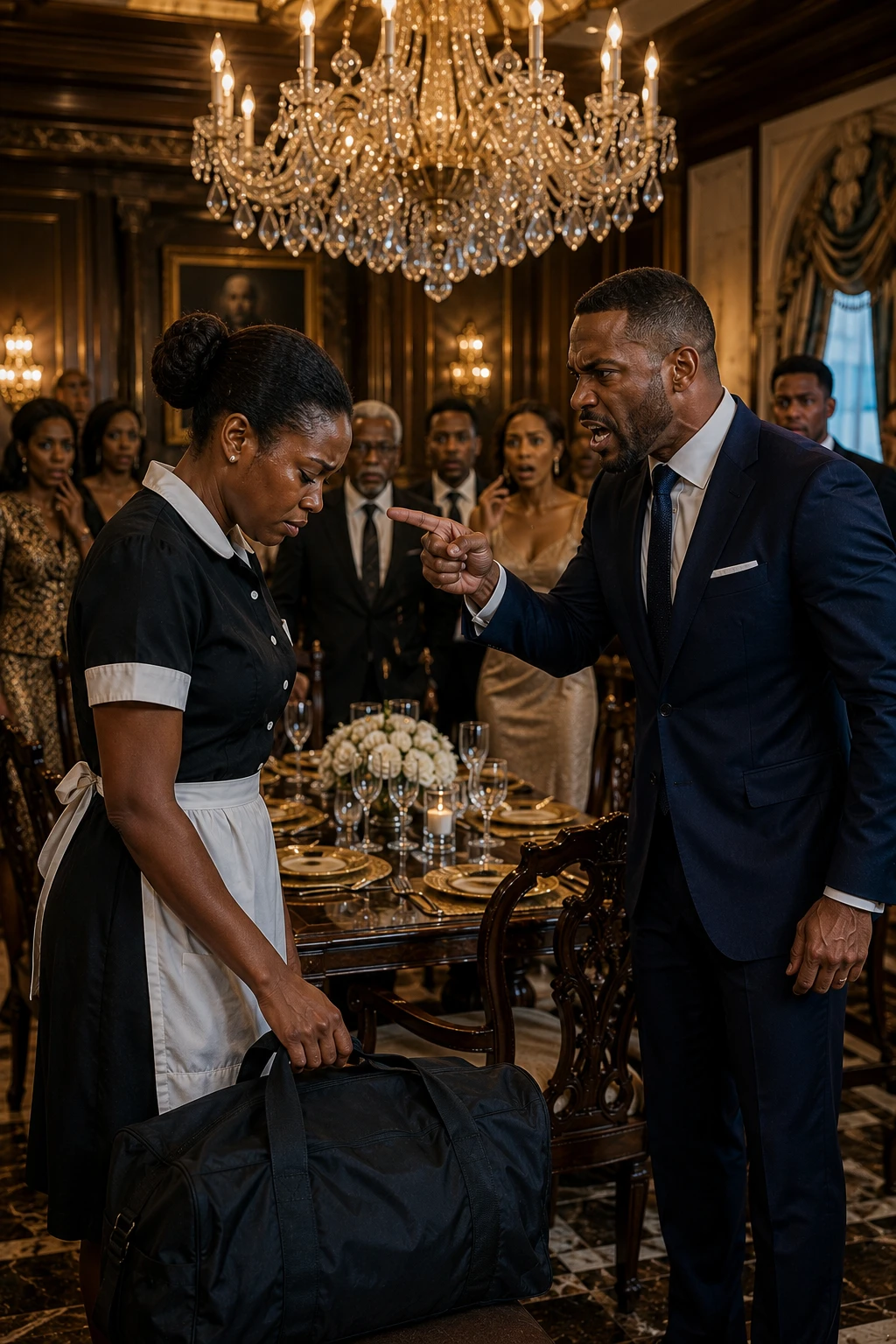
She Was Hired As A Maid But Her Billionaire Boss Fell In Love And Made Her His Wife.
Part 1: The Gates of Independence Layout
There is a street in Enugu, along the prestigious Independence Layout, where the towering white buildings do not look like ordinary houses. They look like sharp, intimidating warnings. They are massive, heavily gated, and protected by spiked iron fences and watchful private guards. Behind every one of these whitewashed walls lives a man who has decided that money is the only language worth speaking, a king of the city’s quiet underworld operating under the guise of legitimate real estate and oil wealth.
Obina Chukwuema was born into that ruthless, gilded world. By thirty-four, he had achieved what most men in Enugu only dreamed of whispering about over warm palm wine at night. He had built a massive real estate empire stretching from Enugu State all the way to the bustling avenues of Abuja. Business partners in Lagos respectfully referred to him as the “quiet giant.” He owned three luxury foreign cars, an expansive mansion with eight bedrooms, and a corporate entity that directly employed over two hundred people.
Yet, none of this impressive resume or material success managed to impress his mother.
Mama Obina, a short, stout woman possessing the relentless energy of ten market women and the stubbornness of a wild bush goat, arrived at her son’s grand mansion unannounced on a bright Thursday morning. It was her custom to drop in whenever she felt her son was straying too far from tradition. She found Obina sitting in his sprawling private study, surrounded by stacks of legal files, glowing laptops, and the lingering, expensive scent of his cedarwood cologne.
“Obina,” she announced without preamble, dropping her heavy leather handbag onto his expensive cream leather armchair. “When am I finally seeing my grandchildren?”
Obina did not even look up from his screen, his fingers dancing rapidly across the keyboard as he finalized a major land acquisition. “Good morning to you too, Mama.”
“Don’t ‘good morning’ me with that flat voice,” she retorted, waving a dismissive hand. “I am not your corporate colleague. I am the woman who carried you for nine months. Answer my question.”
He let out a long, exhausted exhale. He had answered this exact question at least thirty-seven times in the past year alone. He had mentally kept count. “Mama, I am completely focused on expanding the business right now. When the time is right—”
“When the time is right!” she clapped her calloused hands together loudly. “Obina, tell me, exactly how old are you getting? What specific time are you waiting for? Is it the Easter festival? The Christmas holidays? The second coming of Christ?”
He finally leaned back in his executive chair, rubbing his temples in defeat. “Mama, please. Let’s not start this again today.”
“There is a very calm, deeply respectful girl from our home village,” she continued, entirely ignoring his plea as she settled comfortably into the chair across from his desk. “Her name is Ugochi. Her father is a retired headmaster. She knows how to cook real native soup, she respects elders, and she will not bring trouble to your house.”
Mama Obina’s voice was firm but entirely patient, dripping with maternal expectation.
“Mama, I have a certain standard of class now,” Obina replied, his tone defensive. “I cannot just pick a girl straight from the village and bring her to Independence Layout.”
Mama Obina stared hard at her son for a long, quiet moment. “‘Class,'” she repeated slowly, the word tasting entirely wrong in her mouth. “Okay, my son. We shall see exactly what your elite city class brings to your doorstep.”
She picked up her handbag, stood up, and poured herself a fresh glass of iced water from the silver pitcher on the side table. She drank it slowly, deliberately watching her highly successful son with the sharp, knowing eyes of a matriarch who had seen many things in life and had learned the art of patient vengeance.
Obina’s current idea of “class” had a very specific name: Sandra Asa.
Sandra was the kind of woman who always made an unmistakable entrance wherever she went. Tall, light-skinned, and always dressed in the most expensive foreign labels, she exuded an aura of manufactured perfection. She had met Obina at a high-profile business gala in Enugu six months ago and had immediately made it her life’s mission to become utterly indispensable to his daily routine. She branded herself as an independent entrepreneur, though no one had ever quite seen her office or her products. She attended all the right social events and spoke English with a slight, airy Abuja accent she had painstakingly practiced in front of her bedroom mirror for years.
Obina was increasingly convinced that Sandra was the one. He took her to the finest, most exclusive restaurants in the Government Reserved Area. He bought her tasteful diamond jewelry. He listened intently when she talked vaguely about her massive investments and her visionary lifestyle board.
He didn’t ask her too many difficult questions about her past. In truth, he avoided asking her deep questions because Sandra possessed a sharp, cutting way of making a man feel incredibly small and defensive whenever he dared to pry into her affairs.
But there was a darker side to Sandra that none of his high-society friends talked about. She beamed radiantly whenever Obina was watching her or when his wealthy associates were around to witness her charm. But the very second his broad back was turned, the warm smile vanished from her face entirely. What replaced it in the quiet moments was a look of cold calculation and disdain.
Part 2: The Modest Apartment
On the other side of Enugu, tucked away in a much more modest neighborhood near Abakpa, Chinello Obi was diligently ironing her single best blouse at five o’clock in the morning. She was twenty-six years old, possessing a fresh diploma in catering and hotel management from a polytechnic institute in Enugu. She was kind, remarkably sharp, and stubborn in a quiet, unyielding way. It wasn’t the loud, obnoxious kind of stubbornness that shouted over people; it was the quiet kind that simply refused to move or compromise her core dignity.
Life had not been particularly easy for Chinello. Her beloved father had passed away when she was just seventeen years old, leaving her brave mother to scrape by and raise three children on a modest primary school teacher’s salary.
Consequently, Chinello had taken on job after job to help the family ledger balance. She had been a server in a noisy local restaurant, a late-night cleaner in a commercial office building, and a sales assistant in a high-end boutique downtown. She was always trying her hardest, always desperately hoping that the next opportunity would finally be the one to lift her family out of financial precarity.
This most recent domestic job had seemed incredibly promising at first. A wealthy woman living in the heart of Independence Layout had hired her as a live-in domestic worker for a salary of thirty thousand naira a month. It wasn’t a fortune, but it was steady, and it was just enough to send a little money home to her mother in the village.
That was until the day her quiet world violently collapsed.
The madam’s younger brother, a heavy, deeply entitled man who constantly reeked of cheap alcohol and bad life decisions, had cornered Chinello in the quiet pantry while she was prepping lunch.
“Come over here and sit down with me for a minute,” he had slurred, smiling in a way that held absolutely nothing friendly.
“Sir, I have a lot of work to finish in the kitchen,” Chinello had replied, keeping her voice strictly steady as she backed away from his advancing frame.
He took another aggressive step closer. She instinctively stepped back until her spine hit the cold tiled wall. He reached out a thick hand to grab her wrist.
What happened next occurred in a blur of adrenaline and survival instinct. Chinello didn’t scream or cower. She grabbed the nearest heavy object from the counter—a solid wooden cooking spoon—and leveled it at his chest.
“If you touch me,” she said very quietly, her eyes burning with unblinking rage, “I will break this completely on your skull, and I do not make empty threats.”
He had blinked in shock, cursed under his breath, and backed entirely out of the kitchen. But instead of leaving the property, he went straight to his sister. He spun a malicious tale, claiming that the new maid was incredibly rude, insubordinate, and deeply disrespectful to the family.
The madam called Chinello into the grand living room that very evening. Chinello had stood straight before her, naively expecting justice and a listening ear. What she received instead was a sharp, humiliating lecture on her social station.
“You are just a maid in this house,” the woman had sneered, looking down her nose at her. “You do not get to embarrass or threaten my family members in my own home.”
Chinello looked at her employer for three full, agonizing seconds. She looked at the expensive clothes, the pampered hands, and the utter lack of human empathy.
“I quit,” she said coldly, untying her apron and dropping it onto the polished floor before turning away.
Back in her small room in the staff quarters, her visiting cousin, Amaka, found her sitting quietly on the edge of the mattress, staring blankly at the wall. Amaka was the kind of fiercely loyal person who thrived in the middle of a crisis and immediately began sketching out tactical plans. She sat down beside Chinello, took her cold hand, and prompted, “Talk to me. What happened?”
Chinello recounted the incident without embellishment. Amaka was quiet for a long, tense moment as the reality of the injustice settled over the room.
“You did the absolute right thing,” Amaka said fiercely.
“I know,” Chinello sighed, the tears threatening to spill. “But doing the right thing doesn’t pay the rent or buy food.”
They sat together in the cramped room. Outside, the neighborhood of Abakpa was loudly waking up to the sound of roaring generators, street hawkers calling out their wares, and the aggressive buzzing of motorcycle taxis weaving through the morning traffic.
“We will find something much better than this,” Amaka squeezed her shoulder. “I promise you.”
Chinello looked at her cousin’s determined face and allowed herself one small, fragile moment of blind trust. “Okay,” she whispered. “We find something better.”
Part 3: The Billionaire’s Search
The new job listing was remarkably simple. Domestic staff urgently needed for a private residence in GRA Enugu. Must be hardworking, trustworthy, and incredibly discreet. Competitive salary package offered. Amaka had stumbled upon the ad in a local WhatsApp group for domestic workers. Without waiting for Chinello’s permission, she had filled out the digital application form, attaching Chinello’s credentials before her cousin had even finished reading the text.
“You are going for this interview,” Amaka had declared, folding her arms. “Do not even think about arguing with me.”
What neither of them knew was that on the other side of that exclusive household listing, Sandra Asa was the person running the entire interview process.
Obina’s previous head housekeeper, a quiet, hyper-efficient village woman named Nosi, had been forced to leave abruptly to care for a severely ill relative back in the village. Needing a trustworthy replacement quickly, Obina had asked Sandra to step in and help him filter candidates for the position. Sandra had eagerly agreed, flashing a brilliant, supportive smile.
What Obina didn’t know was the real reason behind Sandra’s enthusiastic smile. It had absolutely nothing to do with being helpful. Sandra had spent the last few months observing how Obina interacted with Nosi—not with distant master-servant coldness, but with genuine, human warmth, sharing easy conversations over breakfast and displaying the quiet comfort that comes from sharing a living space every day.
Frankly, it made Sandra increasingly nervous. She couldn’t articulate her anxiety rationally, but she had made a firm internal decision: the new maid would be carefully selected. She would be completely unremarkable—unattractive, devoid of charm, and completely uninteresting—the kind of plain woman that a busy billionaire like Obina would never even accidentally notice in a room.
Sandra sat regally behind Obina’s polished glass dining table that Monday morning, systematically interviewing eleven desperate women. She dismissed the first candidate for being too physically attractive. She dismissed the second for having an overly bright, engaging smile. She dismissed a third simply because the woman possessed excellent posture and an elegant walk.
Then, Chinello walked into the grand dining hall.
She was wearing a simple, unpretentious purple blouse and a dark, sensible skirt. Her natural hair was braided flat against her scalp in a no-nonsense style. Her face was completely clean, unadorned by makeup, radiating an honest, hardworking aura.
Sandra observed her for approximately four cold seconds and immediately thought, Yes, this one is perfectly safe and dull.
“Can you cook basic meals?” Sandra asked, looking down at her notes.
“Yes, ma,” Chinello replied respectfully. “Traditional Igbo soups, as well as continental pastries. I also worked briefly in a commercial catering kitchen.”
“Are you discreet? Can you keep your head down?”
“I strictly mind my business, Ma.”
“Good.” Sandra made a brief checkmark on her pad. “You’re hired. Report on Monday.”
Chinello blinked, surprised by the lack of scrutiny. “Don’t you want to see my references or police clearance?”
Sandra waved her manicured hand dismissively. “I can read people well enough. See you Monday.”
Chinello walked out of the intimidating mansion entirely unaware that the glamorous woman who had just hired her had done so specifically because she considered her a non-entity. She would soon spend the coming months proving just how catastrophic that underestimation truly was.
Monday morning arrived with a crisp winter chill. Chinello arrived at the iron gates at exactly 6:30 a.m. as instructed. The gateman let her in with a silent nod. The mansion was breathtakingly quiet and vast. She found the main kitchen—gleaming, massive, and equipped with industrial-grade appliances she had only ever seen on cooking shows. She stood there for a long, silent moment, simply taking in the scale of her new workplace. Then, she tied her plain white apron tightly around her waist and went straight to work.
She cleaned the marble surfaces methodically. She prepared a flawless breakfast—fresh akara and golden moi-moi alongside a steaming pot of Lipton tea—laying it out on the dining table with surgical precision.
When Obina walked down the grand staircase dressed in a sharp charcoal-gray suit, she was already standing quietly in the far corner of the kitchen, wiping down the stainless steel counters. He stopped in his tracks, his eyes darting to the beautifully arranged breakfast spread.
“Who made this?” he asked, genuinely surprised.
“I did, sir,” she said clearly, keeping her eyes respectfully lowered.
He sat down at the table and began to eat in silence. He didn’t offer any compliments, but as Chinello observed from the corner of her eye, he ate absolutely every single morsel on the plate.
Part 4: The Mother’s Eye
The first week in the Chukwuema household passed without any major friction. Chinello cooked, she cleaned, and she quietly reorganized the massive pantry in a way that made the entire kitchen feel lighter and more functional. She learned very quickly which items belonged in which drawers, which cupboard Oena reached into first in the morning, and which light switches he habitually left alone. She watched his movements quietly, speaking only when directly addressed, but her sharp mind was absorbing every detail of the household’s rhythm.
On her third day, she found an old FC Barcelona football jersey tucked into the very back of a laundry closet she was deep-cleaning. It was faded from years of washing, clearly a beloved relic from his youth. She carefully folded it and placed it neatly on a shelf in his dresser, not saying a word about it.
On her fifth day, she noticed that the billionaire came home looking profoundly frustrated, his broad shoulders tight, his voice clipped and impatient as he ended a phone call in the hallway. Without asking, she brewed a fresh pot of traditional nsala soup, pairing it with soft-boiled yam, and left it quietly on the kitchen counter without knocking on his private study door to announce it.
Thirty minutes later, she heard the microwave hum. She allowed herself the smallest, most triumphant smile of the week.
However, Sandra noticed the subtle shifts in the household’s mood. She dropped by the mansion on Wednesday evening and found Obina in a significantly better frame of mind than she had anticipated for a Thursday.
“The new maid seems to be working out just fine,” he remarked casually while pouring himself a glass of wine.
“Yes,” Sandra agreed, her smile coming a fraction too fast. “She’s alright… just doing her basic job, nothing special.”
But that night, after Obina had excused himself to take a shower, Sandra walked into the gleaming kitchen. Chinello was diligently drying the last of the heavy copper pots. Sandra stepped close enough that the younger woman was suddenly overwhelmed by the sharp, cloying scent of her expensive French perfume.
“I want to make something abundantly clear to you,” Sandra began, her voice dropping to a register that was very soft but freezing cold. “You are just a maid in this house. That is all. You cook, you clean, and you stay strictly in your designated lane.”
She leaned in closer. “You do not engage in conversations that aren’t strictly necessary. You do not sit in any room in this mansion except the kitchen and the staff quarters. Do you understand me?”
Chinello looked up, meeting the socialite’s hostile gaze steadily without flinching. “Understood, ma’am.”
“Good,” Sandra smiled tightly. “I knew I was right to hire you.”
She turned on her heel and clicked her designer heels out of the room. Chinello set the copper pot down onto the rack, took a deep, steadying breath, and went back to her drying towel. She had dealt with entitled people her entire life; she wasn’t going to let an insecure girlfriend break her spirit.
Three weeks into her employment, the dynamic of the house was violently disrupted by the unannounced arrival of Obina’s mother. Mama Obina arrived with two large travel bags, a heavy cooler of homemade ogiri spice, and a very strong, vocal opinion on every single aspect of her son’s life.
She noticed Chinello within five minutes of crossing the threshold.
“Who is this girl?” she demanded, pointing her walking stick at the younger woman.
“The new maid, Mama,” Obina sighed from his armchair.
Mama Obina looked at Chinello the way an experienced tailor evaluates a piece of fabric—turning her eyes over the girl, checking her posture, her neat hair, her calm demeanor. “What is your name, my dear?”
“Chinello, Ma.”
“And where are you from?”
“Udi Local Government Area, Ma.”
The older woman’s eyes softened by a fraction. “Ah, Udi. Those people know the value of hard work.” She nodded slowly. “Good.”
That evening, Chinello took extra care to prepare a meal that filled the vast, sterile house with genuine, home-cooked warmth. She prepared a massive pot of ofe nsala with fresh catfish, thick ede soup, white rice, fried plantains, and a separate small pot of goat meat pepper soup. She had noticed Mama Obina wincing and rubbing her knee earlier in the afternoon, and she knew from her village upbringing that hot pepper soup was a traditional balm for joint pain.
Nobody had asked her to make the specialty pepper soup. She had simply taken the initiative out of pure kindness.
Mama Obina took exactly one spoonful of the pepper soup, leaned back into her plush dining chair, and announced to the empty room, “This girl knows how to cook like a real wife.”
Sandra arrived shortly after, and sensing the dangerous weight of the matriarch’s immediate approval, made a bold, deceptive decision on the spot.
“I prepared everything for you this evening, Mama,” Sandra lied effortlessly, flashing a wide, ingratiating smile. “I wanted to do something truly special for your visit.”
Mama Obina turned her sharp gaze to look at Sandra. Then, she slowly turned her head to look at Chinello, who was quietly clearing away the used plates from the far end of the table. Chinello said absolutely nothing. She kept her eyes respectfully lowered and continued her work.
But Mama Obina had not raised a self-made billionaire by being a fool. She had lived long enough to know which hands were stained with kitchen oil and which woman actually smelled of authentic woodsmoke.
The older woman kept her thoughts to herself. Not yet. But she stored the crucial information away in that quiet part of a mother’s heart that never forgets a deception.
Later that evening, after Sandra had finally been driven away by her driver, Mama Obina found Chinello washing the heavy pots by herself in the quiet kitchen.
“You worked very hard today, my child,” the matriarch said simply, leaning against the doorway.
“Thank you, Ma,” Chinello replied, wiping a bead of sweat from her brow.
“Are you taking care of yourself? Are you okay?”
Chinello looked up, deeply surprised by the genuine, maternal concern. “Yes, Ma. I am fine.”
Mama Obina studied her pale face for a long, heavy moment. “Come and find me if you ever need anything,” she said cryptically. “Anything at all.”
With that, she turned her back and walked down the hall. Chinello stood frozen by the sink, and for the first time in many weeks, she had to blink very quickly to stop the hot tears from spilling over her lashes.
Part 5: The Contract and the Climax
The real estate contract had been eight months in the making. It was a massive, highly competitive development project for a luxury housing estate on the outskirts of Enugu, valued at over five hundred million naira. Obina had wanted this specific tender more than he had wanted almost anything else in his professional life. He had prepared the bids, negotiated with local chiefs, presented to international banks, and waited on pins and needles.
On a rainy Friday evening in November, the official email confirmation dropped into his inbox.
He read the legal notification while standing dead center in his opulent study, still wearing his suit jacket, his mobile phone clutched tightly in his fist. For three seconds, the gravity of the news registered. Then, he threw his head back and laughed—a big, unguarded, entirely genuine laugh that echoed off the high ceilings.
He called his primary business partner. He called his lead attorney. He opened an incredibly expensive bottle of vintage champagne he had been hoarding in his climate-controlled cellar for exactly this victorious occasion. He drank much more than his usual limit, completely intoxicated by the magnitude of his success.
By the time the night deepened, the backup generator hummed quietly in the yard, and the rest of the grand mansion fell silent, Obina was very, very drunk.
Sandra had called him earlier in the evening. He had relayed the life-changing news over the speakerphone. She had congratulated him, of course, but her voice had carried a shrill brightness that sounded much more like anxious relief than genuine joy. She had promised to come over to the estate early the next morning to celebrate properly.
He was entirely alone when he aimlessly wandered down the sweeping staircase toward the ground floor. The kitchen light was bleeding onto the dark tiles. Chinello was still awake, standing over the counter, diligently grinding fresh yellow pepper and crayfish for the next morning’s staff stew.
She heard his heavy, uncoordinated footsteps before she actually saw him. She turned around and found him standing right in the doorway.
He looked like an entirely different person. He lacked the perfectly composed, commanding aura of the billionaire who moved through the city like a warlord. Instead, he was just a tired, happy man who had consumed too much alcohol and had completely forgotten how to be careful.
“I won the estate contract,” he slurred slightly, his voice uncharacteristically loose and warm. “They signed the papers, Chinello.”
“Congratulations, sir,” she said softly, turning back to her grinding stone.
He didn’t leave. He stepped closer into her workspace. She looked up. He looked down.
What happened next was not aggressively planned by either of them. It was a dangerous convergence of too many volatile elements at once: his lowered guard, her proximity, the late hour, and a moment of pure human vulnerability that too often occurs in the blind space between one breath and the next.
It was a mistake that lasted for one single night. But it was a mistake that would irrevocably alter the course of both their lives.
By the time the sun broke through the gray morning clouds, Obina was completely sober—and completely horrified. He stood in the silent master hallway, staring blankly at his own reflection in the gold-gilded mirror, feeling a heavy wave of deep shame so intense it made him physically dizzy.
What have I done? he thought, his heart pounding in panic.
He had violently violated his own strict sense of social order. He had crossed an insurmountable class line that he could not uncross. He had done the one shameful thing a man in his elevated position was absolutely forbidden to do. He had mixed his elite world with that of his domestic staff.
And like many frightened, powerful men throughout history, his immediate instinct was to make his mistake someone else’s problem.
He summoned Chinello to his formal study at exactly eight o’clock that morning. He stood rigidly behind his massive mahogany desk, refusing to offer the young woman a chair. His face was a mask of cold corporate control, and his voice, when he spoke, was entirely devoid of warmth.
“Your services are no longer required here, Chinello,” he stated, looking past her shoulder. “You will be given one full month’s salary as severance. Please pack your personal belongings and be out of the gates by noon.”
Chinello stood completely still in front of the desk. She looked at his averted face, searching for a shred of the man from the kitchen last night.
“You are firing me?” she asked. It was not a plea; it was a statement of fact.
“Yes.”
“Why?”
A suffocating silence stretched between them.
“Why?” she asked again. And this time, there was an unmistakable steel in her quiet voice. A warning, if he had been wise enough to hear it.
“It is simply better this way,” he said coldly.
She turned on her heel without another word. She went back to her room and packed her modest canvas bag in exactly forty minutes. She walked out of the heavy iron gates with her head held perfectly high, her jaw set, and her hands perfectly steady. She did not look back at the mansion, not even once.
But back in the familiar dust of Abakpa, she completely fell apart. Not publicly, not with dramatic wailing. In the quiet safety of her bedroom, she sat alone on the floor and let herself weep for exactly one full hour.
Then, she washed her steaming face. She brewed a hot cup of lemon tea, sat down with her cousin Amaka, and laid out the stark, unfiltered truth of her dismissal.
Amaka listened with a quiet, dangerous intensity that meant a storm was brewing in her mind. “That wicked man,” Amaka hissed, jumping to her feet. “He cannot do this to you. He cannot just throw you out like a common—”
“Amaka, stop,” Chinello interrupted. “Listen to me. He did it.”
“Are you okay? Did he hurt you?” Amaka demanded, checking her cousin’s arms.
“I am not physically hurt.”
“Are you sure, Chinello?”
“I am completely sure.”
Amaka observed her cousin for a long, protective moment. “Okay. Let me think. We will deal with this.”
Two and a half weeks later, a quiet nausea drove Chinello to purchase a cheap pregnancy test from the local pharmacy. Then, doubting the results, she bought a second one, and then a nervous third one.
Three pink lines. Three terrible, world-changing lines.
She sat on the edge of her mattress, the three plastic sticks laid out neatly on the quilt, and stared at them in a daze for a very long time. Then, she carefully placed them into her handbag, put on her best purple blouse, and began the long bus journey back to Independence Layout.
The security guard at the gate of Obina’s mansion almost didn’t let her step onto the property. But Chinello stood her ground on the pavement, calmly informing the man that she would stand there under the blazing sun until someone with actual authority came out to address her. Intimidated by her unyielding posture, he buzzed the gate open.
Obina was sitting in his grand living room with Sandra Asa, who was laughing elegantly at a joke on the television.
When Chinello pushed the front door open and walked into the foyer, Sandra vaulted off the couch in a fury. “What on earth are you doing back here? You were dismissed weeks ago!”
Chinello ignored the socialite entirely. Her dark eyes were fixed on the pale face of the billionaire.
“Sir,” Chinello said clearly, her voice cutting through the space with absolute authority. “I am pregnant. And the child is yours.”
The silence that fell upon the vast living room was absolute. Sandra’s face cycled through three distinct expressions in three seconds: shock, absolute fury, a rapid mental calculation, and then a cold, defensive sneer.
“She is lying, Obina!” Sandra shrieked, rushing to his side. “She is just a conniving maid. How could you possibly know whose child that is?”
Before Obina could formulate a catastrophic reply, the heavy front door swung open.
Mama Obina walked into the foyer. She had not been expected this early, having returned only to collect a traditional wrapper she had accidentally left behind on her Thursday visit. She stood in the doorway, taking in the bizarre scene: the three pregnancy sticks lined up on the glass coffee table, Sandra’s panicked posture, Chinello’s proud, pregnant belly, and her son’s ashen face.
The older woman dropped her expensive handbag onto the marble floor with a highly deliberate thud.
“Someone,” she announced in a quiet voice that demanded absolute obedience, “is going to explain this mess to me right now. Starting with you, Obina.”
Part 6: The Ultimatum
The conversation that followed in the grand living room was, without a doubt, the most difficult and humiliating hour of Obina’s highly successful life. Under the unblinking, X-ray gaze of his mother, he was forced to confess the truth of what had happened on the night he signed the real estate contract. He didn’t share every vulnerable detail, but he shared enough for the matriarch to understand the gravity of his mistake.
Mama Obina listened to the bitter end without uttering a single interruption. When he finally stopped speaking, she sat in her armchair, her face an unreadable map of disappointment and profound calculation.
“This young woman,” Mama Obina declared, pointing a firm finger at Chinello, “will stay safely in this house until the baby is born.”
“Mama, I am not asking for your permission—” Obina began to protest, red-faced.
“—I am not asking you either, Obina. I am telling you what will happen.” She turned her sharp eyes to Chinello. “Are you willing to stay under this roof, my child?”
Chinello looked at the small, fierce matriarch who had treated her like a human being long before anyone else in this privileged circle had even acknowledged her existence.
“Yes, Ma,” Chinello said, her voice steady. “I will stay.”
Sandra snatched her designer handbag off the floor, her face twisted in an ugly grimace. “If she stays in this house, Obina, I walk out that door right now, and you will never see me again!”
Mama Obina casually turned her head to look at her son, leaving the ultimate decision entirely in his hands.
Obina stood in the center of his expansive living room, caught violently between the superficial life he had carefully constructed for himself and the messy, authentic reality that was now demanding his integrity. He looked at Sandra, seeing the desperation and the shallow nature of her threats. Then, he looked at Chinello, who sat quietly, carrying his flesh and blood.
“She stays,” Obina said flatly, looking his girlfriend in the eye.
Sandra let out a breathless gasp of disbelief, turned on her heel, and stormed out of the mansion, slamming the heavy door behind her.
Life in the mansion was not comfortable. Not at first. Obina was not cruel, but he was painfully distant, wrapping himself in a cloak of formal professionalism. He went out of his way to make it clear to everyone that he had not chosen this domestic arrangement and certainly didn’t plan to enjoy it. He spoke to Chinello only when absolutely necessary, and he made a point of avoiding the kitchen in the evenings so he wouldn’t have to share her space.
Chinello understood his psychological retreat. She was a woman who had been discounted and pushed aside her entire life; she knew exactly how to wait out a storm.
Her cousin Amaka came to visit on the first Saturday afternoon, finding Chinello in the massive kitchen happily stirring a steaming pot of groundnut soup while casually watching a football match on the small portable television resting in the corner.
“Wait,” Amaka stopped, pointing a finger. “You are watching European football?”
“I grew up with three older brothers in Udi,” Chinello smiled faintly. “I honestly had no choice in the matter.”
“And who are you supporting?”
Chinello nodded toward the framed, faded FC Barcelona jersey hanging on the far wall of the open-concept living room. “Barcelona. Because of Messi, of course.”
Amaka burst into loud, approving laughter. “Well, what a lovely coincidence. Go and change out of your work clothes this evening. I mean it, Chinello. You are carrying this billionaire’s child, yet you are walking around his mansion like you are still the hired help. You are a proud mother. Show him what kind of woman he has let into his fortress.”
Chinello took her cousin’s tactical advice to heart. Not in an obnoxious or dramatic way—she didn’t suddenly parade around in evening gowns—but she began to take care of herself differently. She styled her hair with care, wore simple but elegant loungewear, and carried herself with an unshakeable inner grace. She stopped making herself invisible in the peripheral vision of the master of the house.
And slowly, without either of them explicitly planning it, the cold atmosphere of the mansion began to thaw.
The breakthrough came via the football match on a random Tuesday evening. Obina was sitting on the leather sofa, intensely watching a high-stakes Champions League fixture. Barcelona was down by a goal, and there were only twenty minutes left on the clock. He was leaning forward, completely engrossed in the tactical crisis on the screen.
Chinello walked into the living room to set down his fresh dinner tray on the side table. She paused, her eyes catching the score.
“They really need to push Pedri higher up the pitch,” she said without thinking, adjusting her wrapper. “He’s dropping entirely too deep into the defensive third.”
Obina turned his head sharply to look at her in astonishment. “You actually understand the game?”
“I grew up with three brothers who watched nothing else,” she replied calmly.
He turned back to the television, his expression thoughtful. “Pedri dropping deep is actually exactly the tactical problem we’re facing.”
She didn’t retreat to the kitchen. Instead, she sat down on the far edge of the oversized sofa—not too close to be presumptuous, but close enough to share the space. For the remaining twenty minutes of the match, they analyzed the plays together. When Barcelona scored a dramatic equalizer in stoppage time, Chinello let out a sharp, joyful sound of satisfaction.
Obina turned to celebrate with her, caught up in the euphoria of the moment, before awkwardly clearing his throat as he remembered he was supposed to be maintaining his cold distance.
But it was too late. The ice had shattered.
Obina looked at Chinello in the warm, golden light of his living room. He really looked at her, seeing past the domestic uniform to the complete, intelligent, and vibrant woman sitting right beside him. A heavy, profound realization washed over his conscience. He felt ashamed of how blind and arrogant he had been for the past year.
He quietly finished his dinner and excused himself to his study, but the impenetrable wall he had built between them had crumbled into dust.
Part 7: The Billionaire’s Awakening
Sandra had not given up hope. She called Obina’s private line every single day. She showed up at the iron gates uninvited twice, sending long, emotional messages about how she had stood by him and sacrificed for his success. She spoke passionately about the bright future they had meticulously planned together.
Obina listened to her voicemails out of a sense of morbid curiosity, but his mind was elsewhere. He began to critically review their history together. He began to remember certain unsettling patterns—the way Sandra was always dropping hints about needing cash for phantom family emergencies: her mother’s urgent medical bills, her little sister’s tuition, a business deal that had suddenly gone south. He had written off millions of naira over the months, blindly telling himself it was the cost of modern romance.
Now, sitting alone in his quiet study, he began to do the math.
Then, one brisk afternoon in December, a sleek black sedan pulled up directly in front of Sandra’s luxury apartment building in Abuja—an apartment that Obina’s corporate account was fully funding.
A furious man stepped out of the vehicle, followed by two confused children and an older woman. The man marched up the steps and banged heavily on Sandra’s front door. When she opened it, looking confused and annoyed, the man spoke loudly enough to carry across the quiet courtyard.
“Sandra! We came to personally thank the good Samaritan who has been sending us all this money for rent. Bring him out here. I want to shake the man’s hand.”
Sandra’s face turned a chalky, terrified white. “Are you crazy? Who told you to come here?” she hissed, trying to push him back.
“Your sister told us,” the man said loudly. “She said a good Samaritan was paying our bills. We just wanted to show some gratitude.”
Unfortunately for Sandra, three observant neighbors were standing on the balcony, taking in every single detail of the drama.
By eight o’clock that evening, the complete story had landed on Obina’s encrypted phone via a mutual acquaintance in the Abuja real estate sector. He sat alone in his massive study, the glow of the desk lamp illuminating his tired face, as he systematically connected the incriminating dots. The secret husband, the hidden children, the fabricated family emergencies that had cost him over four million naira in just eight months. He realized, with a sickening thurn in his stomach, that he had been the “good Samaritan” funding his mistress’s double life.
He didn’t rage. He didn’t smash his glass against the mahogany wall. He simply sat in the quiet room, confronting the humiliating reality of how deeply he had been played.
Sandra arrived at the Enugu mansion early the next morning. She was dressed in an immaculate white blazer, her face carefully painted, clearly expecting to execute another rehearsed performance to win back her lifestyle.
She sat across from Obina in the grand living room, crossed her legs elegantly, and waited for him to look up and greet her.
Obina let her sit in the silence for a long, uncomfortable minute. Finally, he closed his laptop and looked at her. “Tell me about your husband, Sandra.”
The immaculately constructed composure instantly fractured. It wasn’t a clean break; it was like watching expensive silk tear violently at the seam. “What… what are you talking about?”
“Your husband. The children. The family in Abuja you’ve been draining my accounts to support.”
The mask slipped entirely. “I was going to leave him!” she stammered, standing up, her voice rising in panic. “I was always going to leave him, Obina, but there were complications with the properties and—”
“How long?” his voice was dangerously soft.
She looked down at her manicured nails, defeated. “Seven years.”
Obina stood up, towering over her, his eyes cold as flint. “Marco. Escort this woman out of my property, and ensure she never returns.”
“Obina, wait! You don’t understand—” she pleaded, but the heavy hand of the enforcer on her elbow cut her off.
Obina stood by the floor-to-ceiling windows and watched her expensive sports car tear out of the compound. He felt a hundred conflicting emotions—betrayal, profound embarrassment, anger—but underneath all of it, a strange, brilliant sense of relief. He thought about the millions of naira lost. He thought about the late-night lies.
Then, he thought about what true loyalty actually looked like.
He turned away from the glass and walked down the quiet hallway toward the kitchen. Chinello was busy preparing a large batch of akara for the household. She was humming an old village tune softly to herself, entirely unaware of his approach.
He stood in the doorway for a long beat, simply watching her. She was six months pregnant now. She moved much more carefully than she used to, but she still radiated that quiet, unshakeable certainty—the certainty of a woman who had decided to be okay no matter what the harsh world threw at her.
When did I become so incredibly blind? he asked himself. When did I start prioritizing shiny surfaces over genuine substance? He cleared his throat softly.
She turned around, her eyes wide with cautious surprise.
“Good morning,” he said, his tone hesitant.
“Good morning, sir,” she replied, her guard immediately going up.
He took a step into the kitchen, looking at her directly. “You don’t have to call me ‘sir’ anymore, Chinello.”
She studied his face, trying to decipher the shift in the weather. “Okay,” she whispered, her hands resting on the counter.
He pulled out a simple wooden chair from the kitchen island and sat down. Not in the formal dining room, not in his leather-bound study, but right here in the beating heart of the house, where she worked and sweated and hummed her quiet songs.
“Are you hungry?” she asked, recovering her composure.
“Yes,” he smiled faintly.
She cracked three eggs into a bowl and began to fry plantains, moving with practiced ease. He didn’t leave the room or check his phone. He just sat there, watching her, feeling a deep, abiding peace settle into his bones for the first time in years.
Part 8: The Baby and the Apology
The baby arrived on a crisp morning in February. A boy, perfectly healthy, incredibly loud, and possessing Obina’s stubborn jawline. As Mama Obina loudly declared upon inspecting the newborn in the nursery wing, “This one is a true Chukwuema, no doubt about it.”
The birth changed something fundamental in the billionaire’s heart.
Obina had not planned to be at the hospital. He had carefully coached himself to maintain a respectable, detached distance from the domestic situation. But when Amaka had called him from the maternity ward at two in the morning, his shoes were on his feet and his car keys were in his hand before his brain could even register the command.
He had sat on the hard plastic chairs outside the delivery room for six hours, sweating through his shirt, terrified of the unknown. When the tired nurse finally walked out and handed him his son—a tiny, squirming, completely unimpressed human being—Obina held the child against his chest and felt a dam burst open. It wasn’t about family duty or social obligation anymore. It was pure, staggering, ancient love.
He carried the baby into Chinello’s recovery room. She was leaning back against the white pillows, exhausted, pale, and more beautiful to him than any supermodel or socialite who had ever crossed his threshold.
He sat gently on the edge of the mattress and handed the bundle back into her tired arms. “He’s perfect,” Obina said, his voice husky.
“I know,” she smiled weakly.
“Chinello…”
“Yes, Obina?”
He looked down at his hands, struggling with the weight of his pride. He had spent months being careful with his tongue, choosing phrases that maintained an emotional distance.
“I am sorry,” he confessed, the words finally tearing out of him. “For the morning I sent you away. For being a coward about my own mistakes. For not seeing… for not seeing your worth.”
She looked at him for a long, forgiving moment. “I know,” she said quietly. “I could see you were trying.”
“I wasn’t trying hard enough at the beginning.”
“No,” she agreed with a soft, teasing glint in her eye. “But somewhere in the middle, you started.”
He leaned down and kissed the baby’s tiny forehead, then brushed a stray braid from Chinello’s damp brow. “I want to be the kind of man this child can proudly look up to.”
“Then be that man,” she whispered.
Part 9: The Billionaire’s Proposal
It was Mama Obina’s grand idea in the end, though she had been planting the seeds for months through her straightforward, village wisdom.
“Chinello is good with the baby,” the old woman would casually drop over breakfast. “Chinello made sure to pack your favorite lunch to the office yesterday. Did you notice? A man who has a woman who truly knows his soul and still chooses to stay by his side… that man is richer than he realizes.”
Obina had taken his mother’s words to heart. More importantly, he had spent the last three months actively watching the mother of his child. He observed how she handled their son with infinite patience and unconditional love, a love that never demanded public applause. He watched her navigate his vast estate with the same quiet certainty she had always possessed, except that now, he was no longer blinding himself to her presence.
He had even watched her professionally dismantle one of his business partner’s wives when the woman made a condescending remark at a dinner party. Chinello hadn’t shouted or caused a scene; she had simply deployed a polite, surgical truth that left the arrogant guest with absolutely nothing to say.
One evening, watching her fall asleep on the living room couch with their infant son resting peacefully on her chest while the television hummed in the background, Obina felt a wave of clarity. It was so complete and absolute that he was almost embarrassed it had taken him this long to realize it.
He made a quick, decisive phone call to a high-end jeweler on Obi Road. He planned no elaborate schemes, no fancy restaurants, no press cameras. That wasn’t who they were.
On a bright Sunday morning in April, while their son napped and the neighborhood was alive with church bells and birdsong, he found her in the garden. She was sitting in a plastic patio chair, quietly reading a novel, her bare feet resting on the dew-kissed grass.
Obina walked over and pulled up a chair right beside her.
“Chinello,” he said, his voice surprisingly nervous.
She placed her book face-down on her lap and looked at him.
He reached into the pocket of his linen trousers and placed a small, velvet-covered box on the armrest of her chair. “I know this isn’t how I should have done any of this. I know I was not kind to you at the beginning. I know you deserve better… not just from me, but from the world. I know you stayed through my arrogance with more grace than I had any right to expect.”
She didn’t reach for the box. She just held his gaze.
“I also know,” he continued, taking her hand, “that you are the most real, grounded person I have ever crossed paths with, and that when I imagine the rest of my life, the picture looks completely wrong without you in it.”
She was quiet for a long, teasing beat. “Are you absolutely sure? Not because of the baby… but because of me?”
“Because of you,” he confirmed, his eyes shining. “The baby is just the best bonus I could have asked for.”
Something warm and incredibly private moved across her face. She reached out and flipped open the velvet lid. The ring inside was simple, elegant, and entirely unpretentious. He hadn’t bought the largest diamond in the shop, but he had chosen a brilliant stone set cleanly in platinum—honest in its design.
“Yes,” she said.
She said it simply, without dramatic tears or theatrical gasps. Just a plain, resolute yes. The way she did everything—clear, certain, entirely true to herself.
He slid the diamond band onto her finger.
Suddenly, the kitchen window overlooking the garden flew open. Mama Obina leaned out, completely unable to contain her excitement, and shouted across the lawn, “Finally! God bless this house today! Chinello, hurry up and come greet your mother-in-law properly!”
At that, Chinello threw her head back and laughed. She laughed from the very depths of her stomach, with her whole face, leaving behind all the struggles, the heartbreaks, and the uncertainties of the past years in one clear, joyful sound.
Obina watched her laugh, his heart overflowing, and thought, This is the treasure I almost walked away from. He promised himself he would never, ever forget her worth again.
Part 10: From Maid to Billionaire’s Wife
Three months after the quiet, immediate-family-only wedding in Enugu—which featured the best jollof rice anyone in the state had eaten in recent memory—Obina sat in his grand study late one evening, reviewing some old tax documents.
He came across an old photograph of Sandra sitting at his dining table, taken back when she was trying to secure her position in his life. He looked at it and remembered what his mother had said to him that fateful morning months ago.
Class. He had used that empty corporate word to dismiss a village girl. He had used it to justify his shallow preference for designer surfaces over true substance. He had spent thirty-four years building a massive real estate empire, yet had almost made the catastrophic mistake of filling his life with nothing.
He thought about Sandra and the careful web of lies she had spun to impress his social circle. Then, he thought about his wife, Chinello. He marveled at how she had never constructed a false persona, choosing instead to remain consistently and bravely herself—even when being herself had cost her dearly.
He thought about their healthy, bright-eyed son sleeping peacefully down the hall, who would grow up watching a father who had learned, albeit late and imperfectly, what it actually meant to be a man of substance.
Obina closed the ledger, clicked off his desk lamp, and walked down the candlelit hallway to their bedroom.
Chinello was sitting up against the headboard, reading a novel. She had a thick book in one hand and their infant son resting securely in the crook of her other arm, humming a soft, rhythmic lullaby to him even though the boy was already fast asleep.
Obina stood in the doorway for a long beat, taking in the beautiful picture of his real life.
“What are you reading?” he asked, walking over to sit beside them on the mattress.
“A novel,” she smiled, closing the cover. “About a woman who starts over.”
“Is it a good story?”
“Very.”
He leaned over and kissed his son’s forehead, then kissed his wife’s lips. They lay together in the comfortable quiet of the night.
“Chinello,” he whispered, his hand resting on her waist. “You were never just a maid.”
She looked at him, her dark eyes shining with quiet amusement.
“I know,” she said softly. “I always knew.”