Silent CEO Pretended to Be a Janitor for a Week—Only One Trainee Girl Treated Him Like a Human
Part 1: The Slide and the Shadow
The 47-story corporate headquarters of Cole & Hartwell Logistics rose above the Chicago skyline like an monolith of blue tinted glass and brushed titanium. From the upper executive suites, the world below appeared orderly, silent, and entirely manageable. At exactly 8:05 a.m. on a cold Monday morning, the city beneath was choked with the gray dampness of an approaching autumn storm. Lake Michigan stretched out toward the horizon like a sheet of unpolished zinc, and the morning traffic on the outer drive crawled through the mist like a line of metal beetles.
Inside the boardroom on the 46th floor, the atmosphere was thick with the sterile scent of premium leather upholstery, fresh espresso, and the distinct, sub-zero chill of industrial climate control.
“Employee satisfaction across our regional centers is up by twelve percent,” Clare Donovan said, her voice carrying that smooth, unhurried cadence that came from years of managing executive human resources pipeline. She clicked her silver remote, and a glossy chart expanded across the massive wall-mounted ledger screen. Bright blue graphic bars climbed upward against a grid of pure white. “Our leadership training pipeline has responded with exceptional clarity to our internal standards. When we track the feedback from our current corporate cohort, three specific words appear in nearly eighty-five percent of the forms: Respect, inclusion, and accountability.“
Several vice presidents sitting along the massive mahogany conference table nodded in unison, their tailored pens scratching neat little marks of approval on their digital tablets.
Evan Cole did not move. He sat at the head of the long table, his broad shoulders perfectly centered against the high back of his leather chair, his hands flat against the polished dark wood. He was thirty-seven years old, a man whose reputation in the logistics market was defined by an absolute, icy silence. The financial news segments frequently ran his framed portrait next to terms like brilliant, untouchable, and severe. Employees throughout the 47-story tower knew his face only from those television graphics and the oversized oil painting hanging in the marble lobby below. They feared him because they mistook his complete physical stillness for anger.
But beneath the glossy report Clare Donovan was currently presenting, tucked beneath the executive summary on Evan’s tablet, lay a physical piece of paper. It was a folded sheet of cheap, lined notebook paper written in uneven blue ballpoint ink. It had been delivered directly to his private residence two days prior by an old man named Walter Simmons.
Walt was sixty-three years old, a veteran janitor who had swept the corridors of Cole & Hartwell for eighteen years, spanning the entire transition from a small family dock operation to a multi-state freight empire. He was currently out on an uncompensated medical leave after a severe knee surgery, but before his clearance had been pulled from the system, he had bypassed HR entirely to mail a physical letter to the CEO’s house.
Mr. Cole, I don’t think you actually know what your company feels like from the basement floor anymore, the ink read, the letters slanting downward where the old man’s hand had grown tired. The custodial staff is treated like furniture by the new management pipeline. The security guards are mocked by the interns when they ask for badges. The warehouse crews on the night shift are blamed for software failures they don’t even have passwords to fix, and when someone files a physical complaint, it vanishes inside the human resources filing system like stone dropped into a well. Sir, this place still moves the freight, but I don’t know if it still has a human heart.
Clare Donovan concluded her presentation with a practiced, elegant smile, her silver remote clicking the screen back to a solid blue logo block. “As you can see from the matrix, the internal culture is remarkably healthy. Isolated concerns always exist at the operational margin, of course, but there is absolutely nothing systemic occurring within the lower tiers.”
Evan looked up from his desk, his dark eyes locking onto Clare’s face with a sudden, freezing focus that made the vice president of operations adjust his silk tie.
“Did Walter Simmons file a formal grievance with your department before his medical leave was processed?” Evan asked. His voice was not loud. He never shouted. He simply spoke with a low, gravelly density that made the room seem smaller than it was.
Clare’s smile tightened by a fraction of an inch, her fingers adjusting the edge of her tablet. “Yes, Mr. Cole. We reviewed his documentation thoroughly at the regional level. It was determined that his observations did not meet the threshold for executive escalation. Walter has been under an immense amount of physical stress due to his joint deterioration. Sometimes our long-term legacy employees struggle to adapt to the objective metrics of modern corporate accountability.”
Evan said nothing. He allowed the silence to stretch across the room for five, ten, fifteen seconds, watching Clare’s eyes drift toward her folder before she could stop them. This was what people feared most about him—the fact that he would not offer a soft phrase to clear the tension in a room. He simply watched the truth expose itself through the nervous movements of the people around him.
“That will be all for this morning,” Evan said quietly, standing up from the table and buttoning his charcoal suit jacket. “I will review the pipeline metrics myself before the weekend presentations.”
The executives filed out of the boardroom with that rapid, relieved efficiency that always followed his dismissive remarks. Evan waited until the glass doors clicked shut before he walked to the window, looking down at the tiny, distant shapes of the container trucks crossing the river bridge below. He reached into his coat pocket and pulled out a small, temporary identification badge that had been generated by the night security team under an absolute non-disclosure agreement.
The name on the cheap plastic face did not say Evan Cole, Chief Executive Officer.
It read: Ed Miller. Facilities Department.
That night, long after the executive floors had gone dark and the digital thermostats had dropped into their evening energy cycles, the richest man in the building took the rear freight elevator down to the sub-basement storage lockers. He removed his tailored charcoal suit, his Swiss watch, and his corporate identity, hanging them from a rusted iron hook behind a stack of industrial detergent barrels. He pulled on a pair of stiff, scratchy gray cotton trousers, a matching shirt with the name Ed embroidered in cheap red script above the pocket, and a pair of heavy, unpolished work boots that smelled of old rubber and floor wax.
By 6:40 a.m. on Tuesday morning, Evan Cole had entirely ceased to exist on the upper floors.
He arrived on the 14th floor—the training and orientation division—pushing a heavy yellow plastic mop bucket that squeaked rhythmically against the floor. The elevator doors slid open, and eighteen newly hired trainees from the fall recruitment pipeline stepped out onto the floor, carrying expensive leather laptop bags, insulated coffee mugs, and the intense, nervous ambition of young graduates desperate to establish their presence in the company.
Evan kept his head down, his gray facilities cap pulled low over his eyes as he tilted the mop, spreading a thin film of lemon-scented chemical cleaner across the gray tiles near the central coffee station.
A young man wearing a sharp navy-blue blazer and polished leather loafers stepped directly around the wet-floor sign without slowing his pace, his eyes fixed on his smartphone screen as he muttered to a colleague about his regional housing allowance.
“Careful, please,” Evan said quietly from beneath the brim of his cap, his voice altered into a flat, gravelly murmur. “The tile is slick near the rim.”
The trainee in the navy blazer stopped his stride, his brows furrowing as he looked down at the gray uniform with an expression of brief, sharp irritation, as if a piece of the office furniture had suddenly made a noise. “Then maybe don’t mop the floor right where the people are supposed to walk,” he said, before stepping over the puddle and continuing toward the classroom door.
A few of the other trainees behind him let out a soft, collective chuckle, their faces turning away from the janitor as they adjusted their corporate identity lanyards.
Evan didn’t answer. He turned his wrist, continuing the smooth, figure-eight movement of the mop against the stone, his mind recording the transaction with the cold, diagnostic precision of a logistics computer. Ten minutes later, a young woman from the marketing division walked past the cart, her fingers twisting a crumpled paper cup that was sticky with old caramel syrup. Without breaking her stride or looking at his face, she dropped the wet trash directly into the small clean supply tray on top of Evan’s cleaning cart, though a green industrial recycling bin stood exactly three feet to her left.
“Thanks, Ed,” she said casually over her shoulder, her voice completely flat as her heels clicked away down the hall.
By 10:00 a.m., the CEO understood exactly what Walter Simmons had been trying to say in his uneven blue ink. It wasn’t a matter of dramatic, targeted violence or screaming insults. It was something far more corrosive to the soul of an enterprise—it was a hundred tiny, daily permissions of human indifference. It was the choice to let a heavy glass door close directly in an old person’s face; it was the decision to treat an invisible worker in a gray uniform like an automated vacuum cleaner that didn’t possess an internal auditory system.
Evan moved his bucket toward the corner of the hallway near the glass classroom wall. Inside, Clare Donovan was standing before a digital whiteboard, her voice muffled by the double-paned glass as she lectured the cohort on synergistic operational alignment.
A sharp, metal scrape cut through the hallway noise.
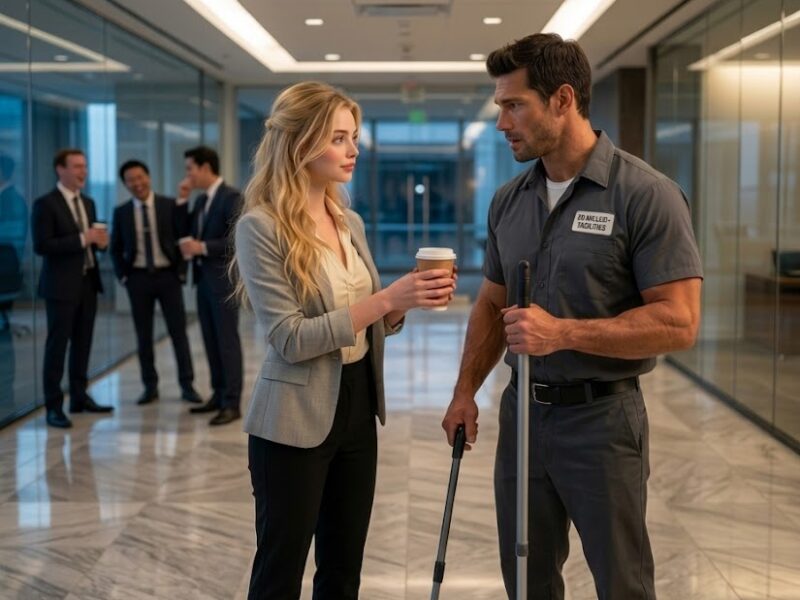
Evan turned his head. A young woman in a simple cream-colored cotton blouse, dark slacks, and a pair of plain black flats that looked new but inexpensive was currently lifting the edge of a heavy steel-framed reception chair, moving it six inches away from the wall before his mop could reach the corner.
“Sorry about that,” she said softly, wiping a stray strand of dark hair from her forehead. She gave him a small, tired, but entirely genuine smile. “I didn’t want you to have to struggle to mop around the iron legs. The corner gets tight.”
Evan stopped his hands against the mop handle, his eyes dropping to the white plastic identity card clipped to her pocket.
The name on the badge read: Maya Bennett. Trainee Cohort. Regional Operations Center, Ohio.
“Thank you,” Evan said, his gravelly voice low beneath his cap.
Maya hesitated for a second, her eyes tracking the heavy gray supply cart, the spilled sugar on the counter near the coffee machine, and the long, empty corridor behind him. “Do you… do you need a hand with moving the secondary row before the break ends?” she asked, her tone entirely natural, devoid of that performative corporate cadence he had heard in the boardroom for five straight years. “It looks like they left a real mess out here after the morning session.”
Inside the glass classroom, Tyler Reed—the young man in the navy blazer—was currently raising his hand with an exaggerated, confident alignment, making Clare Donovan smile as he offered a polished, empty sentence about resource optimization. But outside in the gray hall, by the wet-floor sign, the girl from Ohio was waiting for a janitor to answer her.
“No,” Evan said softly, his fingers tightening against the wooden handle. “I’ve got the weight of it. Thank you.”
Maya smiled again, her eyes warm. “Well, thank you for keeping this place from falling apart under our feet,” she said, before turning to answer Clare’s voice as the classroom doors opened for the next module.
Evan remained standing in the corridor for a long time, his eyes tracking the simple cream blouse through the glass wall as she took her seat in the back row, well away from the managers. For the first time in his five years as Chief Executive Officer, he realized that the most critical metric in the 47-story tower was not being recorded on the slides upstairs. It was sitting right here in the dirt of the floor, where only one person had remembered that a gray uniform still contained a living human being.
Part 2: The Ohio Variance
Maya Bennett had spent three hours the previous evening using a rusted iron travel iron to smooth out the creases in her single cream-colored blouse. The small apartment she had secured near the elevated train tracks in Chicago smelled permanently of old grease, damp plaster, and the sharp metal dust of the transit line. Every time the blue line train roared past her window, the thin glass panes would rattle in their wood frames, and Maya would close her eyes, counting the seconds until the vibration cleared, reminding herself that the noise was still infinitely better than returning to the small town in eastern Ohio with another unfinished chapter in her notebook.
She needed this logistics internship. She didn’t merely want it to build her profile; she needed the direct monthly stipend to prevent her mother’s medical prescription line from being canceled by the pharmacy counter back home.
Two years ago, during her junior year of college, her mother had suffered a massive ischemic stroke that had left the left side of her body entirely non-functional. Maya had dropped her classes within forty-eight hours, packed her books into plastic milk crates, and returned to the small valley town to manage the long-term physical therapy routines. Her younger brother, Caleb, had quietly abandoned his own plans for the local technical college to take a twelve-hour shift at a diesel repair garage, his knuckles permanently blackened by engine oil as they tried to balance the remaining property taxes on their father’s small, unpaved house.
The neighbors had called her responsible and good, but Maya knew that corporate human resource departments did not possess an evaluation metric for family responsibility. On a digital recruitment profile, a two-year gap spent lifting an elderly woman into a bath stall simply looked like an empty white line of non-productivity. It looked like a failure of ambition.
So when the automated acceptance email from Cole & Hartwell Logistics had arrived in her inbox, she had packed her single large suitcase with two pairs of slacks, three clearance-rack blouses, and a pair of black flats that pinched her heels until the skin bled, telling herself that she would survive any environment the city could present if it meant she could send four hundred dollars back to Caleb every Friday morning.
“The core of modern supply chain architecture isn’t about moving physical boxes,” Tyler Reed said, his voice carrying that bright, effortless projection that came from four years of undergraduate presentations at Northwestern University. He was standing near the coffee station during the afternoon break, his hand holding a ceramic mug with the company logo aligned perfectly toward the hallway. “It’s about information synchronization. If you optimize the digital data layer, the physical freight has to follow the algorithm automatically. It’s pure efficiency.”
He was speaking to Brandon and Elise, two other trainees whose parents both held positions within the downtown financial district. They were listening with that tight, competitive focus that characterized the entire fall cohort, their heads tilting in synchronized approval as Tyler dropped his terms.
“Looks like our internal facilities tier is already optimized,” Brandon remarked with a smirk, nodding his chin toward the end of the long corridor.
Evan, still wearing the gray cap and the badge that marked him as Ed Miller, was currently on his knees near the skirting board, using a stiff wire brush to clear an old patch of black scuff marks left by a delivery cart. His shoulders were bent, his hands covered in coarse yellow rubber gloves that were wet with chemical solvent.
Tyler Reed glanced down at the janitor, a small, amused smile playing at the corner of his mouth. “Yeah, well, at least the company knows how to keep the scenery clean. Good to know we’re considered important enough to have our own dedicated infrastructure unit assigned to the floor.”
Elise let out a sharp, musical little laugh, turning her tablet over to check her presentation notes.
Maya stood three feet away from the group, her fingers pressed hard against the paper cup of cheap, bitter office tea she had drawn from the side dispenser. She looked at Tyler’s polished leather loafers, then looked down at the old man—or who she believed was an old man—scrubbing the baseboard in the dust.
Tyler took a small sip of his espresso, then tossed a used plastic stir stick toward the small gray waste basket near the counter. His wrist flipped carelessly, and the sticky piece of blue plastic missed the rim, bouncing off the wall and landing directly in the middle of Evan’s clean rag tray.
“Oops,” Tyler said, his voice completely light, devoid of any actual apology as he turned back to Brandon. “Looks like Ed’s got a retrieval task on his sheet.”
Evan didn’t stop his hands. He kept his head down, his brush moving rhythmically against the scuff mark, his fingers reaching out toward the sticky piece of plastic.
Before his rubber glove could touch the blue stir stick, Maya stepped across the tile floor. She bent down, her cream blouse brushing against the yellow frame of the mop bucket, her fingers catching the sticky plastic before the janitor could lift it. She stood up straight and dropped it directly into the center of the trash can, her eyes fixed on Tyler’s face with a cold, level clarity that caught the young man entirely by surprise.
“You didn’t have to do that, Maya,” Tyler said, his brows rising in mild, upper-class amusement as he looked at her fingers. “That’s quite literally what his operational tier is cleared to handle on the log.”
“I know,” Maya said, her voice quiet but remarkably steady, lacking the nervous strain that usually appeared whenever she spoke in the classroom sessions. “I know he’s here to clean the building, Tyler. But making the mess on purpose wasn’t part of your assignment.”
The small circle near the coffee machine went silent, the ambient hum of the air conditioning suddenly seeming louder against the glass. Brandon adjusted his watch strap, his eyes moving uncomfortably between Tyler and the girl from Ohio.
Tyler gave a short, dry laugh, his fingers tapping against his ceramic mug. “Ohio, right?” he asked, his tone dropping into a smooth, condescending register that carried a distinct social warning. “The regional distribution office down in the valley?”
“Yes,” Maya said, her chin remaining level.
“That explains the manners,” Tyler smiled, his voice perfectly polite on the surface while executing a complete social exclusion. “It’s very sweet, Maya. Really. But you’ll find out pretty quickly that downtown operations move a little too fast for that kind of small-town administrative detail. People upstairs expect us to focus on the numbers, not the floor rugs.”
Maya felt a sudden, sharp heat rise along the back of her neck, the familiar weight of her regional displacement pressing down on her chest. She looked at Brandon and Elise, but their faces were entirely blank, their eyes already looking past her toward the classroom door as Clare Donovan stepped out with her lesson binder.
For a second, every survival instinct she had developed during the long therapy years told her to soften her mouth, to give a small, compliant laugh to prove she could take the joke, to let the insult disappear so she wouldn’t become the difficult element in the cohort. Instead, she took her paper cup, turned her back on Tyler’s smile, and walked back into the training room without saying another word.
At the base of the wall, Evan Cole slowly rose from his knees, his gray cap tilting upward just enough to watch her cream blouse disappear through the glass doors. He removed his yellow rubber gloves, his eyes fixing on the single black mark that remained on the baseboard. The scuff mark was gone, but the diagnostic matrix in his head had just recorded a much deeper fracture in the foundation of Cole & Hartwell Logistics.
Part 3: The Boardroom Ready Model
By Wednesday afternoon, the casual atmosphere of the initial orientation had vanished entirely, replaced by the sharp, defensive posturing of a high-stakes corporate selection tracking trial.
Clare Donovan walked into the glass-walled classroom at precisely 1:00 p.m., her heels executing a series of rapid, authoritative cracks against the floor that brought the eighteen trainees into immediate, silent alignment. She didn’t drop her folder onto the table; she placed it exactly in the center of the dark wood, her eyes scanning the faces with that smooth, diagnostic evaluation that made Maya feel as though her clearance-rack blazer were being appraised for its raw material value.
“Today we begin your first major operational assessment,” Clare said, her voice crisp, modulated, and completely devoid of any introductory pleasantries. “You will be divided into three distinct groups. Each team will be given access to our unedited Midwest distribution ledger from the past two quarters. Your assignment is simple: identify the core systemic bottleneck across our regional truck freight routes and design a scalable optimization proposal. You will present your findings directly to our senior executive board on Friday morning.”
A collective, nervous rustle passed through the desks, several trainees straightening their shoulders as if the executive board were already sitting behind the whiteboard.
“We are looking for three specific capabilities,” Clare continued, her silver remote highlighting the terms on the digital screen. “Strategic operational vision, objective data clarity, and executive presence. You have forty-eight hours to finalize your models. Choose your leads now.”
Within five minutes, Group Three had been organized around the central table near the windows. No vote was taken for the leadership position; Clare Donovan had simply glanced toward their corner, her eyes lingering on Tyler’s tailored navy jacket, and remarked, “Tyler, given your background in the New York freight internship, why don’t you coordinate the data framework for this unit?”
“Happy to provide the structure, Ms. Donovan,” Tyler said, his smile modest, bright, and perfectly balanced to project leadership without arrogance.
He sat down at the head of the group table, uncapping a heavy silver fountain pen with a fluid, deliberate movement that made it look as though he were preparing to authorize an international treaty. Brandon immediately opened his laptop to screen-share the raw route data, while Elise began downloading the cost-reduction templates from the corporate library.
“Okay, team,” Tyler said, leaning forward and drawing a large, clean triangle on his legal pad. “Let’s think big. Let’s focus on the macro tier. Automation of regional hubs, third-party logistics integration, and deep labor cost reduction. Senior leadership upstairs doesn’t want to look at minor warehouse complaints; they want clean, scalable ideas that can be presented in a single five-slide matrix.”
Maya sat at the far end of the table, her fingers tracing the edge of her unpolished plastic tablet. She had spent the last two hours analyzing the raw route times from the eastern Ohio distribution loop—a territory she knew better than anyone else in the room because her brother had driven those same lanes for three months before his garage job.
“The macro ideas won’t scale correctly if the local data layer is corrupted,” Maya said quietly, her voice cutting through Brandon’s typing noise.
Tyler looked up from his pad, his silver pen pausing mid-air, his face arranged into an expression of patient, polite tolerance. “Meaning what, exactly, Maya? The data comes directly from our central routing software.”
“The software is ignoring the actual transit variance,” Maya said, turning her screen so that the entire group could see the raw timeline graphs. “Look at the late delivery spikes along Route 44 during the November window. The algorithm flags those drivers as inefficient because they missed their three-hour receiving window at the regional hub. But if you cross-reference those dates with the local weather matrix, those were the nights the lake-effect snow hit the valley ridges. The software doesn’t adjust the driver schedules for safety delays; it simply penalizes their individual metrics.”
Brandon frowned, looking over his glasses. “The software is standard across sixty companies, Maya. The drivers know the performance parameters when they sign their route sheets.”
“The drivers can’t drive sixty miles an hour through an ice storm on a two-lane ridge road, Brandon,” Maya said, her voice rising slightly as the memory of her brother Caleb sitting at their kitchen table with white knuckles came flooding back into her mind. “If you penalize them for weather variance, they start rushing the loading docks. When they rush the docks, the warehouse teams have to clear the freight before the manifests are verified in the system. That’s why we have a six percent freight-loss variance in the Midwest loop. It’s not a failure of individual driver discipline; it’s that our central office algorithm is protecting its own efficiency model by pushing the physical risk down to the people who have the least authority to change the schedule.”
The group table went completely quiet, Elise’s fingers freezing over her keyboard as she stared at the raw data numbers.
Tyler Reed leaned back in his chair, his silver pen tapping against his chin as he studied Maya’s face with a sudden, sharp interest. For the first time all week, he didn’t use the condescending small-town label. He smiled—a warm, inclusionary smile that looked remarkably generous.
“That is… actually an incredibly strong operational insight, Maya,” Tyler said, his voice rich with approval as he began writing rapidly on his pad. “Really. It’s a classic workflow friction problem. The field reality doesn’t align with the theoretical model upstairs. We can build our entire presentation around this loop. We’ll call it the Field-Tier Variance Correction Model.”
Maya felt a sudden, unexpected lift in her chest, a warm wave of relief washing through her shoulders as she saw Brandon begin typing her bullet points into the shared master document. “Thank you,” she whispered, her fingers finally relaxing against her tablet. “I have the full warehouse delay logs from the last quarter if you want to map the loading times.”
“Perfect,” Tyler said, nodding with intense focus. “Log everything into the shared cloud file by five o’clock. You handle the raw field metrics, Maya. I’ll take the lead on translating it into an executive frame so it’s boardroom ready for Friday.”
She spent the next four hours working until her eyes were bloodshot, compiling the irregular driver logs, organizing the weather reports, and building a detailed workflow template that paired data analysts with warehouse supervisors before route schedules were finalized by the software. Her name appeared cleanly in the blue margin of the shared document beside every core strategic recommendation.
At 6:30 p.m., after the rest of the group had gone down to the lobby to clear their evening schedules, Maya remained at her desk, her blazer hanging from the back of her chair as she verified the final column numbers.
Outside the glass wall, Evan Cole stood in his gray facilities shirt, a white microfiber cloth clutched in his hand as he wiped away a ring of greasy fingerprints left by a manager on the exterior panel. From his position in the dark hallway, his eyes tracked the digital projection on the wall inside. He saw Maya’s name linked to the core analysis slides. He saw the precision of her logistical mapping—it was the first report he had seen in three years that didn’t try to hide the human cost of the company’s profit margin beneath abstract financial jargon.
Maya stretched her arms, clicked her save button, and closed her laptop, her face exhausted but filled with a quiet, hard-earned confidence.
Two hours later, sitting on the edge of her narrow mattress in the train-line apartment, she pulled up her smartphone to review the team’s finalized presentation draft before the morning dry-run.
The screen loaded, and Maya’s breath stopped in her throat.
The shared document had been completely edited at 7:42 p.m. by Tyler Reed. The section marked Field-Tier Variance Correction was still there, but the heading had been altered in a bold, premium font to read: The Reed Operations Framework: Macro-Sychronization Metrics.
Every single one of Maya’s detailed observations about driver safety, weather delays, and warehouse bottlenecking had been re-worded into smooth, empty corporate jargon. And her name—the small blue marker that had stood beside the core strategic recommendations—had been removed entirely, shifted down to a tiny, grey font note at the absolute bottom of the final slide under the title: Supporting research compiled by M. Bennett.
Maya stared at the screen until the blue light burned her eyes, the cold, metallic roar of the elevated train outside shaking the floorboards beneath her feet like an old mockery.
Part 4: The Language of the Board
The next morning, the rain hit the glass walls of the 14th floor with a heavy, relentless rattle that seemed to darken the interior corridors. Maya stood outside the classroom door at exactly 8:15 a.m., her fingers clenching the edge of her laptop folder so hard the cardboard backing began to buckle under her grip.
Tyler Reed walked out of the elevator lane, his navy suit freshly pressed, his hair perfectly styled as he carried a premium leather folder under his arm. He was whistling a low, cheerful tune, his face completely free of any tension as he noted her presence.
“Tyler, can we talk about the master presentation document for five minutes?” Maya asked, her voice carrying a tight, controlled strain that made him halt his stride.
“Sure thing, Maya,” Tyler said, his smile perfectly bright, his tone full of that easy, unbothered generosity that came from a man who knew he held every card in the deck. “What’s on your mind? The formatting looks incredible, doesn’t it?”
“You moved my entire warehouse and driver analysis under your personal heading,” Maya said, her dark eyes looking directly into his face, refusing to let him look past her this time. “You removed my name from the operational framework entirely, Tyler. You turned my core strategy into a footnote called ‘supporting research.'”
Tyler let out a soft, patient sigh, leaning his shoulder against the glass paneling with an expression of gentle, parental concern. “Maya, look… let’s be entirely realistic about how team assets are managed in a high-tier corporate structure like Cole & Hartwell. This isn’t an undergraduate seminar where everyone gets a golden star next to their paragraph. This is a competitive pipeline.”
“That doesn’t give you the right to steal my work,” she whispered, her hands shaking against her folder.
“I didn’t steal anything, Maya,” Tyler said, his tone cooling into a sharp, professional delivery. “I streamlined the content. I took raw, unpolished field notes from a regional loop and structured them into an integrated macro strategy that an executive like Evan Cole can actually read without getting bogged down in individual driver complaints. That’s what leadership is. It’s the ability to shape raw input into an executive frame. If you want to succeed in this town, you need to learn how to be a team player, not get defensive about ownership metrics.”
“I’m not asking for special credit, Tyler,” Maya said, her chest rising with a fierce, quiet anger. “I’m asking not to be entirely erased from the room.”
Tyler straightened up from the glass, his eyes narrowing into two thin, cold lines of warning that held no trace of his previous charm. “Careful, Maya,” he said quietly, his voice dropping into a register that was meant only for her ears. “That kind of language can make a trainee look incredibly difficult to the human resources managers. Clare Donovan is looking for people who fit our corporate culture. Getting emotional about slide credit before the first presentation isn’t a good look for an Ohio profile. Let’s just keep it professional, okay?”
He turned on his heel and walked into the classroom, his leather shoes executing a series of smooth, confident snaps against the floorboards.
Maya stood alone in the dark hallway, the cold gray rain running down the exterior glass sheets across from her. She felt smaller than she had since the day she left the valley, the familiar, crushing weight of her socioeconomic isolation locking around her throat like an iron ring. She knew what the word difficult meant in a building like this—it meant you didn’t have a father on a board to smooth over your rough edges; it meant your clearance-rack blazer didn’t belong in the room; it meant you could be replaced by an automated system before the weekend started.
During the afternoon dry-run, Clare Donovan stood at the back of the conference room, her eyes tracking Group Three’s presentation slides with intense approval.
“Excellent synthesis of our operational variance, Tyler,” Clare said, clapping her hands together with a refined, musical alignment as the final slide cleared the screen. “The Reed Framework is exactly the kind of top-tier, proactive leadership modeling we want to see developed in our pipeline. It shows an exceptional grasp of how data clarity can drive resource optimization.”
“Thank you, Ms. Donovan,” Tyler said, bowing his head with just the right amount of humility. “The team contributed some excellent field color during the initial mapping sessions, of course, but we really wanted to focus on creating a boardroom-ready model for Mr. Cole.”
Maya sat at the far end of the row, her hands folded tightly beneath the dark wood of the table so that no one in the room could see the white-knuckle tremor in her fingers. She didn’t say a word. She allowed her name to remain hidden in the grey footnote at the bottom of the wall.
Outside in the corridor, Evan Cole paused with his spray bottle clutched in his yellow rubber glove, his cloth resting against the handle of his yellow mop bucket. He had heard every syllable of Tyler’s presentation through the half-open door. He had seen Clare Donovan’s approving nod. His face grew incredibly still beneath the gray cap, his dark eyes locking onto Tyler’s navy blazer with a cold, terrifying intensity that would have stopped the presentation instantly if anyone had bothered to look through the glass.
Ten minutes after the session dismissed, Evan found Maya sitting alone on a low stone bench near the dead-end of the service hallway, her laptop closed on her knees. She was staring at her phone screen, her teeth digging into her lower lip as she wiped a sudden, stray trace of wetness from beneath her left eye with the corner of her sleeve.
Evan stopped his cleaning cart three feet from her bench, resting both his hands over the smooth wooden handle of his mop. “You all right, Miss Bennett?” he asked, his gravelly voice low and steady in the quiet corridor.
Maya gave a short, bitter little laugh without looking up at his face, her fingers twisting the plastic strap of her laptop bag. “I’m fine, Ed. Really. I’m just… learning how the architecture works in Chicago. It’s a very clean system.”
“No,” Evan said quietly, his physical stillness drawing her eyes upward toward his gray cap. “You’re not learning how the system works. You’re learning how broken things ask decent people to cut their own skin to fit the frame.”
Maya blinked, her dark eyes studying his face with a sudden, deep intensity. For a common janitor, Ed Miller had an extraordinary posture—his shoulders were perfectly level, his chin held at an angle that didn’t belong to a man who had spent eighteen years clearing trash cans. There was a pale, clean line around his left wrist where an expensive watch had clearly rested for years, and when he spoke, his words carried the heavy, absolute gravity of a man who was used to authorizing structural changes.
“If I open my mouth to object, I’m considered ‘difficult,’ Ed,” Maya whispered, her voice cracking slightly under the weight of the confession. “If I stay silent… I disappear completely before the Friday presentation. My family back home… they need this ledger line to clear. I can’t afford to be difficult.”
Evan’s face softened beneath his cap, though his voice remained low and dangerous. “Don’t let this building teach you that swallowing a lie is proof of corporate maturity, Maya,” he said. “The people upstairs… they aren’t looking at your resume. They’re looking to see if you’ll help them hide the rust on the wheels.”
“Ed,” Maya said slowly, her eyes tracking the precise alignment of his hands against the mop handle. “Were you… were you ever a manager before you came to the facilities tier?”
Evan looked toward the central classroom where Tyler Reed was currently sharing an espresso with Clare Donovan, his mouth curving into a cold, hidden smile. “I’ve been responsible for an immense number of people, Maya,” he said softly. “But for a long time… I didn’t actually see them soon enough.”
He pushed his yellow bucket away down the long tile floor before she could ask another question, leaving the girl from Ohio alone in the corridor with a strange, heavy realization—that the only real leader in the 47-story tower was the man holding the wire brush.
Part 5: The Glass on the Marble
By Thursday evening, the trainee floor had been entirely stripped of its educational architecture, transformed into a glittering, high-stakes theater for the senior executive networking reception.
The standard desks had been cleared away into the storage lockers, replaced by tall, polished chrome cocktail tables that reflected the brilliant white light of the modern chandeliers overhead. A professional jazz trio played a low, smooth melody from the corner gallery, and uniform catering staff moved through the crowd of three hundred executives and trainees carrying massive silver trays loaded with white wine and premium appetizers. The air smelled of expensive wool suits, aged scotch, and the collective, desperate anxiety of young people trying to perform charisma for the vice presidents.
Maya Bennett stood near the far edge of the room under the shadow of a structural column, her fingers clenching a glass of sparkling water she had not touched since seven o’clock. She was wearing the same black slacks and flats she had worn to the office that morning, her clearance-rack blazer feeling heavy and coarse against her shoulders as she watched the circles of interaction around her.
The conversations moving through the tables were a foreign language to her ears—casual, effortless references to private East Coast graduate schools, summer ski trips in Aspen, and fathers who served on the boards of regional manufacturing trusts. Maya knew how to cross-reference a freight manifest; she knew how many hours a warehouse dock team could work before their attention failed; she did not know how to turn her life into a series of charming anecdotes to amuse a director.
Across the room, Tyler Reed was completely in his element. He stood at the center of the largest table near the windows, flanked by Clare Donovan and Grant Keller—the Senior Vice President of International Operations.
“Our proposal for the Friday matrix focuses entirely on predictive route correction,” Tyler said, his voice projecting with that clear, corporate resonance that effortlessly claimed the space around the cocktail table. “The key to the Midwest expansion isn’t about adding asset infrastructure; it’s about reframing regional operational friction as a systems-level coordination variance. If you manage the algorithm correctly, the field anomalies disappear.”
Grant Keller nodded his silver head in approval, taking a slow sip of his whiskey. “That’s a remarkably mature insight for a trainee, Tyler. Most operational reports we get from the field are just a list of local complaints about equipment or hours. Where did you isolate that weather-loss metric?”
Maya felt a sharp, sudden heat flash along her jawline. She set her sparkling water down on a tray, her feet moving across the marble floor before her survival fear could lock her joints. She stepped into the light of the central table, her chin tilted up, her voice clear and resonant.
“The insight didn’t come from an abstract framework, Mr. Keller,” Maya said, her eyes locking onto the vice president’s face with absolute honesty. “It came from the raw warehouse log history along the Ohio loop. When our central office software promises a three-hour delivery window without crossing the data with local weather systems, the entire physical risk is pushed down to our drivers and our dock teams. They start rushing the manifests to clear their metrics, and that’s what causes our six percent product-loss variance. It’s a systemic design flaw, not a driver discipline issue.”
Tyler’s smile didn’t vanish; it simply tightened into a smooth, professional barrier as he stepped slightly in front of her stance. “Maya has an incredibly unique… field-tier perspective, Mr. Keller,” he said with a short, condescending chuckle that drew a polite laugh from Brandon. “It’s very useful color for our lower logs. I took her raw field observations and shaped them into our operations strategy so they’re suitable for executive review.”
Clare Donovan lifted her glass, her eyes catching Maya’s face with a cold, clear warning that carried the full weight of her human resource authority. “Tyler has done a magnificent job translating raw regional input into our standardized leadership language, Grant,” Clare said, effectively closing the circle. “That’s the kind of executive presence we look for in our directors.”
Raw regional input.
Maya stood at the edge of the silk dresses, her face burning under the cosmetics of the women around her, realizing that her entire mind, her hours of night work, had been categorized as raw material to be processed by a man who had never seen a snow ridge in his life.
A sharp, explosive crash shattered the jazz rhythm.
Two tables down, Brandon had turned his arm too quickly, striking an oversized wine glass that sat on the edge of a chrome table. The glass shattered violently against the marble floor, a wide, dark pool of red wine spreading rapidly across the pale stone, splashing against the leather shoes of the nearest senior director.
The executives immediately stepped back, their faces twisted into expressions of mild annoyance as they checked their clothing.
Tyler Reed turned his head toward the end of the room where Evan Cole was standing in his gray facilities uniform, a large plastic trash bag clutched in his hand as he emptied the side containers.
“Hey, Ed!” Tyler called out, his voice raised loud enough to carry over the jazz trio, ensuring that the entire executive circle could hear his direction. “We’ve got an operational spill over here by the window! You might want to get your mop before someone important ruins their leather!”
A few of the trainees near the bar let out a soft, nervous titter.
Evan didn’t drop his bag. He set it down with a slow, deliberate calculation, his dark eyes rising from beneath the gray cap to lock directly onto Tyler’s face with a freezing intensity that made the young man’s smile falter for a fraction of a second. He walked slowly toward his cart, reaching for his wire brush and a roll of heavy blue paper towels.
Tyler turned back to Grant Keller, throwing his hands out in a loose, arrogant gesture. “Careful with that tile, Ed,” he added with a clear, sharp laugh that carried across the tables. “That Italian marble probably costs more than your entire facilities tier draws for a monthly paycheck. Don’t scratch the finish.”
The room went completely still for half a second, the casual cruelty of the remark leaving a cold stain on the air that even Clare Donovan looked slightly uncomfortable managing. But nobody spoke; nobody offered a phrase to help the old worker who was currently walking toward the broken glass.
Maya didn’t think about her file. She didn’t think about the red digital note Clare Donovan could place beside her name. She crossed the marble floor in three rapid strides, dropping down onto her knees directly into the pool of red wine, her clearance-rack blazer trailing in the wet stain as she began picking up the massive, jagged shards of glass with her bare hands.
“Maya, don’t,” Evan said quietly, his gravelly voice dropping its facility accent as he reached the spill, his hand reaching out to catch her shoulder.
But she had already reached for a long, thin shard that lay pinned beneath the chrome leg of the cocktail table. Her fingers slipped on the wet glass, and the sharp crystal edge sliced deep across the center of her palm. Maya inhaled sharply, a bright, dark line of blood appearing instantly against her skin, dripping down onto the white marble floor.
“Look at that,” Tyler muttered, stepping back with an expression of disgust. “This is getting completely out of hand. It’s an operations reception, not an emergency room.”
Evan Cole dropped his brush. He didn’t move like a janitor answering a corporate order anymore; he moved with the absolute, terrifying authority of a sovereign clearing a field. He knelt in front of Maya, his large hands catching her wrist with an unyielding, protective strength. He pulled a clean, white linen cloth from his side pocket—not an industrial paper towel, but an expensive, private monogrammed handkerchief he had kept in his interior frame—and pressed it hard against her bleeding palm.
“Hold the pressure right there,” Evan said, his voice dropping into a low, thunderous register that cut through the jazz music like a lead weight. “Look at me, Maya. Keep the hand elevated above your shoulder line.”
Maya looked into his face, her breath coming in short, ragged gasps from the pain. The gray facilities cap had fallen back from his brow, and for the first time all week, she saw the cold, brilliant, untouchable steel of the man’s features under the main chandelier. There was no accent in his mouth; there was nothing poor about the line of his jaw. There was only a controlled, protective fury that was directed entirely at the circle of people standing above them.
“I’m okay, Ed,” she whispered, her fingers clenching the white linen as the blood began to seep through the threads.
“No,” Evan said, his dark eyes locking onto hers with an absolute, unconditional focus that seemed to empty the ballroom of its three hundred guests. “You are bleeding for a system that isn’t worth a single drop of your skin.”
Part 6: The Red Note
By 8:30 a.m. on Friday morning, the executive floor of Cole & Hartwell Logistics was flooded with the clean, white light of a clear autumn sky, the storm having passed over the lake during the midnight hours.
Maya Bennett sat in the low leather chair across from Clare Donovan’s massive glass desk, her left hand wrapped in a thick, white professional bandage that smelled of antiseptic. Her laptop was resting on her knees, closed and dark, her fingers tracing the plastic seam of her folder. She had received the automated calendar invite at exactly 8:12 a.m.—a simple block of text that read: HR Operational Review: M. Bennett.
Clare Donovan sat behind her desk, her white silk blouse immaculate, her fingers typing a final entry into her system before she clicked her screen closed. She looked across at Maya with an expression of intense, maternal sympathy that felt entirely artificial to Maya’s ears.
“Maya, I want to begin our session by saying that the regional office in Ohio spoke very highly of your technical focus during the logistics harvest last summer,” Clare said, her voice smooth, modulated, and perfectly balanced. “You have an immense amount of raw analytical potential. But potential has to be paired with adaptability if you want to survive our leadership pipeline.”
“My hand was bleeding, Ms. Donovan,” Maya said, her voice remarkably quiet, her eyes remaining fixed on the human resource director’s face.
“And we have already processed the medical claim under our facilities coverage line, Maya,” Clare said, leaning back in her leather chair and folding her hands over her folder. “The injury itself isn’t the operational metric we’re reviewing this morning. The issue is how you chose to manage the social environment afterward. Your choice to initiate a public confrontation with Tyler Reed during a senior executive reception showed an absolute failure of emotional control in a leadership setting.”
Maya looked at the monitor behind Clare’s head. A red digital marker was currently glowing beside her profile photo on the tracking screen. “Tyler insulted an old worker who has given eighteen years to this building, Ms. Donovan. He called his monthly salary a joke in front of the entire operations board. He stole my entire strategy proposal and turned my name into a footnote called ‘supporting research.’ Is that what your framework defines as executive presence?”
Clare’s expression cooled by exactly one degree, her fingers tapping against her mahogany desk frame. “Tyler Reed demonstrates an exceptional level of executive maturity, Maya. You may disagree with his formatting choices, but leadership often requires the confidence to claim operational space and drive an abstract strategy home to the board. Accusations of theft require physical documentation within our grievance filing system. We cannot manage emotional complaints about slide alignment.”
She slid a thin white document across the glass desk, her finger pointing toward a line at the bottom marked with a red digital tab.
“This pipeline is highly competitive, Maya,” Clare said softly, her voice carrying that terrible, clean gentleness that wore a tie. “I don’t want one uncomfortable evening to ruin your long-term professional reputation in this market loop. If you choose to sign this voluntary withdrawal form this morning, our department can frame your exit as a timing variance due to family health stress. You could reapply for our regional center loop in six months with a clean record. It’s an act of mercy.”
Maya looked down at the white paper on the glass, the words voluntary withdrawal looking small and neat under the high ceiling. She understood the calculus perfectly now—Clare Donovan wasn’t offering her a second chance in Ohio; she was offering her total disappearance so that Tyler Reed’s presentation could clear the board without an inconvenient question from the floor.
“What about Walter Simmons?” Maya asked quietly, her fingers tightening around her bandaged palm. “The janitor whose knee broke because he didn’t have a backup shift? Was his exit framed as a timing variance too?”
Clare stood up from her chair, her face a hard, unyielding mask of institutional finality. “Your session is concluded, Miss Bennett. You have until twelve o’clock to clear your locker on the 14th floor. If you choose not to sign the clearance form, your red file will be transmitted to the regional network automatically before the afternoon audit.”
Maya didn’t sign the paper. She stood up slowly, her laptop bag clutched against her ribs with her single good arm, and walked out of the glass suite without saying another word.
She walked past the silver elevator bays, past the central coffee machine where someone had already spilled a carton of cream and left it to curdle on the counter, and pushed through the heavy iron door marked Service Stairwell Lane. The concrete steps inside were empty, cold, and smelled of dust and old masonry.
Maya sat down halfway between the 14th and 13th floors, her clearance-rack blazer resting against the rough concrete wall as she covered her face with her bandaged hand. She didn’t cry loudly; she simply sat in the silent gray space, her torso shaking in rhythm with the distant, heavy thud of the machinery downstairs, realizing that she had lost the only line that was keeping her mother’s pharmacy counter clear.
The heavy fire door at the top of the landing clicked open.
A regular series of heavy rubber boot steps echoed down the concrete stairs. Evan Cole walked down the landing, still dressed in his gray facilities shirt, carrying a small first aid kit and a cold bottle of mineral water under his arm.
Maya let out a short, ragged laugh that sounded like dry ash in her throat. “Do you… do you just possess an automated alert system that triggers whenever someone is having the worst morning of their life in this building, Ed?”
Evan sat down on the concrete step exactly one level below her stance, leaving a respectful distance between his gray boots and her black flats. He didn’t look down at his shoes; he looked up at her thick white bandage, his face completely devoid of that sub-zero executive distance that usually occupied his portraits.
“I’ve been tracking the operational metrics on this landing for eighteen years, Maya,” he said softly, his voice carrying that deep, structural resonance she had heard near the broken wine glass.
“I thought if I worked eighteen hours a day, it would be enough, Ed,” Maya whispered, her chin dropping toward her collarbone. “I thought if I stayed decent, if I didn’t play the selection games, if I just built a good strategy that helped our people… the numbers would speak for themselves. But being decent in a building like this just makes it easier for people like Tyler to use you as a step.”
“No,” Evan said, his fingers reaching out to set the water bottle beside her laptop bag. “That is what people like Clare Donovan want you to believe so you’ll leave the room without making a noise. The problem isn’t that your heart is too soft for logistics, Maya. The problem is that we’ve built an entire corporate skyscraper that has learned how to reward the theater of leadership while punishing the actual human beings who understand the freight.”
Maya studied his profile in the dim light of the stairwell—the unyielding line of his jaw, the absolute lack of fear in his voice, the way he spoke about human resource directors as if they were junior staff who had forgotten their place. “Ed,” she asked, her voice dropping to a low, breathless whisper as a sudden, wild suspicion began to map itself in her mind. “Who are you really? Why are you sitting in a concrete stairwell holding an industrial bandage?”
Evan Cole stood up from the step, his gray cap remaining behind on the concrete as he turned his face toward the door panel. “I’m the man who is responsible for this entire tower, Maya,” he said quietly. “And it’s time for me to go upstairs and clear the ledger.”
Part 7: The Master Ledger Matrix
At exactly 10:00 a.m. on Friday morning, the main executive conference room on the 47th floor of Cole & Hartwell Logistics was arranged for the final cohort presentations. The massive wall-sized windows looked out over a brilliant, sunlit expanse of downtown Chicago, the lake blue and calm after the storm. The twelve members of the senior board sat along the left side of the mahogany table, their faces serious, while the vice presidents and regional directors occupied the secondary rows behind the leather chairs.
Clare Donovan stood near the digital projection screen, her face elegant, relaxed, and entirely serene as she cleared her microphone. Tyler Reed waited beside her at the lectern, his navy-blue suit jacket buttoned perfectly, his silver fountain pen clutched in his fingers like a scepter.
Maya Bennett sat in the absolute last row near the entrance doors, her bandaged hand resting openly in her lap, her face pale but completely still. She had refused to clear her locker at noon. She knew she had no job line left to save, but she had promised herself that she would look Tyler Reed in the eye while he reads her words out loud to the board.
“Our final strategic recommendation for the Midwest distribution framework addresses our regional bottleneck through predictive route correction,” Tyler began, his voice carrying an absolute, effortless projection that immediately claimed the attention of the directors. He clicked his silver remote, and a beautiful, high-definition slide matrix expanded across the wall. “By optimizing our information synchronization layer, we can effectively isolate our field anomalies and reduce our labor variance by fourteen percent across the next quarter.”
The slides were magnificent—colored in premium corporate blues and golds, filled with clean, elegant icons that translated the raw physical stress of the freight lanes into a series of beautiful, bloodless data vectors. Tyler spoke with absolute confidence, using his silver pen to trace lines across the grid, presenting the Reed Operations Framework as a masterpiece of modern resource allocation.
“It’s an exceptionally clean model, Mr. Reed,” an elderly board director said, leaning forward and adjusting his reading glasses. “But I’m looking at your weather-loss metrics along the Ohio loop. What practical, field-level experience supports this framework? Have you actually spent any time on the warehouse floor or spoken with our night-shift drivers about these route times?”
Tyler paused for less than a half-second, his smile remaining perfectly stable, his shoulders executing a tiny, practiced shrug of corporate modesty. “We analyzed our central data ledger thoroughly, sir. And we spent a great deal of time evaluating our field realities from an objective, strategic operational perspective. The data indicates that driver discipline adjusts automatically once the performance parameters are stabilized by the central office software.”
Maya felt her heart executing a fast, terrifying rhythm against her ribs. She looked at Clare Donovan’s approving nod; she looked at the directors who were preparing to check their boxes; she thought of her brother Caleb sitting in a cold garage with grease under his nails because a corporate algorithm had labeled his shift inefficient. If she stayed silent right now—if she allowed the fear of her red file to keep her mouth closed—she wouldn’t just be losing her internship. She would be helping these people erase every driver and janitor who had built the tower.
Maya stood up from the back row, her chair executing a sharp, wooden click against the floorboards that made every executive head turn sharply toward the door.
“The field realities Tyler mentioned aren’t abstract data vectors, sir,” Maya said, her voice trembling for a single second before settling into a clear, resonant density that stopped Tyler’s pen mid-air. “They came directly from the raw loading logs along the eastern valley loop—logs that Tyler Reed has never actually opened. The driver delays along Route 44 aren’t a failure of individual discipline; they are a direct design flaw in our central software, which penalizes human beings for lake-effect snowstorms while our human resources pipeline buries their physical safety grievances to protect its satisfaction matrix.”
Clare Donovan’s face went entirely dead pale, her body straightening as she stepped in front of the screen. “Maya, please… questions from our trainee cohort will be processed through our standard review panel after the board concludes its evaluation. This is not the appropriate location for an emotional outburst.”
“It’s not an emotional outburst, Ms. Donovan,” Maya said, her hand pointing directly toward the gold icons on the wall. “It’s the unedited logistics of this company. We are training our future directors to steal the intelligence of the people on the floor, re-word it into boardroom-ready language, and then fire the trainees who refuse to perform the lie when someone spills wine on the marble floor. Your culture isn’t healthy, sir. It’s just very well polished.”
Tyler Reed let out a short, high-pitched laugh that sounded remarkably brittle against the high glass walls. “This is completely absurd. She’s an unranked intern from a regional loop who was flagged for emotional instability last night—”
“Let her finish her analysis, Mr. Reed,” a quiet, deep voice called out from the open doorway behind the board table.
The room went completely, deathly silent.
Evan Cole walked into the conference room. He was no longer wearing the gray cotton trousers or the cheap embroidery of Ed Miller. He wore a dark, perfectly tailored charcoal suit that fit his broad shoulders like iron armor, his Swiss watch catching the clean sunlight of the window, his face arranged into that absolute, physical stillness that the news segments frequently called severe.
Clare Donovan’s silver remote slipped from her fingers, bouncing loudly against the mahogany table before landing in the center of the ledger sheet. Her mouth opened, but no sound cleared her throat as her eyes locked onto his features.
Evan walked slowly to the head of the table, his eyes scanning the faces of his directors with a cold, terrifying intensity that made three vice presidents sit up straighter in their chairs. He picked up Clare’s remote from the wood, clicked his index finger against the control block, and completely cleared Tyler’s blue slides from the wall.
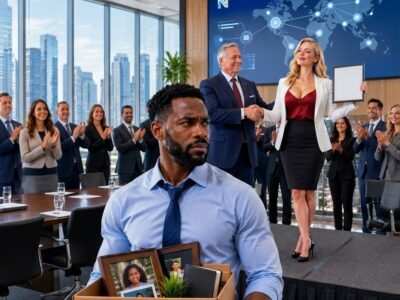
“My name is not Ed Miller,” Evan said, his gravelly voice dropping into the center of the boardroom with the weight of an iron vault closing. “And for the past five days, I haven’t been sitting in the executive suite. I’ve been mopping the tiles on the 14th floor, picking up discarded caramel cups from our marketing interns, and watching our future leadership candidates treat the facilities tier like furniture that doesn’t possess an auditory system.”
He clicked the remote, and a series of internal security recordings expanded across the massive wall screen.
The first video layer was crystalline—it showed the exact second Tyler Reed had flipped his blue plastic stir stick into the janitor’s tray while Brandon laughed. The second slide showed the digital version history of the operations presentation, Maya’s name being systematically deleted from sixty strategic bullet points at 7:42 p.m. by Tyler’s corporate profile. The third recording was the security track from the networking reception—the sharp crash of the wine glass, Tyler’s public demand that “Ed” clear the spill before someone important ruined their shoes, Maya dropping to her knees in her clear-rack blazer, and Clare Donovan watching the deep slice in her palm with an expression of cold, institutional silence.
The final image on the screen was a scanned copy of Walter Simmons’s handwritten letter, its uneven blue ink standing thirty feet high against the titanium panels.
“I spent this week on the floor because I realized I had stopped trusting satisfaction matrices that make us look better than we are,” Evan Cole said, his dark eyes locking onto Tyler’s pale face with a finality that made the young man’s silver pen drop from his hand. “Ambition is not a metric of performance in this building, Mr. Reed. Using other people as steps to clear your own profile is a structural failure of character. Your placement in our leadership pipeline is terminated effective immediately.”
Tyler didn’t scream; he didn’t give a presentation sentence. He gathered his leather folder with fingers that were shaking violently and slipped through the rear glass doors like a ghost clearing a stage.
Evan turned his head slowly toward Clare Donovan, his corporate mask completely set over his features. “Ms. Donovan, your management clearance is suspended pending a complete independent audit of our grievance reporting loops. You may clear your desk by twelve o’clock. Our security guards will assist you with the elevator line.”
Clare looked at the board members, but their faces were entirely blank, their eyes already turning toward the CEO as she walked out of the room, her high heels executing a series of faint, irregular cracks against the marble that faded into the foyer.
The boardroom remained perfectly quiet, the sun from the lake hitting the thick wrap of the white bandage on Maya’s hand.
Evan Cole walked down the length of the long table, stepping past his senior vice presidents until he reached the last row where the girl from Ohio was standing. He didn’t offer her a private favor; he didn’t give her an performative presentation smile. He reached out his hand, his grip firm, honest, and completely respectful as he took her bandaged fingers.
“Miss Bennett,” Evan said, his gravelly voice carrying across the entire operations board with absolute clarity. “Our company has an immense amount of asset infrastructure, but we are dangerously short on leaders who still know how to see another human being in the dark. Would you be willing to step up to the front table and present the core warehouse data to my directors as yourself?”
Maya Bennett looked at the long mahogany table, looked at the elder board members who were currently opening their notebooks to write down her name, and then looked into the dark, steady eyes of the CEO who had knelt in the red wine to hold her hand.
“Yes, Mr. Cole,” she said, her voice shaking once before clearing into an absolute, unshakeable stability. “Let’s start with the weather data.”
Epilogue: The Floor and the Sky
One year later, the 14th floor of Cole & Hartwell Logistics smelled differently on a Friday afternoon. The sharp, lemon-scented chemical cleaners were still used to scrub the tiles, but the air conditioning no longer carried that freeze-frame chill of executive distance.
A large, open wooden table had been installed near the central coffee station, its surface covered in fresh fruit baskets, professional logistics magazines, and a digital terminal that was linked directly to the operations loop. A small group of truck drivers in their heavy leather jackets stood near the counter, sharing an espresso with two corporate analysts while they compared the regional weather maps for the upcoming weekend shift.
Maya Bennett walked out of the elevator lane, her dark blue suit tailored and clean, her stride carrying that smooth, unhurried confidence that came from twelve months of running the company’s internal operations audit division. Her left palm carried a thin, silver-white scar across the center line—a neat, permanent mark that she never tried to hide beneath her cuffs.
She had been hired as a senior strategy analyst because her Field-Tier Variance Correction model had reduced product-loss across the Midwest loop by forty-two percent in its first two quarters, saving the company six million dollars in asset insurance. Evan Cole had entirely recused himself from her evaluation pipeline, ensuring that her salary and her promotions were authorized solely by an independent committee of the board, preventing her success from looking like a private concession from the executive suite. Her name stood on its own ledger.
She walked down the long corridor toward the stairwell landing, carrying two small boxes of premium pastries she had purchased from a small bakery near the river train line.
Evan Cole was standing near the windows at the end of the hall, his dark coat unbuttoned, his hands clutched inside his pockets as he looked out at the evening lights of the city breaking through the gray lake mist. He was thirty-eight now, and though the financial news segments still called him silent and brilliant, the framed portrait in the lobby had been replaced by a large, unposed photograph of the entire facilities and operations staff sitting together on the grass of the corporate park.
“The new recruitment cohort arrived this morning, Evan,” Maya said, stepping up to the window frame beside him, her tone completely natural between them.
Evan turned his head slowly, his eyes locking onto her face with an immediate, deep warmth that had been carved out of twelve months of evening walks along the river where no corporate titles were allowed to define the space. “Did anyone try to step around the wet-floor sign today?” he smiled.
“No,” Maya laughed, setting the pastry box down on the low sill. “The new training manual has a mandatory twelve-hour module spent loading trucks at the regional loop before they’re cleared to receive a laptop lanyard. Tyler Reed’s old business fraternity sent an inquiry last week, but the board filed it under non-compatibility metrics.”
Evan took a small piece of the pastry, his eyes looking down at the yellow mop bucket that sat parked inside the facilities locker across the hall. Walter Simmons had returned from his medical leave three months ago, his knee fully functional, currently occupying an advisory suite on the 4th floor called the Internal Culture Variance Office. He still knew where every wire brush was hidden in the sub-basement, but his signatures now held the legal authority to halt any software deployment that compromised the driver safety rules.
“That whole week, Maya,” Evan said quietly, his voice dropping into that low, gravelly register that had once terrified the board. “When I was sitting on that concrete step with the gray shirt… you were the only person in forty-seven stories who asked if I needed an extra hand with the weight.”
Maya smiled, her fingers reaching out to link through his broad palms, her silver scar bright against his dark sleeve under the twilight of the window.
“I didn’t see the Chief Executive Officer under that gray cap, Evan,” she whispered, her eyes tracking the distant container trucks crossing the river bridge safely below them. “I just saw a tired man who was willing to get down in the dirt to clear the scuff marks. The title was just something you had left in your other coat.”