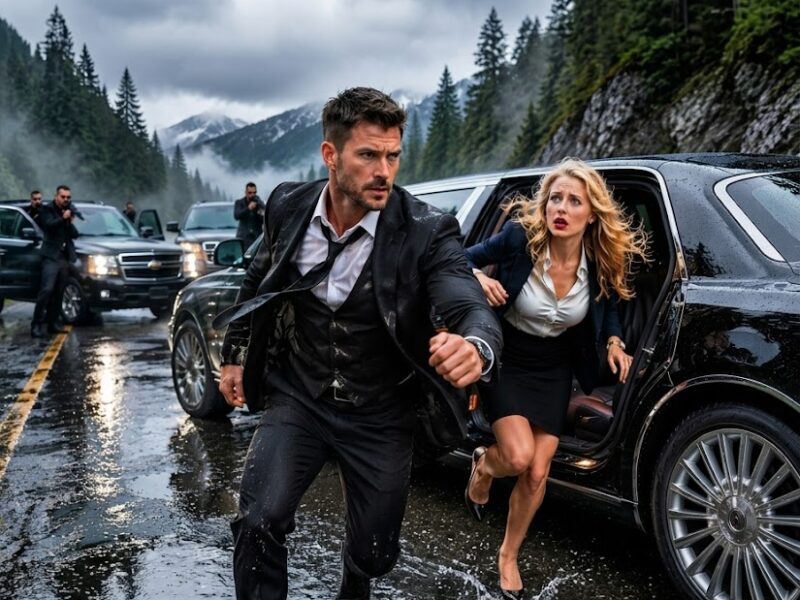
The Billionaire Hired A Broke Single Dad As Her Driver—Then His Navy SEAL Past Saved Her .
Part 1: The Integrity of the Machine
The morning Ronan Hale drove to the Blackwood estate for his interview, he wore the same charcoal suit he had worn to his wife’s funeral three years before. It was pressed clean and buttoned at the collar with the quiet discipline of someone who understood that effort was not the same as performance. The other candidates waiting in the marble-floored foyer looked like men who had spent money to appear useful—tailored lapels, polished shoes, the practiced composure of those who simulate calm rather than possess it. Ronan sat with his hands resting on his knees, watching the room not from the center, but from the edges, where the exits were and where the sight lines crossed.
He had submitted the application because his daughter, Tessa, had printed it for him, telling him to stop pretending that being broke was the same as being humble. When the assistant led him to the vehicle bay, Ronan was asked to demonstrate a standard pickup sequence: open the rear door, settle the principal, confirm the route. Instead of opening the door, he walked the length of the vehicle first. He crouched at the rear passenger tire, tilted his head near the front left wheel well, glanced at the undercarriage from the side, and ran two fingers along the seam of the rear bumper.
Gideon Cross, Audrey Sterling Blackwood’s head of security, stood watching from six feet away with the expression of a man who had seen this kind of theater before and was not impressed. But Ronan was not performing. He had found that the rear right tire was running 17 pounds per square inch below the safe operating threshold. He would not move a vehicle carrying a passenger until that was corrected. He said so plainly, without apology and without inflation. And when the technician confirmed the reading, Gideon’s expression shifted by the smallest possible degree.
Audrey herself appeared in the bay doorway when the delay ran long, carrying a coffee and the stillness of someone accustomed to running meetings. She studied Ronan the way she studied anomalies in a financial report, looking for the pattern that would tell her what she was looking at. She asked him whether he always slowed down schedules like this. He told her he only did it when the schedule was moving faster than the safety margin could sustain.
There was no charm in his voice, no pivot toward a compliment designed to manage her reaction. Gideon noted afterward that Ronan’s military service record contained several years of sealed deployment history, which was either a reason to disqualify him or a reason to look more carefully. Audrey filed the detail and moved to the road test.
During the assessment, Ronan identified construction staging on the primary route and rerouted without being asked, handling Audrey’s sudden mid-trip destination change with the same unhurried adaptation he brought to everything else. When he returned the vehicle to the bay, he parked it with the nose out—the habit of someone who never wanted to reverse in a hurry without having planned for the moment. Audrey hired him before the day was out. She didn’t know he was a former Navy SEAL; she hired him because he had checked the tires and because he gave her a direct answer. She did not yet know that Ronan Hale had spent years training himself to disappear precisely because disappearing once meant the difference between a rescued life and a buried one.
As she walked toward the elevators, Audrey felt a strange sense of reprieve. She had spent a decade building a fortress of competence around herself, yet here was a man who seemed to exist outside the perimeter of her usual calculations. Little did she know, she had just invited the calmest storm she would ever encounter into her world.
Part 2: The Pattern in the Mirror
The first week taught Ronan more about Audrey Sterling Blackwood’s world than the job description ever could. Her schedule changed three times before noon each morning, not because of chaos, but because of control. She moved her own calendar like a chess clock, maintaining an advantage that most people around her didn’t notice she was manufacturing. Every person who approached the vehicle at curb pickup had an agenda—briefings, requests, social surveys disguised as small talk. Ronan absorbed it all from the front seat, cataloging the variables.
He noted that her protection detail changed formation without updating her and that the vehicle bay’s entry log was signed manually rather than cross-referenced by key card. He noted the gray sedan parked across the street from the waterfront office, appearing in his mirrors at different angles during entirely different routes. He didn’t say anything yet. Once was noise, twice was correlation, three times was a pattern.
By the end of the second week, Ronan had three confirmed sightings of the gray sedan. He compiled his observations—specific, attributed, free of speculation—and handed the summary to Gideon Cross. Gideon thanked him with the tone of a man professionally obligated to accept the information, but who had no intention of acting on it.
The next morning, Ronan changed the route to Audrey’s 9:00 a.m. meeting without advanced notice. The gray sedan appeared at the secondary exit. There was no way to know that route unless someone had access to the navigation system or had been briefed by someone inside the scheduling chain.
Ronan told Audrey directly when they were stopped at a light. She was quiet for four blocks, her mind processing the data. She didn’t dismiss the report. She asked what he needed to confirm the hypothesis. When he said he needed to check the undercarriage for unauthorized hardware, she told him to proceed. That night, in the lower parking level, Ronan found it: a small, weatherproof tracking unit mounted above the rear axle.
Gideon Cross did not dismiss the device. He sealed it in an evidence bag, his professional skepticism replaced by the focus of a man who has found a problem he cannot treat as routine. Access to the undercarriage required either a key card or a maintenance credential. Ronan looked at the list of names with clearance, and one name—Von Reddic, Gideon’s own deputy—stayed on his mind.
But the real crisis was Audrey’s business. She was preparing for a board vote on the sale of her logistics division to a shell company with an ownership structure designed to be invisible. Her uncle, Carile, had been pushing the vote for weeks, collecting proxies and scheduling meetings when he knew she would be grounded by travel. She had found two massive financial anomalies in the company’s internal modeling, and she was building a private evidentiary file.
Ronan overheard a fragment of her call with Carile from the front seat. The flatness of her voice when she was choosing precision over volume told him everything: she was being boxed in. He requested a restricted schedule protocol, limiting advanced notice of her movements to himself, Gideon, and one administrative assistant. She agreed without full justification, proving that her trust in him had evolved from professional convenience to operational necessity.
But that night, the lower bay camera lost its signal for exactly twelve minutes. When the feed was restored, no incident report was filed. Ronan knew the blackout wasn’t a glitch. He knew that the threat was moving inside the house, and he was the only one who had seen the layout of the game.
Part 3: The Broken Route
The anonymous threat came at 9:17 p.m. A masked phone call, calm and unhurried. Drive Friday’s route without deviation. Don’t alert anyone, and your daughter will never have reason to know anything happened.
Ronan listened to the recording twice. He confirmed Tessa was safe with a quick call, then reported the threat to Gideon. He didn’t mention his military history, only the facts. Gideon’s team traced the relay to a device two blocks from the security office. Tessa was advised to vary her routes, but Ronan refused to let her be moved to the estate—that was exactly where the threat wanted her, in a smaller, controllable perimeter.
Audrey asked him why he wouldn’t accept her protection. He explained that she was proposing to make his daughter part of her fortress, but that protecting Tessa didn’t require accepting the threat’s frame. It required making the threat irrelevant. Audrey sat with this for a long time, realizing that Ronan wasn’t just guarding her; he was teaching her how to see danger without becoming a prisoner to it.
Friday was the scheduled signing at Blackwood Island. Audrey refused to change the plans. She believed the answer to being threatened was not to become less visible, but to become more armored with fact. The convoy assembled at 7:30 a.m.
They were forty minutes out when the advanced vehicle turned off the route, claiming a staged incident ahead. Then, the radio went dead—not a failure, but active compression. Ronan saw the black SUV behind them, its grill height all wrong, and the second SUV angling across the road ahead.
Ronan didn’t drive into the trap. He cut the wheel, reversing into a narrow service access road hidden behind a drainage barrier—a route he’d memorized from an old maintenance survey. The SUVs couldn’t follow. He deactivated the car’s GPS and activated a personal beacon registered to a contact outside the company network.
At a decommissioned forest checkpoint, he locked the limousine and walked Audrey inside. As he checked her for injuries, he found her phone running abnormally hot. He ran a diagnostic and found surveillance software authenticated by the security team’s internal system. Someone on the team had been watching her every move for three weeks.
The checkpoint was a one-room structure with old survey maps on the wall. For ninety minutes, they waited for the beacon to bring a response. Audrey used the time to lay out the Meridian acquisition analysis. She sequence the numbers, the proxy votes, the legal entities, and the suppressed reports. Ronan listened, realizing the threat wasn’t just about an acquisition; it was about systematically dismantling her authority from the inside out.
When the backup radio finally crackled, it was Gideon’s voice—authenticated by a challenge phrase Ronan had retained from the morning briefing. Gideon confirmed Vaughn had been the one to authorize the convoy’s route change and had been rerouting communications through a guest terminal.
TheSUV was found abandoned three miles away, the occupants gone, but they had left a folder behind. It contained a document on Blackwood Meridian letterhead—a compensation agreement for Ronan Hale, offering him a million dollars to ensure Audrey reached the island. It was unsigned, but it was the first physical evidence of a betrayal that went straight to the heart of the board.
As the sun began to rise over the mountain road, Ronan knew that the game had moved past driving and into the realm of survival. And Audrey, looking at the evidence on the table, realized that her driver wasn’t just a man who knew how to handle a vehicle; he was the only person in her life who hadn’t been bought.
Part 4: The Boardroom Collision
The board meeting had been advanced by twelve hours, a move designed to catch Audrey while she was still isolated. Carile stood at the head of the conference table, his posture one of reluctant steward stepping forward in a moment of necessity. He was midway through his third premise—that Audrey had abandoned her security team—when the elevator doors opened.
Audrey walked in. She was composed, carrying a document case. She sat down, acknowledged her enemies by name, and waited.
“Carile,” she said, her voice cutting through the room. “Would you like to proceed, or should I?”
She presented the evidence. The tracking device found on the axle. The authentication certificates for the monitoring software. The route logs showing Vaughn’s override. The fabricated compensation document recovered from the SUV. The financial maps Helena Ashford had built, showing the shell companies and the offshore equity structure. She itemized the timeline of the 48-hour disappearance window and how it corresponded to the emergency authorization clause in the board charter.
Gideon Cross confirmed the security documentation item by item. Helena Ashford confirmed the legal ownership trail. By the time Audrey finished, the room wasn’t just quiet; it was paralyzed. Vaughn was detained in the lobby. Carile tried to claim he was acting in the company’s interest, but Audrey shut him down.
“A plan requiring the CEO to be incapacitated, isolated, and publicly discredited is not a business decision,” she said. “It is an act against my liberty.”
A board member tried to pivot back to Ronan, questioning the omission of his special operations background. Audrey looked at him and said that Ronan’s background was currently more thoroughly documented than anyone else’s in the room and invited him to verify his own.
Ronan stood in the corridor, providing his formal statement to a county investigator. He didn’t offer classified secrets; he offered facts. Timestamps. Locations. Artifacts. When the investigator asked about his military history, he stated it was available through federal channels and that nothing in his past had been required to handle the events of the last forty-eight hours. He had simply driven carefully, observed accurately, and communicated honestly.
Audrey exited the meeting room to find Ronan finishing his statement. She confirmed to the investigator that Ronan had acted under her express direction and that his actions had preserved her life and the integrity of her company.
The board voted to suspend Carile. Vaughn was charged with fabrication and conspiracy. The Meridian routing system acquisition was halted. By 3:00 p.m., the narrative had shifted entirely.
But as Audrey walked with Ronan toward the elevator, she realized the battle wasn’t over. They had won the board, but the entities behind Carile remained in the shadows. Audrey offered Ronan the directorship of personal security. It was the position of a lifetime. He declined.
He didn’t refuse because he didn’t like her. He refused because he had finally learned that life was not a contingency plan. He wanted his life back—the ordinary parts that didn’t require a mission schedule. Audrey sat in her office, watching him leave. She realized she had finally found someone she could trust, and the first thing he taught her was that even she couldn’t buy the most important things in life.
Part 5: The Quiet Aftermath
Six months later, the board had been restructured. Carile Blackwood was gone, and the company was navigating a new era of transparency. Audrey Sterling Blackwood was still the CEO, but she was no longer the fortress she had once been.
Ronan spent his days in a quiet, converted industrial office near the waterfront, where he operated an independent consulting firm. He wasn’t a driver anymore, though he kept the rebuilt sedan, the one that had belonged to his wife. He had cleared his debts and saw Tessa off to university. He felt, for the first time in his life, a sense of belonging that wasn’t tied to a mission.
Audrey visited him in the small office one Friday afternoon. She didn’t come with an agenda or an assistant. She came with questions that weren’t about audits or logistics.
“Do you ever regret it?” she asked, leaning against his desk. “Walking away from all of it?”
“Regret isn’t a productive use of time,” Ronan replied, closing his logbook. “I had to walk away so I could finally stay.”
Audrey looked at him, searching his face for the man who had driven her through a rain-soaked forest, the man who had faced down two SUVs and a board of directors with the same unflinching calm. “I think you’re the only person I’ve ever met who actually meant what they said.”
“I was a driver, Audrey. Drivers have to mean what they say. If you don’t know where you’re going, you’re just wasting gas.”
She laughed—a real laugh, not a boardroom chuckle. “I’m not wasting any more time, Ronan. I want to talk about the future.”
“That depends on the route,” he said.
“Then let’s take a new one,” she said.
They left the city, driving toward the coast. The sedan ran with the quiet, humming reliability of a machine that had been cared for. They didn’t talk about the board or the shell companies. They talked about things they hadn’t had time for—the books they read, the memories of people they’d lost, the small, seemingly unimportant things that made life a life rather than a schedule.
When they reached the high point of the coast road, Ronan pulled the car over. The view across the sound was breathtaking, the water catching the last of the afternoon light.
“I was told once that I was a liability,” Audrey said, staring at the water. “That I was unstable, that I was a risk.”
“You were a threat to their control,” Ronan corrected. “That’s different.”
“I think I’m still a threat,” she said. “But not to them. To the version of myself that let them push me.”
Ronan turned the key, letting the engine die. “That’s a good place to start.”
Part 6: The Uncharted Road
The view across the sound felt like a boundary. Audrey realized that for years, she had been operating inside a narrative written by men who found her capability inconvenient. Ronan, by refusing to be bought, had shattered the logic of that narrative.
“My father left a trust,” Audrey said, the words coming out slowly. “He told me once that the only thing you own is the distance between where you started and where you decided to stop. I think I’ve been running for a long time.”
“Running is a choice,” Ronan said. “So is stopping.”
“What do you see when you look at me now?” she asked.
“I see a CEO who finally owns her own schedule,” he replied.
Audrey leaned her head back against the seat. “I want to talk about that advisory role again. Not a trial. Not a temporary setup. Something else.”
“I told you, I’m not doing permanent deployment.”
“I’m not asking for deployment,” she said. “I’m asking for a partnership. A firm that consults on strategic security and operational integrity, built from the ground up, with you as the lead.”
Ronan looked at her. “You want to build a rival to your own protection team?”
“I want a rival to the failures I’ve had to live with,” she said. “And I want a partner who doesn’t use a paycheck to decide what’s true.”
Ronan watched the water. He had built his life on being the instrument, the silent, invisible force. He had never been the one to set the course.
“I’ll have to think about it,” he said.
“Take all the time you need,” Audrey replied. “But look at the view while you think about it.”
She stepped out of the car and walked to the edge of the overlook. Ronan joined her. The air was cool and salt-scented. He realized that the danger was gone, but the road ahead was just as uncertain. Yet, for the first time, he didn’t feel the need to look for exits.
“I remember what you said at the checkpoint,” Audrey whispered. “About people who are in your car being your responsibility.”
“I meant it,” he said.
“Then I’m still in your car,” she said.
He didn’t move. He stood there, watching the water, knowing that the most dangerous thing in the world wasn’t a tracking device or a board room coup. It was the possibility of finally letting someone in. He decided right there that the risk was worth taking, because for the first time in years, the destination didn’t matter half as much as the drive.
Part 7: The New Horizon
The consulting firm—Hale-Sterling Strategic—was registered on a Tuesday morning. It wasn’t a grand launch. No press conference, no ribbon-cutting. Just a document filed and a shared commitment to building something that wasn’t designed to be a fortress.
Audrey continued to run the company, but the board had been purged, the audit structure was independent, and the Meridian acquisition was officially dead. She felt a lightness that she still occasionally checked for fear, but it stayed.
Ronan worked from the industrial office near the waterfront. He was selective. He worked with facilities in states of crisis, helping managers learn the difference between managing a budget and managing people. He didn’t promise salvation; he promised clarity.
Tessa finished her research position and moved into a small apartment three blocks from his office. They had dinner on Sundays, the kind that lasted for hours and involved more laughter than any of their previous years had seen.
One evening, Audrey came by the office. She stood in the doorway, looking at the maps on the wall, the logbooks, the rebuilt engine components from the sedan sitting on a workbench. It was an office that looked like a life in progress.
“You’re not sitting at the center,” she noted.
“I prefer the edge,” Ronan said. “Better view of the door.”
“Are you ever going to let your guard down?” she asked.
Ronan looked at the sedan in the parking lot below, then back at her. “I think I already have.”
He stood up, put on his coat, and walked to the door. “Do you have a destination in mind for tonight?”
“No,” Audrey said. “I think I’d like to see where the road goes.”
Ronan smiled. He didn’t check the navigation system. He didn’t look for exits. He didn’t worry about what was coming in the mirrors. He just opened the door, held it for her, and walked out into the cool, open evening.
He had spent years driving for other people, carrying their threats and their secrets. Now, he was just a man driving toward a horizon he had chosen for himself.
“Where are we going?” she asked.
“I don’t know,” Ronan said, starting the engine. “Let’s find out.”
The road stretched out before them, unmapped and full of possibility. For the first time, the drive wasn’t about surviving the trip. It was about who you were sitting next to when the miles finally started to add up. They drove until the lights of the city were just a soft glow in the rearview, and they didn’t stop until they found the place where the silence finally felt like home.









