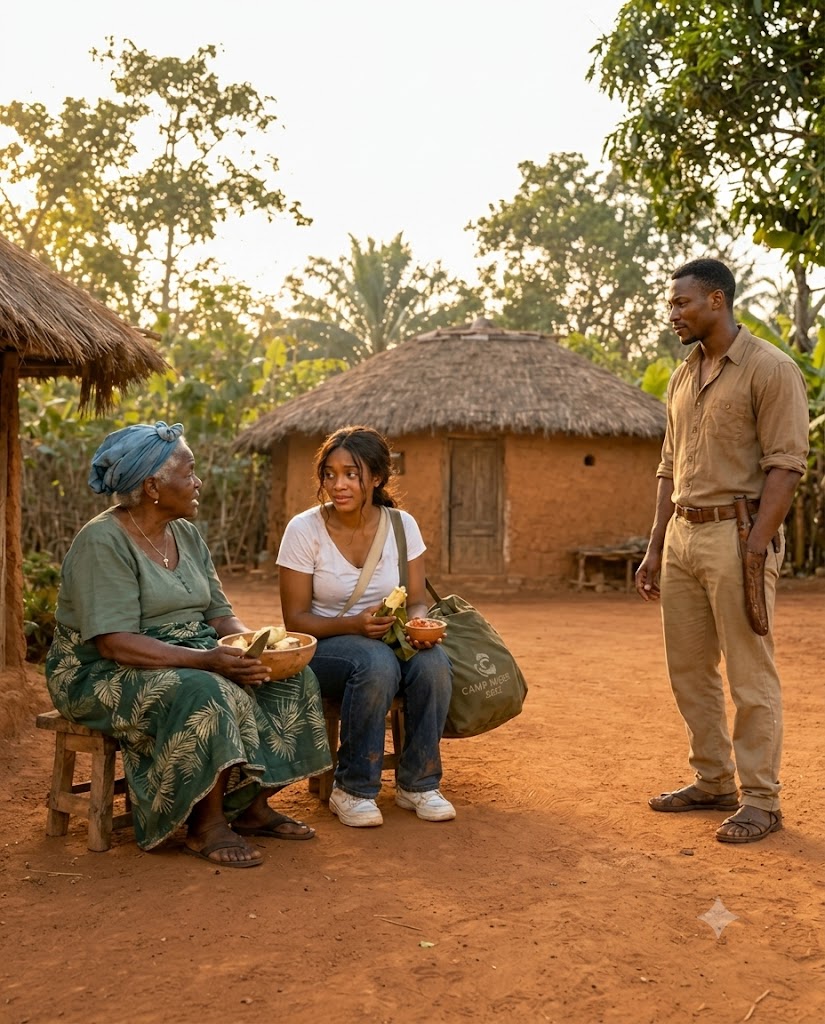
The Billionaire’s Daughter & The Village Farmer
Part 1: The Golden Cage of Banana Island
The air in the grand ballroom of the Nosu estate on Banana Island was thick with the scent of imported white lilies, expensive French champagne, and unspoken political desperation. Chandeliers carved from Bohemian crystal cast a warm, golden glow over three hundred of Nigeria’s most elite guests. Senators, oil magnates, and fashion icons mingled beneath the vaulted ceilings, their laughter harmonizing with the gentle string quartet playing from the mezzanine.
It was supposed to be the happiest night of Amara Nosu’s life. At twenty-six, she was draped in a hand-stitched emerald lace gown that cost more than a modest family home in the mainland. Her fiancé, Ekenna Okafor, stood beside her on the raised dais, his arm draped possessively over her bare shoulders. He looked every bit the dashing young heir to a sprawling political and real estate dynasty.
“Isn’t this just magical, my darling?” Ekenna whispered, leaning in so his lips brushed her ear. His breath smelled faintly of mint and dry gin. “The whole of Lagos is here for you tonight.”
Amara offered a tight, careful smile, her fingers whitening where they gripped her champagne flute. “The whole of Lagos is here for my father, Ekenna. Let’s not pretend otherwise.”
Ekenna’s smile didn’t reach his dark, calculating eyes. “Same thing, sweetheart. Same thing.”
He stepped away to the microphone, tapping it gently to command the room’s attention. The murmurs of the elite dropped instantly into a respectful, anticipatory hush. Ekenna puffed his chest out, gazing at the crowd with practiced, statesman-like charisma.
“Friends, brothers, distinguished guests,” Ekenna began, his voice echoing smoothly. “Tonight, I want to raise a toast to the most beautiful woman in Lagos. To the woman who has agreed, against all odds and against all my father’s initial predictions, to be my wife. To Amara.”
The room erupted into applause. Glasses clinked, and cameras flashed violently from the press pen stationed by the gilded doors.
“To Amara!” the crowd roared back.
Amara blinked against the harsh strobes of the cameras, a sudden, cold dread pooling in her stomach. Ekenna had been different over the last six months. The warmth she had fallen for at the charity gala had evaporated, replaced by a rigid, possessive urgency. She felt like a trophy being polished for an auction rather than a bride being celebrated.
As the applause died down, Ekenna leaned over to one of his groomsmen, muttering something under the cover of the applause. Amara, feeling suddenly suffocated by the heavy perfume and the suffocating gaze of the society crowd, quietly turned and slipped behind the massive velvet drapes that led to the private terrace overlooking the dark, restless Atlantic.
She needed a moment to breathe. She needed a moment to escape the script her mother and father had written for her since the day she was born.
She walked past the silent orchids, her bare feet sinking slightly into the plush outdoor carpet. As she neared the far end of the terrace, she heard the heavy glass doors slide open behind the drapery. It was Ekenna’s voice. He wasn’t using the warm, honeyed tone he used with her. He sounded sharp, dismissive, and utterly transactional.
“My father needs the Nosu shipping contracts before the next election,” Ekenna said, his words clear and distinct in the humid night air. “Otherwise, our liquidity crisis will completely derail the Senate seat.”
A low chuckle came from his brother, Chinedu. “You’re really tying yourself to the old man’s sinking ship for some docks?”
“Are you an idiot?” Ekenna scoffed. “By the time her ring comes off her finger, the Senate seat will be entirely in our name, and the shipping routes will be absorbed by our logistics firm. She is the cheapest political investment I have ever made.”
“My brother,” Chinedu laughed, a dark, cynical sound. “You are a wicked, wicked man.”
“I am a strategic man,” Ekenna corrected, swirling his glass. “The pretty face is just a bonus.”
A swell of boisterous laughter echoed from the men. Inside the terrace, the world stopped for Amara. The emerald lace gown felt as if it were constricting around her throat, turning into a shroud. The cheapest political investment. The words repeated in her mind, rhythmic and deafening, like the beating of a war drum.
She didn’t cry. She didn’t scream. She simply looked down at the glittering, flawless diamond resting on her left ring finger. With a calm, terrifying precision, she slid the heavy ring off her skin and placed it gently on the edge of the marble balustrade.
She didn’t return to the ballroom. She didn’t pack a bag. She hiked up the heavy, beaded skirts of her gown, walked down the service stairs, and stepped out into the chaotic, unforgiving midnight streets of Lagos. She was leaving the only world she had ever known, and she had absolutely no idea where the dark road would take her.
Part 2: The Midnight Escape
The yellow dashboard lights of the battered Danfo bus cast a jaundiced glow over the sea of tired, unsmiling faces. Amara sat wedged in the third row by the window, the rough vinyl seat sticking to the damp silk of her ruined gown. The air inside the bus was a suffocating cocktail of unwashed skin, heavy engine exhaust, and fermenting street food.
It had been an agonizingly long night. After fleeing Banana Island, she had wandered blindly into the mainland, her expensive designer heels shredding against the uneven, garbage-strewn pavement of Ojota before she had finally ditched them in a dumpster. She had flagged down a night bus at 3:00 AM, paying the bewildered conductor with a gold-plated Cartier watch she’d unclasped from her wrist—the only portable wealth she had left on her person.
“Madame, the party has not finished for you, eh?” the conductor had squinted, taking the heavy gold timepiece. “You look like you escape from a rich man’s house.”
“Just take me to the motor park,” she’d rasped, her throat tight with exhaustion and adrenaline.
Now, hours later, the bus was hurtling eastward, away from the glittering skyscrapers of Victoria Island, plunging deep into the dense, red-dirt terrain of Imo State. The city people around her slept fitfully, jostled by the violent potholes of the Enugu-Port Harcourt expressway. Amara stared out the smeared, rain-streaked window, watching the endless green canopy of the Niger Delta blur past.
She had left her phone, her credit cards, and her access to a billion-dollar trust fund back on the marble counter of the Banana Island mansion. She was completely, utterly untraceable. For twenty-six years, she had been a carefully managed corporate and political asset. Her friendships had been vetted by her mother’s social committee; her suitors had been background-checked by her father’s legal team. Even her degree in international relations had been chosen to facilitate the expansion of the Nosu Group’s European subsidiaries.
For twenty-six years, every room she had ever walked into had already calculated her net worth before she had even introduced herself. Ekenna’s cruel words—”the cheapest political investment I have ever made”—were just the loudest manifestation of a cage she had been trapped in her entire life. She needed to go somewhere normal. Somewhere where her surname meant nothing, where her bank balance was a mystery, and where her hands, soft and uncalloused, could learn how to touch the earth without someone calculating the profit margin of the dirt.
“Auntie, you dey sleep?” a raspy, market-woman voice suddenly broke her reverie.
Amara blinked, turning away from the window. An elderly woman beside her, wrapped in a faded Ankara wrapper, was eyeing her with a mixture of suspicion and maternal concern. “You dey travel go where this time of night? You look like someone wey miss road.”
Amara offered a weak, tight-lipped nod. “I am going to Umuahara. My… sister lives there.”
The woman raised a brow, unconvinced by Amara’s polished, stilted diction, which contrasted sharply with her ragged appearance. “Umuahara? That place na deep interior oh. Red soil village. You get person to meet for there?”
“Yes,” Amara lied softly, turning her gaze back to the gray, rapidly brightening horizon. “A friend.”
The bus groaned, its suspension squealing in protest as it took a sharp turn off the paved highway onto a narrow, red-clay arterial road. Thick vegetation closed in on both sides, the morning mist clinging to the palm fronds. This was the real Nigeria—far from the air-conditioned boardrooms and champagne galas. It was raw, unpolished, and completely detached from the balance sheets of the Nosu Group.
As the bus slowed down, the conductor began shouting destinations through the cracked window. Umuahara. The end of the line. Amara grabbed her small duffel bag, her heart hammering against her ribs. She was stepping out of the frying pan and directly into the fire, and she had no safety net.
Part 3: The Rough Reality of Umuahara
The red dust of Umuahara settled on Amara’s face like a fine, unforgiving powder. The bus had long since rattled away, leaving her standing alone at the edge of a bustling, chaotic village market square. The noise was deafening—women shouting in rapid, melodic Igbo, the clatter of aluminum basins, and the choking blue smoke rising from local food fires.
Amara pulled the rough wool of her gray cardigan tighter over her shoulders. She felt naked, stripped of her armor. She walked toward a small, makeshift stall constructed of corrugated iron and weathered timber, where a weary-looking woman was frying bean cakes over an open charcoal brazier.
“Excuse me, sir… I mean, ma,” Amara corrected herself, her voice betraying her elite upbringing. “I would like to buy a bottle of water, please. And some bread.”
The woman didn’t stop turning the golden-brown akara in the bubbling oil. She didn’t even look up. “Pure water na fifty naira. Bread na five hundred. Cash or transfer?”
Amara’s stomach plummeted. She had forgotten. The cash economy of the rural interior didn’t care about the billions sitting in her dormant GTBank account. She reached into her pocket and pulled out a sleek, titanium debit card—the exclusive private banking card embossed with her father’s signature.
“I have a card,” Amara said, holding it out with trembling fingers. “A premium card. You can charge it on the POS machine.”
The akara seller finally stopped her frying. She slowly wiped her greasy hands on her wrapper and stared at the piece of metal in Amara’s hand as if it were an alien artifact. Then, she let out a loud, derisive snort that drew the attention of several nearby traders.
“My sister, make I tell you something,” the woman scoffed, shaking her wooden spoon. “POS machine no dey work for here since the network crash for market last Christmas. Network for this whole village no fit even reach one bar. If you don’t get paper money, you don’t get food. Simple. Now move aside, you dey block my customer.”
Humiliation, hot and sharp, prickled behind Amara’s eyelids. The untouchable billionaire’s daughter, the woman who had once chartered a private jet just to fetch a specific pastry from Paris, was now being chased away from a bean stall in a forgotten village because she lacked fifty cents in paper currency.
She turned away, her cheeks burning. She walked blindly down the narrow, unpaved road, the midday sun beating down mercilessly. Her designer sneakers, the only pair of shoes she’d had on hand when she fled, were already gray with dust, their soles thin and inadequate for the jagged stones of the village path.
By 2:00 PM, the bustling market had given way to sprawling, quiet cassava farms. Amara was dizzy, dehydrated, and desperately hungry. Her soft, unblemished hands were shaking. She had walked for miles, entirely out of her depth, realizing too late that her romanticized notion of a “simple life” was an actively hostile environment for someone entirely unequipped for it.
She spotted the skeletal frame of an unfinished concrete block building off the main path. It was meant to be a local primary school, abandoned halfway through construction due to embezzled funds. Hoping for a sliver of shade, she pushed past the unhung wooden doorway and stumbled into the dark, dusty interior.
The cool air inside was a relief, but as her eyes adjusted to the dim light, she gasped.
Standing in the far corner, holding a heavy rusted machete and glaring at her with dark, uncompromising eyes, was a young man in a sweat-stained singlet and work trousers. He looked like the very spirit of the unyielding red earth—rugged, dangerous, and entirely unimpressed by the pale, terrified girl standing in his doorway.
“Who are you?” the man demanded, his voice dropping to a menacing, protective register. “What are you doing in my site?”
Part 4: The Compound on the Hill
“Please… please do not hurt me,” Amara stammered, raising her hands defensively as she backed into the rough concrete wall. “I am not a thief. I just needed to sit down.”
The young man lowered the machete an inch, his dark, piercing eyes raking over her torn, dust-covered cardigan and her pale, panic-stricken face. He took in the terrified posture and the absolute exhaustion rolling off her. The hostility in his posture slowly shifted to guarded confusion.
“I will not hurt you. Calm down,” the man said, his deep voice carrying a surprisingly gentle undertone beneath the rough exterior. He tossed the machete onto a pile of cinder blocks. “My name is Obina. I am from this village. I came here to check this building… boys from the neighboring village sometimes sleep here and steal from the farms. I did not expect to find a woman hiding in the dust.”
Obina stepped closer, his boots crunching on the debris. “Are you hurt? Are you hungry? Speak to me.”
“Both,” Amara whispered, her knees finally giving out. She slid down the rough concrete wall until she was sitting in the dirt, the fight entirely drained from her body.
Obina sighed, a heavy, weary sound. He crouched down so he was at eye level with her. He didn’t offer empty platitudes or patronizing pity. He simply looked at her with a profound, unreadable directness.
“Get up,” he said, extending a large, calloused hand. “Come with me.”
“Where?” she asked, eyeing his strong hand warily.
“To my compound,” Obina said simply. “My grandmother will feed you. After you eat, you will tell me your story. And after your story, we will decide what to do with you.”
Dazed, terrified, yet recognizing that she had absolutely no other options in this unforgiving wilderness, Amara took his rough hand and let him pull her to her feet.
He led her through a labyrinth of narrow, red-dirt paths until they reached a secluded compound surrounded by a woven bamboo fence. Several modest, well-maintained mud-brick huts with corrugated iron roofs sat beneath the shade of towering mango trees. In the center of the yard, an elderly woman with silver hair wrapped in a vibrant Ankara cloth was fanning a charcoal stove.
“Obina, who is this girl?” the matriarch asked in a sharp, melodic voice, not looking up from her cooking.
“Mama Neka, I found her at the unfinished school building,” Obina explained, guiding Amara to a wooden stool beneath the eaves. “She slept there last night. She has nowhere to go.”
The old woman stopped fanning. She slowly turned her piercing gaze toward Amara. It was a look that seemed to see straight through the dust, the designer clothes, and the fabricated stories of a “sister in the village.”
“Come and sit, my daughter,” Mama Neka said, her tone softening, though her eyes remained intensely calculating. “Obina, bring the yam from the fire. Bring also the small palm oil and the salt. Quickly.”
“Yes, mama,” Obina nodded, disappearing into a smaller cooking hut.
Mama Neka walked over and handed Amara a calabash of cool, clear well water. “Eat slowly,” the old woman instructed as Amara drank greedily. “If you eat too fast on an empty stomach, your body will reject it.”
Amara nodded, tears of overwhelming gratitude pricking her eyes. For three weeks, she had been hunted, surveilled, and treated as a bargaining chip by her family. Here, in the middle of a dirt compound, a stranger and his grandmother were offering her sustenance without asking for her social security number, her pedigree, or her signature on a contract.
Obina returned, holding a steaming clay plate of roasted yam, accompanied by a small dish of red palm oil flecked with local spices. Amara took a bite. It was simple, rustic, and the most delicious thing she had ever tasted.
As she ate, Mama Neka watched her with that same unnerving clarity. “Obina,” the matriarch said, her voice carrying across the quiet compound. “This girl will sleep tonight in your late mother’s hut.”
Obina paused, stoking the fire. “Mama, I do not know who she is. She could be running from the police.”
Mama Neka smiled, a slow, knowing expression that crinkled the corners of her eyes. “I know who she is.”
“Who is she, then?” Obina asked, exasperated.
“She is somebody who needed a yam,” the old woman said simply, turning back to her stove.
Part 5: The Labor of the Smoke
The next morning, the reality of her new sanctuary set in with the rising sun. Amara woke up on a woven mat in a small, whitewashed hut. The air smelled of dried grass and morning rain. There were no plush mattresses, no climate control, and no en-suite bathroom. Just a clay pitcher of water and a basin.
She stepped out into the courtyard. Mama Neka was already sweeping the red dirt with a bundle of dried twigs, her movements rhythmic and efficient.
“Lagos girl, wake up,” Mama Neka called out without stopping her sweep. “You will earn your keep in this compound. Today, you sweep. Tomorrow, you fetch water from the stream. The day after that, you will help me in the kitchen. We are not a luxury hotel. If you cannot work, you cannot eat. Do you understand?”
“Yes, Mama Neka,” Amara said, pushing her tangled hair from her face.
“Good. Take the broom. Show me how you sweep.”
Amara took the bundle of twigs and awkwardly began to drag it across the dirt, bending deeply from her waist, her arms straining to push the heavy debris.
Mama Neka let out a sharp cluck of disapproval. “No, no, no. Not from the waist. You will break your back by noon. From the knees. Bend your knees, like this.”
The old woman demonstrated, her spine perfectly straight, her core engaged as she glided across the yard. Amara tried to mimic her, her muscles trembling from the unfamiliar exertion. Dust plumed around her, sticking to the sweat on her brow. Her soft, manicured hands immediately began to blister against the rough twigs.
“Harder,” Mama Neka critiqued. “The dust will not leave just because you are asking it politely.”
By mid-afternoon, Amara’s arms felt like lead, and her back was screaming in protest. She was covered in red dust, sweating profusely, and had never felt happier. For the first time in her life, her exhaustion was not the result of a panic attack over a board meeting or a diplomatic dinner. It was pure, honest, physical labor.
She was at the pump filling a heavy plastic jerrycan when a shadow fell over her.
“Well, well, well. Look at the billionaire’s princess playing village maiden.”
Amara turned. Standing on the path was a striking local woman in a vibrant, fitted wrapper. Her hair was braided beautifully, and her eyes flashed with intense territorial jealousy. It was Niki—the young woman from the village market who was known throughout Umuahara to have set her sights on Obina five years ago.
“Hello, Niki,” Amara said politely, wiping her brow with the back of her blistered wrist.
“Lagos girl, pack your bags and go,” Niki said, stepping closer, her voice dripping with venom. “I have been watching you. Sleeping in Obina’s compound, eating from his pot, walking with him to the market. Obina is not your toy. He is going to be my husband. Do you hear me? Mine.“
Amara stood her ground, the quiet steel she had inherited from her father finally rising to the surface. “Obina is a grown man, Niki. He can decide who his friends are.”
“You think you are his friend?” Niki laughed, a harsh, ugly sound. “I am warning you, Lagos girl. This village will not protect you forever. I have ways of making people leave a village… quietly or loudly. You can choose.”
Before Amara could formulate a response, the bushes rustled, and Obina stepped onto the path, his machete in his hand, his dark eyes locked onto Niki with a dangerous intensity.
Part 6: The Waterfall of Truth
“Niki,” Obina said, his voice a low, vibrating growl that made the local woman take a nervous step back. “What are you doing in my compound’s path?”
“I was just… welcoming our guest, Obina,” Niki stammered, her predatory confidence evaporating in seconds. “Just telling her how things work around here.”
“The guest does not need your instruction,” Obina said, stepping between them. “Go back to your father’s farm, Niki. And if I hear you have spoken to Amara like that again, you will not be welcome in this compound.”
Niki shot Amara a look of pure, unadulterated hatred, turned on her heel, and marched away down the red-dirt path.
Obina watched her leave, then turned to Amara, his expression softening into deep concern. “Are you alright? She has a sharp tongue.”
“I am fine,” Amara said, looking down at her blistered, shaking hands. “I have dealt with sharks in boardrooms. A jealous woman with a machete is practically a vacation.”
Obina chuckled, though the tension didn’t leave his shoulders. He gestured to the jerrycan. “Come. Let me carry that for you. The sun is setting, and Mama Neka has prepared a spot by the stream for us to talk.”
“The stream?”
“The Umuahara Waterfall,” he clarified. “My grandfather used to take me there when I was small. The other villagers will not come there after dark. They believe the pool is haunted by a water spirit.”
“Is it?” Amara asked, a playful, unfamiliar spark in her voice.
Obina looked at her, his dark eyes holding a world of unsaid things. “Maybe.”
They walked in silence until they reached a secluded clearing deep within the lush, primeval forest. A narrow stream cascaded over a series of mossy black rocks into a crystal-clear, emerald pool. The air was cool, damp, and smelled of wet stone and wild orchids.
Obina sat down on a large, flat boulder at the edge of the water. He patted the stone beside him, and Amara sat down, the cool mist of the waterfall kissing her heated skin.
“My mother used to say,” Obina said, looking into the dark, reflective depths of the pool, “that the water spirits in this pool can tell when a person is lying. If you stand in the water and say something untrue, the spirits will pull you under.”
Amara smiled, a bittersweet expression. “Is that a warning, Obina?”
“It is a question,” he replied softly. “You promised me the truth today. But tomorrow, you might be a coward, and I might be afraid to ask. Today, I am brave. Ask me what you want, and I will answer. Then, it is your turn.”
Amara took a deep breath, the scent of the orchids filling her lungs. “Are you in love with somebody else?”
“No,” Obina answered instantly, his gray eyes locking onto hers, unwavering.
“Are you running from a husband?” he countered, his voice tight with sudden anxiety.
“No,” Amara smiled, a genuine, radiant laugh escaping her lips. “I am running from a fiancé. I walked out of my own engagement party three weeks ago. He thought I was a political asset for his Senate campaign. I am no longer engaged.”
Obina exhaled, a visible weight lifting from his broad shoulders. He reached out, his rough, calloused fingers gently brushing a stray lock of hair behind her ear. “What is your real name, Amara?”
“Amara,” she whispered. “That part is real.”
“What is the part you haven’t told me?” he asked, his touch lingering on her cheek.
Amara closed her eyes, gathering her courage. She had to be brave. She couldn’t build a real life on a foundation of omission.
“My family is wealthy,” she said, opening her eyes to meet his. “Very wealthy. My father owns shipping companies and logistics conglomerates across the continent. My mother sits on the board of three international foundations. I was raised in a house with twelve bedrooms in Banana Island. I grew up eating every dinner with five forks.”
Obina went perfectly still. The roar of the waterfall seemed to fade away. He stared at her, processing the staggering chasm between their two worlds. “A shipping magnate…” he breathed. “You are…”
“Amara Nosu,” she finished for him. “The missing heiress the Lagos news has been hunting for three weeks.”
Obina pulled his hand back slowly, looking down at his worn work boots. The silence between them was heavy, pregnant with the sudden, violent collision of two entirely different realities.
Suddenly, a distant, rhythmic thumping echoed from the edge of the forest. It wasn’t an animal. It was the distinct, unmistakable sound of a low-flying helicopter, its rotors beating the air above the canopy, circling Umuahara.
Part 7: The Billionaire’s Landing
The heavy blades of the Sikorsky S-76 helicopter whipped the palm fronds of Umuahara into a violent frenzy, flattening the tall grass and sending a cloud of red dust billowing across the village square. The villagers had scattered, terrified by the deafening mechanical bird descending upon their quiet, forgotten world.
The private chopper, emblazoned with the gold crest of the Nosu Group, touched down with a heavy thud on the cleared patch of the unfinished primary school site. The dust hadn’t even begun to settle when the door swung open.
Chief Okinosu—a titan of West African industry, dressed in a pristine white agbada and flanked by four armed, plainclothes private security operatives—stepped onto the red clay. His face was dark, thunderous, and contorted with the frantic, possessive rage of a billionaire who had just located his most valuable asset.
“Clear the area!” the head of security barked in English, pushing past a bewildered village elder.
Amara and Obina emerged from the tree line, stepping into the chaotic windstorm of the idling aircraft. When Amara saw her father, her breath hitched.
“Daddy,” she called out, raising a hand to shield her eyes from the dust.
Chief Okinosu’s eyes locked onto her. He marched forward, bypassing his security team, and grabbed her roughly by the upper arms, shaking her with a mixture of profound relief and unhinged fury. “Do you have any idea what you have done, Amara?” he bellowed over the whine of the turbine. “Three weeks! Three weeks I have not slept. Your mother has lost five kilos! The whole of Lagos has been tearing itself apart searching for you. We thought you were dead! We thought you were kidnapped by militants!”
“Daddy, please, stop,” Amara pleaded, trying to pull away from his bruising grip. “I am fine. I wasn’t kidnapped.”
“I do not want to hear it!” Okinosu shouted, his eyes darting to her ragged clothes, her dust-streaked face, and her blistered hands. He glared past her, zeroing in on Obina, who stood a few paces back, his posture defensive, his jaw set like granite.
The billionaire’s face twisted with pure, aristocratic disgust. He pointed a thick, gold-ringed finger at the local farmer. “You! You have been keeping my daughter here in this filth? In this bush?”
Obina didn’t shrink away from the billionaire’s wrath. He stepped forward, matching the security guards’ aggressive glares with the quiet, terrifying dignity of a man standing on his own ancestral land. “Sir, with all due respect, she came to my compound on her own. She has been a guest. She has been treated with respect by my grandmother and every member of this village. We have asked her for nothing.”
“Treated with respect?” Okinosu laughed, a dry, hysterical sound. He looked at his daughter as if she had lost her mind. “My daughter has been bathing from a bucket! My daughter has been sleeping on a straw mat! My daughter is standing in front of me smelling of smoke, and you call this respect?”
Okinosu reached into the deep pocket of his agbada, pulled out a thick, brown manila envelope, and threw it forcefully onto the red clay at Obina’s feet. It landed with a heavy, humiliating thud.
“Compensation,” the chief spat, his voice dripping with classist venom. “For the food, for the bed… take it and forget you ever saw her face. If I see you near my daughter again, I will have my legal team charge you with kidnapping and human trafficking.”
Amara felt her blood turn to fire. “Daddy, no! You cannot do this!”
“Silence, Amara!” Okinosu roared. He turned to his head of security. “Get her in the SUV. We are going to the private airstrip in Owerri. The jet is waiting.”
Two large security guards stepped forward, grabbing Amara by the elbows. She struggled, kicking the red dirt, screaming for them to stop, but she was nothing against their trained holds. They dragged her toward the waiting fleet of armored G-Wagons idling by the edge of the clearing.
Obina watched her being taken away, his fists clenched so tightly his knuckles turned white. He looked down at the brown envelope of cash lying in the dirt at his feet, then back up at the billionaire.
Obina bent down, picked up the thick envelope, and walked with measured, heavy steps right up to Chief Okinosu. He didn’t raise his voice, but the sheer, suffocating gravity of his presence caused the security guards to instinctively reach for their sidearms.
“Take your money, Chief Okinosu,” Obina said, his steel-gray eyes boring into the shipping magnate’s soul. “And take your daughter. But get off my land. You are not a god here. You are just a trespasser with a loud engine.”
Without waiting for a reply, Obina dropped the brown envelope at the chief’s expensive leather shoes, turned on his heel, and walked back toward the dense, green embrace of the Umuahara forest.
Amara watched him disappear from the tinted window of the accelerating SUV, tears streaming silently down her dust-streaked face. Her father had won the battle, but she knew, with absolute certainty, that she had left her heart behind in the red dust of the village. And a woman like Amarosunwasu does not easily bow her head twice.
Part 7: The Voice of the Smoke
Five months later. The grand ballroom of the Nosu mansion on Banana Island was once again drowned in champagne, but this night was different. It was not a celebration of a merger; it was an exhibition of absolute power.
Four hundred members of the Nigerian elite, alongside international press corps and ambassadors, sat in absolute silence. At the podium stood Amara. She did not wear an emerald lace gown. She wore a simple, striking, pitch-black silk suit that screamed CEO rather than debutante.
“Friends, family, distinguished guests, members of our beloved press,” Amara’s voice projected clearly through the state-of-the-art sound system. “Thank you for coming on such short notice. Tonight, my house and the house of Senator Babatunde Okafor were supposed to be joined together. Tonight, I was supposed to formally accept the hand of Ekenna Okafor in marriage.”
She paused, looking directly at the front row, where Ekenna and his bewildered father sat, flanked by her own grim-faced parents.
“Daddy, may I speak?” Amara asked, turning slightly to where her father sat at the center of the dais.
Chief Okinosu, sensing a complete loss of control, offered a stiff, tight-lipped nod. “Of course, my dear. A small word from the bride.”
Amara turned back to the microphone. “Good evening, everybody. Thank you for coming. I have something to say, and I will only say it once. Three weeks ago, I left this house with a duffel bag. I went to a village in the east called Umuahara. I had no phone signal. My credit card was useless. I slept on the dusty floor of an abandoned building. And on the second morning, I was found by a man called Obina and his grandmother, Mama Neka.”
A collective gasp rippled through the high-society crowd. Flashbulbs began to pop wildly.
“They fed me,” Amara continued, her hazel eyes blazing with a quiet, unyielding fire. “They taught me to sweep. They taught me to fetch water. They taught me to pound fufu with their bare hands. The children of that village let me sit under a mango tree and teach them English. The women of that village dressed me in their wrappers and let me dance with them at the New Yam Festival. They asked me for nothing. They gave me nothing but kindness. They gave me, in three weeks, the only three weeks of my adult life that I have ever felt like a person, and not a contract.”
She pointed a steady finger at Ekenna. “Three days ago, my father went to that village. He threw a brown envelope of cash at the man who saved my life. He called it ‘compensation.’ As if Obina was a market vendor who had sold him a yam.”
Tears glistened in her eyes, but her posture remained flawless. “Daddy, I love you. I am not blaming you. You did the only thing you know how to do. But you cannot buy what you do not understand. And I will not let you buy any more of my future tonight.”
She turned to the groom, her voice ringing like a bell. “Ekenna, I will not marry you tonight, or any other night. You do not love me. I do not love you. I never have. Find your Senate seat somewhere else. Try the Adigunlay daughters. Two of them are pretty. One of them actually likes you.”
To the press at the back of the room, she offered a cool nod. “You can write whatever you like. I do not care. Tomorrow morning, my name will be in every newspaper in Nigeria. It already is. Tonight, I welcome it.”
She unclipped the lapel microphone and set it deliberately on the podium. “To everybody else, thank you for coming. The food, I am told, is excellent. Please enjoy it. The champagne is paid for. Stay as long as you like. Good night.”
Amara stepped off the stage. The elite crowd sat in stunned, paralyzed silence. As she walked toward the service exit, her mother began to stand, but Ekenna’s father held her back with a heavy hand.
Outside, the warm Atlantic breeze hit her face. Her personal driver, David, was waiting by the door of her bulletproof sedan.
“Drive where to, madam?” David asked respectfully, opening the door.
Amara looked at the dark, open road leading to the mainland, heading east toward Imo State. “East,” she said clearly. “Imo State. I will tell you the village when we get closer.”
Part 8: The Sunrise at Umahara
The red dust of Umuahara tasted like victory. The sleek black Mercedes idled at the edge of the bamboo-fenced compound. Amara stepped out into the humid morning air, her designer shoes sinking into the familiar red clay.
Mama Neka was sitting by the mortar, shelling melon seeds. She looked up, and for the first time in Amara’s memory, the formidable matriarch dropped her bowl.
“Mama Chidi, good afternoon,” Amara said, her heart in her throat. “I mean, good morning.”
The old woman stood up, wiping her hands, her face breaking into a wide, toothless, triumphant grin. “I prayed. I prayed every morning for seven days. I told God if he sent you back, I will slaughter a goat. Today, I am slaughtering a goat!”
Amara laughed, a bright, clear sound that startled the chickens in the yard. “Where is Obina, mama?”
“My daughter, he’s at his farm,” Mama Neka said, gesturing to the rolling green hills behind the compound. “He has been at his farm every single day since you left, from sunrise to sunset. He does not eat the food I cook for him. He does not speak to anybody. Mama Neka says he has not slept in two weeks. Go to him.”
Amara didn’t wait. She turned away from the car, gathered the long skirts of her black suit, and began running up the narrow, familiar path toward the cassava hill. Her lungs burned, her heart hammered, and for the first time in her life, she was running toward exactly where she was supposed to be.
She crested the hill. Standing amidst the tall, green stalks of cassava, holding a hoe with his muscular arms, was Obina. He wore his faded singlet, his skin glistening with sweat in the early morning sun. He froze when he heard her footsteps, slowly turning his head.
“Amara…” he breathed, dropping the hoe into the dirt.
“I rejected the marriage, Obina,” she called out, breathless, stopping a few feet from him. “I walked out of my engagement party in front of three hundred people. I told them I was not a contract.”
Obina closed the distance between them, his heavy boots sinking into the tilled earth. He stopped inches away, his dark eyes searching her face with fierce, protective intensity. “The money your father threw at me… that money is still in the dust where he threw it, is it not?”
“It is,” she answered, tears welling in her eyes. “The wind carried some of it away, but the rest is still there.”
“Amara, I am setting up a foundation here in Umahara,” Obina said, his voice trembling with emotion. “Your father’s cooperative—the Umuahara Farmers Brotherhood, the dream he died before he could build. I am going to fund it with the land I have. I want you to lead it with me. I want to split my time between Lagos and here. I want to do this with you… if you will have me.”
Amara smiled, reaching out to place her soft, calloused hands on his broad, sweat-slicked shoulders. “People will say you’re with me for the money, Obina.”
“People will say a lot of things,” Obina whispered, pulling her flush against his chest. “We will not listen to them.”
“People will say I brought a checkbook,” she murmured, looking up into the eyes of the only man who had ever truly seen her. “But the checkbook is in my father’s name, Obina. Not mine, not yours. His. The cooperative will be in his name. Mama Neka will be the chair. You will be the operations director. I will be one of three trustees with no individual signing authority.”
Obina let out a rough, disbelieving laugh, burying his face in her dark curls. “Mama Neka warned me not to listen to my fear. Do you remember?”
“She has been right about everything since I was seven years old,” Amara said, closing her eyes as the morning sun broke over the cassava hill, bathing the green valley in warm, golden light.
“Then do not start doubting her now,” Obina said, his lips brushing hers in a slow, perfect rhythm.
The past was a script they had both discarded. The future was unwritten, wild, and entirely their own. As they stood together in the rich, dark soil of the Niger Delta, listening to the distant, peaceful roar of the waterfall, Amara knew she had finally found the perfect dish. It had taken smoke, sweat, and a great deal of patience, but the smoke had cleared, the morning had broken, and for the first time in her life, she was absolutely, undeniably home.