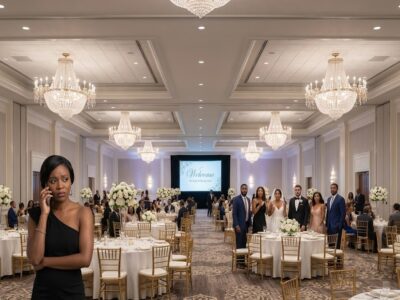
The Don Saved His Mistress First—Leaving His New Wife Trapped Beneath the Wedding Ruins
Part 1: The Armor of Light
The chandeliers in the Vulkoff estate ballroom held 400 candles each, and on the night of Damian Vulkoff’s wedding, every single one of them was lit. It wasn’t sentiment. Damian didn’t do sentiment. The candles were a statement. The same way the 20-piece orchestra was a statement. The same way the 300 guests in black tie were a statement. The same way the armed men positioned at every exit in tailored suits with earpieces were a statement. Everything about Damian Vulkoff was a statement. He had built his empire on the understanding that power, when displayed correctly, discouraged challenges before they could be made. The estate, the music, the light—all of it was armor. All of it was a warning.
He stood at the head of the ballroom in a charcoal suit that cost more than most men earned in a year, and he watched his wedding reception from behind his own eyes. He watched the way a general watches a battlefield—measuring, calculating, noting who stood where, who spoke to whom, and whose smile didn’t reach their eyes. His jaw was set. His posture was immaculate. His champagne glass had not been touched.
Beside him, in ivory silk that caught the candlelight and made her look like something carved from expensive stone, stood Vivien Hail, his wife. As of four hours ago, legally and formally, and before the representatives of six crime families and two corrupt federal judges, his wife. She was beautiful. He had always known she was beautiful. It had been one of the facts he cataloged about her when the arrangement was first proposed, the way he cataloged everything neutrally and without particular feeling. Twenty-nine years old, educated, composed, daughter of a man whose shipping routes ran through three of Damian’s controlled ports. The marriage made structural sense. It closed a gap in the network. It formalized an alliance that had been informal for too long and therefore vulnerable. He had agreed to it the same way he agreed to any sound strategic decision—quickly and without ceremony.
What he had not cataloged, because it was not something that appeared on any document his people had prepared, was the way Vivien Hail carried herself. Not with arrogance, not with the calculated performance of a woman who knew she was being watched. She moved through the world with a kind of quiet certainty that he found, in his more honest moments, difficult to look away from. She said exactly what she meant. She didn’t perform. In the six months of their formal engagement, during the dinners and the meetings and the careful negotiations between their respective families, she had never once tried to impress him. That, more than anything, had unsettled him. He didn’t know what to do with a person who didn’t need anything from him.
Now she stood beside him in the ballroom his father had built, and she was smiling at the guests with the same calm certainty she brought to everything. And Damian was acutely aware of the distance between them—two feet of physical space that felt, in ways he couldn’t have articulated, much larger.
“The Moretti table looks unhappy,” Vivien said without turning her head.
He glanced toward the east end of the ballroom. She was right. Paulo Moretti, 70 years old and three generations deep in the rackets that ran the eastern docks, was sitting with the rigid stillness of a man actively suppressing anger. The two men flanking him mirrored the posture.
“They’re always unhappy,” Damian said.
“They’re unhappy in a specific direction tonight.” She took a small sip of her champagne. “Third chair to Moretti’s left. The man in the navy jacket. He’s been watching the service corridor entrance for the last twenty minutes.”
Damian didn’t look immediately. He had learned long ago that looking immediately was how you told people what you’d noticed. He counted to four, then let his gaze drift naturally across the room, passing over the Moretti table as if by accident. Navy jacket, mid-50s, unremarkable face—except for the stillness of it, which was the same kind of stillness Damian associated with men who had done very specific kinds of work. The man was not eating. His hands were below the table.
Damian felt the shift in his chest. Not fear, exactly. Something more like the sensation of stepping onto ice and hearing it creak. A recalibration. An updating of threat assessment.
“Good catch,” he said.
Vivien didn’t respond. She just continued smiling at the room. He had not expected her to be good at this. It was not something he had prepared for, and the fact that it had not occurred to him to prepare for it annoyed him in the abstract, distant way that miscalculations annoyed him. He filed it away.
The orchestra had shifted into something slower, something meant to encourage dancing, and several couples had drifted to the floor. Damian watched this without moving. He did not dance. This was known, accepted, not questioned. What was not known, what he had not announced and would not announce, was that his attention had already begun dividing itself the way it always did when threat signals accumulated between the public surface of the event and the operational layer beneath it. He had two men watching Moretti. He needed four.
He reached for his phone. He was composing the message to his head of security when he felt it—the pressure change, a vibration in the floor that didn’t match the orchestra. Something mechanical and large operating somewhere it wasn’t supposed to be operating.
Then the lights went out.
All 400 candles and every electric fixture in the ballroom extinguished simultaneously. For one half-second, the room existed in perfect, absolute darkness. In that half-second, Damian Vulkoff’s entire body moved from calculation to pure animal awareness—the ice in his veins, the slowing of breath, the compression of focus down to a single white point of attention.
Then the flashbangs detonated. Two of them near the main entrance. The sound wasn’t sound anymore; it was pressure, a physical thing that punched through the chest and rewrote the room around it. The screaming started. The glass started breaking. Somewhere near the service corridor, a door exploded inward on its hinges and masked figures came through it in formation, moving fast, dressed in black, armed with weapons that didn’t belong at a wedding.
The ballroom became a different place—a killing ground. That was the only honest description for what it became in the seconds after the first shots were fired. Not at any particular person, not yet, but into the ceiling, into the chandeliers, sending crystal and plaster raining down in a cascade that drove 300 wedding guests to the floor in a single convulsive wave of animal panic.
Damian had already moved. His hand found Vivien’s wrist—an instinct, or something close to it, the automatic reflex of a man who did not want collateral damage—and he pulled her down behind the head table, his body going low and fast in the way that muscle memory preserves long after conscious thought has been replaced by something more primitive. His security detail was moving. He could hear them, could hear the specific, controlled chaos of trained men responding to a scenario they had rehearsed. Return positions, extraction routes. The estate had been war-gamed to the inch.
“Stay down,” he said to Vivien. His voice was flat. No panic in it. There was never panic in his voice, because panic was a waste of oxygen, and he had learned a long time ago to metabolize fear into precision.
She was already low, her white dress pulled around her on the marble. Her face was pale, but her eyes were tracking—not shut, not buried, but watching, assessing. He registered this and then moved past it. Three shooters visible from his position, possibly more at the entrance. The formation suggested military or paramilitary training. The dispersal pattern was too clean for hired street work. This was not opportunistic. This was engineered.
His earpiece activated, his security chief’s voice clipped and controlled. “We have eight confirmed on the floor. Minimum two more in the gallery. Don, extraction point Charlie is blocked. Recommending—”
The table above them took three rounds and exploded in a shower of splinters and crystal. Vivien made a sound—not a scream, more like a single compressed syllable of shock. Damian turned his body instinctively, putting his back between her and the direction the rounds had come from.
And then he heard it. Across the ballroom, through the noise and the screaming and the orchestral instruments falling from their stands as musicians dove for the floor—a voice. One voice, high and clear and completely wrong for this chaos. The way a candle flame is wrong in a hurricane. Not screaming. Singing, or trying to. A single broken note of shock, the sound of someone who had been mid-phrase when the world came apart.
Celeste.
The name detonated in his chest like the flashbangs had detonated in the room, with physical force, with a pressure that rewrote everything around it. He knew exactly where she was. He had known where she was all evening in the way you always know the location of something you are trying not to think about. The performance stage, raised three steps above the main floor, stage right of the orchestra. It was positioned exactly where his father had always positioned guest performers at estate events.
She had been scheduled for 30 minutes of performance time during the reception—a concession he had approved without particular thought when the event coordinator had submitted the evening’s agenda, knowing that Celeste Rowan was the kind of name that impressed the kinds of people who needed to be impressed tonight. He had told himself that the decision was entirely operational, entirely strategic, entirely divorced from the private reality that had existed between them for seven months.
He turned his head. The stage was 40 feet away across a ballroom that had become a landscape of overturned chairs and broken glass and screaming human bodies. He could see it from where he crouched. He could see the stage lights—the only lights still working—casting everything in a narrow amber wash. He could see the podium tipped on its side. He could see the microphone stand fallen. He could see Celeste flat on the stage floor, her silver dress catching the amber light, not moving.
Something happened to Damian Vulkoff in that moment that he would spend the next six months trying to name and failing. It was not heroism. He knew what heroism felt like from the outside, had watched men perform it, had understood it as a social technology like all other social technologies. This was not that. This was something dumber and deeper and more animal than heroism. This was the specific, screaming wrongness of watching something you loved being in danger, and having your body understand that fact before your mind could process any of the tactical implications.
He stood up.
“Damian!” Vivien’s voice was sharp.
He was already moving. He heard her. He heard the word, his name in her voice with the particular quality of a person who has just understood something. Some part of him that was still capable of moral processing understood in that same instant what it meant that he was moving, what it said, what it cost. But that part of him was very small right now. The part of him that was moving toward the stage was very large, and the large part was winning.
Part 2: The 37 Minutes
He went low and fast across the ballroom floor, using the toppled tables as cover. His security detail was calling in his earpiece, and he wasn’t answering. His mind was running the angles of where the shooters were, where they were looking, and the trajectory of the threat between his current position and the stage. Two men shifted in his direction. His chief of security materialized from behind a column and drew their attention with a controlled burst that scattered them toward the east wall. Twelve feet. Eight feet. The stage steps.
He took them in one movement, went flat beside Celeste on the stage floor, got his arm under her, and rolled her toward the back of the stage where the heavy velvet curtain provided at least the appearance of cover. She was conscious. Her eyes were open, wild, her breathing shallow and rapid. She was unhurt. He ran his hands over her with the efficient assessment of a man who had checked bodies before and found her whole.
“You’re okay,” he said. “You’re not hit. You’re okay.”
She grabbed his lapel with both hands. Her knuckles were white. “Damian—”
“I’ve got you.” He said it without thinking. He said it the way you say things that are true before you’ve decided whether they should be said.
And what he did not do, what he would think about in the months that followed with the grinding, mechanical repetition of a thought that refuses to be finished, was turn around and go back for Vivien. He did not go back.
The firefight lasted eleven minutes. His security team, supplemented by the private details of three other crime families who had no interest in dying at someone else’s wedding, systematically cleared the ballroom from east to west, neutralizing seven of the attackers and driving the remainder back through the service corridor and out of the estate. Two of Damian’s men were killed. Seven guests were injured, three of them seriously. The ballroom, by the time the last shot was fired, looked like something that should be condemned.
In the ringing silence afterward, Damian stood at the back of the stage with Celeste’s hands still in his. He became aware gradually, the way you become aware of cold, of the sounds from the other side of the room. Not gunfire, not screaming. The sounds of men working, moving debris, calling to each other in low, urgent voices.
He crossed the ballroom floor. His people parted for him. He walked to the head table, or what had been the head table before the ceiling structure above it had partially collapsed, bringing down a section of decorative beam and a portion of the upper gallery rail. It created a compressed wreckage of wood and crystal and overturned furniture that had, in a very literal sense, trapped the area where he had told Vivien to stay down—where he had left her.
She was alive. He could see that as soon as he got close enough. He could see the movement, the hand visible at the edge of the debris, the controlled and deliberate quality of her breathing that told him she was conscious and had been conscious the whole time. A beam had come down across her lower legs, pinning her, and the gallery rail had collapsed in a way that created a kind of cage around her. It was not crushing her, but trapping her—too heavy and too tangled for her to move without the precise and careful work of extraction.
She looked up at him when he arrived. Her dress was torn. There was blood on her cheek from broken glass. Her hair had come undone and was loose around her face. She was looking at him with an expression that he could not immediately identify. Not anger, not fear, not the theatrical betrayal of a woman building toward a scene. It was quieter than any of those things. It was the expression of a person who has received confirmation of something they had been hoping very much was not true.
“There she is,” Vivien said. “The reason.”
He crouched beside her, reached for the beam.
“Don’t.” Her voice was level. “Your men are better trained for this than you are. Let them do it.”
He looked at her. The beam was 200 pounds if it was anything. He called two of his extraction team over. They began the careful, methodical process of clearing the debris, and Damian sat on his heels in the wreckage of his wedding and watched his wife’s face. He understood with the certainty of a man who has spent his life making assessments that something had ended tonight. Not in the explosion, not in the gunfire. It ended in the moment he stood up from behind this table and walked the other way.
She didn’t speak again while his men worked. She watched the ceiling. Her hand lay flat against the marble floor, fingers relaxed. She might have been lying in a field somewhere, looking at the sky, for all the distress visible in her posture. He had seen men in combat maintain less composure than Vivien Hail maintained in her ruined wedding dress under forty pounds of debris.
It took thirty-seven minutes to free her. He counted. He wasn’t sure why he counted, except that his mind required something to do, and counting was something he could do without having to look directly at the thing he had done.
When his men finally lifted the last beam and helped her to her feet, she stood for a moment, testing her weight. Her legs held. She turned to face him.
“I need a doctor,” she said.
“Already called.” He took a step toward her.
“I can walk,” she said.
She walked out of the ballroom on her own. Her steps were careful and slightly uneven—the muscles in her legs bruised, the joints stiff from compression—but she walked. She walked without assistance, and she walked without looking back at him.
The estate’s medical staff met her at the ballroom door. Damian stood in the middle of the wreckage of his own reception and did not move for a long moment. Around him, his people moved, securing the perimeter, removing the dead, documenting the damage. The orchestra’s instruments lay scattered across the stage. The chandeliers had come down in sections, and the candles they had held were scattered across the marble floor like the aftermath of something you might describe, in a different context, as ceremonial.
He was aware of Celeste behind him, still on the stage, still in her silver dress, watching him. He did not turn around. He was aware of his head of security, Gregor Vas, appearing at his elbow with a tablet and a controlled expression, carrying the body language of a man delivering news he already knows will not be received well.
“Talk,” Damian said.
Part 3: The Short List
“Eight attackers,” Gregor said. “Six neutralized on site. Two extraction routes used, both pre-identified, both consistent with someone who had detailed knowledge of the estate’s security layout.” Gregor paused. “Don, these weren’t outsiders. The entry points they used, the timing on the lights, the frequency they used to jam our comms—they had the schematics. They had our rotation schedule. They knew exactly where to hit, and exactly when.”
Damian said nothing.
“That’s a short list of people,” Gregor said.
“Yes,” Damian said. “It is.”
The ballroom was quiet now, except for the work of it—the movement, the documentation, the clinical processing of a crime scene that an hour ago had been a celebration. Somewhere in the estate, in the medical suite on the third floor, his wife was being examined by doctors. Somewhere in the estate, in whatever room his people had escorted her to after he’d brought her off the stage, Celeste Rowan was sitting with the evidence that had made her, apparently, worth crossing a ballroom under fire to protect.
He thought about that last part. He thought about the way he had framed it in his mind: sensitive information, organizational exposure, the logical calculation of a man protecting an asset. And he thought about the expression on Vivien’s face when she’d looked up at him from the rubble. There she is, the reason. He had not denied it. He had reached for the beam, but he had not denied it.
“Pull the guest list,” Damian said, Gregor still standing beside him, waiting. “Every family with a seat tonight, I want their people’s movements documented from the moment they entered the estate. I want the service staff cross-referenced against our files. And I want the Moretti table, specifically the man in the navy jacket. I want to know his name, his history, and where he is right now.”
“Already running it.”
“And Gregor,” he finally turned. “Whatever you find, whoever you think it might be, you bring it to me before you act on it. Do you understand?”
Gregor’s expression did not change, but something shifted behind it. A micro-adjustment, the kind Damian had learned to read over years of watching men hear things they knew were important. “Understood, Don.”
Damian walked to the east window. The estate grounds were lit with the working lights his security team had brought in, and beyond the treeline, he could see the dark and the nothing beyond the dark. He pressed two fingers to the glass and felt the cold in it.
He had built this empire on the premise that clarity mattered, that every decision could be broken down to its components, evaluated on its merits, and made with intelligence rather than impulse. He had maintained this premise for sixteen years through three hostile takeovers, two betrayals, one war, and the slow accumulation of power that had made him the most feared name in the network. He had discarded that premise tonight in approximately four seconds. He had discarded it not for strategy, not for intelligence, not for any reason that would survive examination, but for a feeling—the specific, screaming wrongness of watching something you loved being in danger.
And the woman who would have been the best thing he’d ever gotten right was currently on the third floor of his house, having her bruised legs examined by his doctors, having counted every second of the 37 minutes it had taken his men to free her from the wreckage. Thirty-seven minutes. He had kept count. He wondered if she had, too.
Somewhere below him, at the estate’s east gate, a vehicle was moving. His security cameras caught it—a dark SUV moving without headlights, using the service road that ran along the property’s edge. It was moving fast, moving like it knew where it was going. He watched it go. He picked up his phone.
“Gregor. East gate, service road. Dark SUV, no plates visible. Get me that vehicle.”
Static. Then: “On it, Don. We’re also getting something else. The Moretti man in navy. Our facial recognition just pulled a match.”
Damian waited.
“His name is Carver. He’s not Moretti’s. He’s freelance. He’s been freelance for three years, since he left the employ of—” A pause. A specific and deliberate quality to the pause that Damian recognized as the pause of a man deciding how to say something. “Since he left the employ of Roman Viscari.”
The name landed in the room. Roman Viscari. Damian’s underboss, his most trusted lieutenant, the man who had been at his right hand for eleven years, who knew the estate’s security layout the way Damian knew it himself, who had access to every rotation schedule, every frequency, every service corridor and extraction route. Roman Viscari, who had sent his apologies for the wedding two days ago, citing a family obligation in the south, and whose absence Damian had registered and filed without suspicion.
The cold in the glass spread through Damian’s fingertips. “Where’s Roman now?” he asked.
The silence on the other end lasted exactly long enough to confirm what he already knew. “We can’t reach him, Don.”
Damian pulled his fingers from the glass, turned from the window. In the ruined ballroom behind him, his people continued their work—cataloging, documenting, clearing the beautiful wreckage of the night. The candles lay scattered across the marble, unlit now, cold. He walked toward the door. Whatever had ended tonight, whatever version of his life and himself and the choices available to him had existed before the lights went out and the world came through the doors—it was over. He understood that with the same flat clarity with which he understood everything. The marriage, the empire, the story he had told himself about why he’d run toward the stage—all of it was in the rubble now, waiting to be examined in daylight.
He pushed through the ballroom door. Upstairs, in the medical suite, a woman with a torn ivory dress and 37 minutes of silence behind her was answering a doctor’s questions in a voice so steady it could have belonged to someone else entirely. And in whatever room they’d given her, Celeste Rowan was sitting with something in her possession, something she didn’t yet know she was carrying that was about to make her the most dangerous person in this story. Not because of what she meant to Damian, but because of what she knew.
Part 4: Facts and White Roses
The medical suite on the third floor of the Vulkoff estate smelled like antiseptic and cut flowers, which was a specific kind of wrong. The flowers had been placed there for the wedding, for the night’s celebration. Now they stood in their crystal vases while a doctor pressed carefully along Vivien’s bruised shins and asked her to rate her pain on a scale of one to ten.
“Four,” she said.
The doctor wrote something down. He was a compact man in his 60s, gray at the temples, the kind of professional who had clearly been on Damian’s private payroll long enough to have stopped being surprised by anything. He did not ask how she had come to be pinned under structural debris on her wedding night. He did not comment on the blood dried on her cheek or the state of her dress. He examined her with the focused neutrality of a man who understood that his job was her body, not her circumstances. She appreciated that. She was not certain she could have managed a conversation about her circumstances.
“Your legs will be bruised for two weeks,” he said. “Nothing is fractured. The laceration on your cheek is shallow—glass, not shrapnel—and will not scar if cleaned properly.”
He told her this in the calm, sequential way of someone reading a list, and she nodded at each item. When he was finished, she thanked him and sat on the edge of the examination table in her ruined dress and looked at the wall.
The flowers were white roses. Someone had chosen white roses for the wedding suite because white roses were what you chose for a wedding suite. Vivien looked at them for a long time without moving.
Thirty-seven minutes. She had counted. Not obsessively, not with the building, theatrical quality of a woman constructing a grievance. She had counted the way she did everything—precisely and without illusion, because she was the kind of person who believed that accurate information, even painful accurate information, was preferable to comfortable uncertainty. Thirty-seven minutes was a fact. What it meant was a fact. What it said about the man she had married four hours ago was a fact. Vivien Hail had spent her entire life refusing to argue with facts, even the ones that felt like a fist to the sternum.
She stood up, tested her legs. They held. She walked to the window and looked out at the estate grounds where the working lights of Damian’s security team turned the manicured lawns into something clinical and strange. Men in suits moved between the trees. Vehicles with no headlights sat at intervals along the perimeter. The beautiful machinery of Damian Vulkoff’s empire operating as it always operated—with precision, with force, and without particular reference to what she needed.
She heard the door open behind her. She didn’t turn around. She knew the sound of his footsteps.
“The doctor says you’re clear,” Damian said. His voice was the same as it always was—flat, controlled, carrying information without inflection. She had spent six months learning to read what lived beneath that flatness. She read it now.
“I know,” she said. “He told me.”
Silence. He came further into the room. She could hear him stop somewhere behind her left shoulder—far enough to be respectful, close enough to be present. It was a precise and calculated distance, and the fact that it was calculated was something she noticed and cataloged.
“Vivien—”
“Don’t apologize,” she said. “I wasn’t going to.”
She turned then, because she wanted to see his face when he said the next thing, whatever it was. He looked the same as he always looked—composed, precise, the architecture of his expression giving away almost nothing. There was something different in his eyes, not guilt exactly. Guilt implied surprise at one’s own capacity for a thing, and she didn’t think Damian was surprised by himself tonight. What was in his eyes was something more like the expression of a man standing in the immediate aftermath of a decision, examining it, finding it exactly as costly as he’d known it would be.
“She had information,” he said. “Documents. Evidence about the organization. If she’d been taken—”
“Stop.” Vivien kept her voice level. “You know I’m not stupid. Please don’t speak to me as though I am.”
His jaw tightened—a small movement. In another man, it might have been nothing. In Damian Vulkoff, it was the equivalent of flinching.
“What I know,” Vivien said, “is that you moved across a room under live fire. I know what that is. I know what that means. I don’t need a briefing on her operational value.” She held his gaze. “What I need to know, the only thing I’m asking, is whether you were ever going to tell me.”
He was quiet for long enough that the answer became unnecessary.
“No,” he said finally. “I wasn’t.”
She nodded once—the small, deliberate nod of a woman receiving confirmed data. “Thank you for that,” she said. “At least that’s honest.”
She walked past him to the door. He didn’t reach for her. He turned to watch her go, and she was aware of his gaze on her back, but she kept her spine straight and her steps measured. She did not look back at the white roses.
She went to the guest room at the end of the hall—her room, which had been prepared for the wedding night and which she had no intention of redecorating as a metaphor—and she locked the door and sat in the chair by the window. She did not cry, because crying required a species of surprise that she did not currently have access to.
She had known, in the abstract, careful way that intelligent people know things they would prefer not to know, that the arrangement of this marriage had components she had not been shown. She had accepted that. What she had not accepted, what she had told herself on the basis of evidence she now understood had been insufficient, was that Damian Vulkoff was a man with enough basic decency to keep the private life of his heart separate from the contractual life of his marriage. She had not required love. She had required honesty, or at minimum, the absence of active deception. She had told him this in the early months of the engagement in language that was so clear she had believed it could not be misunderstood. She had been wrong about that. She was rarely wrong about things. The experience of being wrong about this specific thing, in this specific way, had a weight to it that she hadn’t anticipated.
She sat in the chair until the working lights outside went off one by one, and the estate settled into a different kind of dark.
Part 5: The Photo at the East Gate
Three floors below, in the estate security operations center—a room that had been a wine cellar before Damian’s renovation, and still had the stone walls for it, which suited the work—Gregor Vas spread twelve photographs across the central table and waited for Damian to look at all of them before he said anything.
Damian looked at all of them.
The photographs were surveillance captures pulled from three different sources: the estate’s own camera system, the private security feeds of two attending families who had agreed to share footage in exchange for a seat at whatever reckoning was coming, and one image pulled from a street camera 200 meters from the estate’s east gate, timestamped 40 minutes after the attack.
The SUV from the service road. The man getting out of it, the face partially visible in the camera’s angle, belonged unmistakably to someone Damian had sat across from at a table approximately twice a week for eleven years.
Roman Viscari. Fifty-four years old, silver hair, heavy build—the kind of face that people described as trustworthy before they knew him better. Damian’s underboss since the year after Damian’s father died, when the empire had required a transition managed by someone with enough institutional knowledge to prevent a collapse. Roman had been that person. Roman had been, in the operational sense, irreplaceable.
Damian set the photograph down. “When did you know?” he asked.
“I had a suspicion three months ago,” Gregor said, his hands flat on the table. “A discrepancy in a routing report. Supplies going to a location that didn’t exist in our current network. I ran it twice and got the same answer. I was building the case before I brought it to you.”
“You didn’t bring it to me.”
“I was building the case,” Gregor repeated, careful, steady. “I needed to be certain before I came to you with an accusation against your underboss. I needed it to be airtight.”
“And is it airtight now?”
“The man in the navy jacket, Carver. We found him east of the city in a building that’s registered to a property management company that traces back through two shells to a holding account Roman has used before.” A pause. “He talked.”
“How much did he talk?”
“Enough.” Gregor finally looked up from the photographs. “The attack was Roman’s. The target was the estate during the wedding. Maximum disruption, maximum casualties, with the specific objective of eliminating you and making it look like an outside operation. The Moretti angle was cover. Carver says Roman’s been building this for eight months.” Another pause, this one with a different quality. “He says Roman’s been working with someone inside the Hail network.”
The stone walls seemed to press in.
“The Hail network,” Damian said.
“Yes. Vivien’s family. Possibly, or someone in the broader shipping operation. Carver doesn’t have specifics above his pay grade, but the access to your estate—the security layout, the schematics, the rotation schedules—that information came from two sources. One internal, which is Roman. One external, which came through a connection in the Hail operation.”
Damian was quiet for a long time. He thought about Vivien’s face in the ballroom, the steady gaze. There she is, the reason. He thought about six months of formal dinners and careful negotiations, the engagement, the marriage contract, the alliance that had made structural sense. He thought about the man or woman somewhere in Vivien’s family network who had fed the schematics of this estate to Roman Viscari, and the question of whether Vivien had known or not known. And the further question of whether it mattered now, which of those was true.
“I want Carver in a secured location,” he said. “I want everything he knows extracted and documented. I want the shell companies traced to wherever they go. And I want Roman found.” His voice didn’t change. It never changed, not for conversation. “To be brought before the families. All of them. I want this done in front of witnesses.”
“Understood.” Gregor gathered the photographs. “There’s one more thing.”
Damian waited.
“Celeste Rowan.” Gregor’s voice was careful now, in the particular way of a man treading on ground he knows is unstable. “When we debriefed her after the attack, she mentioned something. She said that Roman came to see her two weeks ago. He told her he was a fan. They spoke for perhaps twenty minutes. She says he was asking about you—personal questions, nothing that seemed operational. But during the visit, she had left her bag in the reception area unattended for approximately ten minutes.”
“Her bag.”
“She keeps documents in it. Personal correspondence. She told us she’d been holding on to a series of letters—communications she had been given by a source she won’t identify—relating to activity within your southern distribution network. She was planning to give them to you directly when the moment was right.”
“When the moment was right,” Damian repeated, with the particular flatness of a man who recognizes the specific cost of timing.
“She didn’t know what she had, Don. She knew it was sensitive, but she didn’t know exactly what it documented. She was frightened. She was trying to figure out how to bring it to you without—” Gregor stopped.
Without implying I’ve been reading your private correspondence was the end of that sentence, and they both understood it without it being said.
“Roman photographed the documents,” Damian said. “That’s why he came to her. He knew she had them, which means he knew she could expose him.”
Everything in the room resettled.
“He wasn’t trying to protect himself from me,” Damian said, not a question. “He was trying to protect himself from the evidence she was carrying. If you’d married, if the two families consolidated, and if Celeste had eventually given you those documents, Roman was done. He needed the wedding to go wrong before that could happen.”
Gregor met his eyes. “He staged the ambush. He needed both of you dead, and he needed it to look like an outside hit.”
The stone walls, the photographs, the single working light overhead casting everything in hard shadow.
“Where is Celeste now?” Damian asked.
“The east wing. Your people are with her.”
He nodded once. He walked to the door, stopped with his hand on the frame, and stood there for a moment in the stone-walled room that had been a wine cellar and was now this, looking at the middle distance with the expression of a man doing the specific math of consequences.
“Roman will know by now that the attack failed,” he said. “He’ll know we have Carver. He’ll know we’re coming.” He turned his head slightly, not quite looking back. “How long do we have before he moves?”
“Hours,” Gregor said. “Not days.”
Part 6: The Secondary Phone
Damian left the room. He found Celeste where Gregor had said—the east wing sitting room, a room that was too large and too formal for what it had become. The furniture was arranged for receiving guests and not for the aftermath of violence. She was sitting on the floor with her back against the wall, which was, he thought, the most honest spatial decision available in a room that offered nothing genuine. Her silver dress was gone, replaced by something plain and borrowed. Her feet were bare on the wood floor.
She looked up when he came in, and he sat on the floor across from her, his back against the opposite wall, which was also more honest than the chairs. They sat like that for a moment without speaking.
“You came across the room,” she said.
“Yes.”
“You left her.”
“Yes.”
She looked at him steadily. She had a way of looking at him that he had never been able to catalog the way he cataloged everything else. It moved around his defenses somehow, found angles he hadn’t secured. “You know what that means for her?”
“I know what it means.”
“Do you know what it means for you?”
He said nothing.
She leaned her head back against the wall. Her throat moved as she swallowed. “I didn’t ask you to do that, Damian.”
“I know.”
“I need you to know that. I need that to be—” She stopped. Her voice had developed a quality at the edge of it, something she was managing with effort. “I was on the floor. I was fine. I was scared, but I was fine. And you…” She pressed her fingers over her mouth for a moment. “It doesn’t fix what it costs. You understand that? You coming across the room doesn’t fix what it costs her.”
“No,” he said. “It doesn’t.”
“Then why?”
“Because I was already moving.” He looked at the wall across from him—old wood, dark with age. “Because I was moving before I had finished thinking about it, and because that’s what it is. Whatever it is, that’s what it is.”
The room was very quiet. From somewhere in the estate, muffled by walls and distance, they could hear the ongoing movement of Damian’s security operation—the machinery of consequence continuing its work.
“Roman came to see me,” Celeste said.
“I know.”
“He went through my bag.”
“I know that, too.”
She tilted her head and looked at him. “How much trouble am I in?”
“You’re not in any trouble,” he said simply. “The trouble is mine.”
“The documents in your bag—I’ll give you everything I have.”
“I know you will.” He finally looked at her directly. “Those documents are going to end Roman’s operation. But first, they’re going to tell him that he’s out of time, which means he’s going to move fast and he’s going to move hard, and the next twelve hours are going to be—” He stopped, reconsidered the word he’d been about to use. “Difficult.”
“I’m not going anywhere,” Celeste said.
“I’m not asking you to.”
“I know you’re not asking.” Her voice was quiet and very clear. “I’m telling you, wherever this goes, I’m not going anywhere.”
He held her gaze for a long moment, then he stood, straightened his jacket, the old operational precision returning to his posture like armor being put back on. “I need the documents,” he said. “All of them. Everything you have.”
She nodded and rose and went to the corner of the room where her bag had been placed, opened it, looked inside, and stopped.
He watched her go still.
“Damian… they’re not here.” Her voice had changed. “They were here. I checked them after the attack. They were here. Damian, the documents are—” She turned to look at him, and the look on her face completed the sentence.
The documents were gone. Someone inside the estate, after the attack, after his security had swept the building, after he’d sent his people to secure Celeste and her belongings—someone inside his own house had taken them.
The bag sat open on the table between them like an accusation. Damian didn’t move for three full seconds. He stood with his hands at his sides and looked at the empty interior of Celeste’s bag—the pocket where the documents had been, the small zippered compartment that was now just canvas and air. And he ran the math in his head with the cold, mechanical precision of a man whose mind defaults to calculation when everything else defaults to rage.
After the attack, his security team had swept the estate. Standard protocol—every room, every person, every bag and case and item of personal property logged and secured. Celeste had been escorted to the east wing by two of his men—men he had chosen himself, men who had been with him for years. The bag had come with her. He had not personally verified its contents. He had taken Gregor’s debrief at face value and moved to the operation center and spent forty minutes building the case against Roman while somewhere in his own house, someone with access he had personally granted was—he exhaled once, slowly.
“Who brought you to this room?” he said. It wasn’t a question.
Celeste was still looking at the bag. Her face had gone the particular white of someone whose shock has not yet converted to any secondary emotion. Not anger, not fear, just the raw and stunned blankness of a person receiving information their mind hasn’t finished processing.
“Micky,” she said. “And the other one. The young one. I don’t know his name.”
“Describe him.”
“Maybe twenty-five. Dark hair, short. He had a scar.” She touched her own chin on the left side. “Here. He carried my bag from the ballroom. He set it in the corner. I watched him set it there.”
Damian was already moving to the door. He pulled it open and spoke to the man outside without raising his voice. “Find Gregor right now. Tell him I need the name of the agent with a scar on his left chin who was on escort duty tonight. Tell him to pull that man’s location immediately and to put hands on him before he tells me the name. Go.”
The man went. Damian stepped back into the room. Celeste was on her feet now, the shock beginning to convert, her hands pressed flat against her thighs in the way of someone managing the physical symptoms of adrenaline. He looked at her and made an assessment. She was steady. She was functional. She was frightened in the useful way that sharpens rather than paralyzes.
“Think,” he said. “The documents—when you checked them after the attack, after the shooting stopped. Where were you?”
“I checked while we were still on the stage. And after that, your men came. They took me, walked me out through the side door. Micky was there, the young one.” She pressed her fingers harder against her thighs. “They put me in the corridor. Told me to wait. I set the bag down. Maybe two minutes.” She looked at him. “Two minutes.”
Two minutes in a corridor during a post-attack sweep. Enough noise, enough movement, enough justifiable chaos that a man reaching into a bag and removing a sealed envelope would look like nothing at all—would look like procedure. The mathematics of it had a specific ugliness, the kind of ugliness that came not from violence, but from patience, from planning, from someone who had seated an asset inside his protection detail and kept that asset dormant and waiting for exactly this kind of night. Roman had not lost when the attack failed. Roman had already sent a second move before the board had finished resetting from the first.
Gregor appeared in the doorway. His face was the face of a man delivering news that he knows will change the temperature of the room.
“The agent,” Damian said.
“His name is Teao Marsh,” Gregor said. “He’s been on the secondary detail for four months.” Gregor came fully into the room. “He’s gone, Don. His post is empty. His vehicle is gone from the east lot. He had a twelve-minute head start by the time we identified the gap.” A pause. “His personnel file was clean. Every verification we ran when we brought him on came back clear.”
“Roman’s been building this for eight months,” Damian said. “A four-month plant is halfway through the clock. He has the documents.”
“Yes.”
Celeste made a sound—short, not quite a word, something compressed and involuntary, the sound of someone absorbing a blow they’d seen coming and felt anyway. Damian glanced at her. She pulled herself straight.
He turned back to Gregor. “What’s in those documents?” he said specifically. “I need to know exactly what we’ve lost.”
Gregor’s jaw set. “We need to talk about that privately.”
“She’s already inside this,” Damian said. “Whatever is in those documents, Roman knows she had them. That makes her a target. She stays informed.” He held Gregor’s gaze. “What’s in them?”
Gregor looked at the wall for a moment. “Based on what Celeste described to us earlier—the source, the content, the time frame—we cross-referenced with an internal investigation we’ve been running for six weeks. The documents are communications between Roman and three of the six family heads present at tonight’s wedding.” He let that sit for exactly one second. “Not just Moretti. Three of them. Roman didn’t plan tonight alone. He had buy-in from inside the council. The attack wasn’t a coup, Damian. It was a vote.”
The room was very quiet. Damian stood in the middle of it and let that information move through him the way you let cold water move through you when there’s no choice but to be in it. Three of the six. He ran the names in his head, ran the faces from the ballroom—the table placements, the body language he had cataloged—and found, with the specific nausea of retrospect, that he could identify which three if he thought about it hard enough. He could find the tells he had seen and not weighted correctly because he had been standing next to his new joys and running threat assessment on the wrong level of the board.
“If Roman has the documents now,” Celeste said, her voice controlled with visible effort, “he can destroy them. He can burn the evidence before you can use it.”
“He won’t destroy them,” Damian said. Both of them looked at him. “He’ll use them,” Damian said. “He’ll use them to consolidate. Show the three families that the evidence is contained, that he has it, that I don’t, that the operation is secure. It buys him loyalty. It buys him time.” He looked at Gregor. “He’s going to move against me through the council. He’ll call a formal session and put forward a motion to replace me before I can bring charges against him. If he gets the three families to support it, the other two will follow. That’s how he finishes this.”
“When?” Gregor said.
“Forty-eight hours, maybe less. He needs to move before I can build a case without the documents.” He paused. “Can we rebuild it from scratch?”
“Carver’s testimony is partial. The shell companies will take days to trace fully. The financial records—” Gregor stopped, reconsidered. “Seventy-two hours minimum if nothing else goes wrong.”
“We don’t have seventy-two hours.”
The silence that followed was the silence of men staring at the arithmetic of a situation that does not resolve favorably.
Then came a knock at the door. Not Gregor’s people. A lighter knock, with a different cadence.
Damian said nothing. The door opened anyway.
Vivien stood in the doorway. She had changed out of the ruined wedding dress. She wore something plain and dark, her hair pulled back simply, and she had the quiet, composed look of someone who had spent the last hour not sleeping, but thinking—which was, Damian understood, what Vivien did instead of sleeping when the situation required it. Her eyes moved across the room—Damian, Gregor, Celeste, the open bag on the table—with the efficient and unsentimental assessment of a woman reading a room she has not been invited into and deciding to enter anyway.
“The documents are gone,” she said. Not a question.
Damian looked at her. “How do you know about the documents?”
“Because I have people, too.” She came into the room. Gregor shifted slightly, a reflexive positioning that she ignored completely. “Not your kind. My kind. The kind that sit in waiting rooms and listen to conversations that aren’t meant to be overheard.” She stopped near the table. “My father’s network. You assume that because someone in that network fed your estate schematics to Roman Viscari, the entire operation is compromised. That’s not necessarily true.”
“Your people fed him the layout of my house,” Damian said, flat, direct.
“One person did,” she said, her voice unflinching. “Someone on my father’s payroll who has been on Roman’s payroll for longer. I’ve known there was a leak in my father’s operation for three months. I didn’t know where it led until tonight.” She paused. “I found out two hours ago who it was.”
The room reorganized itself around this.
“And you’re telling me this now?” Damian said.
“I’m telling you this now because the alternative is watching Roman Viscari call a council session in the next thirty-six hours and dismantle your empire while I sit in a guest room on the third floor of a house that almost killed me tonight.” Her eyes were steady and very clear. “I have no interest in revenge, Damian. I want to be precise about that. What I have an interest in is not being collateral damage to a war I didn’t start.”
Gregor was looking at Damian with an expression that communicated professionally, and without editorializing, that this was either a significant asset or a significant complication, and that he was waiting for instruction on which it would be. Celeste had taken two steps back and was standing near the wall with her arms crossed, watching Vivien with an expression that was too complicated to be simply named—not hostility, not deference, something more like the expression of someone watching a person do something they did not expect.
Damian looked at his wife—at the woman he had married four hours ago and abandoned seven minutes into the worst night of both their lives. He looked at her standing in this room with her chin level and her voice steady, offering him intelligence from a network he had dismissed. He felt something move in his chest that was not tactical and not strategic, and that he did not have time for right now.
“Who is the leak?” he said.
“My father’s logistics coordinator, a man named Fenwick. He’s been routing information to Roman through the Hail shipping network for approximately five months.” She paused. “He’s also the person who can confirm the three family heads who co-signed the attack. He was present for two of the conversations. He was kept on because Roman trusted him and because he’s very good at appearing to be nothing.”
“Where is Fenwick now?”
“Somewhere he doesn’t know I know about.” Her voice was composed, but there was something underneath it—not satisfaction, more like the quiet cost of having done a thing that needed doing. “I had him followed tonight. He didn’t leave with the attackers; he stayed in the guest list until the evacuation. He’s currently in a hotel three miles from here under a name that isn’t his.” A pause. “He’s waiting for Roman to contact him, which means if you find Fenwick before Roman does, you have a living witness who can rebuild your entire case.”
The arithmetic changed. Damian felt it the way you feel a structural shift—not dramatically, not with any theatrical quality, just the specific and physical sensation of weight redistributing. He looked at Gregor.
“Put together a four-man team,” he said. “Clean. Nobody who was on the secondary detail tonight.” He looked at Vivien. The hotel. She told him. He relayed it to Gregor, who left the room immediately.
And then it was the three of them—Damian, Vivien, and Celeste—in the east wing sitting room with its formal furniture and its single lamp and its window looking out on the dark estate grounds. The silence between them had the specific quality of a silence containing things that will eventually need to be said, but cannot be said yet because the operational present is still consuming all available air.
Vivien turned to go.
“Vivien.” His voice caught her at the door. She stopped, did not turn around immediately. When she did, her face was the same—composed, level, the expression of a woman who has made her decisions and is at peace with the cost of them. “Why?” he said. Not why did you help? She could read the question more precisely than that.
“Because innocent people will die if Roman wins this,” she said. “Because Celeste didn’t ask to be inside any of this, and neither did I. And neither did the seven people lying in your medical suite right now.” A pause. “And because whatever you are, whatever this is, whatever tonight was—you’re not Roman Viscari. And that distinction still matters to me.”
She left.
He stood looking at the empty doorway for a moment, then he turned to Celeste, who was looking at him with that complicated expression still on her face.
“Don’t,” he said.
“I didn’t say anything.”
“Don’t say it.”
She looked at the floor, then back at him. “What do you need me to do?”
“Stay in this room. Stay with my people. Don’t open the door for anyone who isn’t Gregor or me.” He moved toward the door. “And the documents—anything else you can remember about what was in them? Any detail, any name? Write it down. Everything.”
“Damian.” Her voice stopped him this time. He looked back. She was standing in the middle of the room with her arms at her sides and her face entirely open in a way she rarely allowed it to be—no management, no performance, just the raw and unprotected face of a woman who has spent seven months in a situation that has finally clarified into exactly what it was. “She’s better for you than I am.”
He had no answer for that. He left the room.
Part 7: The Split Verdict
Gregor’s team reached the hotel in twenty-two minutes. The room was registered under a false name—third floor, east-facing. They went in clean, controlled, professional—four men who understood that the objective was extraction, not confrontation, and who had done this kind of work enough times that the mechanics of it required no discussion.
The room was empty. Not vacated—recently emptied, with the specific quality of a space abandoned in haste rather than a planned departure. A glass of water on the nightstand, still cool. A jacket on the chair, left behind. A phone on the floor near the bathroom door, screen cracked, battery pulled. On the desk, a single sheet of hotel stationery, written on it in a hand that was controlled but pressured—the handwriting of someone writing fast and frightened—were seven words.
Gregor photographed it and sent it to Damian’s phone. Damian read it in the corridor outside the east wing.
He knows about the woman. Run. It’s over.
He stood in the corridor with his phone in his hand and the note on the screen, and he understood in the space of one breath that Fenwick had been contacted before Gregor’s team arrived. Roman’s network had a faster reflex than he’d accounted for. And the note was not Fenwick’s warning to himself; it was Fenwick’s warning to someone else.
The woman.
He was already moving down the corridor when his phone rang. Gregor’s number. He answered without stopping.
“Talk.”
“The hotel had a secondary camera we didn’t pull initially,” Gregor said. “Parking level. We just reviewed the footage.” A pause that contained something Damian recognized as the pause of a man about to change the shape of the night. “Fenwick wasn’t alone when he left. He was with someone. Someone who came to the hotel.”
“Who?”
“Vivien’s personal assistant. The woman who’s been with her for three years. She drove him out of the parking level eleven minutes before our team arrived.”
Damian stopped walking. The corridor was empty around him. The estate was quiet, with the particular quiet of a place that has been through violence and is now processing it, and he stood in the middle of that quiet with the phone at his ear and felt the floor of the situation open under him in a way that no amount of operational precision had prepared him for.
“Don,” Gregor said. “If Vivien’s assistant is Roman’s, then everything Vivien just told us—”
“I know what it means,” Damian said. The hotel location. Fenwick’s name. She had given his team information that sent them to an empty room and given Roman eleven minutes to move his asset. That was either the worst coincidence in—”I know what it means, Gregor.” His voice was very quiet now, the quiet that came after the flatness when something had moved too deep for the flatness to cover. “Find Fenwick. Find the assistant. Pull Vivien’s movements for the last six hours and document everything she said in that room.” He paused. “And put someone outside her door.”
“Is that protective custody, or—”
“It’s both,” he said. “Until I know which one it needs to be, it’s both.”
He hung up. He stood in the corridor of his estate on his wedding night and he thought about Vivien’s face—the level eyes, the composed voice, the steady and deliberate quality of a woman offering intelligence that had sent his team to an empty room. He thought about thirty-seven minutes of debris. He thought about, “Whatever you are, you’re not Roman Viscari, and that distinction still matters to me.” He thought about the note on the hotel stationery: He knows about the woman. Which woman? Celeste? Vivien herself? Some third person he hadn’t yet identified, some thread he hadn’t yet found in the web of tonight?
The door to Vivien’s room was locked from the inside. Damian stood in the corridor with two of his men behind him and his hand raised to knock, and stopped himself before his knuckles hit the wood. He stood there for three seconds—which was, for him, a long time—running the variables. If she was Roman’s, knocking was announcing himself. If she wasn’t, not knocking was an accusation he couldn’t take back. If her assistant was the connection and Vivien herself was clean, then he was about to do something to his marriage that the ballroom hadn’t finished doing.
He knocked.
Silence. Then movement—the specific sound of someone crossing a room who wasn’t asleep and hadn’t been asleep. The lock turned. The door opened four inches, and Vivien looked at him through the gap with a face that told him immediately and without ambiguity that she had been sitting in this room thinking hard and had arrived at conclusions he had not yet reached.
“Your men are outside my door,” she said.
“Yes.”
“Both of them.”
“Yes.”
She studied his face for a moment. Whatever she found there made something shift in her expression—not surprise, not hurt, something quieter and more considered than either. She opened the door fully and stepped back, and he came in, and she closed it behind him.
The room was dim; she hadn’t turned on more than one lamp. The chair by the window had the particular disturbed quality of a chair that has been sat in hard for an extended period—cushion compressed, armrest slightly angled. She had been in that chair for a while.
“Fenwick is gone,” she said. Not a question.
“Yes.”
“And my assistant drove him.”
He was quiet for one beat too long.
“Damian,” her voice was very even. “I know about Sarah. I’ve known for eleven days that something was wrong with her. I was building the case.” She pressed two fingers to the bridge of her nose—the first physical gesture of fatigue he had seen from her all night. “Three weeks ago, she started asking questions she had no reason to ask. Access patterns changed. Small things. The kind of small things you only notice if you’re already watching.” She dropped her hand. “I was watching because my father told me two months ago that Roman Viscari had been making quiet inquiries about our shipping routes. My father told me to watch for anyone in our network who seemed too interested in the Vulkoff estate security structure.”
Damian listened.
“I didn’t tell you because I didn’t have confirmation,” she said. “I didn’t tell you because bringing an accusation against a member of your extended household without proof, three weeks before a wedding that was already a political structure as much as a personal arrangement…” She stopped. “I made a judgment call. It was the wrong one.”
“You gave me Fenwick’s location tonight,” Damian said.
“I gave you what I had. I didn’t know Sarah had already moved.” Her eyes were direct and entirely without evasion. “You want to know if I’m Roman’s? Ask me.”
“Are you Roman’s?”
“No.”
No pause, no qualification, no performance—just the word with the specific gravity of a truth that doesn’t require decoration.
“I’m not anyone’s,” she said. “That has always been the difficulty with me.”
He looked at her for a long time. He was good at reading people. It was perhaps the skill he had refined more carefully than any other over sixteen years of building an empire that ran on the accurate assessment of human intention. He read her now, fully and without the filter of what he wanted to find. And what he found was a woman who was telling him the truth, and who was also exhausted and also furious, and also, underneath all of it, carrying something that looked like the specific loneliness of a person who is always the one watching while everyone else is busy looking somewhere else.
“Sarah,” he said. “Where would she go?”
Vivien crossed to the desk, picked up a folded piece of paper, and held it out to him. He took it—an address, handwritten, the ink still slightly fresh, written in the last hour.
“I have one person she trusts,” Vivien said. “I had that person call her twenty minutes ago. Said she needed help, needed a place. Sarah told her to come to that address.” She paused. “She doesn’t know I know about it.”
He looked at the address, looked back at Vivien. “You’ve been running your own operation,” he said.
“I’ve been surviving,” she said. “There’s a difference.”
He pocketed the address. He moved to the door. His hand found the handle and he stood with his back to her for a moment and thought about 37 minutes. He thought about the ballroom. He thought about the specific and irreversible quality of certain decisions.
“I’m going to end this tonight,” he said. “Roman, the three families, all of it. When it’s done—”
“Don’t,” she said quietly. “Don’t make me a promise on the other side of something that hasn’t happened yet. I have enough of those already.”
He left without answering. She was right not to want it. He knew that. He left anyway.
The address was a warehouse on the city’s southwest edge, the kind of building that had been three different things over thirty years and currently existed in the ambiguous state of a space between purposes. Loading bays sealed, upper windows dark, but the interior lit and occupied in ways that a street-level pass wouldn’t register.
Damian’s people had eyes on it in eighteen minutes. He rode in the front vehicle, Gregor beside him, four men behind. Two more vehicles followed, dark.
“Sarah is inside,” Gregor said, reading from his phone. “Confirmed heat signatures. Our people count four bodies on the ground floor, possibly more on the upper level. One of the vehicles in the lot matches a plate registered to Roman’s secondary driver.”
“Roman’s here?”
“Perhaps, or he sent someone with enough authority to manage the asset transfer.”
“What asset transfer?”
Gregor’s face did the thing it did when the news was the kind that restructures a room. “Celeste. We think Roman’s people have Celeste.”
The vehicle felt different. The air in it, the quality of the dark outside the windows. Damian spoke carefully. “When?”
“Forty minutes ago. The two men we had on her—one is unconscious in the east wing corridor, one is missing. The room is empty.” A pause. “They went through the window on the ground floor, east wing, the garden wall. Someone had a vehicle waiting.”
Forty minutes. While he’d been standing in Vivien’s doorway running variables, they’d gone through a window and taken the one person whose testimony, combined with Fenwick and the rebuilt financial case, could put Roman in front of the council with nothing left to hide behind.
He put his fist against the door of the vehicle. Once. The metal absorbed it. “Change of plan,” he said. “We go in fast. Fenwick and Celeste—extraction priority one. Roman, if he’s there, we take him breathing. If he’s not there, whoever is inside that building tells us where he is.”
“Understood.”
“And Gregor,” he turned. “No one dies in that building tonight who doesn’t have to.”
Gregor held his gaze for exactly long enough to indicate that he understood the distinction being drawn—the distinction between the operation that Damian ran and the operation that Roman had run, between the man Damian had always been and the man tonight was trying to make him into. “Understood, Don.”
They went in at 3:14 in the morning. The loading bay doors came down fast and hard, and Damian’s men moved through the breach with the particular efficiency of people who do this in the dark and have done it enough times that fear has been metabolized into something that functions like calm. Damian came in behind the first wave, and the warehouse resolved around him in fragments.
Concrete floor, high ceiling, the smell of oil and metal and something chemical underneath it. Crates stacked along the walls, a single cluster of work lights in the center, casting everything in a hard white circle. Three men in the light. Two of them turned at the breach, hands going for weapons.
The next forty seconds were loud and close and physical in the way that real violence is always more physical than the mind prepares for. The sound of bodies hitting the floor. The smell of gunpowder. The specific quality of pain when a crate edge catches you across the ribs as you go down behind it—which is what happened to Damian when the second shooter tracked him, and he moved left and didn’t move quite fast enough. The impact across his left side was bright and immediate and something he cataloged and moved past, because stopping was not available.
Two shooters down, the third surrendered. His men moved fast and clean through the rest of the ground floor. Then Gregor’s voice was in his ear. “Upper level. We have voices.”
The stairs were metal, industrial, running along the warehouse’s north wall. Damian took them with one hand on the rail and the other on his weapon, his ribs registering their complaint with every step in the specific and insistent way of injured bone that will not be ignored but can, for now, be managed.
The upper level was a single long space, a former supervisor’s gallery, glass-walled, overlooking the floor below. Three figures inside. One of them, Celeste, standing, arms crossed—a posture that Damian recognized as Celeste refusing to perform fear even when she felt it, which she did by default, which was something he had always known about her. One of them, Fenwick, seated, gray-faced—the look of a man who has been moved around like a piece on a board for so long that the capacity for independent motion has been exhausted. And Roman Viscari.
He was standing at the window looking down at the warehouse floor when Damian came through the door, and he turned with a slowness that was theatrical in its composure. Damian saw in his face something he had not seen there in eleven years of working beside this man—the specific and unguarded expression of someone who has been caught, who knows they have been caught, and who has decided, in the time available, to perform certainty rather than admit to the fear beneath it.
“You came yourself,” Roman said.
“Yes.”
“I expected Gregor.”
“I know you did.” Damian stepped into the room, his men fanned behind him, positioning without instruction. The geometry of it closed off the exits with the same practiced precision as everything else tonight. His ribs were screaming. He breathed through it. “Celeste, are you hurt?”
“No.” Her voice was level. She moved toward him, and he put one hand briefly on her arm—an assessment, then a release—and she stepped back and stood beside Fenwick with her arms still crossed. Her eyes on Roman were not frightened; they were furious, which was, Damian thought, the correct emotional response to the situation.
Roman looked between them. He had his hands in his pockets, which was a choice—keeping them visible and unthreatening, communicating that he understood the tactical position while refusing to perform submission. It was, Damian recognized, the move of a man who had spent decades in rooms where dominance was read in micro-signals, and who was still playing that game even now.
“You want me to explain myself?” Roman said.
“No,” Damian said. “I want you to understand something first.”
Roman waited.
“I have Carver. I have Fenwick. I have Sarah. Or I will within the hour.” Damian’s voice was flat and precise and entirely without heat. “I have the financial records, the shell companies, the routing accounts—three months of transaction data that documents every payment you moved through the southern network. I have two witnesses who were present for conversations between you and members of the council.” He paused. “The documents Celeste had—the ones your man took from her bag tonight—they were copies. The originals are in a location that Celeste secured three weeks ago because she understood, better than I gave her credit for, that they needed to be protected.”
Something moved in Roman’s face—a very small movement, the movement of a man who has made a calculation and discovered it was wrong.
“The council session you’re planning to call,” Damian said, “call it. Bring every family head into a room. I’ll be there, and everything I just described will be there with me. You can make your case in front of all of them, and so will I.”
Roman was quiet for a long moment. When he spoke, his voice had lost some of its theatrical composure. Not all of it, but the layer that had been performance was gone, and what was underneath was older and harder and more honest. “You know three of the six backed this. You know that even if you bring your evidence, even if you expose me, three of the six families already know what happened tonight and already chose a side.”
“Yes.”
“Then you understand that even with everything you have, the council is split. You take this to a formal session, and you get a split verdict and a split organization. And a split organization bleeds.”
“I know,” Damian said.
“So you understand what I’m telling you. Even now, even with all of this—” Roman spread his hands slightly. “This ends with a negotiation, not a tribunal. You’re smart enough to know that.”
“I used to think so,” Damian said.
Something in his tone made Roman’s expression shift.
“Bring the heads,” Damian said. “All six tonight if you can reach them. If not tonight, tomorrow morning. You call the session, Roman, because if you don’t, I will. And the difference between you calling it and me calling it is the difference between a man who is choosing to face this and a man who is being dragged to it.” His voice was very quiet now. “I know which one of those stories plays better in a room full of men who value things like dignity and procedure.”
Roman stared at him.
“And if you’re wondering,” Damian said, “whether I’m doing this because I think I can win… I’m doing this because it’s the only way that anything gets decided in front of witnesses who matter, and the only way that what you did tonight gets answered in a room that can actually answer it.” He turned to Gregor. “Take him.”
Gregor moved forward with two men. Roman did not resist. He made his assessment, found the math inarguable, and submitted to the handling with the stiff and careful dignity of a man preserving what could still be preserved. His hands were secured. He was walked to the door.
At the door, he stopped. His guards let him stop.
“The woman,” he said, not looking back. “Your wife. She’s more dangerous than you know.”
“I know exactly how dangerous she is,” Damian said. “That’s the first thing you’ve said tonight that I agree with.”
Roman left the room. Damian stood in the vacated space and breathed through his ribs and felt the adrenaline beginning its slow withdrawal, leaving behind it the specific and total exhaustion of a body that has been running on emergency reserves for hours. His hand went to his left side, pressed carefully. The rib was cracked—probably not broken, manageable. He’d had worse.
Celeste was beside him, not touching, but close. “The originals,” she said quietly. “Are there actually originals?”
He looked at her sideways.
“There are originals,” she said. “But you didn’t know about them until just now. You made that up on the spot.”
“I made a logical inference.”
“You bluffed.”
“In eleven years,” Damian said, “Roman has never once seen me bluff. He doesn’t know what it looks like from me. That’s worth something.” He paused. “We have six hours to find the originals and verify that my inference was correct before the council session.”
“And if the inference is wrong?”
He looked at the window. Through the glass, his men were moving Fenwick toward the stairs. Below, in the warehouse, the sounds of his operation were concluding—the specific post-confrontation quiet of a space returning to itself after violence has moved through it.
“Then we find out what I look like when I’m wrong,” he said.
His phone vibrated. Gregor’s number. He answered.
“We have a problem.” Gregor’s voice was the voice of a man standing in front of something he did not expect. “The council session. Three of the family heads have already been contacted. Not by Roman. The calls went out twenty minutes ago.” A pause. “Don, the calls came from inside your estate. The calls came from Vivien’s room. She’s been on it for the last forty minutes. Don, she called all three of the families who backed Roman, and she called them before you.”
The drive back to the estate took nineteen minutes, and Damian spent all of them on the phone. Not with Gregor, not with his lawyers or his financial people, or the three family heads whose lines had lit up in the last hour like something was being coordinated without him. He spent them on the phone with a woman named Audra Chen, who was 71 years old and had been the Vulkoff family’s legal architect for thirty years—who had drafted every significant contract and alliance document the organization had produced since Damian’s father’s time, and who answered the phone at four in the morning the way she answered it at noon, with the precise, unhurried voice of someone who has long since stopped being surprised by the hours that power keeps.
He told her what he needed. She listened without interrupting, which was one of the things he valued most about her.
“It’s possible,” she said when he finished. “But it requires all six heads in the same room, and it requires them to agree that the evidence meets the threshold. If three of them are already compromised—”
“They’re not compromised,” Damian said. “They made a calculation. There’s a difference. The calculation can be revised when the math changes.”
A pause. “And you believe the math has changed?”
“I believe that what Vivien did tonight changes it. Yes.”
Another pause, longer. “I’ll be at the estate in forty minutes.”
He hung up. The vehicle moved through the dark city, and Damian pressed two fingers to his cracked rib and breathed steadily. He thought about Vivien making calls to three family heads from a secondary phone in a locked room while his men stood outside her door. He thought about the specific and deliberate quality of everything she did—the timing, the information management, the way she had given him Fenwick’s location and then given Sarah’s location, and how those two moves had looked like cooperation and might have been something more complex than cooperation. The question of which it was mattered enormously and could not be answered by logic alone. He thought about what she had said: Whatever you are, you’re not Roman Viscari, and that distinction still matters to me. He had believed her when she said it. He still believed her. The problem was that believing someone and understanding their complete intentions were two different things. He had confused them before, and it had cost him. The cost this time, if he was wrong, would not be personal. It would be everything.
The estate appeared through the trees, its working lights still burning, and he rode through the gate with the specific and exhausted clarity of a man who has been awake for twenty-two hours and is going to be awake for several more.
She was still in the chair by the window when he came in. She had not turned on more lights. The secondary phone—the one Gregor had flagged—was on the desk beside her, visible, not hidden, positioned with the deliberate quality of something placed rather than left. He looked at the phone. He looked at her.
“Sit down,” she said. “Please. I’m tired of looking up.”
He sat—not across the room, but in the chair nearest to hers, angled toward her, close enough that the conversation could be quiet. His ribs registered the movement, and he let them register it without reacting. She saw it anyway. Her eyes went to his left side, assessed, and returned to his face without comment.
“The three family heads,” he said.
“Gianni Corso, Peter Hulk, and Marcus Webb,” she said, the three who backed Roman’s operation. She folded her hands in her lap. “I called them at 11:40, 11:43, and 11:48. Before you went to the warehouse, before you confronted Roman.”
“What did you tell them?”
“I told them that Roman had failed, that you were alive, that you had Carver and Fenwick, and that the documents existed in an original form that Roman’s people had not been able to access.” She paused. “And I told them that I was calling as the Hail representative to this alliance, and that the Hail network’s continued cooperation with their shipping routes—specifically the eastern corridor that runs through Hulk’s territory and the southern access that Corso has used for nine years—was contingent on their behavior in the next twenty-four hours.”
The room was very still.
“You leveraged your father’s routes,” Damian said.
“My routes,” she said with a quiet precision. “The Hail network transferred primary operational authority to me eight months ago when my father’s health declined. I run those shipping corridors. I have for eight months.” A pause. “Your people didn’t know that. The marriage documents referenced my father as the controlling party because that’s what he wanted publicly, and I didn’t correct it because it wasn’t relevant until tonight.”
He looked at her for a long time. “You’ve been the operational head of the Hail network since before this marriage was arranged.”
“Yes. Which means the alliance this marriage was meant to formalize was already effectively mine to give or withhold.” She met his gaze. “Yes.”
He absorbed this—the specific, restructuring quality of it, the way it reordered everything he had understood about the arrangement, about her position, about the calculation she had made in agreeing to this marriage. She had not come to this as a daughter being traded; she had come as a principal making a strategic decision, and she had made it while allowing everyone in the room to believe she was the former.
“Why?” he said.
She was quiet for a moment. When she answered, her voice was honest in the way that very tired people become honest—not brutally, not performatively, just plainly, without the energy for anything more constructed. “Because I wanted to see what you were before you knew what I was. Because when a man knows he’s dealing with an equal, he performs. When he thinks he’s dealing with a subordinate, he’s himself.” She looked at the window. “I needed to know who you were. I needed that information before I committed the network to this alliance.”
“And what did you find?”
She looked back at him. “I found a man who was going to be worth the risk right up until the night he wasn’t.”
The sentence landed. He didn’t deflect it or qualify it or build a case against it. He sat with it because it was true, and because sitting with true things, even costly ones, was the only honest option.
“The calls you made tonight,” he said. “To the three families. You knew it would look like you were coordinating against me.”
“I knew it might.”
“Yes. You did it anyway because the alternative was letting Roman survive the night politically, even after you’d taken him physically, and watching three family heads calculate that a split organization was survivable if it meant they kept their routes and their leverage.”
She shifted slightly in her chair. “Corso, Hulk, and Webb are not loyal to Roman. They made a calculation that removing you was better for their operations than keeping you. I changed that calculation by making the Hail routes conditional on your survival.” A pause. “They’ll be at the council session. All three. They’ll vote with the evidence. Not because they suddenly believe in justice. Because the math changed.”
He said nothing for a long moment. “You saved my organization,” he said.
“I protected my routes,” she said. “They happened to be the same action.”
He almost smiled. It was a specific and small thing, barely visible—the fractional movement of a face that doesn’t smile often and isn’t smiling now exactly, but has moved in that direction. She saw it. She did not return it.
“Vivien,” his voice was different now. The operational flatness had left it. What was underneath was raw and less managed, and he was aware, more honest than he usually allowed. “The ballroom. I need to—”
“No,” she said, not harshly, quietly, and with a finality that was complete without being cruel. “Not tonight. Whatever you need to say about the ballroom, I need you to say it when we’re not both running on empty at four in the morning with an underboss in custody and a council session in six hours. I need you to say it when it isn’t part of the operational debrief.” She looked at him steadily. “Can you do that?”
He looked at her—at the composed and exhausted and entirely singular face of a woman who had just leveraged a shipping empire to save his life and was asking him, as the price of it, to wait.
“Yes,” he said.
She nodded once—the same small, deliberate nod. “Go find Audra Chen,” she said. “She’ll be here soon. Build your case.” She turned back to the window. “I’ll be here.”
The council session convened at 10:00 the following morning in the estate’s formal dining room, which had been cleared of its wedding decorations and set instead with the particular austerity of a room being used for serious business. Six chairs on one side of the long table. Damian and Audra Chen on the other. Gregor standing at the wall. On a screen at the room’s end, an organized presentation of fourteen months of financial documentation, three witness testimonies, and the original documents that Celeste had, in fact, secured in a safety deposit box three weeks prior, accessed and retrieved by Audra’s people at 7:00 that morning. Damian had been right about the inference. He hadn’t said so to anyone; it was not the kind of thing that required saying.
The six family heads sat with the specific and controlled expressions of powerful men who understand that the room they are in is going to produce an outcome they must live with. Corso, Hulk, and Webb sat with the additional quality of men who have already been told by a telephone call the previous night that certain options are no longer available. They were not beaten, but they were, in the precise operational sense, contained.
Damian stood at the head of the room and presented his case without theater. He laid out the evidence in sequence: Roman’s construction of the conspiratorial network, the eight months of planning, the staged attack, the attempt on Damian and Vivien’s lives, the plant inside Damian’s security detail, the coordination with three council members whose support had been purchased through promises of restructured route access that Roman had no actual authority to make. He did not raise his voice. He did not perform anger or grief or the particular kind of wounded dignity that men in his position sometimes performed in rooms like this. He presented facts. He let them sit.
Roman was brought in when the presentation was complete—not in chains. That would have been theater, and Damian had chosen against theater this morning. He was brought in and seated at the end of the table and given the opportunity to respond, because this was how it was supposed to work, because the families had procedures for this, and those procedures existed for reasons that Damian, even now, believed in.
Roman looked at the screen, looked at the documents, looked at Carver’s signed testimony and Fenwick’s and the financial records that documented eleven months of payments through accounts that traced back without ambiguity to his own holding structure. He looked at Damian.
“You have it all,” he said.
“Yes.”
Roman sat back in his chair. The theatrical composure was gone now—not replaced by fear or collapse, but by something more stripped and honest, the expression of a man who has come to the end of a particular road and is, in some exhausted and private way, done performing the pretense that there was another option.
“I wanted it done,” he said. “I wanted the organization to survive past you. I thought—” He stopped, reconsidered. “I thought you were going to take it somewhere it couldn’t follow. The marriage, the alliance, the legitimization agenda you’ve been running on the side for three years.” He looked at the table. “I thought you were going to dismantle what we built.”
“I was going to change what we built,” Damian said. “That’s not the same thing.”
“It felt the same.”
“I know.”
The room was quiet—six family heads, two lawyers, a room full of evidence, and two men who had sat across from each other twice a week for eleven years, talking with the flat honesty of people who have run out of time for anything else.
“You tried to kill my wife,” Damian said.
“I tried to remove an alliance that I believed was dangerous.”
“She was in the rubble for thirty-seven minutes, Roman.”
Roman said nothing.
“The motion,” Audra said, her voice precise and without feeling in the way of a woman who has been in rooms like this before and understands her function in them. “The council is prepared to vote on the matter of censure, asset seizure, and permanent removal from the organizational structure. All heads present. Majority governs.”
The vote took four minutes. It was not unanimous. Marcus Webb abstained, which was the specific and calibrated political gesture of a man who wanted to preserve future options while not actively opposing the inevitable. The other five voted for censure, full asset seizure, permanent removal.
Roman stood when it was read. He stood with the same careful dignity he had maintained all night. He looked at Damian one last time, and what was in his face in that last look was not hatred and not remorse exactly, but something that sat between them—the specific and unresolvable expression of a man who believed he had been right and knows it will never matter.
“You’ll change it,” Roman said. “You’ll change everything, and in ten years, no one will remember what it was before.”
“Some things need to be forgotten,” Damian said.
Roman was taken out.
The three compromised family heads—Corso, Hulk, Webb—stayed for an additional two hours. What followed was not a negotiation exactly and not a punishment exactly. It was the specific and pragmatic process of restructuring relationships that had been bent without being broken, of establishing new terms under conditions that all parties understood had been changed permanently. Damian was not merciful in the way of someone being generous; he was precise. He extracted commitments, restructured access, and imposed conditions that would be verifiable and that carried consequences. He did it without anger and without performance, and by the time the three men left the estate at 1:00 in the afternoon, the organization had a different shape than it had had the night before—a cleaner shape.
Audra found him in the corridor afterward, her briefcase in hand, her coat already on. “It held,” she said.
“Yes.”
“The Hail network’s role, the shipping leverage—that was decisive. Without it, Corso and Hulk might have abstained rather than voting with you.” She paused. “Your wife is a careful strategist.”
“I know.”
“You didn’t know before last night.” She looked at him sideways. “I’ve been watching this organization for thirty years. I knew her father for twenty of them. When the transfer of authority happened eight months ago, I wondered if you’d been told.” She adjusted her briefcase. “I thought perhaps you were allowing her to maintain the fiction for strategic reasons of your own.”
“I wasn’t told,” he said.
“No,” she said. “I didn’t think so.” She paused at the door. “For what it’s worth—and I’m aware it may not be worth much at the moment—she structured the calls to the three families last night very precisely. She told them exactly enough to change their calculation and nothing that could be used against you operationally. She could have offered them concessions. She could have bought their votes with route access. She didn’t.” A pause. “She made your case for you, Damian. She just did it from a room she’d been locked in.”
She left. He stood in the corridor for a while.
He found Celeste in the east wing, packed. Her bag—a new one borrowed, the original still held as evidence—was by the door, and she was standing at the window in the plain, borrowed clothes she’d had on since the night before. When he came in, she turned with the look of someone who had already completed the internal conversation she needed to have.
“The originals,” she said. “Your people retrieved them this morning.”
“Yes.”
“So it’s done. The operational part.”
“Yes.”
She nodded. She looked at the bag by the door. “I’m leaving today. I have a friend in Portland. She’s been asking me to come for two years. I kept saying I would.” A small, dry pause. “I kept not going.”
“Celeste—”
“No.” Gentle, but final. “I know what you’re going to say. I know how you feel. I have always known how you feel, which was part of the problem, because knowing how you feel and knowing what you’ll choose are two different kinds of information. I spent seven months confusing them.” She looked at him directly. “You ran across the room for me. You did. That was real. But you left her in the rubble, and that was also real. You are going to spend the rest of your life figuring out which one of those things you actually are.” She paused. “I can’t wait around for that answer. I need to go build something that doesn’t require waiting.”
He looked at her for a long time. “Portland,” he said. “You’ll tell me when you’re settled.”
“I’ll tell you that I’m safe,” she said. “That’s different from telling you where I am.”
He understood the distinction. He nodded.
She picked up her bag. She crossed the room and stopped in front of him and put her hand against his face briefly once, with the specific quality of a gesture that is also a closure. Then she walked past him and through the door, and he heard her footsteps in the corridor, and then he didn’t hear them anymore.
He stood in the empty room for a while. The window showed the estate grounds in daylight—the gardens, the treeline, the gate in the distance. The working lights were gone. The overnight machinery of consequence had packed itself up, and the world had returned to looking like itself. He breathed through his cracked rib. Let it hurt. Let the hurt be accurate.
Vivien was in the library. Not hiding—she didn’t hide, he understood that now with the full weight of twenty-four hours of evidence—but occupying the library in the particular way of a person who has decided that if they are going to wait, they will wait somewhere with books. She was at the long table near the east window with three volumes open in front of her and a cup of coffee that had gone cold beside her. She was not reading. She was sitting with her hands flat on the table, looking at the middle distance with the expression of a woman doing the specific interior work of a person who has been through something and is now, in the quiet aftermath, taking stock.
She looked up when he came in. He sat down across from her. He left space between them—not the calculated distance of the previous night, but the honest space of two people who have not yet established what the current terms are.
“It held,” he said. “The council. Roman is out. The three families are restructured.”
“I know,” she said. “Gregor told me an hour ago. Your assistant, Sarah—we have her. She’s cooperating.”
“I know that, too.”
He looked at his hands on the table, then at her. “I owe you an accounting, not an apology. I understand you said you don’t want an apology. An accounting of what I did and what it cost, and what I understood about it at the time versus what I understand now.”
She waited.
“I ran across the room because I was in love with her,” he said. “I want to be precise about that, because everything else I’ve told myself about it has been a version of a lie, and I’m done with that version.” He kept his eyes on hers. “I was in love with her, and I ran toward her, and I left you. I left you not because I had completed any calculation about your safety versus hers, but because in that moment, you were my wife and she was the person I loved, and my body made a choice that my mind had been refusing to make for seven months.”
Vivien was very still.
“What I understood at the time,” he continued, “was almost nothing. What I understand now is that I married you without telling you that I was already in something, and that the absence of that information was a deception by omission that you did not deserve and that I performed deliberately and in full awareness.” He paused. “And I understand that the 37 minutes, the time it took my people to reach you—those minutes are mine. Not the attack, not the structural failure. The thirty-seven minutes are what I chose.”
The library was quiet. Morning light came through the east window.
“She’s gone,” he said. “Not because I asked her to go. Because she chose to. Portland.” He paused. “I thought you should know.”
Vivien looked at the window for a moment. When she looked back, her face had the quality he had come to understand as her most honest expression—not the composed public face, not the operational precision, but this: the face of a woman who is thinking exactly as much as she is feeling about a thing that requires both.
“I know you were in love with her,” she said. “I’ve known since the third month of our engagement. There were signs—nothing obvious, nothing you flaunted—but I was watching for things that a person in your position might have reason to keep private, and I found them.” A pause. “I told myself it was manageable. I told myself that what we were building didn’t require that particular kind of exclusivity, and that I was sophisticated enough to understand the difference between a political marriage and a romantic one.”
“And then the ballroom,” she said it simply, without performance. “And I discovered that I am apparently not as sophisticated as I believed.”
He said nothing.
“What I keep coming back to,” she said, “isn’t the running. It’s the not coming back.” She looked at him steadily. “You made your choice. I understand what the choice was. What I couldn’t understand, what I lay under that debris for thirty-seven minutes trying to understand, is how a man I had spent six months watching—a man I had assessed very carefully and found to be, beneath everything, someone with a functional moral core—how that man did not come back.”
“I don’t have an answer to that,” Damian said. “That’s the part I don’t have an answer to.”
“I know,” she looked at her hands. “That’s the part that matters most.”
The silence stretched—not uncomfortable, the silence of a room absorbing something real, which takes longer than the absorbing of performances.
“I’m going to leave the estate,” Vivien said. “Not today. There are still things to finalize with the network transition, and Audra needs documentation from me before the alliance terms can be formalized. But within the week.” She met his eyes. “I’ll honor the alliance. The Hail routes stay committed to the Vulkoff network under the terms we agreed. That doesn’t change.”
“That’s not what I’m concerned about.”
“I know it’s not.” She was quiet for a moment. “I’m not ending this because I hate you, Damian. I want to be precise about that, because I think you deserve precision.” She looked at him with the full, unflinching quality of the gaze he had been unable to look away from since the first dinner of their engagement. “I’m ending this because I spent six months watching you be exactly who I thought you were. And then one night you showed me who you are when it costs something, and those two people are not entirely the same. I can work with complicated. I can work with flawed. I’ve worked with both my entire life.” A pause, and this one had weight in it. “What I can’t work with is a man who, when the ground gives way, does not come back.”
He sat with that. He let it be what it was.
“Is there anything I can say?” he said, not pleading, genuinely asking with the flat honesty of a man who has used every other tone and found them insufficient.
She thought about it. He appreciated that she thought about it rather than answering reflexively.
“No,” she said. “Not now. Maybe not ever. But no.”
He nodded—the same small, deliberate nod she used, and he wasn’t aware he had adopted it until it was done. He stood, his ribs making themselves known. He moved carefully, and she watched him move. He saw the specific quality of watching in her eyes—not indifference, not the blank regard of a woman who has already completed the severing. Something still present, something that had not decided yet whether it was grief or just the honest residue of a thing that had almost been something else.
“The organization,” she said as he reached the door. “What you said to Roman about changing what was built. Were you telling the truth?”
He turned. “Yes.”
She looked at him. “Then do it. Whatever it costs, do it the way you said.” She looked back at the window. “Not for me. Just do it.”
He left the library.
The weeks that followed had the specific texture of aftermath—not dramatic, not resolved in any clean or satisfying way, but the grinding and necessary work of a structure being rebuilt from components that no longer fit together the way they had before. Roman Viscari’s assets were seized and distributed through the council’s formal process. The three family heads who had backed him operated under the new terms Damian had set—constraints they resented and observed because the math required it. Carver and Fenwick gave full testimony. Sarah gave partial testimony and was removed from the network and from Vivien’s employ permanently.
Audra Chen worked for three weeks formalizing the Hail-Vulkoff alliance under terms that reflected what the arrangement actually was—a partnership between two operational principles rather than the fiction of a dynastic marriage. Vivien signed the documents on a Tuesday afternoon in Audra’s office with Damian present, in no particular ceremony. When it was done, she shook Audra’s hand and Damian’s hand and left.
She was in the city for another week, finalizing the network transition with her own people. Damian knew this because the operational overlap required it, not because he had her followed or asked about her movements. He understood, with the clarity that had come from a very long night of understanding things he should have understood earlier, that some forms of knowing were no longer available to him, and that this was the correct outcome.
He saw her once more before she left. Not planned. He was coming out of a meeting in the east corridor and she was coming from the direction of the library where she had apparently spent a final morning, and they met in the corridor with the specific unguardedness of an encounter neither had prepared for. She was carrying two books from the library. She looked at him with the level eyes, the composed face, and something underneath it that he could not name and did not try to.
“Portland,” she said. “She called last week. She’s settled.”
Vivien nodded. “Good.”
“Where are you going?” he said.
She considered whether to answer. He watched her consider it. “My father has a house in the north. I’ve been meaning to go for years.” She paused. “I’m going to go.”
He looked at the books under her arm. He did not ask which ones. She did not offer.
“Vivien.” His voice was the voice he used when what he was about to say was the truest available thing, and he knew it and was choosing to say it anyway without protection. “I’m sorry. Not for the attack, not for Roman, not for the things that were done to you that were not mine to prevent. For the thirty-seven minutes. That’s what I’m sorry for.”
She looked at him for a long moment. “I know,” she said.
She walked past him down the corridor, to the door, and through it. He stood in the corridor and heard the car on the gravel outside, and then he didn’t hear it anymore. He went back to work.
The changes to the organization took fourteen months. Not a sudden dismantling—he wasn’t naive, and he hadn’t made promises he couldn’t keep. What he did was the specific and unglamorous work of a man who has decided that the structure he inherited can be rebuilt into something that does not require the same fuel to run. The illegal operations were contracted, then reduced, then in several cases closed entirely, replaced with legitimate enterprises that used the same networks and the same people and did not require the same violence to maintain. Some of the families accepted this, some resisted. He handled the resistance the way he handled everything—directly, without performance, and with a precision that made the cost of continued resistance clearer than the cost of adaptation.
It was not clean. There were nights when it was actively ugly. There were decisions that cost him money and reputation and, in two cases, men he had trusted who found the new structure less profitable than the old one, made the calculation accordingly, and left. He let them leave. Gregor stayed. Audra stayed. The two family heads who had voted cleanly on the night of the council stayed. Gradually, as the new structure proved both survivable and profitable, others moved toward it with the pragmatic flexibility of people who understand that empires shift or die.
He did not marry again. Not out of grief exactly—he was precise enough with himself to know that what he felt was not the simple grief of a man who lost something beautiful and couldn’t move forward. It was something more complicated: the specific and earned understanding of a man who made a choice at the worst possible moment and knows, with the certainty that comes from living with a thing for months and years, exactly what that choice said about him. He carried it. He didn’t perform carrying it. He just knew what it was and he let that knowledge do the work that knowledge is supposed to do—not punish, but inform.
He heard from Vivien occasionally in the operational sense. The alliance ran cleanly. The Hail routes were managed with the same precision she brought to everything, and the reports that came through Audra’s office reflected an operation being run very well by a woman who had apparently decided that the north and the house and the life she was building there were worth the energy she had previously spent watching other people be themselves. He heard, second or third-hand, that she had begun something with a man in the northern city. He received this information without reaction, filed it as data, and understood that his reaction or lack of it was probably its own kind of answer to a question he hadn’t been asking.
He heard from Celeste once—a card, paper, not digital, from Portland, which contained no message, only her signature and a sketch of a microphone stand, the kind you might use on a stage, rendered in quick pencil strokes with the confident, abbreviated shorthand of someone who draws for pleasure and not performance. He kept it in his desk drawer. He didn’t examine why.
On a morning in November, fourteen months after the wedding, Damian stood at the east window of his estate—the same window he had stood at the morning after the attack, pressing two fingers against the cold glass—and looked at the grounds in the early winter light. The gardens had gone spare and clean, the trees stripped, the lawns the dull and honest color of dormant things.
He was forty-one years old. His organization was, in the complicated and qualified sense of the word, legitimate. The empire had not collapsed. The people who had worked in it for years had, most of them, survived the transition into something they could tell their families about. Roman Viscari was in a facility that the council maintained for men who had violated its structures beyond the threshold of negotiation. He was alive; he was not a factor. Vivien Hail was in the north, running the Hail network from a house her father had loved, building a life that was hers in the clean and uncomplicated way that very few things in her previous life had been hers. Celeste Rowan was in Portland, doing work he didn’t know the details of, alive and settled and somewhere she had chosen to be.
He stood at the window and pressed two fingers to the glass and felt the cold. The empire survived. He had done what he said he would do. He had paid the prices that required paying and not performed the payment. Just paid it—the daily and unglamorous cost of being a man who had looked at what he was at the moment it was most visible and decided to become something else. It was not redemption—he was precise enough to know that word didn’t apply. Redemption implied an accounting that was settled. And this was not settled.