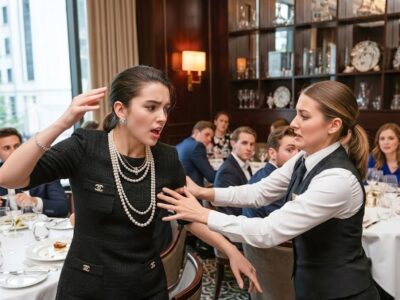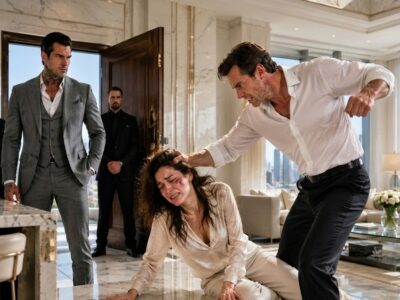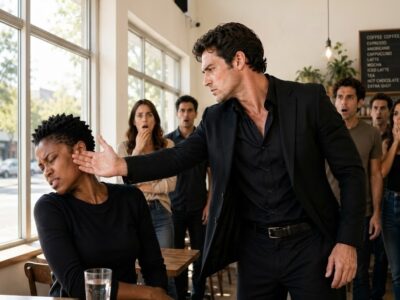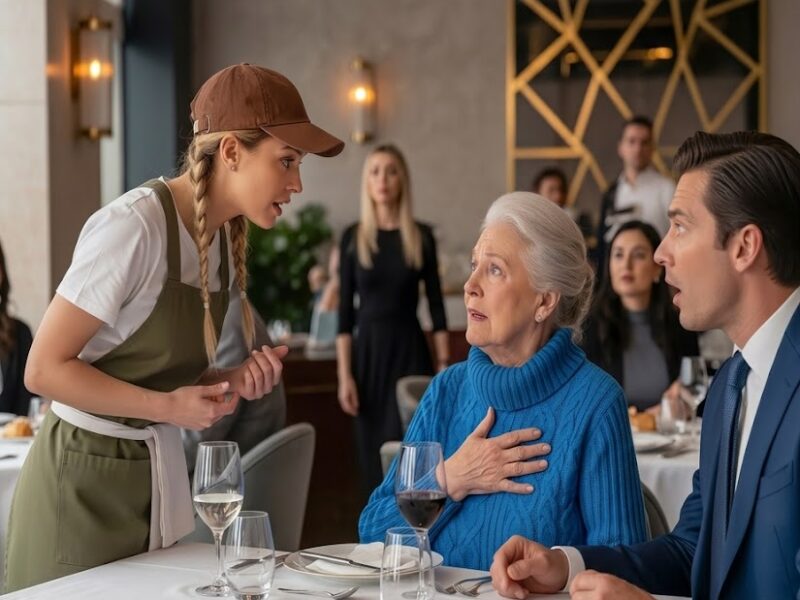
The Italian Billionaire Heard the Waitress Speak to His Mama in Italian — “You Just Stole My Heart”
Part 1: The Weight of Velvet and Iron
Rain lashed against the floor-to-ceiling glass of The Velvet Room, Manhattan’s most ostentatious dining establishment, located a stone’s throw from Central Park. Inside, the ambient temperature was strictly controlled, smelling of charred truffles, aged mahogany, and the distinct, metallic tang of generational wealth.
Lucia Rossi adjusted her crisp white collar and tightened the black apron around her waist. She winced as the coarse fabric rubbed against a deep bruise on her hip—a parting gift from a crowded uptown subway car during peak rush hour. Her feet throbbed inside her mandatory two-inch black heels, but her back remained unyielding, perfectly straight. She could not afford to slouch. She could not afford to drop a fork. Above all, she could not afford to lose this job.
“Table four is cleared and waiting. The Romanos are five minutes out,” Gerard, the floor manager, hissed as he swept past her. Gerard was a sharp-featured man who managed the floor with the cold precision of a drill sergeant, treating empathy as a fatal flaw. He snapped his fingers inches from Lucia’s face. “Wake up, Rossi. You’re on bread and water service for them tonight. Do not speak unless spoken to. Do not look Mr. Romano directly in the eye. And for the love of God, if his mother looks displeased, do not argue. Just bow your head and fade into the wallpaper.”
“Yes, Mr. Gerard,” Lucia whispered, her fingers tightening around the cold handle of a silver water pitcher.
She knew who the Romanos were; everyone in New York did. Lorenzo Romano, thirty-two years old, was the head of Romano Shipping Enterprises, a maritime conglomerate spanning three continents. The financial tabloids portrayed him as an icy, calculated titan who bought out competitors with the same casual nonchalance as buying a newspaper. But the true shadow in the room was not Lorenzo. It was his mother, Donatella Romano. Rumor had it that the elderly matriarch had reduced a world-renowned chef to tears the previous week simply because his risotto lacked “soul.”
Lucia adjusted her thin-framed glasses. A year ago, she hadn’t cared about Manhattan high society. She had been living in Florence, completing the final semester of her master’s degree in art restoration, her world defined by the scent of turpentine, linseed oil, and five-hundred-year-old pigments. Then her father, Marco, suffered a massive heart attack back in New York. The subsequent medical bills had mounted like an avalanche. Her student visa had flickered out, forcing her back to the States. She had traded her fine brushes for serving trays, sacrificing her academic dreams to pay for Marco’s daily regimen of heart medication and hospital stays.
The heavy mahogany doors swung open. A quiet hush washed over the main dining room.
Lorenzo Romano walked in first. He was tall, broad-shouldered, and clad in a tailored charcoal suit that looked structural in its precision. His hair was dark and swept back, framing sharp features and deep, espresso-colored eyes that currently looked thoroughly unimpressed by his surroundings.
Clinging to his arm was Vanessa St. James, daughter of a Manhattan real estate empire. Vanessa was a regular at The Velvet Room, famous among the waitstaff for treating service workers like background props. She wore a ruby-red dress that cost more than Lucia’s annual rent, her smile calculated and sharp.
Behind them walked Donatella Romano. She moved slowly, using a dark cane not out of necessity, but to point at things she found distasteful. She was draped in severe black silk, her silver hair styled in a tight bun, her eyes scanning the restaurant like an inspector assessing a crime scene.
Gerard rushed forward, bowing so low his back nearly clicked. “Senora Romano, Mr. Romano, Miss St. James. Welcome. Your primary table is ready.”
“It smells of industrial bleach,” Donatella said, her voice raspy and weighted with an thick, unyielding central Italian accent.
“Mother, it’s lavender potpourri,” Lorenzo said softly, his deep voice carrying a bone-deep exhaustion.
“Lavender masks filth,” Donatella snapped. “Sit me down. My knees hurt.”
As the party moved toward Table 4, Vanessa’s oversized handbag swung outward, striking Lucia hard in the stomach. Lucia gasped, stumbling back half a step, the silver water pitcher wobbling dangerously in her hands.
Vanessa didn’t even stop. She merely checked her designer bag for scuffs. “Watch where you stand,” she tossed over her shoulder.
Lorenzo paused, his dark eyes shifting toward Lucia. For a fraction of a second, his expression softened into something resembling hesitation. But before he could speak, Vanessa pulled his arm. “Come on, Enzo. Don’t let the staff distract you. I have so much to tell you about the opera board.”
Lucia steadied herself, drawing a slow, silent breath. Just get through the shift, she reminded herself. Pay the electric bill. Buy Dad’s medicine.
She approached the table with quiet steps. “Sparkling or still water, sir?” she asked neutrally.
“Sparkling for Lorenzo and me,” Vanessa commanded without looking up. “And bring the old lady tap water. She doesn’t need the bubbles.”
Lucia froze slightly. To address Donatella Romano as “the old lady” in front of staff was bold; to order her tap water at a five-star establishment was an open insult.
“I will have sparkling,” Donatella interjected coldly, staring straight at Vanessa. “And a slice of fresh lemon.”
“Whatever,” Vanessa sighed, snapping open her menu. “Just bring it.”
As Lucia leaned over to set down Lorenzo’s glass, she caught a subtle drift of his cologne—sandalwood and sea salt. Lorenzo looked up, their eyes meeting for a brief, sharp second. In his gaze, Lucia didn’t see arrogance; she saw an exhausting wariness, a man trapped between an aggressive socialite and a formidable mother.
“Thank you,” he murmured softly.
“You’re welcome, sir,” Lucia replied.
“Excuse me,” Vanessa interrupted, snapping her long fingers. “I didn’t ask for ice. Take it back.”
Lucia looked at the glass. “Madam, there is no ice in this glass.”
“I said take it back. It looks cold,” Vanessa sneered. “Honestly, Enzo, the service here has plummeted. We should have reserved at Le Bernardin. She looks like a frightened rabbit. I’ll bet ten grand she drops a tray before the main course.”
Lucia took the glass back, her knuckles turning bone-white around the stem. She retreated to the service pantry, closing her eyes tightly. She counted slowly in her head, slipping into her native Italian: Uno, due, tre…
She had no idea that back at Table 4, a single whispered sentence in an obscure dialect was about to explode the entire evening into chaos.
Part 2: The Whispered Dialect
By the time the appetizers were served, the tension at Table 4 had thickened into an suffocating atmosphere. Lucia stood near a decorative marble pillar, watching the table like an hawk while waiting for the cue to clear plates.
Vanessa was dominating the conversation, gesturing wildly with a fork full of yellowfin tuna, dropping names of European designers and Manhattan politicians. Lorenzo nodded politely at fixed intervals, his gaze drifting repeatedly toward his wristwatch. Donatella, meanwhile, hadn’t touched her food. She sat back, her arms crossed over her chest, staring out at the rain-drenched pavement of Central Park South, looking profoundly isolated despite the wealth surrounding her.
Lucia stepped forward carefully during a lull in Vanessa’s monologue. “Is everything to your satisfaction with the carpaccio, Senora?”
Donatella looked up, poking the thinly sliced beef with her fork. “It is cold. The meat has no life. It tastes as though it lived in a dark refrigerator and never saw the Italian sun.”
“I can ask the executive chef to prepare a fresh dish, Senora,” Lucia offered gently.
“Don’t bother,” Vanessa cut in, waving a dismissive hand. “She complains about everything. It’s prime Tuscan beef, Donatella. Just eat it.”
Donatella’s jaw set into a hard line. “In my home, we do not eat cold cardboard and call it food.”
“Well, darling, you aren’t in your little village anymore,” Vanessa said, her voice laced with patronizing sweetness. “You’re in New York. Adapt or starve.”
Lorenzo set his wine glass down hard against the tablecloth. “Vanessa. That is enough.”
“I’m just saying, Enzo! She’s ruining the evening. We are supposed to be discussing our merger party, and she’s brooding over raw beef.” Vanessa turned her head toward Lucia, flicking her wrist. “Take the plate away. Bring the main courses, and fetch another bottle of the ’05 Cabernet. Quickly.”
Lucia leaned in to remove the dish. As her hands touched the china, Donatella leaned back, muttering under her breath in a low, rapid-fire stream of words.
It was not standard Italian. It was a dense, highly localized dialect spoken only in the high rural hills near Lucca and Siena—a linguistic relic that tourists never heard and textbook scholars rarely mastered.
“Questa vipera non ha rispetto, non ha cuore,” Donatella muttered bitterly to herself. “Mio figlio è diventato cieco davanti a una strega senza anima.” (This viper has no respect, no heart. My son has gone blind in front of a soulless witch.)
Lucia’s hands froze over the table. The cadence of those words went straight through her. It was the exact dialect her grandmother had used in her kitchen in Tuscany—the cadence of her childhood, of warm bread, oil paint, and forgotten heritage.
Lorenzo rubbed his temples, letting out a heavy sigh. He recognized his mother was speaking Italian, but he lacked the fluency in that specific regional dialect to grasp the nuances. “Mama, please. Speak English so Vanessa can follow.”
“I am speaking to myself,” Donatella grumbled stubbornly. “Since no one here listens anyway.”
Vanessa let out a sharp, mocking laugh. “Oh, let her mutter to herself, Enzo. Senility comes for all old people eventually.”
The word hung in the air like a stain.
Lucia felt a sudden, fierce heat rise up her neck. Every professional boundary in her mind screamed at her to keep quiet. She needed this job. She needed the hourly wage to buy her father’s blood pressure medication tomorrow morning. But she looked at Donatella’s face—at the deep, silent humiliation shining in the old woman’s eyes as a cruel socialite mocked her mind—and Lucia thought of her own father lying fragile in a hospital bed.
Lucia picked up the plate. She did not look at Vanessa. She looked directly into Donatella’s tired eyes.
She did not speak in textbook English. She did not use basic tourist Italian. She spoke directly in the rich, archaic dialect of rural Lucca, her voice smooth, firm, and carrying across the quiet dining room.
“Signora, il rispetto non si compra con i soldi, e la classe non si indossa come un vestito,” Lucia said softly, her pronunciation flawless. “La vipera fischia solo perché ha paura dell’aquila.” (Ma’am, respect cannot be bought with money, and class cannot be worn like a dress. The viper hisses only because it fears the eagle.)
The silence that followed was absolute.
The clattering of silverware at nearby tables seemed to vanish. Donatella’s eyes widened in profound shock. Her hand flew to the pearl necklace at her throat, her lips parting as if she were looking at a ghost.
Lorenzo froze in his chair, his dark eyes snapping up to fix entirely on Lucia. He didn’t understand every word, but he understood the sudden change in his mother’s face—and he recognized the fierce, defensive cadence of his ancestral home.
Vanessa blinked, looking back and forth between them in complete confusion. “What? What did she just say? Did this waitress just speak gibberish at me?”
Lucia instantly shifted back into polished English, her face morphing back into a mask of professional composure, though her heart was hammering violently against her ribs. “I simply informed Senora Romano that I would clear her plate immediately, madam.”
Donatella suddenly let out a sharp, ringing laugh—a sound of unadulterated delight that echoed across the dining room. “No!” the matriarch said, her stern face cracking into a brilliant smile. “No, she said much more than that!”
Donatella leaned forward, looking at Lucia as if seeing her for the first time—taking in the worn frames of her glasses, her spotless white apron, and the quiet dignity in her posture. “Da dove vieni, ragazza?” she asked, her voice trembling slightly. (Where are you from, girl?)
“My father is from Siena, Senora,” Lucia replied softly in Italian. “But my grandmother raised me in a small village near Lucca.”
“Lucca,” Donatella whispered, her eyes shining with sudden emotion. “I knew it. I could hear the earth of my home in your voice.”
“Excuse me!” Vanessa slammed her hand onto the table, rattling the crystal stemware. “I don’t know what kind of hillbilly language game this is, but it is ridiculously rude! Enzo, are you going to sit there and let the server mock me in front of the entire room?!”
Lorenzo did not look at Vanessa. He slowly rose from his seat, his massive frame imposing, his eyes locked entirely on Lucia. The tired, bored expression he had worn all night was completely gone, replaced by a sharp, intense focus.
“You speak the high Tuscan dialect,” Lorenzo said, his deep voice carrying a quiet weight. “My mother hasn’t heard anyone speak that dialect in New York for over twenty years.”
“It is a beautiful dialect, sir,” Lucia said, holding the dirty plate firmly against her side. “It would be a tragedy to let it die.”
“You are fired!” Vanessa shrieked, standing up. “Manager! Where is the manager?!”
Gerard, who had been watching the scene unfold from the bar with growing horror, materialized beside the table in seconds, pale and sweating. “Miss St. James! What happened?!”
“This incompetent girl just insulted me!” Vanessa raged. “She’s conspiring with Lorenzo’s mother to humiliate me! Get her out of this building right now, fire her without pay, and comp this entire meal!”
Gerard turned on Lucia, his face twisting into a mask of rage. “Rossi! What the hell did you do?! Turn in your apron—”
“If she leaves, I leave,” Donatella said.
Her voice wasn’t loud, but it was made of solid steel. She did not look at Gerard. She looked directly at her son.
“And if I leave, Lorenzo,” Donatella added, “you can explain to the board why I am pulling my family shares from your merger.”
Vanessa gasped. Gerard stopped mid-sentence, looking like he was about to suffer a stroke.
Lorenzo looked at Vanessa’s distorted, angry face, then turned his gaze back to Lucia, who stood her ground despite Gerard’s furious glare. A slow, genuine smile spread across Lorenzo’s face, completely transforming his features.
“Gerard,” Lorenzo said calmly.
“Y-yes, Mr. Romano?”
“Lucia isn’t going anywhere,” Lorenzo said, unbuttoning his jacket and pulling out the empty chair beside him. “In fact, I think she should join us. Sit down, Lucia.”
Lucia’s eyes widened. “Sir… I cannot. I am on duty. I could lose my job.”
“You won’t lose your job,” Lorenzo said, his voice dropping into a dangerous, commanding tone. “Because as of five seconds ago, I am buying this restaurant.”
Part 3: The Price of Dignity
Vanessa let out a sharp, hysterical laugh. “You bought the restaurant?! Enzo, stop being dramatic! You can’t just buy a Manhattan restaurant on a whim to prove a point!”
Lorenzo casually pulled a sleek black smartphone from his inner jacket pocket. He tapped the screen twice and placed it face-up on the white tablecloth. “My head of acquisitions has been negotiating with the owner, Mr. Henderson, for three months. I just authorized his full asking price via text. Effective immediately, my holding group owns this building, the cellar, and the employment contracts of every person standing in this room.”
He turned his dark gaze toward Gerard, who looked as though his soul had left his body.
“Gerard,” Lorenzo commanded quietly. “Bring a fresh glass. Pour Miss Rossi a glass of the ’05 Cabernet.”
“R-right away, Mr. Romano! Immediately!” Gerard stammered, turning on his heel and nearly tripping over a chair as he rushed toward the sommelier station.
Lucia stood frozen, her hands clutching the dirty plate. “Mr. Romano, please. This isn’t necessary. I am wearing a staff uniform. I smell of the kitchen.”
“You smell of honest work and dignity,” Donatella said firmly, tapping her cane against the floor. “Sit down, bambina. Do not make an old woman strain her neck to look at you.”
Lucia hesitated, then slowly sat down in the plush velvet chair Lorenzo held out for her. It was soft and warm—a stark contrast to the cold metal folding chairs in the basement breakroom where she took her ten-minute lunches.
“This is an absolute farce!” Vanessa snapped, her face flushed red. “You are letting a waitress sit at our table? She is wearing an apron, Lorenzo!”
“She is wearing the uniform of someone who earns her living,” Lorenzo said, his voice dropping to a temperature cold enough to freeze water. “Something you have never done for a single day in your life, Vanessa.”
Gerard returned, his hands trembling visibly as he placed a crystal glass in front of Lucia and poured the deep red wine.
“Drink,” Donatella encouraged softly. “It helps settle the nerves after dealing with fools.”
Lucia took a small, cautious sip. The wine was velvet on her tongue, tastes of black cherries, oak, and dark chocolate—a world away from the cheap boxed wine she drank at her kitchen table while balancing her budget ledger.
“So,” Donatella said, leaning her elbows on the table and ignoring Vanessa entirely. “You said your father is from Siena. What is his name? What does he do?”
“His name is Marco Rossi,” Lucia said, her voice growing steadier. “He was a master woodworker and furniture restorer. That is how I learned to appreciate old things. I was finishing my master’s degree in art restoration in Florence before… before he fell ill.”
Lorenzo’s eyes sharpened with interest. “Art restoration? You have academic training?”
“I was one semester away from completing my thesis,” Lucia admitted, gazing into her wine glass. “My research was focused on the consolidation of flaking pigments on 17th-century oil canvases. But my father suffered a severe heart attack. I had to return to New York to manage his care and pay his medical expenses.”
“Boring!” Vanessa groaned loudly, tossing her linen napkin onto her plate. “Can we please stop listening to the waitstaff’s sob stories?! Enzo, we have tickets to the Met Opera tomorrow night. I need to know if you’re wearing the tuxedo or the tailored suit.”
Lorenzo didn’t look at her. “I am not going to the opera with you, Vanessa.”
Vanessa froze. “What?”
“I am not going to the opera with you tomorrow, nor am I attending the charity gala with you this weekend,” Lorenzo said smoothly, leaning back in his leather chair. “In fact, I think this dinner has reached its conclusion for you.”
A collective gasp echoed secretly among the nearby waitstaff who were subtly listening in.
Vanessa’s jaw dropped. “Are you… are you breaking up with me?! Over a servant?! My father is your primary investor in the shipping expansion!”
“Your father is a business associate,” Lorenzo corrected coldly. “And business does not obligate me to tolerate your cruelty toward my mother, nor your arrogance toward people who work for a living. You called my mother senile. You treated Lucia like dirt under your shoe. Leave.”
Vanessa stood up so fast her chair screeched against the hardwood floor. She grabbed her designer bag, her eyes burning with pure venom. “You will regret this, Lorenzo! You think this little peasant girl is pure? She saw a billionaire and played the Italian nostalgia card! She’s a conniving gold-digger!”
She turned her glare toward Lucia, leaning down until she was inches from Lucia’s face. “And you… don’t get comfortable. You just stepped into a world that will crush you. I wipe out girls like you for breakfast.”
With a dramatic spin, Vanessa stormed down the central aisle of the restaurant, the sharp click of her heels echoing off the glass walls until the heavy oak doors slammed shut behind her.
The silence at Table 4 was instantaneous and refreshing.
Donatella let out a long, peaceful breath. “Finally. The air in this room smells clean again.” She reached across the table and patted Lucia’s hand gently. “You did well, ragazza. You didn’t raise your voice, and yet you won.”
“I didn’t mean to disrupt your dinner, Senora,” Lucia murmured, feeling a wave of exhaustion hit her.
“Trouble is precisely what my son needed,” Donatella chuckled, shooting a sharp look at Lorenzo. “He has been living like a corporate ghost for three years. Look at him now. He actually has color in his face.”
Lorenzo flushed slightly, but his gaze remained fixed on Lucia. “My mother is right about one thing, Lucia. I apologize for how you were treated tonight. And I am entirely serious—you are no longer a server at this restaurant.”
Lucia’s chest tightened with sudden anxiety. “Mr. Romano… please. I need this job. I have to cover my father’s daily care—”
“You aren’t fired,” Lorenzo interrupted, his dark eyes softening into a genuine, warm smile. “You are being reassigned. But we can discuss your new role tomorrow. For now, tell me more about your restoration work. My family owns an estate in Tuscany with a damaged 17th-century portrait that no expert in New York has had the courage to touch.”
For the next hour, Lucia forgot the rough fabric of her apron. She forgot the throbbing pain in her feet. She spoke passionately about chemical solvents, pigment stabilization, and the delicate ethics of preserving history. Lorenzo listened intently, asking sharp, intelligent questions, while Donatella ate her dinner with genuine appetite.
It was the most extraordinary hour of Lucia’s year. But as the clock struck eleven, reality returned with a cold vengeance.
They walked out of the restaurant together as the rain finally began to clear. A sleek black Maybach idled at the curb.
“Let my driver take you home,” Lorenzo offered, standing beside Lucia on the damp pavement.
“Oh, no thank you,” Lucia said quickly, clutching her worn coat around herself. “The subway is fine.”
“Nonsense,” Donatella commanded from inside the warm leather interior of the car. “A girl from Lucca does not ride the night train alone. Get in.”
Lucia yielded, stepping into the luxurious vehicle. “Could you… could you actually drop me off at St. Jude’s Hospital?” she asked quietly. “I want to check on my father before visiting hours end.”
Lorenzo’s expression grew serious. “Of course.”
During the ride uptown, Lorenzo asked about her father’s condition. Lucia explained the reality—the failing heart valve, the massive specialist fees, and the grueling double shifts she worked to keep the account active.
Lorenzo listened silently, his jaw tightening with every word. When the car pulled up to the glass doors of St. Jude’s, he reached out and gently caught Lucia’s hand before she could open the door.
“Tomorrow morning at nine o’clock,” Lorenzo said, his touch warm against her skin. “Come to Romano Tower. Penthouse floor.”
“Why?” Lucia whispered.
“Because I have a contract for you,” he said softly. “One that has nothing to do with serving water.”
Lucia nodded, her heart fluttering. She stepped out into the night air and walked into the hospital lobby, feeling lighter than she had in months.
But as she reached the nurse’s station on the cardiology floor, she found Brenda, the night nurse, looking at her with an expression of profound panic.
“Lucia… thank God you’re here,” Brenda whispered, pulling her into an empty room. “We have a massive problem.”
Part 4: The Shadow of Sabotage
Lucia felt the blood drain from her face. “Is it Dad?! Did he have another episode?!”
“No, no—physically, Marco is stable,” Brenda said quickly, holding Lucia’s shaking shoulders. “It’s the administration office. An hour ago, an emergency flag was placed on his file.”
“A flag? What does that mean?”
Brenda looked around nervously before dropping her voice to a whisper. “An anonymous tip came through to the hospital’s legal department, claiming that your income declarations for the sliding-scale financial aid were fraudulent. They frozen his medical account, Lucia. The billing director left a notice: if the outstanding balance of eighteen thousand dollars isn’t paid in full by noon tomorrow, they are transferring your father to the state care facility in Brooklyn.”
Lucia gasped, stumbling back against the wall. “The state facility?! Brenda, that place is understaffed and miles away! He’s waiting for a critical valve replacement! The shock of moving him could kill him!”
“I know, honey,” Brenda said gently, tears in her eyes. “I tried to fight it, but the instruction came from the top down. The administrative note had a reference name attached to the inquiry—St. James Real Estate Holdings.”
The room seemed to tilt on its axis.
Vanessa.
She hadn’t just walked away from the restaurant; she had immediately used her family’s corporate clout to ruin Lucia’s life. Vanessa knew Lucia worked double shifts to pay for her father’s care. It had taken her only one phone call to locate Marco Rossi’s account and pull the plug.
“She’s trying to kill him,” Lucia choked out, horror clawing at her throat. “She’s punishing me through my father.”
“You have until noon tomorrow,” Brenda warned softly. “If eighteen thousand dollars isn’t in that account, the transport team is ordered to move him.”
Lucia walked numbly into her father’s room. Marco was asleep, his face pale against the white hospital sheets, the steady beep-beep-beep of the heart monitor filling the dim space. She sat down in the vinyl chair beside his bed, taking his rough, calloused hand in hers, tears spilling silently over her eyelashes.
The hope she had felt in Lorenzo’s car shattered into dust.
If she went to Lorenzo tomorrow and begged for eighteen thousand dollars, what would it look like? It would look exactly like Vanessa’s accusation—that she was a calculating grifter using Italian heritage to milk a billionaire for cash. Lorenzo would despise her. But if she didn’t get the money, her father would be moved to a chaotic state ward and die.
Lucia gripped her father’s hand tightly, wiping her face with her sleeve. Sadness slowly burned away, replaced by an icy, desperate resolve.
“I won’t let them take you, Papa,” she whispered into the dark room. “I won’t let her break us.”
She stayed by his side all night. When the sun began to rise over the East River, Lucia washed her face in the small hospital bathroom, smoothed out her clothes, and set her shoulders. She would go to Romano Tower at nine o’clock. She would not beg. She would negotiate. She would offer her master’s-level art restoration skills in exchange for an advance. She would sell her craft, not her dignity.
As she stepped out of the hospital lobby at 8:00 AM, her phone buzzed with an alert from a popular Manhattan celebrity blog.
The headline read: “VELVET ROOM DRAMA: BILLIONAIRE LORENZO ROMANO DUMPS HEIRESS FIANCÉE FOR STRIPPED-DOWN WAITRESS.”
Below it was a grainy photograph taken through the window of the Maybach the previous night—showing Lorenzo gently taking Lucia’s hand as they spoke outside the restaurant. The article framed Lucia as an opportunistic gold-digger who had staged an argument to trap the shipping magnate.
Vanessa was launching a full-scale media war to destroy her reputation before Lucia could even step into Lorenzo’s office.
Lucia closed the article, her jaw clenched tight. “All right, Vanessa,” she muttered under her breath. “You want a fight? Let’s fight.”
At 8:55 AM, Lucia entered the soaring glass-and-steel lobby of Romano Tower on Park Avenue. The reception area looked like a modern cathedral of extreme wealth.
She walked up to the security desk. The blonde receptionist glanced up from her monitor, her eyes flicking from Lucia’s modest clothes to a tablet screen displaying the exact same gossip article.
“Can I help you?” the receptionist asked, her tone laced with disdain. “Deliveries go around to the loading dock in the rear.”
“I am not a delivery,” Lucia said, holding her head high. “I have a nine o’clock appointment with Mr. Lorenzo Romano.”
The receptionist smirked faintly. “Mr. Romano does not see unscheduled walk-ins, especially—”
“Send her up immediately.”
Lorenzo’s voice boomed suddenly through the intercom speaker on the reception desk, deep and commanding.
The receptionist turned a pale shade of grey. “Y-yes, sir. Elevator one, ma’am.”
Lucia stepped into the private express elevator. As the doors sealed shut and the car shot upward fifty floors, her stomach twisted into knots.
The elevator doors opened directly into Lorenzo’s penthouse suite. The office was vast, featuring floor-to-ceiling windows overlooking the skyline. But Lucia didn’t look at the view. Her eyes were immediately drawn to the center of the room, where an artist’s easel stood, covered by a black silk sheet.
Lorenzo stood by the window, holding a cup of espresso. He wore a sharp navy suit today, but his collar was unbuttoned, his dark hair slightly rumpled. He looked less like a cold titan of industry and more like a man carrying an immense burden.
“Good morning, Lucia,” he said, turning around. “I assume you saw the news blogs this morning.”
“I did,” Lucia said, taking a step into the room. “And I know who leaked that photo.”
“Vanessa’s publicist,” Lorenzo said flatly. “She thinks publicly humiliating you will force me to back down. She underestimates me.”
He walked over to the easel and took hold of the black silk sheet. “Before we discuss anything else, I need you to see this.”
With a smooth pull, he removed the cover.
Lucia gasped, taking an involuntary step forward.
Part 5: The Masterpiece and the Trap
Sitting on the heavy oak easel was a large oil painting, clearly from the late 17th century. It depicted a striking woman with dark, intelligent eyes and silver-threaded hair, wearing a rich crimson velvet gown and holding a split pomegranate in her hands.
The artwork was extraordinary, but its condition was catastrophic. A jagged, three-inch tear ran through the canvas near the subject’s shoulder. Decades of oxidized, yellowed varnish obscured the vibrant paint beneath, and improper storage had caused severe flaking along the lower border.
“This is my great-great-grandmother, Contessa Caterina Romano,” Lorenzo said softly, gazing at the canvas. “It hung in our family’s villa outside Lucca for generations. During World War II, my family hid it in an underground wine cellar to prevent it from being looted. Moisture almost destroyed it. I have brought five top art restoration experts from London and New York into this office. Every single one of them told me the same thing—repaint the damaged sections. Cover it up. Make it look brand new.”
Lucia stepped closer, her eyes scanning the canvas with practiced, professional intensity. Her fingers twitched with the instinctive desire to grab a magnifying glass and a scalpel.
“They are idiots,” Lucia said firmly, completely forgetting who she was speaking to. “Repainting it would be an act of vandalism! Look at the brushwork—it’s clearly from the school of Pietro da Cortona. If you paint over those flakes, you destroy the original hand of the master!”
Lorenzo watched her, a quiet flare of admiration in his dark eyes. “What would you do?”
“First, I would consolidate the flaking pigment using a mild rabbit-skin glue solution under controlled heat,” Lucia explained rapidly, gesturing near the canvas without touching it. “Then I would remove that yellowed varnish using a specialized solvent gel—acetone diluted in mineral spirits—applied with micro-swabs so the original paint underneath isn’t stripped. And the tear… you don’t patch it with tape like an amateur. You weave the linen threads back together from the reverse side under a microscope.”
She turned to face Lorenzo, her face glowing with genuine passion. “If you repaint her, Mr. Romano, you erase her history. You erase the war she survived.”
Lorenzo stared at her for a long, quiet moment. The silence in the penthouse stretched tight.
“You are hired,” Lorenzo said quietly. “I will pay you fifty thousand dollars to restore this portrait, plus full coverage for all laboratory materials.”
Lucia’s breath caught in her throat. “Fifty… fifty thousand?”
It was more than enough to clear her father’s hospital debt, secure his valve surgery, and cover her rent for six months.
“I accept,” Lucia said, her voice shaking slightly. She swallowed hard, steeling herself for the next sentence. “But… I have one condition, Mr. Romano.”
Lorenzo raised an eyebrow, leaning against his desk. “Name it.”
“I need an advance of eighteen thousand dollars today. Right now.”
Lorenzo’s expression cooled slightly. A faint shadow of disappointment crossed his features. “An advance? Lucia, you haven’t laid a single tool on the canvas yet. Why the sudden urgency?”
Lucia closed her eyes for a brief second. She could make up an excuse. She could say it was for equipment, or rent, or lab space. But she looked at the portrait of the strong woman who had survived a war, and she looked at the man who had protected his mother at the dinner table last night.
“Because Vanessa St. James froze my father’s medical account last night,” Lucia said, her voice cracking with raw emotion.
Lorenzo went dead still.
“She used her family’s corporate connections to flag his account for fraud,” Lucia continued, tears finally spilling over her eyelashes. “If eighteen thousand dollars isn’t paid by noon today, the hospital is transferring my father to a state facility. He has a failing heart valve, Lorenzo. Moving him could kill him. I am not a gold-digger. I don’t want your charity. I will work eighty hours a week on this painting… I just need to save my father.”
The air in the penthouse seemed to drop ten degrees. Lorenzo’s face hardened into a mask of pure, terrifying rage—not directed at Lucia, but at the injustice of what he was hearing.
Without a word, he turned, grabbed his desk phone, and dialed a direct line.
“Get me the Chief Executive Administrator of St. Jude’s Hospital,” Lorenzo commanded, his voice cold and sharp as glass.
He waited five seconds, his dark eyes fixed entirely on Lucia’s tear-stained face.
“This is Lorenzo Romano,” he said into the receiver, his voice dropping into a dangerous, low rumble. “You have a patient in your cardiology wing named Marco Rossi. You have an administrative flag on his account placed by St. James Holdings. Remove it immediately.”
He listened for a moment as the voice on the other end stammered an explanation.
“I don’t care about your internal policy!” Lorenzo cut in ruthlessly. “Listen to me very carefully. My legal department is wire-transferring five hundred thousand dollars to St. Jude’s main account within ten minutes. That covers Marco Rossi’s surgery, his private suite, and a dedicated team of top specialists for as long as he requires care. If anyone attempts to move him, or if Miss St. James calls your office again, I will buy your medical group by five o’clock and fire your entire administrative board. Do we understand each other?”
He slammed the phone down.
Lucia stood frozen, her hands pressed against her mouth, overwhelmed by shock. “Lorenzo… five hundred thousand dollars… I can’t possibly repay that…”
Lorenzo crossed the room in long strides. He stopped inches from her, reaching out to gently take her shaking hands in his.
“You don’t owe me a single cent,” he said fiercely, his dark eyes burning with intensity. “Vanessa brought a war to my doorstep by attacking an innocent man to get to me. That is an insult to my family name. You focus on restoring Caterina’s portrait, Lucia. I will handle Vanessa.”
Over the next three weeks, Lucia’s life transformed into something extraordinary.
Lorenzo set up a private, high-tech restoration laboratory for her on the executive floor of Romano Tower. The scent of chemicals, varnish, and linseed oil replaced the greasy air of The Velvet Room. Marco was moved to a state-of-the-art private suite at St. Jude’s, where Manhattan’s top cardiac surgeon performed a successful valve replacement.
Every evening around six o’clock, Lorenzo would step down into Lucia’s lab. He would loosen his tie, pour two glasses of wine, and simply sit on a stool, watching her work under the magnifying lamps with delicate precision.
They talked for hours—not about wealth or corporate rivalries, but about art, Tuscan architecture, and their shared memories of Italy. Lucia discovered that Lorenzo carried the weight of a massive empire solely out of duty to his late father, while Lorenzo discovered that Lucia had a vibrant, sharp humor and a deep, unshakeable courage.
A powerful, magnetic connection bloomed between them—quiet, intense, and undeniable.
On a rainy Thursday evening, three weeks into the project, Lucia applied the final protective coat of varnish to Contessa Caterina’s portrait. The canvas glowed. The colors were rich, the tear entirely invisible, the subject’s eyes gleaming with life.
“It’s finished,” Lucia whispered, stepping back.
Lorenzo walked up behind her. He didn’t look at the painting. He looked at Lucia, his hand gently sliding up her arm to rest on her shoulder. “She looks breathtaking. Just like the woman who saved her.”
Lucia’s breath hitched as she turned to face him. Lorenzo leaned in, his dark eyes locking onto hers, his mouth inches from hers.
Before their lips could meet, the heavy glass doors of the restoration lab burst open with a loud, violent bang.
Part 6: The Unraveling Scandal
“Isn’t this a touching little fairytale!” a sharp, shrill voice shrieked.
Vanessa St. James stood in the doorway. She was flanked by two burly men in dark suits, her eyes wide, manic, and bloodshot, her designer dress rumpled. She looked like a woman who had completely lost her grip on reality.
Lorenzo instantly stepped in front of Lucia, shielding her with his body. “Vanessa. You were formally served with a restraining order. Security was instructed to arrest you on sight.”
“I bribed your loading dock guards, Enzo!” Vanessa cackled, taking a step into the lab. “You think a piece of paper stops me?! You humiliated me! My father pulled his investment from your shipping merger this morning! Your stock dropped six percent at the opening bell!”
“Let it drop,” Lorenzo said coldly. “I don’t care about the merger.”
“Well, you’re going to care about this!” Vanessa snarled, pointing a shaking finger at Lucia. “I ran a deeper background check on your little charity case, Lorenzo. Did you know her student visa technically expired four days before her father’s heart attack? She filed her extension paperwork late! She’s an illegal alien!”
Lucia went pale. During the chaotic week her father was hospitalized, there had been a bureaucratic delay with her visa renewal—a minor technical oversight her lawyer was currently rectifying.
“It’s a gray area, sure,” Vanessa sneered, pulling a phone from her clutch. “But one call from my father’s connections at Federal Immigration Services, and she’ll be placed in a detention center by midnight! How does deportation sound, Lucia?! Taking your pathetic, sick father back to Italy in handcuffs?!”
“You are a monster,” Lucia whispered, trembling with rage.
“I am a St. James! We win!” Vanessa screamed. She suddenly reached into her bag and pulled out a heavy glass jar filled with black industrial permanent ink. “Let’s see how much your billionaire hero loves you when your precious masterpiece is ruined!”
Vanessa lunged toward the easel, her arm swinging back to throw the black ink directly onto the newly restored 17th-century canvas.
“NO!” Lucia screamed, diving forward.
But Lorenzo was already moving. With the lightning reflexes of a trained athlete, he intercepted Vanessa mid-stride, grabbing her wrist in a vice-like grip and twisting it downward.
Vanessa shrieked in pain, dropping the jar. It shattered on the marble floor, splashing thick black ink across the floor and ruining Lorenzo’s handmade leather shoes—but missing the painting by mere inches.
“Touch that canvas again,” Lorenzo growled, his face inches from Vanessa’s, his voice shaking with a terrifying, primal rage, “and I will not just sue you. I will use every dollar of my fortune to dismantle your father’s company brick by brick. I will expose his offshore tax evasions. I will publish the security footage of you attempting to destroy a historical artifact. I will turn you into an absolute outcast in this city!”
He shoved her back forcefully. Vanessa stumbled, landing hard on the floor right in the spilled ink, her red dress stained black.
Four armed building security guards rushed into the room, guns unholstered.
“Take her out,” Lorenzo ordered, his voice cold as ice. “Hand her directly to the NYPD officers waiting downstairs. Press charges for aggravated breaking and entering, felony vandalism, and violation of a protection order.”
Vanessa was dragged out kicking and screaming, her frantic profanities echoing down the hallway until the heavy doors sealed shut.
Silence returned to the lab.
Lucia sank onto a wooden stool, burying her face in her hands, her body shaking with violent sobs. “She’s going to do it, Lorenzo… she’s going to call immigration… she’s going to ruin everything…”
Lorenzo immediately dropped to his knees in front of her. He took her shaking hands away from her face, ignoring the black ink staining his hands.
“Look at me, Lucia,” he commanded softly but fiercely. “Look at me.”
Lucia looked up, her eyes filled with tears.
“I don’t care about the stock price. I don’t care about the merger,” Lorenzo said, his voice thick with genuine emotion. “For three years, I lived like a dead man walking, doing what was expected of me for corporate status. Your fire, your honor, your love for your father… you woke me up. You saved my family’s history. Now let me protect your future.”
“How?” she sobbed. “The gala is tomorrow night… she told the press she’s going to release the visa documents to the media at the event…”
Lorenzo’s dark eyes narrowed, a cold, brilliant resolve settling into his features. “Let her try. Vanessa wants a public spectacle? We will give New York a show they will never forget.”
He stood up, pulling Lucia to her feet and holding her tightly against his chest.
“Go home, rest, and prepare yourself,” Lorenzo whispered into her hair. “Don’t wear a server’s uniform tomorrow night, Lucia. Wear a gown fit for a queen. Because tomorrow at the Plaza Hotel, you aren’t standing behind me. You are walking beside me.”
Part 7: The Language of Love and War
The Grand Ballroom of the Plaza Hotel glittered like a mountain of cut diamonds. Crystal chandeliers cast brilliant light over five hundred of New York’s most elite figures—senators, titans of industry, European royalty, and media moguls—all gathered for the annual Romano Foundation Charity Gala.
The room was buzzing with vicious whispers. Vanessa St. James’s PR team had worked overtime, feeding salacious stories to every major gossip rag in Manhattan. Everyone knew the rumor: Lorenzo Romano had lost his mind, abandoned his high-society fiancée, and fallen for a penniless, undocumented server.
At the top of the sweeping marble staircase, Lucia paused, her hand trembling against the velvet handrail.
She wore a breathtaking gown of liquid gold silk that Lorenzo had custom-ordered for her from Milan. It draped elegantly over her frame, shimmering under the ballroom lights. Her dark hair was styled in a classic, sophisticated updo, secured with delicate diamond pins that had belonged to Donatella.
Lorenzo stepped up beside her, looking striking in a midnight-black tuxedo. He offered her his arm, his eyes gleaming with pride. “Ready, mia regina?”
“They are waiting for us to fail,” Lucia whispered, looking down at the sea of critical eyes below.
“They don’t know who you are,” Lorenzo said softly. “By the end of tonight, they will.”
As they descended the grand staircase together, an absolute hush fell over the ballroom. The sheer visual impact of the couple was arresting. Lorenzo moved with effortless authority, while Lucia walked with the quiet, regal dignity of a woman who had faced hardship and refused to break.
They reached the elevated main stage, where the restored portrait of Contessa Caterina stood concealed under a velvet curtain. Donatella Romano was already seated nearby in an ornate velvet chair, watching Lucia with a proud, gleaming smile.
Lorenzo stepped up to the microphone. “Ladies and gentlemen, welcome. Tonight is about honoring history and legacy—”
“LIES!”
A shrill, hysterical voice echoed through the ballroom’s sound system.
Vanessa St. James marched down the central aisle toward the stage. She wore a dramatic crimson dress, holding an emergency microphone she had snatched from the AV booth. Her eyes were sunken, her face pale and distorted.
The crowd gasped. Dozens of guests immediately pulled out their smartphones, video recording the unfolding disaster.
“Vanessa,” Lorenzo said calmly into his mic. “You are trespassing.”
“I am exposing the truth!” Vanessa shrieked, turning to address the crowd. “Look at her! A pathetic, scheming waitress who was wiping down tables three weeks ago is now wearing Romano family jewels! She is an illegal alien whose visa expired! She targeted Lorenzo for a green card and his fortune because her father is a broke, dying old man!”
An uncomfortable murmur rippled through the crowd of billionaires. It was vicious, ugly, and exposed.
Vanessa pointed her finger at Lucia. “I have the immigration documents right here! She is a fraud!”
Lucia looked at Vanessa. She felt no fear—only a deep, profound calm. She gently tapped Lorenzo’s arm, stepped past him, and walked directly to the front edge of the stage. She did not need a microphone; her voice, trained in classic Italian opera vocal projection, carried clearly to every corner of the vast room.
“My father is not dying, and he is not broke,” Lucia announced, her voice ringing like a bronze bell. “He is a master craftsman who raised me with honor. And yes—I was a waitress! I scrubbed tables! I carried trays for twelve hours a day to pay for my father’s heart surgery! Is working hard to save your family a crime in this room?!”
She paused, sweeping her calm gaze over the wealthy crowd.
“If working with your hands to keep your parents alive is considered shameful by New York society,” Lucia continued, her tone iron-hard, “then I do not want your respect. But you, Vanessa… you have never worked a single hour in your life. You froze a dying man’s hospital account out of petty spite. You tried to ruin an irreplaceable 17th-century painting out of jealousy. You speak of wealth… but you are the poorest person in this room.”
The ballroom went completely dead silent. Several older, prominent patrons in the front row began nodding slowly in agreement.
“Lies!” Vanessa screamed, her voice cracking. “Security, arrest her!”
“Silence, you foolish girl!”
Donatella Romano stood up from her chair. She didn’t use her cane. She walked directly to the microphone, her presence commanding immediate, absolute authority over the entire room.
“You talk of class, Vanessa St. James,” Donatella said, her raspy voice vibrating through the speakers. “You have no class. And as for your claims of a conspiracy… let us hear the truth.”
Lorenzo pressed a button on his smartphone.
Instantly, the ballroom’s surround-sound audio system crackled to life, playing a crystal-clear digital recording—captured by the laboratory’s security system two days prior.
Vanessa’s screeching voice echoed through the Plaza Hotel: “I ran a background check! One call from my father’s connections, and she’ll be deported! How does deportation sound, Lucia?! Taking your pathetic, sick father back to Italy in handcuffs?!”
Followed by the clear, sharp sound of Vanessa smashing the ink bottle onto the floor.
The room erupted into collective gasps of disgust. The high-society guests turned their backs on Vanessa, staring at her with utter contempt. Vanessa’s father, the real estate mogul, covered his face in embarrassment and quickly walked away from his daughter, completely abandoning her in public.
Two uniformed NYPD officers stepped out from the back foyer, approaching Vanessa.
“Vanessa St. James,” the lead officer declared, snapping handcuffs onto her wrists. “You are under arrest for felony vandalism, breaking and entering, and criminal harassment.”
As Vanessa was escorted out of the ballroom sobbing in complete humiliation, a single person in the crowd began to clap. It was Donatella. Then Lorenzo joined. Within five seconds, the entire room erupted into a thunderous, standing ovation.
Lorenzo turned to Lucia, taking her hand and walking back to the center easel. “Now… let us reveal true art.”
Together, they pulled the velvet curtain away.
A collective gasp of awe swept through the crowd. The portrait of Contessa Caterina glowed under the stage lights, restored to its original, breathtaking magnificence—vibrant, flawless, and timeless.
Lorenzo looked down at Lucia, ignoring the hundreds of cameras flashing in the room. He reached into his inner pocket and pulled out a small, antique velvet box.
Lucia’s hand flew to her mouth. “Lorenzo…”
He opened the box to reveal an ancient, exquisite gold ring set with a single, deep Tuscan ruby.
“I did not buy this at a jewelry store,” Lorenzo said softly, dropping to one knee before her. “This ring belonged to Contessa Caterina. She wore it through war, poverty, and exile as she rebuilt my family’s legacy. It belongs to a woman of strength, honor, and courage. It belongs to you.”
He looked up into her eyes, his expression filled with profound devotion.
“Lucia Rossi… you spoke to my mother in the dialect of home. You spoke to my soul in the language of truth. Will you marry me? Will you help me build a real life?”
Tears of pure happiness streamed down Lucia’s cheeks. She looked at Donatella, who was smiling through her own tears, and then down at the man who had fought for her.
“Yes,” Lucia whispered, her voice carrying over the crowd. “Sì, mio amore! Yes!”
Lorenzo slid the ancient gold ring onto her finger, stood up, and pulled her into a deep, passionate kiss. The ballroom erupted into deafening cheers and applause.
Outside, a gentle rain fell over Manhattan, washing clean the streets of New York. But inside the Plaza, wrapped in the warmth of gold light and true love, the server who had once been invisible had finally found her home—not because of wealth or status, but because she had possessed the courage to speak the language of truth.