The Maid Who Toppled an Empire
Part 1: The Sound of the Slap
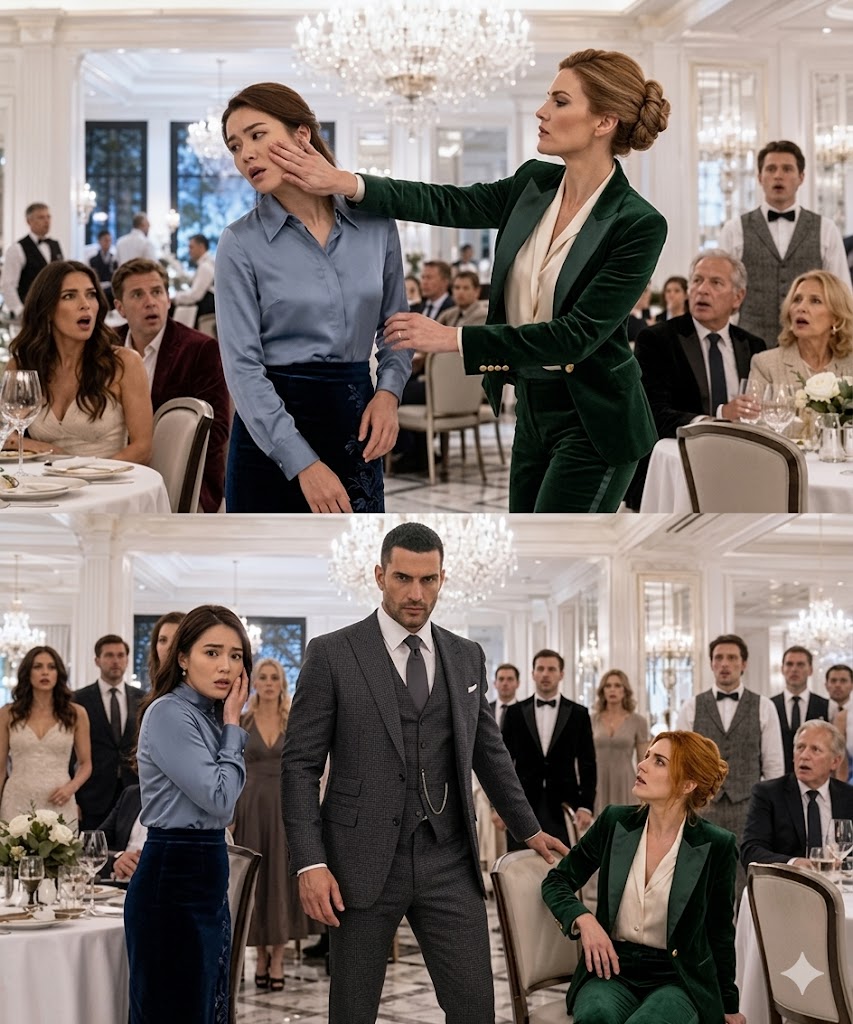
The slap was loud enough to make a senator drop his fork. It wasn’t just a sound; it was an event, a sudden, sharp fracture in the air that seemed to vibrate against the crystal glassware. For one breathless second, every whispered deal, every million-dollar secret inside the most exclusive dining room in Manhattan seemed to stop midair, suspended in the sudden vacuum of the room’s collective shock.
A young waitress stood frozen beside a table draped in pristine white linen, one hand pressed to her cheek where a thin, bright red line was beginning to bloom beneath her left eye. She didn’t cry out. She didn’t retreat. She simply stood there, a statue of quiet defiance in a room designed for people who expected the world to bow.
Across from her, Chloe Harrington—the beautiful, untouchable fiancée of New York’s most feared man—stood trembling with a rage that had nothing to do with the environment. She was wearing a silk Valentino blouse that had been splashed with exactly three drops of sparkling water. Three drops. That was all it took for the veneer of high society to peel away, revealing the jagged edge of her character.
But what happened next was not about the water. It was not even about the slap. It was about the man who rose from the table.
Daniel Moretti did not raise his voice. He did not curse. He did not threaten anyone in the way ordinary men threaten—with noise or grand gestures. He simply placed his wine glass down on the table, the crystal making a soft, melodic clink that sounded like a funeral bell. He looked at his fiancée, his eyes a pale, unreadable gray, and said, “Sit down, Chloe.”
The restaurant fell so silent that people could hear the ice shift in a glass three tables away. Laura was not the kind of restaurant where scenes happened. It sat behind a polished black door on East 65th Street, with no sign, no menu posted outside, and no hope of entry unless your name mattered before you were born. Tonight, Daniel Moretti occupied the center table in the private dining room beneath a chandelier of smoked crystal.
To the newspapers, he was the thirty-two-year-old CEO of Moretti Holdings, a cold young venture capitalist. To the men who controlled the docks, offshore money, union votes, and the quiet back rooms of the city, Daniel was something else. He was the heir who had inherited a collapsing empire and rebuilt it without wasting a single bullet.
Sitting beside him was Chloe Harrington, the daughter of a power broker with deep Albany connections. Their engagement was the talk of the city—a romantic merger. But those who understood the city knew it was a treaty. Chloe wore the treaty on her left hand: a five-carat emerald-cut diamond large enough to bend the light whenever she moved.
“The lighting is terrible,” she had been complaining all evening, her face turned toward Daniel as if the chandelier had personally insulted her. “And the floral designer for the wedding is refusing to import white peonies. Can you imagine?”
Daniel had been thinking about a shipping manifest at Pier 40 when Maya Jenkins approached the table with a bottle of chilled sparkling water. Maya had worked at Laura for three weeks. She was quiet, efficient, and almost invisible. She had learned how to make herself small—not because she was small, but because small things were harder to hit.
“Sparkling or still, Mr. Moretti?” she asked softly.
As she poured, Chloe had lifted her hand, her wrist striking the bottle. The water splashed onto her sleeve.
“Don’t touch me,” Chloe had hissed, her voice cutting through the dining room like a dropped knife. When the maître d’, Mr. Rousseau, hurried over to intervene, Chloe ignored him, her eyes locked onto Maya’s. “Apologize properly.”
Maya’s jaw tightened. “I’m very sorry.”
“No,” Chloe said, a cruel smile touching her lips. “Not like that.”
And then, the slap.
As Daniel Moretti rose, the entire room seemed to hold its breath. He wasn’t looking at the waitress. He was looking at Chloe, his face unreadable, his composure so absolute it was terrifying.
“Sit down, Chloe,” he repeated, his voice barely a whisper, yet it reached the corners of the room.
Chloe looked at him, her defiance faltering under the weight of his gaze. She looked like she wanted to argue, but the coldness in Daniel’s eyes stopped her dead. She slid back into her chair, her hand still trembling.
Daniel turned his attention to Maya. He looked at the red mark on her face, then down at the linen napkin she still clutched in her hand. He didn’t offer a platitude. He didn’t offer money. He just looked at her, and for a fleeting moment, the mask of the ruthless CEO seemed to slip, revealing something darker and much more focused.
“Are you hurt?” Daniel asked.
Maya didn’t lower her eyes. She didn’t shrink. She looked him straight in the face. “I’m fine, sir.”
“You’re not fine,” Daniel said. He turned to the maître d’. “Rousseau, bring her to my office. Now.”
The restaurant buzzed with a sudden, frantic energy. A waitress, a slap, and now the boss was inviting her to his inner sanctum? It was a breach of everything they understood. As Maya followed Rousseau, she felt the weight of three hundred pairs of eyes on her back. She didn’t look back. She walked toward the back office, her mind already racing with the implications. She had been invisible for three weeks; now, she was the center of a storm she hadn’t started but knew she would have to navigate.
She entered the office, and the heavy door clicked shut behind her, sealing her inside with the most dangerous man in New York.
Part 2: The Inquiry
The office was a study in minimalist violence—bare stone walls, a massive oak desk, and a single, low-hanging light that cast the room in shades of charcoal and shadow. Maya stood in the center, her hands at her sides, refusing to let her posture collapse. She had spent a lifetime learning how to survive the whims of people who felt they owned the world; she knew that the moment you showed fear, you became a target.
Daniel Moretti sat at the desk, his charcoal suit jacket discarded on a nearby chair. He watched her for a long time without speaking, his eyes tracing the mark on her cheek with a clinical intensity. He wasn’t looking at her as a waitress; he was looking at her as a puzzle.
“You didn’t cry,” Daniel said, his voice quiet.
“Crying wouldn’t have fixed the blouse,” Maya replied, her voice steady.
Daniel leaned forward, his hands clasped on the polished surface of the desk. “You didn’t look away, either. Most people in this room look at me like I’m a landslide they’re trying to avoid. You looked at me like I was another person in the room.”
“You are, aren’t you?”
He laughed, a dry, humorless sound. “You have a dangerous mouth for someone who makes minimum wage.”
“I have nothing to lose, Mr. Moretti. That makes me more dangerous than anyone in this building.”
The door opened and Mr. Rousseau entered, carrying a small medical kit. He looked at Maya, then at Daniel, his face tight with concern. “Sir, the young lady—”
“Leave the kit, Rousseau. And close the door,” Daniel ordered.
The maître d’ hesitated, then placed the kit on the corner of the desk and retreated, closing the door softly. The silence returned, heavier than before.
“Who are you?” Daniel asked, his tone shifting from amusement to something sharper.
“I’m a waitress. I told you that.”
“You’re a waitress who carries herself like a soldier, who doesn’t flinch when a wealthy, spoiled woman assaults her, and who isn’t afraid to speak to me like an equal.” He stood up, walking toward her, his presence filling the room. “You were watching me long before the water spilled, weren’t you?”
Maya held her ground. She could feel the heat radiating from him, the sheer pressure of his authority. “I watch everyone, Mr. Moretti. It’s part of the job.”
“You’re a spy,” he said, not as a question, but as a realization.
Maya smiled, and for the first time, it reached her eyes—a small, cold, and entirely mirthless expression. “A spy? That’s a bit dramatic, don’t you think? I’m just a woman who pays attention to details.”
“And what details have you picked up on tonight?”
“I noticed that your fiancée is terrified of you. I noticed that your business partners are afraid of you. And I noticed that you don’t actually like her very much.”
Daniel stopped inches from her. He was taller than her, and the shadow he cast seemed to swallow her whole. “You’re playing a dangerous game, Miss Jenkins.”
“I haven’t even started playing yet,” she whispered.
She reached for the medical kit on the desk, opened it, and pulled out an ice pack. Without asking, she pressed it against her own cheek, her gaze never leaving his. The power dynamic in the room was shifting in real-time, the air thick with an unspoken, volatile tension.
“Why are you really here?” Daniel asked, his voice dropping.
“To earn a living,” she said, but the words felt like a lie.
“There are easier ways to earn a living in this city.”
“But none of them bring me this close to the center of the hurricane,” she replied.
Daniel stared at her, and in his eyes, she saw the flicker of something he had spent years trying to suppress: a genuine, burning curiosity. He was a man who took apart empires, and he had just found a component he couldn’t identify.
“If you’re working for someone else,” he said, his voice low and dangerous, “tell me now. If you’re here to steal, to sabotage, or to sell my secrets, I will find out, and I will destroy you.”
Maya leaned in, her voice just a breath away from his. “I’m not working for anyone, Mr. Moretti. I’m just waiting.”
“Waiting for what?”
“For the moment when the glass finally breaks.”
The office door rattled. Someone was knocking—frantic, insistent. It was Chloe.
Part 3: The Treaty in Question
The knock on the door was frantic, the sound of a woman who was used to being given exactly what she wanted, exactly when she wanted it.
“Daniel! Open this door!” Chloe’s voice was high-pitched, laced with the metallic tang of hysteria. “I know she’s in there! Fire her! Fire that pathetic little girl right now!”
Daniel didn’t turn. His eyes were locked on Maya, whose hand was still holding the ice pack to her face. He looked at the door, then back at the waitress. The office felt like a pressurized cabin, the tension mounting to a point where even the air felt jagged.
“She’s demanding your head,” Daniel said.
“She’s demanding a sacrifice,” Maya countered. “She thinks that if she gets rid of me, she can ignore the fact that her fiancé just chose to stand up for a waitress instead of his future wife.”
Daniel’s expression flickered. “I didn’t stand up for you. I stood up for order. You were doing your job. She was being a spectacle.”
“Is that what you tell yourself?” Maya asked, her voice soft. “That it’s just about order? That you’re a man of principle?”
Daniel’s jaw tightened. “My principles are my own. They don’t concern a waitress.”
“Then why are we still here?” she asked, gesturing to the closed door. “Why didn’t you just fire me and go back to your expensive wine?”
Daniel opened his mouth, but the door rattled again, more violently this time. “Daniel! If you don’t open this door, I’m calling my father! He’ll shut this place down!”
“She’s a threat to you,” Maya said, her eyes dropping to the door. “Not to me. To you. The longer you keep her waiting, the more of your ‘order’ you lose.”
Daniel walked to the door and unlocked it. He didn’t open it fully; he just let it swing wide enough for Chloe to see him. She stood there, her face a masterpiece of distorted rage, her eyes searching the room for Maya, who had stepped into the shadow of the bookshelf.
“Where is she?” Chloe demanded, her eyes darting around. “I want her gone! I want her out of the city! I want to know who let a creature like that even stand on this floor!”
“Go home, Chloe,” Daniel said. His voice wasn’t loud, but it had the weight of a stone falling through water. “The night is over.”
“The night is over? You slapped me down in front of the entire dining room, and you think I’m just going to go home?”
“You didn’t get slapped down,” Daniel said. “You fell. There’s a difference.”
Chloe’s breath hitched. She looked at him with a mixture of hatred and terror. She realized, in that moment, that the treaty she was counting on wasn’t nearly as solid as she had thought. She turned, her heels clicking aggressively on the marble, and stormed down the hall.
Daniel closed the door and turned back to the room. Maya was still standing in the shadows, her expression unreadable.
“She’s going to make this very difficult for you,” Maya said.
“Difficult is my baseline,” Daniel replied.
He walked back to his desk, but he didn’t sit down. He looked at the ice pack on the floor where Maya had dropped it. “You have five minutes to tell me why you’re really here, Maya Jenkins. And if the truth isn’t in those five minutes, you’re going to regret the day you walked into Laura.”
Maya stepped forward into the light. She looked tired, but beneath the fatigue, there was something else—a resolve so deep it seemed to anchor her to the earth.
“My father worked for your father,” she began. “Twenty years ago.”
The silence in the room changed instantly. It was no longer the silence of tension; it was the silence of a sudden, brutal history. Daniel’s face went still, all the movement vanishing from his features.
“My father didn’t work for anyone,” Daniel said. “He was a partner.”
“He was a ghost,” Maya said. “And so was mine.”
Part 4: The Ghost of the Past
“Your father,” Daniel said, his voice dropping to a whisper, “was Marcus Jenkins.”
Maya didn’t confirm or deny. She simply stood there, a living, breathing shadow of a name that hadn’t been spoken in these circles for two decades. “He wasn’t a partner, Daniel. He was the one who kept the books. He was the one who held the codes, the one who tracked the transfers, and the one who knew exactly where the bodies were buried.”
Daniel gripped the edge of his desk, his knuckles turning white. Marcus Jenkins had been his father’s right-hand man—the man who had supposedly disappeared with a suitcase of cash and betrayed the family just days before the elder Moretti was assassinated.
“He was a traitor,” Daniel spat. “He disappeared the night my father died.”
“He didn’t disappear,” Maya said. “He was executed. He was taken out by the same people who killed your father, because he knew they were coming for you, too.”
Dominic looked at her as if she were speaking a foreign language. “How do you know that?”
“Because he left something behind,” she said. “He left me. He spent the last months of his life training me, teaching me the things that no one in this world wants to remember. He taught me that in a world of ghosts, the only way to survive is to become one.”
The gravity of the situation was suddenly overwhelming. Daniel, the man who had climbed to the top of the empire, was realizing that he hadn’t reached the summit; he had only climbed to the center of a much larger, much older trap.
“If you’re here for revenge,” Daniel said, his voice hollow, “you’re late. I already dismantled the men who took the empire from us.”
“I’m not here for revenge,” Maya said. “I’m here to finish the audit.”
She reached into her pocket and pulled out a small, encrypted drive—the same kind of drive that held the secrets of every major Syndicate deal. She placed it on the desk. “This isn’t just about my father or yours. This is about what they built and what they were trying to hide when they were killed. Everything you think you know about Moretti Holdings, about the Harrington treaties, about the source of the capital—it’s all a lie.”
Daniel stared at the drive. “What are you talking about?”
“The money didn’t come from the docks,” she said. “It came from the infrastructure. It came from the very things that kept this city running. Your father and mine were building a city-wide control system, not just a criminal enterprise.”
Daniel’s world was spinning. He thought he was a venture capitalist, a king of commerce, but he was merely the latest iteration of a machine that was centuries old.
“If this is true,” Daniel said, “then everyone in that dining room is complicit.”
“Everyone,” Maya agreed. “Including your fiancée’s father. Especially him.”
The implications were catastrophic. If the Harrington family was involved, then his engagement wasn’t just a treaty; it was a cage. They were trying to bind him to their version of the machine, to make him a permanent, compliant cog.
“Why tell me?” Daniel asked. “Why not just burn it all down?”
“Because you’re the only one left who isn’t entirely part of the machine yet,” Maya said. “You’re arrogant, you’re cold, and you’re cruel, but you’re not a puppet. You still have a shred of the hunger that killed your father. That makes you the only asset I can use.”
“Asset?” Daniel laughed, a sound that held genuine bitterness. “I’m not your asset.”
“You are if you want to know who actually killed your father,” Maya whispered.
The door to the office exploded inward. Three men in tactical gear stormed the room, weapons drawn.
Part 5: The Siege of Laura
The men in tactical gear moved with the precision of professionals. They weren’t police; they were mercenaries, the kind of shadows that didn’t leave a trace. Daniel didn’t hesitate. He dived behind the desk, pulling Maya down with him just as a volley of suppressed gunfire chewed through the mahogany.
“They were waiting,” Maya hissed, her voice sharp with adrenaline. “They knew we were talking.”
“How?” Daniel asked, his mind already calculating their options.
“It doesn’t matter,” she said. “We have to move.”
Daniel flipped the desk, creating a barricade, and returned fire with his own concealed pistol. The room was a cacophony of shattering glass and splintering wood. Through the chaos, he caught a glimpse of their attackers. They wore insignias he didn’t recognize—not the Syndicate, not the Harringtons.
“Who are they?” Daniel yelled.
“They’re the cleanup crew,” Maya said, her eyes fixed on the door. “They’re here to erase everything.”
They scrambled toward the ventilation shafts, the only way out of the sealed office. Daniel boosted Maya up, her movements liquid and lethal as she climbed into the cramped, metallic dark. He followed, the sounds of his office being systematically dismantled below him.
They crawled through the ductwork, the air thick with dust and the smell of ozone. They emerged into the kitchen, the very kitchen where Maya had been working only hours before. The dining room was empty, the guests having fled at the first sign of trouble.
“The back exit,” Maya said. “We can get to the street from there.”
They reached the alley, the cold city air a sharp contrast to the heated violence of the office. But the alley was blocked. A black sedan idled there, and standing in front of it was Thomas Harrington, Chloe’s father.
He wasn’t holding a weapon; he was holding a cigarette. He looked at them—at the billionaire and the waitress—with the tired, disappointed expression of a man who had seen this movie before.
“Daniel,” he said, his voice calm. “You were doing so well. Why did you have to go and ruin it with a conscience?”
“You killed my father,” Daniel said, his voice a low, dangerous rumble.
“I didn’t kill him,” Harrington said. “I just allowed the market to correct itself. He was becoming… inconvenient.”
“And the drive?” Daniel asked. “Is that what you wanted all along?”
“The drive is merely a redundancy,” Harrington said. “You don’t need a drive when you own the server.”
He motioned to the men in the sedan. “Get them.”
Maya didn’t wait. She lunged forward, not for Harrington, but for the car. She hot-wired it in seconds, the engine roaring to life with a screech of tires. Daniel leaped into the passenger seat, and they roared down the alley, the bullets pinging against the rear frame.
“Where are we going?” Daniel shouted.
“We’re going to see the one person who isn’t part of the machine,” Maya said, her eyes glued to the rearview mirror. “We’re going to the docks.”
Part 3: The Docks of No Return
The car lurched through the city, dodging traffic with a reckless abandon that seemed to defy the physics of the midtown rush. Maya was a driver of surgical precision, weaving through the tight corridors of the lower East Side until the skyline of Manhattan became a distant, jagged silhouette.
“The docks?” Daniel asked, his breath coming in short, sharp hitches. “You’re taking me to the one place where the Syndicate has eyes everywhere?”
“The Syndicate eyes are blinded,” Maya replied. “They think you’re dead or in hiding. We’re heading to the forgotten pier—the one your father used to keep off the books. The one that doesn’t exist on any corporate map.”
Daniel frowned. He knew the history of the Moretti empire, but he had never heard of a forgotten pier. “My father was a king of the city, not a ghost.”
“Your father was a master of layers,” Maya corrected. “And the layer you lived in was only the surface.”
The docks were a wasteland of rusting iron and rotting timber, the scent of salt and decay hanging heavy in the night air. They parked behind a collapsed warehouse, the headlights casting long, spectral shadows over the debris.
“Why here?” Daniel asked.
Maya didn’t answer immediately. She walked toward the edge of the pier, where the dark water lapped at the rotted pylons. She reached down and pulled a hidden chain, and a section of the floorboards groaned, then swung upward, revealing a staircase leading down to a hidden, subterranean chamber.
“Down there,” she said, “is the archive. Every deal, every bribe, every casualty of the last thirty years of New York’s growth. My father wasn’t just tracking the money; he was tracking the blood.”
Daniel followed her down the stairs, his heart hammering against his ribs. The chamber was lit by dim, flickering LEDs, and the walls were lined with rows of filing cabinets and a solitary, massive server bank. It was a digital and physical tomb of a city’s darkest history.
“You’ve been holding this?” Daniel asked, looking at the sheer volume of data.
“I’ve been preparing it,” she said. “The files are already set to be released to every major news outlet in the country in one hour, unless I input the master code.”
“And if you don’t?”
“Then the world finds out that the city’s entire growth was built on a foundation of orchestrated chaos, and the Harrington family is at the center of it.”
Suddenly, the lights went out.
The sound of footsteps echoed from the stairs above—slow, rhythmic, and heavy. Someone had found them.
“They’re here,” Maya whispered, pulling the gun from her waistband.
“Who?”
“The people who killed our fathers,” she said.
A flashlight beam cut through the darkness, landing on them. At the top of the stairs stood a figure, tall and unmistakable. It wasn’t one of Harrington’s men.
It was the maître d’ from Laura. Mr. Rousseau.
“I’m sorry, Mr. Moretti,” Rousseau said, his voice light and apologetic. “But there’s a new owner of this pier, and he isn’t interested in audits.”
“Rousseau?” Daniel asked, stunned. “You were my father’s right hand.”
“I was a keeper,” Rousseau said, his face hardening. “And you have become a liability.”
The chamber erupted.
Part 4: The Betrayal of the Maître D’
The bullets hissed through the air, sparking against the steel cabinets. Daniel dragged Maya behind a stack of crates, returning fire with erratic, desperate shots. Rousseau was not the mild-mannered man he had played in the dining room. He was a professional, his movements efficient and utterly ruthless.
“He was the one,” Maya hissed, pressing her back against the crate. “He was the cleanup crew for your father, and he was the one who handed the empire to Harrington.”
“I should have killed him years ago,” Daniel snarled.
“You didn’t know,” Maya said. “That was the point.”
Rousseau stepped down one step, his flashlight sweeping the room. “You know, Daniel, it really is a shame. You had such promise. You were turning the Syndicate into something respectable. But the past is a persistent thing. It never quite stays dead.”
“What do you want?” Daniel called out.
“I want the drive,” Rousseau said. “And I want you both gone. The Harrington family is willing to pay a very high price for your silence.”
Maya looked at Daniel, her eyes bright with a dangerous idea. “We can’t fight them with guns, Daniel. We have to use the room.”
“What room?”
“The archive,” she said. “The servers. They aren’t just for storage; they’re a grid. If I can reroute the power from the main pier, I can cause an overload.”
“It’ll take out the entire dock,” Daniel warned.
“Better the dock than us,” she said.
Maya scrambled toward the server bank, her fingers flying across a hidden interface. She wasn’t just a maid; she was a systems engineer, trained in the shadows to bridge the gap between physical and digital warfare.
“Do it!” Daniel yelled, covering her with a steady stream of fire.
Rousseau lunged, his gun aimed at Maya. Daniel tackled him, the two of them crashing into a filing cabinet. The force of the impact shook the chamber, sending sparks showering from the exposed wiring.
Maya finished the sequence. EXECUTE.
The lights exploded. A surge of electricity surged through the room, turning the server bank into a torch. The explosion threw them all to the floor, the chamber groaning under the force of the overload. The walls began to buckle.
“The exit!” Maya screamed, dragging Daniel toward the staircase.
They scrambled up the stairs as the chamber began to collapse, the sound of falling timber and twisted metal a deafening roar. They hit the pier just as the floorboards behind them disappeared into the dark, churning water.
Rousseau was gone.
The warehouse was a skeleton of ruin, engulfed in flames that licked at the night sky.
“Is it done?” Daniel asked, gasping for air.
Maya looked at the burning pier, then at the drive in her hand. It was scorched, but intact. “No,” she said. “It’s only just begun.”
Part 5: The Glass Walls Crumble
The fire at the pier was the first crack in the foundation. By morning, the city was in an uproar. The rumors of a Syndicate collapse turned into news reports about a massive investigation into the Harrington family. But the real story wasn’t just the fire; it was the contents of the files Maya had released to the media.
Every bribe, every dirty contract, every name—the digital release was like a slow, burning poison spreading through the veins of the city.
Daniel sat in a safe house—a small, nondescript apartment in Brooklyn—watching the coverage. He looked like a man who had been hollowed out and rebuilt. Beside him, Maya was typing at a laptop, her face illuminated by the harsh, blue light of the screen.
“They’re scrambling,” she said. “The Harrington lawyers are already filing for bankruptcy, trying to distance themselves from the disclosures.”
“It won’t be enough,” Daniel said.
“No, it won’t. But it’s the beginning.”
Daniel stood and walked to the window. He saw the city differently now. It was no longer a stage for his power or a machine he had to manage. It was a place of people—people like his father, people like Maya’s brother, people who had been chewed up and spit out by a system they didn’t understand.
“Why did you come to work for me?” Daniel asked, turning to her. “You could have destroyed me from the outside. You could have released the files months ago.”
Maya stopped typing. She looked at him, and for the first time, her armor felt thin. “Because I needed to know if you were like them. I needed to see if you would turn into your father, or if you would choose to be something else.”
“And?”
“And I think you’re still choosing,” she said.
The door buzzer rang. It was an old-fashioned sound, one that didn’t belong in their world of digital threats and encrypted data.
“Who is it?” Daniel asked.
“It’s Rebecca,” a woman’s voice called out.
Daniel froze. Rebecca. His sister. He hadn’t spoken to her since the day he took over the company.
He opened the door. Rebecca stood there, looking at him with a mix of shock and pity. She wasn’t alone. She had two men with her—men in clean, sharp suits, the kind that weren’t Syndicate. They were lawyers.
“They’re coming for you, Daniel,” Rebecca said, her voice shaking. “The rest of the Syndicate. They’ve formed a new alliance. They don’t care about the files. They just want the territory.”
“Let them come,” Daniel said.
“They have the police,” Rebecca warned. “They’ve bought the precinct. You have no one.”
Maya stepped forward. “He has me.”
Rebecca looked at the maid, then at the folder on the table, and finally at her brother. She understood then that the world she had been trying to protect—the world of respectability and quiet, expensive dinners—was gone.
“Then we’re all going to die,” Rebecca said, her voice hollow.
“No,” Maya corrected. “We’re just going to make sure that when we go down, we take the whole machine with us.”
Part 6: The Final Gala
The Syndicate’s final summit was held at the very place it began: the Meridian Hall. It was a desperate attempt to consolidate power, to bury the scandal, and to kill the threat.
Daniel and Maya arrived not in an armored limousine, but in a standard black sedan, their appearances deceptively simple. The room was tense, the atmosphere thick with the smell of expensive cologne and the metallic scent of hidden weapons.
They walked into the ballroom, the crowd going silent as they moved through the center of the hall. This wasn’t a gala; it was a wake.
“You’re brave,” a voice said. It was Chloe’s father, Thomas Harrington. He sat at the head of the table, his face a mask of predatory calm. “Or just stupid.”
“I’m just here to settle the bill,” Daniel said, walking to the table and placing the drive in the center.
“That drive is worthless,” Harrington said. “The public doesn’t care. The police don’t care. We own the game.”
“You own the game,” Maya said, stepping forward. “But you don’t own the players.”
She clicked a button on her phone.
Every screen in the hall, every phone in the room, every digital interface in the ballroom, projected the live stream of a confession. It wasn’t just files; it was video evidence. It was the face of Mr. Rousseau, the maître d’, appearing on the giant monitors.
He was in a room, his hands tied, the lighting harsh and clinical. He was talking. He was detailing every murder, every bribe, every instruction Harrington had ever given.
“I was the cleanup crew,” Rousseau’s recorded voice said. “And I have the receipts to prove it.”
The ballroom exploded.
The guests were no longer the elite; they were panicked animals, scrambling for the exits. But this time, the police weren’t bought. They were waiting at the doors.
Harrington went pale. He tried to stand, but Daniel grabbed him by the lapels, pulling him down into his seat.
“This is the end of your order,” Daniel said, his voice cold. “The trial begins now.”
Maya watched the chaos, the destruction of the house of cards she had spent her life dismantling. She felt a profound, exhausting sense of accomplishment. She had been the maid who cleaned up the messes, and tonight, she had finally cleaned the city.
As the sirens wailed, drowning out the shouting, she turned to leave. She didn’t want to see the arrests. She didn’t want to see the fall of the giants. She had done her part.
“Where are you going?” Daniel called out over the noise.
“Home,” she said. “I have a lot of towels to fold.”
She walked out into the cold New York night, the sirens behind her sounding like music. She was still Savannah Reeves, the maid from Akron, and for the first time in years, she felt entirely, utterly free.
Part 7: The Quiet Aftermath
The city was a different place the next morning. The news cycles were filled with the collapse of the Moretti and Harrington empires. The trials were underway, the truth finally exposed for all to see.
Daniel stood in his office, his desk empty, his company under investigation, and his life as he knew it gone. But he didn’t feel the weight of it. He felt light.
He walked to the window and looked out at the city. It was still there. The skyscrapers were still there, the streets were still busy, but the machine had been broken. It was no longer a cage; it was just a city.
He found Savannah in the hotel cafeteria, where she had returned to work, the only one who seemed unbothered by the chaos of the world. She was wiping down a table, her movements precise and calm.
“You’re still here,” he said.
She looked up, her expression as unreadable as the day he had hired her. “Work still needs doing. Dust doesn’t stop just because of a scandal.”
“The company is gone,” he said. “The empire is in pieces.”
“Good,” she said. “Maybe now you can build something that lasts.”
“What are you going to do?” he asked.
“I don’t know,” she said. “I have a lot of books to read. I have a lot of silence to fill.”
Daniel reached into his pocket and pulled out a small, heavy box. “You saved my son, you saved my sanity, and you saved my soul. I don’t know how to pay you for that.”
“You already have,” she said, nodding toward the window. “You walked out of the room.”
She turned and went back to her work, the maid who had folded a towel and destroyed an empire.
Daniel watched her for a long time, the man who had lost everything finally realizing that he had gained the only thing that mattered: a chance to start over.
He walked out of the hotel, the morning sun hitting his face. He didn’t look back. He didn’t have to. The empire was gone, the city was clean, and for the first time in his life, he didn’t have to worry about who was standing behind him. He was alone, and he was finally, truly, free.
The story of the Vasari empire became a legend, a cautionary tale whispered in the dark corners of the city, but the story of the maid who folded a towel remained the only truth that truly mattered—a simple, quiet truth about the power of hands that are willing to do the work.
And as the city moved on, unaware of the ghosts it had buried or the history it had rewritten, Savannah Reeves continued to walk her path, her life a quiet, resilient rhythm in the heart of a city that had finally learned how to speak.