“The Midnight Escape: A Husband’s Treachery, a Wife’s Calculated Silence, and the Final Envelope That Shattered an Empire”
Part 1: The Day the Lie Died
My name is Trevor Mitchell, and the day my marriage ended began like any other lie. That morning, the sun was bright, mocking the shadows I had carefully cultivated in my life. I stood in our bedroom, buttoning a dress shirt, while my wife, Hannah, sat on the edge of the bed nursing our three-month-old daughter, Grace. The sight should have been the anchor of my world, a scene of domestic holiness that would make any man fall to his knees in gratitude.
“I have a big presentation in Dallas today,” I said, my voice steady, practiced. “It’s going to be a long one. Don’t wait up.”
Hannah looked at me, her eyes clouded with the perpetual exhaustion of new motherhood. She smiled—a soft, weary, trusting thing—and nodded. “Good luck, Trev. We’ll be here when you get back.”
I kissed her forehead, feeling the scent of baby powder and sacrifice, and walked out the door. I didn’t go to Dallas. I didn’t even go to the office. Instead, I drove to a luxury hotel downtown where Vanessa was waiting. Vanessa was everything Hannah was currently too tired to be: vibrant, manicured, and obsessed with the hollow thrill of our affair.
We spent the day in a haze of boutiques. I bought her a diamond bracelet that cost more than my first car, designer handbags that would sit in her closet gathering dust, and perfume that smelled like artificial longing. We kissed in fitting rooms, our laughter echoing off the expensive, cold walls, oblivious to the fact that I was actively gutting the life I had built.
When I finally returned home that evening, shopping bags heavy in my hands, I was buoyed by a smug sense of accomplishment. I thought I was balancing two worlds. I thought I was untouchable. But as I pushed open the front door, the silence hit me like a physical weight. It wasn’t the peaceful, heavy silence of a sleeping house. It was the sterile, hollow vacuum of a place that had been scrubbed clean.
“Hannah?” I called out.
The house didn’t answer. I dropped the bags and walked into the living room. The couch was gone. The coffee table was gone. Even the family photos that had lined the walls were missing, leaving behind pale, dust-free rectangles. The nursery, once the heart of our home, was an echo chamber of bare floorboards. No crib. No swing. No Grace.
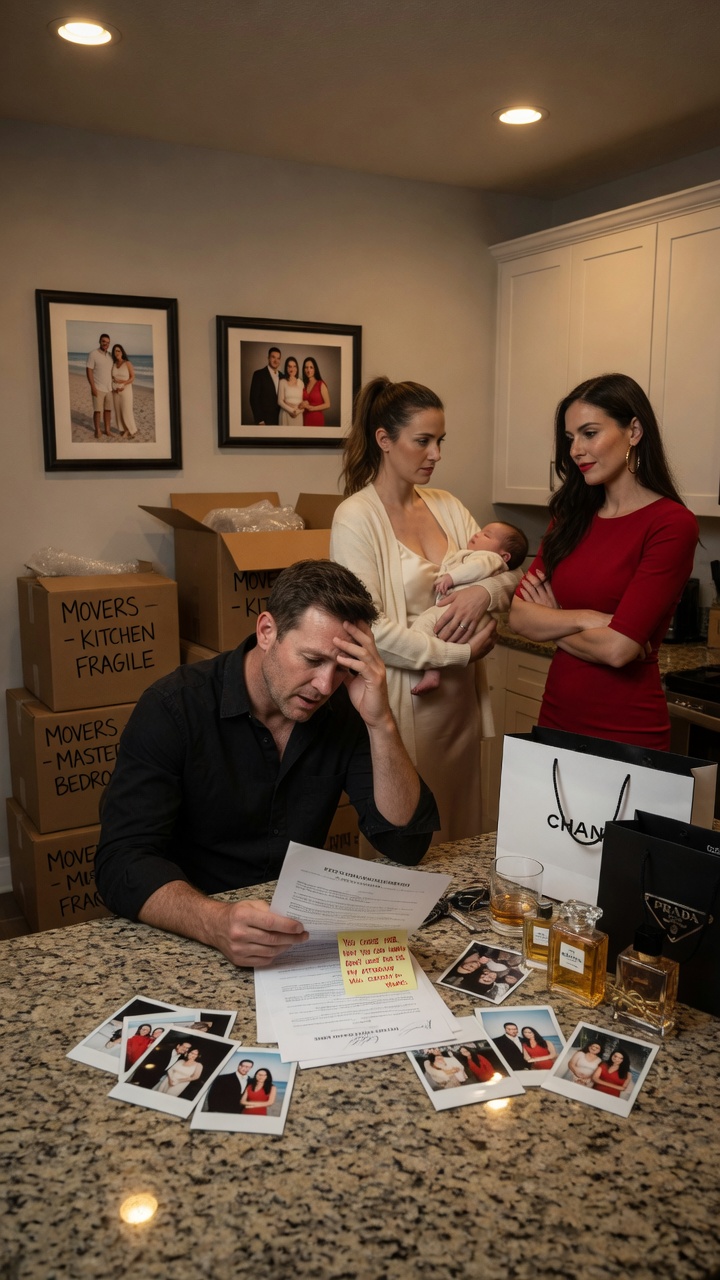
Panic, cold and sharp, ignited in my chest. I raced from room to room, but every space told the same story of calculated erasure. My belongings remained, sitting like garbage in an abandoned building. And there, sitting squarely in the middle of the kitchen island, was a manila envelope. My name was scrawled on the front in Hannah’s precise, elegant handwriting. I tore it open, my hands shaking so violently the paper rattled. Inside were receipts, hotel bills, and photographs of Vanessa and me—every secret expense and every stolen kiss laid bare. And on top, a single note: You chose her. Now you can have her. Don’t look for us.
Part 2: The Architecture of Erasure
I sat at the kitchen island, the cold granite biting into my arms, as the reality of my situation crystallized. Hannah hadn’t just left; she had conducted a tactical withdrawal. She had moved with the efficiency of a ghost, erasing her presence while I was busy playing the part of a wealthy benefactor to a mistress who didn’t even know my real middle name.
I tried to call her, but the line was already dead—disconnected. I tried her sister, her parents, her friends. Blocked. Every digital thread we had shared, every connection point to the woman I had married, was severed. She hadn’t just walked out; she had performed a surgical excision of me from her life.
My phone buzzed. A text from Vanessa: Had so much fun today, baby. Can’t wait to see you tomorrow. Wear that cologne I like.
I stared at the screen, the glowing letters looking like a death sentence. I looked at the empty nursery door, then at the divorce papers splayed across the counter. The irony was suffocating. I had gone to great lengths to hide the affair from Hannah, yet she had been collecting the evidence like a collector of fine art. She had known. For months, she had been nursing our daughter, enduring the sleepless nights and the physical toll of birth, all while watching me build a monument to my own infidelity.
I realized then that the woman I lived with wasn’t the soft, trusting creature I had assumed her to be. She was sharp, observant, and capable of a patience that now felt predatory. She had waited for me to trip, waited for me to invest enough in Vanessa that I would be distracted, and then she had pulled the rug out. I looked at the legal documents again, my eyes catching on the petition for full custody. Abandonment and financial misconduct. She was going to destroy me in court. But as I turned to the very final page of the filing—the exhibit labeled “Exhibit D”—my blood went cold. It was a document I hadn’t even known existed, a legal memorandum that didn’t just pertain to our marriage. It was something that suggested my financial life, my career, and the very foundation of my standing in the firm were based on a lie I hadn’t even realized I was telling.
Part 3: The Hidden Fault Line
I stared at Exhibit D. It was a series of internal emails from my firm’s compliance department, dating back two years. They detailed a pattern of “irregular financial activity” under my oversight as a project manager—activity that had, unbeknownst to me, been flagged and investigated. Hannah hadn’t just found out about Vanessa; she had somehow bypassed the company’s firewall to access my internal professional records.
The walls of the kitchen felt like they were closing in. I had always been arrogant about my work, assuming that because I brought in the numbers, the details didn’t matter. Now, it was clear that those details were a noose. Hannah had been documenting my professional negligence alongside my infidelity. If these papers went to the district attorney, I wouldn’t just be losing my wife and daughter; I would be facing federal charges.
How had she done this? She was a high school teacher, not a cybersecurity expert. Yet, these documents were authentic, stamped with the firm’s digital signature. I spent the next three hours in a fugue state, pouring over the papers. Every hotel charge I thought was encrypted, every restaurant bill I thought was private, was listed with agonizing precision. She hadn’t just caught me; she had mapped me.
The silence of the house was punctuated by the occasional hum of the refrigerator, a mocking reminder of the domestic life I had demolished. I picked up the phone, my thumb hovering over Vanessa’s contact. I wanted to scream, to blame her for everything, to hold her responsible for the wreckage. But I knew better. I was the one who had brought the wolf into the nursery.
I decided I had to get to the office. If I could get to the server, if I could find out how she had obtained the compliance reports, maybe I could contain the damage before the morning came. I grabbed my keys, but as I reached for the door, I saw a light flickering in the driveway. A car was parked at the curb, its engine idling. My heart surged—was it Hannah? Had she come back to reconsider? I pulled the curtain back, peering through the slats. It was a black sedan, unmarked. It sat there for a long, heavy minute, then slowly pulled away. They weren’t here to talk; they were watching.
Part 4: The Midnight Server Room
I reached the office just before midnight. The building was a monolith of glass and concrete, looming against the dark sky like a tombstone. My keycard still worked, which was a small miracle. I moved through the empty hallways, my footsteps echoing against the floorboards, every shadow looking like a process server or a detective.
I bypassed the elevator and took the stairs, my lungs burning. The server room was cold, the constant hum of the processors acting as the only soundtrack to my panic. I sat at my terminal, my fingers dancing across the keys, searching for the access logs. What I found made me recoil.
The logs showed that my own login credentials had been used to access these files, but the IP address came from our home network—at 3:00 a.m. while I was supposedly “in Dallas.” Hannah had been using my laptop, my login, and my own administrative privileges to conduct a deep-dive forensic audit of my life. She had been sitting in our bed, watching me sleep, while she was busy building the case for my total annihilation.
But that wasn’t the worst part. Buried beneath the logs was a folder titled “Project Grace.” I opened it, expecting more divorce data. Instead, it was a file from an external investigation firm, one specializing in white-collar crime. They had been tracking my firm’s accounts for months. Hannah hadn’t just been playing private eye; she had hired professionals to dismantle my reputation.
As I stared at the screen, a new email notification popped up. It was from the firm’s CEO, marked “Urgent.” Trevor, we are aware of the discrepancies in your department. Compliance will meet you at 8:00 a.m. tomorrow to discuss the findings.
They knew. My own boss knew. The noose wasn’t just tightening; it was already around my throat. I heard a sound from the hallway—the heavy, rhythmic strike of a security guard’s flashlight against his palm. I had to get out. I downloaded the “Project Grace” files to a flash drive, shoved it into my pocket, and scrambled toward the fire escape.
Part 5: The Chase
The city looked different from the fire escape—a labyrinth of wet alleys and blinding headlights. I didn’t go back to the house. I couldn’t. It was compromised. I drove to the outskirts of the city, my hands shaking so hard I could barely steer. Every passing car felt like a pursuit vehicle; every flashing neon sign felt like an indictment.
I stopped at a 24-hour diner, the kind of place where people go to disappear, and ordered a coffee I didn’t want. I needed to think. If Hannah had gone to this length, she wasn’t just looking for a clean break. She was looking for justice, or perhaps, something more vindictive.
I checked the flash drive. The “Project Grace” files contained something I had missed in my initial panic: a series of recordings. I plugged the drive into my laptop, my headphones trembling. Hannah’s voice filled my ears, but she wasn’t talking to me. She was talking to a detective.
“He’s not just unfaithful,” she was saying, her voice cold and devoid of the warmth I had once known. “He’s a cog in a machine that’s been laundering money for years. He thinks he’s a project manager, but he’s actually the primary signature on accounts that don’t exist.”
I gasped. I was a patsy. I had been signing off on files for years, thinking I was just handling logistics, while the firm was using my credentials to funnel millions. Hannah hadn’t just caught me cheating; she had accidentally uncovered a massive criminal enterprise that I was ostensibly leading.
If I went to the police, I would be admitting to a crime I didn’t know I was committing. If I stayed silent, the firm would frame me as the architect of the entire scheme. I was a man trapped between a vengeful wife and a criminal organization that viewed me as an expendable asset. I had to find them. I had to find Hannah and explain that I was a victim as much as she was, even if I was a victim of my own stupidity.
Part 6: The Vanishing Point
I tracked the car Hannah had used to leave—I had seen the license plate on the security footage from our neighborhood—to a rental agency in Austin. It took every favor I had left in the bank, every shred of dignity, to get a clerk to cough up the destination. She had driven to a small coastal town in Maine.
I didn’t care about the gas, the distance, or the mounting fatigue. I drove through the night, the world transforming from the arid plains of Texas to the lush, dark greenery of the East Coast. By the time I crossed into Maine, my eyes felt like they were filled with sand, but I didn’t stop. I couldn’t.
I reached the town—a quiet, salt-sprayed place that felt a million miles from the life of high-stakes commerce I’d left behind—just as the sun was beginning to break. I found the cottage she had rented, a small, weathered place perched on a cliff overlooking the Atlantic.
My heart was in my throat as I walked up the porch steps. I knocked, the sound weak and pathetic. The door opened. It wasn’t Hannah. It was her sister, Clara. She looked at me with a hatred so profound it felt like a physical heat.
“She’s not here, Trevor,” Clara said, her voice dripping with venom. “And even if she were, I’d throw you off this cliff before I let you talk to her.”
“I have to explain,” I begged, my voice breaking. “I was set up. I didn’t know what the firm was doing.”
Clara laughed, a sharp, bitter sound. “You spent every night at hotels with that tramp while your daughter screamed for her mother. Don’t talk to me about being set up. You set yourself up.”
She slammed the door. I stayed on the porch for hours, staring at the gray expanse of the ocean, the salt air stinging my eyes. I realized then that I had lost the right to be believed. Even if I was innocent of the laundering, I was guilty of the betrayal, and that was the only thing that mattered to the people who loved her.
Part 7: The Final Evidence
I spent the night in my car, watching the cottage. I was about to give up, to drive away and let the firm swallow me whole, when I saw a figure emerge from the cottage. It was Hannah. She was carrying Grace, walking toward the shoreline.
I didn’t think; I just moved. I ran down the path, the sand clogging my shoes, calling her name. She stopped, turning around, her face pale in the morning light. When she saw it was me, her expression didn’t change—no fear, no anger, just a profound, hollow exhaustion.
“Trevor,” she said, her voice steady. “Go away.”
“I have the flash drive,” I said, holding it out like a peace offering. “I know about the firm. I know I was being used. Please, Hannah, you have to help me.”
She looked at the drive, then at me. She didn’t take it. She just pulled Grace closer to her chest. “That’s not what I wanted, Trevor. I didn’t want you to save yourself. I wanted you to see what you had traded away.”
“I see it now,” I wept. “I see it every second.”
“Then look at it,” she said, nodding toward the ocean. “Look at it until you understand that you can’t buy back what you destroyed with a bracelet or a bag.”
She turned and started walking away. As I watched her go, I noticed something caught in the sand where she had been standing. It was a photograph—the one she had saved for last. I picked it up, my hands trembling. It wasn’t of me. It wasn’t of the affair. It was a copy of the firm’s internal ledger, with a name highlighted in bold red ink: Trevor Mitchell – Lead Scapegoat.
Underneath the name, in Hannah’s handwriting, were the words: I knew you were a liar, Trevor. I just didn’t know you were their fall guy until I saw the files. I left so you would have a chance to disappear before they killed you.
The ground beneath me seemed to vanish. She hadn’t just left to punish me; she had left to give me the one opportunity I hadn’t earned. I looked out at the vast, uncaring ocean, the ledger in my hand, and realized that my wife—the woman I had discarded—was the only person who had ever truly tried to save me. And I had finally run out of time.