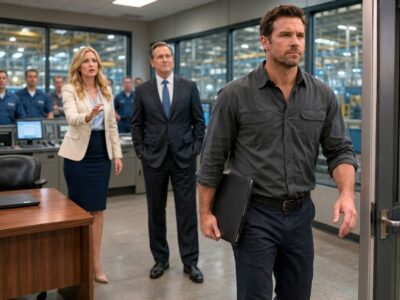
The Single Dad Returned From France—Then the CEO Ran Out and Hugged Him in Front of Everyone
Part 1: The Silence of the Forty-Second Floor
The headquarters of Kingsley Whitmore Global occupied a gleaming, razor-sharp tower on the southern edge of Manhattan. Its sheer glass facade caught the late-afternoon winter light, reflecting the gray expanses of New York Harbor in long, vertical strips that made the building look less like an office complex and more like an unyielding monument to old money and modern corporate ambition. Inside those high-ceilinged walls, however, the atmosphere had shifted dramatically over the past thirty days. The air felt thick, charged with the nervous energy of an impending execution, because the man who once sat closest to the CEO’s inner circle had completely vanished.
Everett Hail’s desk on the forty-second floor remained untouched. A thin film of dust had begun to collect on his dual monitors and his ergonomic keyboard, and his high-clearance security badge remained active in the corporate registry but entirely unused since the first week of the previous month. The only official explanation anyone in the firm had received was a deliberately vague, single-paragraph internal memorandum circulated by the human resources department. It stated that Mr. Hail had been reassigned to a confidential international engagement at the CEO’s personal discretion.
That explanation satisfied almost no one. It particularly failed to satisfy the senior vice presidents, because Everett Hail did not look like the kind of high-powered operative a global financial conglomerate would send overseas for anything critical. The corporate rumors that filled the empty vacuum of his prolonged absence grew uglier, sharper, and more coordinated with each passing day.
Everett possessed no family fortune. He had no Ivy League pedigree displayed in gold leaf frames on his walls, and he didn’t wear the custom-tailored Italian wool suits that the junior executives used to establish their rank in the hallways. To those who judged a person’s worth entirely by appearance, his presence in the upper echelons of Kingsley Whitmore Global had always seemed like a charitable gesture—a piece of unearned sentimentality from the female CEO—rather than a strategic business decision.
The whispers moved through the conference rooms, the private dining lounges, and the high-speed elevator banks with the lethal efficiency of a biological virus. They said the single dad from the suburbs had finally been exposed as a fraudulent fraud. They whispered that Genevieve Whitmore Kingsley, the brilliant but notoriously icy chief executive, was simply too embarrassed to admit she had wasted corporate resources on a man out of pity.
Barrett Ashford III fed those whispers with surgical precision. He was the company’s chief financial officer, a man whose lineage was deeply woven into the fabric of Manhattan’s financial history. His family name appeared on hospital wings, university libraries, and museum galleries across the state. Barrett never said anything directly accusatory during the official board meetings where the minutes were recorded, but he always knew exactly how to find the right corridor, the right mahogany lunch table, or the right after-hours cocktail gathering to plant another seed of calculated doubt.
He told the junior analysts that Everett had completely stopped sending operational progress reports within forty-eight hours of his arrival in France. According to Barrett, that silence proved there was no progress to report. He told the senior vice presidents that a man who couldn’t afford a decent winter coat had no business representing a company worth tens of billions in European banking circles. He argued that the sheer embarrassment of Everett’s presence in Paris would cost them more than whatever distressed asset deal Genevieve imagined he could secure.
Barrett’s voice carried the particular, crushing confidence of a man who had never had to prove his right to occupy a room. When he spoke about Everett’s inadequacy, people listened. They didn’t listen because the evidence was compelling; they listened because Barrett’s social gravity made his cruelty feel like common sense. He even circulated a mocking joke among the trading floor staff that Everett was probably using the corporate travel budget to take his six-year-old daughter sightseeing along the Seine because he couldn’t afford a vacation on his own salary. The laughter that followed that joke was sharp enough to cut through any remaining goodwill the absent man might have held among the staff.
Genevieve Whitmore Kingsley endured the systematic erosion of Everett’s reputation in absolute, stony silence. She had to. Every instinct telling her to defend him publicly had to be suppressed beneath the absolute weight of strategic necessity. The multi-billion-dollar refinancing agreement being negotiated in France demanded total, airtight secrecy. She understood with terrifying clarity that the moment she revealed any specific detail about the nature of Everett’s mission, the information would leak through Barrett’s vast internal network and reach the competing interest groups that were already circling Kingsley Whitmore Global like patient predators, waiting for the family-built empire to show a mortal wound.
So she sat through board meetings where her authority was slowly being eaten away at the edges. She sat at the head of the long obsidian table on the sixty-first floor while Sterling Beaumont, the elderly chairman of the board, questioned her judgment with increasing, public sharpness. Sterling did not raise his voice; men of his background never needed to. His questions landed with the cold, heavy force of final verdicts.
“Why had she entrusted an international debt negotiation to an unknown advisor?” Sterling asked during the Friday morning session, his white hair gleaming under the LED lights. “Why had she not consulted the board before dispatching a man without credentials? And why, after thirty days of total silence, was there no verifiable result to justify the massive risk she had taken with the company’s future?”
Genevieve looked down the length of the table, her face an unreadable mask of ice that financial journalists had spent a decade describing as glacial. “The results will be on this table before the restructuring deadline on Monday morning, Sterling,” she said, her voice steady and controlled. “Not a minute before.”
Sterling Beaumont didn’t smile. He adjusted his glasses, leaned forward, and delivered the ultimatum that everyone in the executive suite had been anticipating for weeks.
“If Everett Hail does not walk through those doors with a fully executed agreement before the board vote at nine o’clock on Monday morning, Genevieve,” Sterling said, his voice flat and unyielding, “the board will initiate a formal vote of no confidence. Your tenure as Chief Executive Officer will end. And it won’t end with a polite resignation. It will end with a removal.”
Genevieve didn’t look at Barrett, who was sitting at the far end of the table, slowly spinning a heavy gold pen between his fingers. She knew he had already drafted the announcement of her termination. She knew he had already cleared out his schedule for Monday afternoon to take her office.
She stood up, walked out of the boardroom, and took the private lift down to her office on the sixty-first floor. The doors closed, shutting out the murmurs of the directors, but as she reached her desk, her phone buzzed with an automated alert from the building’s security gate.
A high-clearance badge had just been scanned at the main entrance on the ground floor. It belonged to Everett Hail.
Part 2: The Logic of the Worn Briefcase
The story of how Everett Hail arrived at Kingsley Whitmore Global in the first place was one that the executive floor preferred to forget. It contradicted every single rule they believed about who belonged in their world.
One month before his sudden departure for France, Everett had walked into the building for his initial interview. He didn’t wear a three-piece suit; he wore a simple white button-down shirt with the sleeves rolled up to his forearms, exposing thick, calloused wrists that looked like they belonged to a carpenter rather than a financial analyst. He carried a brown leather briefcase so worn that the stitching along the bottom seam had been repaired twice by hand with a heavy nylon thread that didn’t quite match the original color. He spoke in a voice so calm, low, and unhurried that people in the meetings often had to lean forward just to catch the text of his sentences.
Genevieve had recruited him personally. She had spent four weeks tracking down his identity after reading a highly confidential case study about a mid-sized shipping firm in the Pacific Northwest. That firm had been seventy-two hours from an involuntary hostile liquidation before an unnamed crisis negotiator stepped into the room, restructured their entire debt architecture over a single weekend, renegotiated three vendor contracts simultaneously, and delivered a revised operating model that turned the company profitable within fourteen months.
She had found Everett living in a modest, two-story house outside Philadelphia, raising his daughter alone after his wife’s death, and consulting for local small businesses that couldn’t afford the prestigious Wall Street agencies but needed someone brilliant enough to save them from drowning. She had offered him a position not as a figurehead, but as her personal strategic advisor—the one person in the building who would sit in the room where the real decisions were made and tell her the truth that everyone else was too afraid or too compromised to speak aloud.
The executive team had despised him from his first morning on the forty-second floor. Barrett Ashford III had made his contempt the most visible, treating every interaction with Everett as an opportunity to establish dominance through public humiliation.
During an early meeting regarding the firm’s European debt exposure, Barrett had turned to Everett in front of twenty senior staff members, a smirk pulling at his telegenic lips. “Tell me, Mr. Hail,” Barrett had asked, his voice dripping with smooth condescension, “have you ever actually set foot inside an international negotiation chamber? Or is your experience limited to picking your daughter up from the second-grade car line and then adjusting cells in a basic financial model from your kitchen table?”
The question had drawn the immediate, sycophantic laughter of the executives who understood that aligning with the Ashford family meant securing their own bonuses.
Everett hadn’t flinched. He hadn’t raised his voice, and he hadn’t returned the insult with one of his own. He had simply waited for the laughter to die down completely, the silence stretched out until it turned uncomfortable for the room. Then, he opened the thick financial dossier that Barrett’s own division had prepared for the session.
With quiet, surgical precision, Everett identified three critical vulnerabilities in the company’s European exposure that the entire finance department had either completely missed or deliberately ignored. He pointed to a cross-collateralization clause that could trigger cascading defaults across two major logistics subsidiaries if the interest rates shifted by even a quarter of a point. He exposed a currency hedge that had been structured to benefit the counterparty bank rather than Kingsley Whitmore Global. Finally, he unearthed a missing disclosure in the quarterly SEC filing that bordered on a serious regulatory violation.
The silence that followed Everett’s explanation was not the comfortable silence of agreement. It was the dangerous, heavy silence of a room full of powerful people realizing that the man they had dismissed as a charity case was significantly sharper than all of them combined. Barrett’s hatred for Everett had crystallized in that exact moment, transforming from casual contempt into something personal, permanent, and vindictive.
“He’s a disruption to our corporate culture, Genevieve,” Barrett had told her in her office later that afternoon, his face red. “He doesn’t understand how things are done on this level. He’s sloppy.”
“He found a four-hundred-million-dollar accounting error in your department, Barrett,” Genevieve had replied, her voice like a sheet of dry ice. “If that’s what you call sloppy, I suggest you clean up your office.”
Now, three days before the Monday deadline, Genevieve stood by her window, her fingers pressing against the cold glass as she looked down at the courtyard forty-seven floors below. She could see the black town cars idling at the gate, the security guards moving through the sleet.
She turned back to her desk. The satellite link to Paris had been dark for twelve hours. Maline Rousseau, the brilliant but notoriously unyielding head of Rousseau Atlantique Capital, had refused her last three calls. The $2.6 billion refinancing package—the one Everett had been sent to secure—was the only thing keeping the company’s fintech and shipping divisions from being forced into a distressed fire sale to their primary competitors.
A soft knock sounded at her door. Her executive assistant, Lydia, stepped into the room, her face pale.
“Genevieve,” Lydia said, her voice barely a whisper. “Barrett just called an emergency meeting of the audit committee in the second-floor theater. He’s handing out copies of his alternative restructuring plan to the institutional investors right now. He isn’t waiting for Monday morning.”
Genevieve didn’t reach for her coat. She didn’t look at her phone. She walked straight out of her office toward the elevator bank, her heels striking the stone floor with a sharp, heavy thrum. “Tell the security desk to hold the elevator doors on the ground floor,” she commanded. “Everett is in the lobby.”
Part 3: The Campaign of Whispers
Barrett Ashford III understood that corporate power was not seized in dramatic, cinematic confrontations. It was accumulated slowly, patiently, through the systematic poisoning of a person’s trust.
Over the thirty days of Everett’s absence, Barrett had run his internal campaign with the meticulous care of a general laying siege to a city. He began each week by noting in the executive summary briefings that no formal communication had been received from the Paris team, framing Everett’s operational confidentiality not as a tactical necessity, but as definitive proof of failure.
He suggested to Sterling Beaumont over private dinners at the Chairman’s Club that Genevieve’s judgment had been entirely clouded by an emotional attachment to her strategic advisor. “She’s running a global conglomerate based on sentiment, Sterling,” Barrett had murmured over his scotch, his voice smooth and knowing. “She recruited a man from the suburbs because she pitied his family situation, and now she’s letting him hold our entire European debt note while he’s probably lost in the transit logs. We cannot afford a CEO who treats twenty billion dollars in assets like a charity project.”
Sterling Beaumont had listened to those words with the heavy, unblinking attention of a man who had survived fifty years on Wall Street by never committing to a side until the bodies were already counted. He didn’t explicitly endorse Barrett’s alternative restructuring plan, but he didn’t forbid him from showing it to the major shareholders either. In the subtle language of boardroom power, that silence was its own form of permission.
By the final Thursday of the month, the erosion was complete. The junior analysts on the forty-second floor had stopped using Everett’s name in their emails, replacing it with the shorthand “the missing variable.” The trading floor had turned the brown leather briefcase into a meme, joking that he had probably left it in a taxi in Paris because he didn’t know how to tip in Euros. The company’s internal culture had fully reconfigured itself to exclude the man before he had even returned to face the verdict.
Genevieve felt the isolation like a physical drop in the room’s air pressure every time she stepped onto the executive floor. She walked through rows of desks where people suddenly found their monitors intensely interesting the moment her shadow fell across their papers. They looked at her coat, her hair, her shoes, searching for some sign that the glacial CEO was finally starting to crack under the weight of the deadline.
She didn’t give them a single thing to write home about. She sat in her office until two every morning, reviewing the historical transaction files for the port operations, her face cast in deep shadow by the monitor light.
“You should let me call the Paris office directly, Genevieve,” Lydia had told her on Friday night, setting a fresh cup of coffee on the desk. “We have contacts at the embassy. We can find out if his name is even on the passenger registry for the return flights.”
“No,” Genevieve said, her fingers remaining flat on her desk. “The moment we look like we’re tracking him through the state channels, Barrett’s lawyers will claim we’ve lost operational control of our own advisor. We stay dark until he walks through the front entrance.”
“And if he doesn’t walk through?” Lydia asked, her voice quiet in the empty room. “Sterling has the no-confidence resolution pre-filed for Monday morning. The PR department has already drafted the statement about your transition to a consultant role.”
Genevieve looked at the silver-framed photograph on her credenza—the one of her father standing on the docks when the first Kingsley Whitmore shipping container was lifted out of the hold fifty years ago. “My father built this tower out of concrete and grit, Lydia,” she said softly. “He didn’t build it so an Ashford could turn it into a shell company for a New York private equity fund. Everett told me he wouldn’t fail. I’m going to hold the floor until the clock hits nine.”
Down on the second floor, inside the corporate theater, the lights were bright. Barrett stood at the central podium, his charcoal suit perfect, his laser pointer illuminating a slide that detailed the liquidation of the company’s European hotel chain. Thirty institutional investors sat in the plush leather seats, nodding as they read the bound portfolios his assistants had distributed.
“The current leadership’s strategy is based on an unverified, confidential debt negotiation that has produced zero documentation in thirty days,” Barrett told the room, his voice resonant and commanding. “We are proposing a clean, immediate operational restructuring. We will sell the European ports to the Falcon Group, liquidate the hospitality holdings, and consolidate our capital into the domestic trading sector. It’s lean, it’s efficient, and it doesn’t rely on the sentimentality of an unvetted single father from Philadelphia.”
A murmur of agreement ran through the row of investors. A senior fund manager from Boston raised his hand. “And the CEO? Does Genevieve have a response to this proposal?”
“Genevieve is currently awaiting a result that isn’t coming,” Barrett smiled, his teeth white under the stage lights. “She has staked her entire career on a man who didn’t even have the credentials to clear the compliance check for our regional offices. By Monday morning, the board will handle the transition. The Kingsley era is finished.”
The doors at the back of the theater didn’t slam open, but the handle turned with a sharp, heavy click that made the nearest investors turn their heads. Lydia stood in the frame, her face pale, her phone still active in her hand. She didn’t look at the investors, and she didn’t look at the slides. She looked straight at Barrett Ashford.
“The Chief Executive is on her way to the lobby,” Lydia said, her voice carrying through the silent theater with absolute clarity. “Mr. Hail’s badge just cleared the ground floor security gate.”
Part 4: The Paris Confession
The negotiation inside the limestone building overlooking the Seine had not been an elegant affair of state dinners and polite handshakes. It had been a brutal, multi-layered financial siege that had spent three weeks running on nothing but espresso, cold cigarettes, and the dense, legalistic text of cross-border tax codes.
Maline Rousseau was a woman who had earned her reputation by never letting a single drop of sentiment enter into her capital allocations. She sat at the center of a polished mahogany table that looked older than the American banking system, her gray hair pulled back into a severe twist, her dark eyes tracking Everett Hail with the unblinking intensity of an auditor who had spent thirty years detecting corporate lies before they were even spoken.
“Your company represents an unacceptable risk metric for our fund, Mr. Hail,” Maline had told him during their third session, sliding a three-hundred-page debt analysis across the table. “The disclosures provided by your finance division contain gaps that suggest either gross negligence or a deliberate attempt to hide your European cross-collateral liabilities. The board is fractured, your CEO is isolated, and your competitor, the Falcon Group, has already offered us a direct asset buyout for your shipping lines if you default next month. Why should Rousseau Atlantique risk $2.6 billion on an empire that is actively trying to destroy itself from the inside?”
Everett sat across from her. He hadn’t brought a laptop or a team of six junior analysts carrying graphic presentations. He had his worn leather briefcase resting on the floor beside his boots, and his white shirt sleeves were rolled up to his elbows, exposing the thick ridges of his wrists.
“You’re entirely correct about the risk, Madame Rousseau,” Everett said, his voice low, calm, and steady. He didn’t try to sugarcoat the numbers, and he didn’t offer her the optimistic growth models Barrett’s department had prepared. “The disclosures you received are unreliable because the financial division of Kingsley Whitmore Global has been structuring our European debt to benefit their private investment funds rather than the corporation treasury. The gaps you see aren’t errors. They’re a trail.”
Maline had frozen, her gold spectacles hovering an inch from her nose. Her team of four senior accountants had stopped typing simultaneously, their eyes slowly lifting from their screens to stare at the American technician.
“What did you just say?” she asked, her voice dropping into a dangerous register.
Everett reached into his briefcase and drew out a thick stack of hand-marked ledger sheets—the private internal transaction records Genevieve had authorized him to carry out of the New York vault. He laid them out across the mahogany table, smoothing the paper flat with his palm.
“For eighteen months, our Chief Financial Officer, Barrett Ashford, has been routing our regional shipping fees through a series of shell companies in Ireland,” Everett explained, his voice entirely free of emotional heat as he pointed to a series of routing numbers. “He’s been deliberately inflating our operational cost metrics to drive down the stock valuation before the restructuring deadline. He doesn’t want this refinancing package to close, Madame. He wants our European assets to go into a distressed default so his partners at the Falcon Group can buy them at an auction for forty cents on the dollar. He’s not managing our debt. He’s shorting our survival.”
Maline had spent three full days cross-referencing his sheets with her own intelligence files. She had sent her private investigators to Dublin, her compliance attorneys to the banking registry in London, and by the end of the week, the truth had emerged from the noise. Every number Everett had written down on those yellow grid pads was exact. Every vulnerability he had exposed was real.
“You are destroying your own company’s executive board in front of an international lender, Mr. Hail,” Maline had noted on their final night together, her voice holding a texture that was dangerously close to awe. “If I include these terms in the refinancing covenant, Barrett Ashford will be facing a federal indictment before the SEC opens on Monday morning. Why would a strategic advisor risk that kind of internal war?”
“Because the twenty-six hundred dock workers at our ports and the three thousand engineers in our fintech division don’t have family trusts to fall back on if Barrett sells their jobs to the Falcon Group,” Everett said, his eyes fixed on hers with an unshakeable clarity. “They given their lives to this company, and they deserve a leader who doesn’t treat their stability like a line item on a liquidation sheet. Genevieve Kingsley wants to build things. Barrett wants to strip them for parts. That’s the only variable that matters tonight.”
Maline Rousseau had looked at the silver medal around her own neck, then looked at the mismatched thread along the bottom seam of Everett’s leather briefcase. She didn’t call her board. She didn’t consult her committee. She picked up her heavy black fountain pen and signed the bottom of the refinancing covenant in one clean, unhurried stroke.
“Your CEO is a very fortunate woman, Mr. Hail,” Maline said, handing him the folder. “She sent an honest man to Wall Street’s execution block, and somehow, you’ve managed to turn the block into a bridge. Take this back to New York yourself. Don’t trust the digital lines tonight. Barrett’s network is still active.”
Everett had taken the train to Charles de Gaulle airport at midnight, boarded the non-stop flight to New York through a driving headwind, and hadn’t closed his eyes for nine hours. He had kept the folder zipped tight against his chest inside his coat, his fingers locked onto the worn leather handle of his bag like it was the only thing keeping the world from falling into the sea.
Now, as the elevator doors of the Kingsley Whitmore Global tower slid open onto the ground level, the cold air from the harbor hit his face, and he stepped out onto the polished white marble of the grand lobby. His boots were damp, his coat was wrinkled from the transatlantic crossing, and his face carried the gray, absolute exhaustion of a man who had spent thirty days carrying an empire on his back without a net.
Part 5: The Grand Lobby Void
The grand lobby of the Kingsley Whitmore Global tower was designed to make a human being feel entirely insignificant. It was a vast, cathedral-like expanse of white Italian marble, six-story glass pillars, and silent water installations that trickled down walls of dark slate. On any normal morning, the space was a high-frequency wash of sound—the sharp heel-clicks of thousands of analysts, the low rumble of corporate town cars arriving at the curb, and the constant, mechanical clatter of the revolving security doors.
But on this particular morning, as the clock on the marble wall ticked toward 8:42 a.m., the entire three-story hall fell into an absolute, suffocating void.
Everett Hail walked through the central glass turnstile. He didn’t look like a savior; he looked like a traveler who had taken a wrong turn on his way to the bus terminal. He carried the worn leather briefcase in his right hand, its mismatched nylon stitching visible under the bright LED ceiling arrays, and his dark winter coat showed the heavy creases of a nine-hour flight spent sitting in an economy seat against the bulkhead. His eyes were bloodshot, his jaw covered in three days of dark, unshaven stubble, and his shoulder was hunched slightly against the weight of his canvas suitcase.
The security guard at the front desk—the same man who had laughed at Barrett’s joke about the sightseeing tour along the Seine—stopped mid-motion, his hand frozen over his keyboard. A group of seven junior vice presidents who had been huddled near the directory board arguing about the alternative restructuring proposal went entirely quiet, their folders slipping an inch through their fingers.
The sound of Everett’s suitcase wheels rolling across the polished marble floor was the only noise left in the building. It was a rhythmic, scraping thud that echoed off the high glass walls like a countdown timer.
Clack. Clack. Clack.
Nobody spoke to him. Nobody offered to help him with his bag. They just stood there, hundreds of wealthy, immaculately tailored people, staring at the single dad from the suburbs who had vanished for thirty days into the smoke of an international crisis and had actually had the nerve to walk back through the front entrance on the morning of his own termination.
Then, the high-speed executive lift bank at the far end of the lobby chimed. A bright white indicator light flashed above the doors of Car One—the private car reserved exclusively for the Chief Executive Officer.
The doors slid open with a soft, pneumatic hiss.
Genevieve Whitmore Kingsley stepped out onto the marble. She didn’t look like the glacial CEO the financial journals had spent a decade dissecting. She wasn’t wearing her glasses, her silk collar was slightly turned at the neck, and she had abandoned a billion-dollar strategic alignment session with the institutional investors mid-sentence on the sixty-first floor the second Lydia’s message hit her screen.
She walked past the rows of senior vice presidents without turning her head. She walked past the security desk, her long charcoal wool coat billowing behind her heels, her stride accelerating with every single step until the controlled, calculated walk of Wall Street’s coldest executive became something completely different—the raw, urgent, undisciplined run of a woman who had spent thirty days holding her breath behind a fortress of ice and could finally let the air out of her lungs.
She crossed the remaining thirty feet of the grand lobby at a full sprint.
Before anyone in the building could process the breakdown of her protocol, Genevieve threw her arms around Everett’s neck. She didn’t care about the flashing cameras of the corporate PR team near the photo display. She didn’t care about the board members who were currently trailing down from the second-floor theater, their jaws slack as they watched from the mezzanine balcony. She buried her face into the damp, wrinkled wool of his coat, her fingers locking behind his neck with a fierce, unmovable pressure that lifted him slightly off his heels.
Everett didn’t drop his leather briefcase. He let the canvas suitcase slide from his hand, his thick, calloused left arm coming up to wrap around her waist, holding her steady against his chest while the entire grand tower of Kingsley Whitmore Global held its breath around them.
“You’re late, Everett,” she whispered against his collar, her voice shaking with an emotion that none of her senior directors had ever heard from her in ten years of governance.
“The wind was against us over the Atlantic, Gen,” Everett said, his quiet, gravelly rumble carrying through the silent lobby like a low frequency. He reached into his coat pocket, pulled out the blue leather document folder bearing the silver wax seal of Rousseau Atlantique Capital, and placed it gently into her hands. “But I told you I wouldn’t fail. The covenant is signed.”
Part 6: The Saboteur’s Ledger
The executive elevator bank chimed again, seventeen seconds later. The doors to Car Three slid open, and Barrett Ashford III stepped out onto the marble, flanked by Sterling Beaumont and three senior directors from the audit committee. Barrett had his leather portfolio tucked firmly under his arm, his face set into an expression of sharp, regulatory outrage as he prepared to publicly humiliate Genevieve for abandoning the investor presentation.
The words died inside his throat before they could pass his teeth.
Barrett froze three feet from the lift doors, his eyes widening as he took in the scene in the center of the lobby—the icy chief executive standing with her hand resting flat against Everett Hail’s chest, her eyes bright with a dangerous, clear certainty, while the single dad from Philadelphia stood with his worn briefcase, his bloodshot eyes fixed directly on the CFO’s face.
“What is the meaning of this disruption, Genevieve?” Sterling Beaumont barked from the mezzanine stairs, his voice carrying the old-money authority of the chairman’s chair, though his eyes were fixed on the blue folder in her hand. “The institutional investors are waiting on the second floor. We are five minutes away from the formal restructure vote.”
“The restructure vote is canceled, Sterling,” Genevieve said, turning slowly to face the chairman. She didn’t look isolated anymore; she looked like the commander of a battleship that had just cleared the harbor lanes. She held up the blue folder, the silver wax seal catching the LED light like a blade. “Rousseau Atlantique Capital has just executed a $2.6 billion refinancing package for our entire European sector. The debt notes are extended for twelve years at a fixed interest rate of two point one percent. Our ports are secure, our hotel lines are preserved, and our fintech engineers remain on the payroll.”
A collective gasp went through the mezzanine level. Two junior analysts actually cheered before Barrett’s dark glare silenced them.
“That’s… that’s impossible,” Barrett stammered, stepping past Sterling, his smooth, telegenic veneer completely cracking wide open at the seams. He pointed a trembling finger at the folder. “Maline Rousseau withdrew from negotiations weeks ago! Her analysts declared our disclosures unreliable! This document hasn’t been cleared through the compliance committee! It’s a legal nullity without the CFO’s sign-off!”
“Maline Rousseau withdrew because your division was systematically feeding her fund falsified audit statements through an encrypted server routing node in Dublin, Barrett,” Everett said.
He didn’t yell. He didn’t drop his briefcase. He stepped forward, his boots heavy against the white marble, stopping exactly three feet from the man who had spent thirty days trying to turn his name into a corporate joke.
“I spent the last two weeks in the records vault in Paris cross-referencing our secondary shipping receipts with the gas logs for your private transport fleets,” Everett continued, his voice low, steady, and completely unhurried. “You’ve been siphoning $41,500 a month out of our logistics treasury into a shell company named Holt Consulting Group to fund your private equity placement with the Falcon Group. You needed this refinancing package to fail, Barrett. You needed our European ports to go into a distressed default so your partners could buy them for scrap and hand you a seat on their executive board next month.”
The lobby went dead silent. The air conditioning hummed a low, lonely frequency through the vents.
“This is a slanderous fabrication!” Barrett shouted, turning to Sterling Beaumont, his hands shaking so violently his leather portfolio slipped, scattering his alternative restructuring slides across the pristine marble floor like discarded cards. “Sterling, call the legal department! Have this man removed by federal security immediately!”
Sterling Beaumont didn’t reach for his phone. He looked down at the paper slides at his feet, then looked down the length of the lobby at the two port authority officers who had just entered through the side turnstiles, their silver badges gleaming under the lights. They weren’t looking at Everett. They were looking at Barrett Ashford.
“The federal warrants were signed by the regional director at seven this morning, Barrett,” Genevieve said, her voice dropping into that absolute, glacial register that meant the discussion was officially over. “The SEC has already frozen your Dublin routing nodes, and your administrative system clearance was revoked five minutes ago. You aren’t the Chief Financial Officer anymore. You’re just a line item in an asset forfeiture case.”
Barrett looked around the room, his eyes darting from the silent security guards to the senior vice presidents who were already stepping away from his shadow, leaving him completely alone in the center of the white marble floor. He looked at Everett Hail—the man who didn’t have an Ivy League pedigree, the man who couldn’t afford a tailored suit, the man he had called a liability on a balance sheet—and he realized with a sickening, sudden clarity that his entire destiny had just been dismantled by a worn leather briefcase and fifteen lines of gas pump math.
“Dante, escort Mr. Ashford to the street level,” Genevieve commanded the head guard. “His security clearance has expired.”
Part 7: The Unbroken Promise
The full staff of Kingsley Whitmore Global’s New York headquarters assembled in the main atrium at 4:30 p.m. It was a vast, glass-domed amphitheater normally reserved for multi-billion-dollar investor presentations and high-profile media rollouts, but today, the atmosphere inside was different. It felt raw, electric, and completely real.
Genevieve Whitmore Kingsley stood at the central podium. She wasn’t wearing her executive blazer; she stood in a simple white silk blouse, her hands resting flat on the mahogany sides of the desk, her face clear of the frozen mask she had worn for nine months of isolation.
“For the past thirty days,” Genevieve said, her voice carrying through the silent auditorium without a single flicker of hesitation, “this company has been running on the momentum of whispers. Many people in this room—including directors who sit on our executive board—spent their lunch hours mocking a man behind closed doors. They weaponized his background, they joked about his wardrobe, and they called his status as a single father an emotional liability that this firm could not afford to tolerate during a financial storm.”
She looked up into the second-tier gallery, where three of Barrett’s former senior vice presidents were sitting stiffly, their eyes fixed firmly on their pads.
“The man you treated as an outsider,” Genevieve continued, her voice rising in power, “just carried the survival of this entire corporate empire across an ocean on his own shoulders. He didn’t do it for a seven-figure buyout contract, and he didn’t do it to get his name printed on a building wing. He did it because he promised this company’s six thousand employees that their jobs wouldn’t be sold for scrap by men who value an ambition over an unyielding piece of character.”
She turned slightly, her hand reaching out toward the back of the stage. “I am announcing the immediate establishment of the Kingsley Integrity Oversight Committee. And its first Managing Director will be Everett Hail.”
The applause that followed was not the polite, rhythmic patter of a shareholder meeting. It was a deafening, thunderous rumble that started on the trading floor level and surged upward through all three tiers of the atrium, shaking the glass dome above their heads. Analysts who had spent weeks repeating Barrett’s jokes were now standing on their chairs, their faces red as they shouted his name into the lights.
Everett stepped forward to stand beside her. He looked completely uncomfortable under the glare of the spotlights, his hands shoved deep into the pockets of his clean charcoal trousers, but he didn’t retreat from the noise. He looked down at the front row, where his daughter, Georgia, was sitting in a front-row chair beside Lydia, her tiny feet swinging under the seat, a brilliant, white-toothed grin lighting up her small face as she pointed a finger at the stage.
“That’s my dad,” she told the senior institutional investor sitting next to her. “He fixes the valves.”
The investor didn’t laugh. He smiled, adjusted his glasses, and leaned down. “He runs the whole system now, kiddo. Trust me.”
Later that evening, after the atrium had emptied and the lights of the South Manhattan tower had settled back into their quiet, late-night corporate hum, Everett walked back down to the ground level lobby. He carried his worn leather briefcase in his right hand, the bottom seam securely held together by that same mismatched nylon thread.
Genevieve was waiting for him near the grand glass wall that separated the white marble from the rainy winter street outside. The lights of the harbor boats were blinking in the dark, throwing long, liquid smudges of red and gold across the water.
“Your car is waiting at the curb, Everett,” Genevieve said, her voice dropping back into that quiet, particular register meant only for him. “Lydia cleared the weekend calendar. You don’t have to look at a shipping ledger until Tuesday morning.”
“I have to get back to Philadelphia tonight, Gen,” Everett said, setting his bag down on the stone floor. “Georgia’s got a soccer match at nine tomorrow morning, and I promised her I’d be the one driving the car line.”
Genevieve looked at the briefcase, then looked up into his gray, exhausted eyes. A slow, genuine smile broke across her face—the rare expression that financial journalists had spent a decade claiming didn’t exist behind her lips.
“You just saved a twenty-billion-dollar global conglomerate from a federal conspiracy, Everett,” she whispered, her hand reaching out to touch his collar. “And your primary operational concern is a second-grade soccer match?”
“An empire is just a box of glass and concrete, Gen,” Everett said softly, his heavy, calloused hand covering her fingers for a fraction of a second before he picked up his bag. “But a promise to your child… that’s the only thing that tracks the structural load. If you don’t hold that line steady, the whole house drops, no matter how much marble you put in the lobby.”
He turned, walked through the revolving turnstile, and stepped out into the crisp winter night air, his coat collar turned up against the harbor wind as he climbed into the backseat of the waiting town car.
Genevieve Kingsley stood by the glass wall, watching the red tail-lights of his car blur into the Manhattan traffic, her chest rising in a deep, painless breath. The tower around her was silent, the storm had passed, and for the first time in her family’s history, the name on the building didn’t feel like a cage. It felt like a home built on ground that would never, ever be moved again.