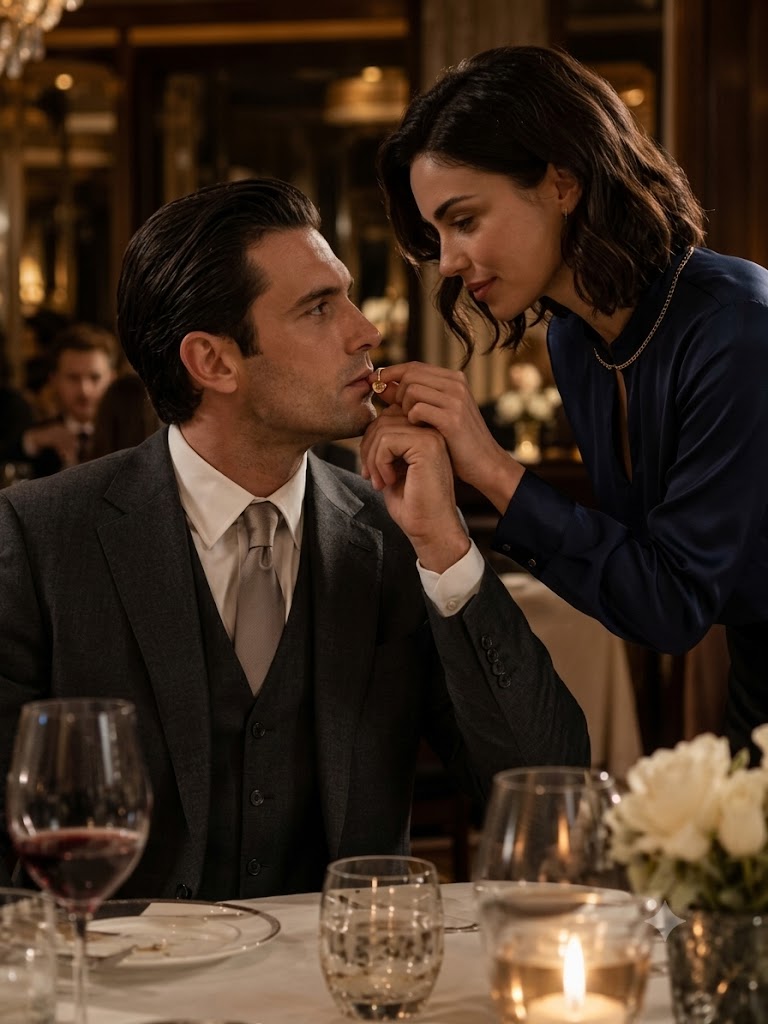
The Waitress and the Wolf
Part 1: The Sicilian Dialect
The Friday evening shift at Bella Notte was running smoothly until table 7 arrived. Four men in expensive suits walked in—the kind of men who carried money and danger in equal measure. They were not regular customers celebrating a promotion or an anniversary. They were men who expected deference. The other servers suddenly became busy with tasks that kept them far from the corner booth. I had worked at Bella Notte for six months, long enough to read a room. I watched from the server station as they settled in with the ease of men accustomed to controlled power.
“Your section, Julia,” Rosa whispered, relief plain in her voice. “Good luck.”
“Thanks for the confidence,” I muttered.
I smoothed my apron and walked toward table 7. As I approached, I caught fragments of their conversation. Italian, but not the textbook kind I’d learned in school. It was rapid, colloquial, threaded with words I recognized from childhood. I greeted them with a smile. “Buonasera, signori. Welcome to Bella Notte. My name is Julia, and I will be taking care of you this evening.”
Four pairs of eyes turned toward me, but the man at the head of the table held my attention. His dark hair was swept back from a face that could have been carved from marble. But it was his eyes that stopped me—deep brown, almost black, assessing me with an intensity that made my skin prickle.
“Water for the table,” he said in English, his accent refined. “And the wine list.”
I nodded and turned away, feeling his gaze burn into my back. “That is Alessandro Marchesi,” Rosa hissed when I returned. “His family owns half of Little Italy. They have connections no one asks about. Be careful.”
I delivered the wine, acutely aware of his stare. He ordered a Brunello di Montalcino. As I turned to leave, one of his men muttered in rapid Italian that I was “too pretty to be just a waitress.” My hand tightened on my notepad, but I kept walking. Then, Alessandro answered—his voice cold, telling the man to shut up.
I should have stayed silent. But something about the man’s dismissive tone made me pause. In the Sicilian dialect my mother had spoken to me as a child, I thanked Alessandro for the defense but told him I could take care of myself.
The silence that followed was absolute. All four men stared at me, shocked. Alessandro went still, his eyes locked on mine. “You speak Sicilian,” he said, his voice rough.
I told him my mother was from Palermo. He switched to Sicilian, asking where exactly. “Ballarò,” I said. His expression shifted—recognition, interest. It was his neighborhood, too. The connection hung between us, sudden and heavy. I fled to the bar, my heart hammering. I had crossed a line, and I knew, looking at him, that there was no going back.
Part 2: The Invitation
When I returned with the wine, Alessandro’s eyes followed every movement. He asked how long it had been since I’d been back to Palermo. Five years, I said. I couldn’t afford it after my mother died. His voice gentled as he offered his condolences. He told me my mother had taught me well; not many Americans spoke true Sicilian. I told him my mother wanted me to remember where I came from.
As I set the bottle down, he told me to call him Alessandro, not Signore Marchesi. It felt too familiar, like crossing a line I couldn’t uncross. He told me not to go far; he wanted to talk more. It wasn’t a request; it was a statement of fact.
The rest of dinner was a blur. Every time I approached, Alessandro’s eyes found mine. He switched between business talk with his men and personal questions about my life, my mother, and my memories of Sicily. It felt like an interrogation. As I cleared dessert, he suggested I go back to Palermo. When I said I couldn’t afford it, he asked what I would say if he made that possible. I told him I didn’t accept charity.
He called it an “opportunity.” He pulled out a business card and wrote on the back. His mother ran a small restaurant in Ballarò and needed someone she could trust—someone who spoke the dialect and understood the neighborhood. He told me his mother was particular, and the fact that I spoke proper Sicilian and carried myself with respect mattered. I told him I had a job. He asked what it paid, then told me his mother would pay better, and the work would be meaningful. I asked why he cared.
He said hearing me speak Sicilian reminded him of home, of the traditions that were dying out. His voice held an unexpected sadness. He told me I had a gift, and it was a waste to serve wine to people who didn’t appreciate it. When the check came, he tipped $500 on a $200 meal. He told me to think about the offer. The number was on the card.
Later, under a streetlight, I studied the card. Call when you are ready to come home. My phone buzzed—an unknown number. It was Alessandro, asking if I’d made it home safely. I asked how he got my number. He said David, the host, had been “very helpful.” I told him I wasn’t his favorite server, but he just answered: “Nevertheless, here we are.” Before hanging up, he whispered: “Buona notte, Julia. Dream of Palermo.”
Part 3: The Sunday Lunch
That night, I dreamt of Palermo—the narrow streets, the market smells, my mother’s laugh. When I woke, there was a new message. His mother wanted to meet me. Sunday lunch, if I was free. It was moving too fast. I told him it wasn’t appropriate. He laughed, telling me his mother knew everyone in Ballarò—perhaps she knew my grandmother.
He was right, and damn him for it. I agreed to one lunch. The car he sent was a sleek black sedan, driven by a quiet man named Tomas. As we drove into the countryside, away from the city, I felt a knot of anxiety tighten in my stomach. Was I desperate for connection, or was this just a job?
The estate was a fortress. Alessandro’s mother was waiting at the door—silver-haired, sharp-eyed, yet warm. “A girl from Ballarò is always welcome here,” she said.
The meal was an experience. The food was incredible, but the atmosphere was electric. Alessandro watched us, his expression unreadable, but every time I caught his gaze, there was that same hunger for connection I’d felt at the restaurant.
As lunch finished, his mother asked me to help her in the kitchen. But as soon as we were alone, her voice changed. “You know who he is, don’t you, Julia?”
“I know his name,” I said.
“No,” she said, her voice dropping. “You know what he is. You know the family he comes from. My son has spent twelve years in the cold. He thinks you are the fire. But fire can burn a house down as easily as it warms it. Are you prepared to be the fire, Julia?”
I stood there, holding a jar of spices, my hands shaking. I didn’t know what she meant, but I knew the danger was just beginning.
Part 4: The Anonymous Warning
“What do you mean, burn the house down?” I asked, my voice barely a whisper. The kitchen hummed with a tension I couldn’t understand.
She turned to the counter, her movements precise. “My son has spent a lifetime guarding doors that should have remained locked. He thinks by finding a piece of home in you, he can stop. He thinks he can just… live.”
“Isn’t that a good thing?” I asked.
“For him? Perhaps. For you? It is a cage he doesn’t realize he’s building.” She turned to me, her eyes clouded with sadness. “You are not just a waitress, Julia. You are a bridge. And bridges are designed to be crossed over.”
I felt a shiver. “I don’t want to be a bridge.”
“Then you should have stayed in the North End,” she said. “But you are here now. And once you have seen the Marchesi family, there is no going back.”
We returned to the dining room, but the atmosphere had curdled. Alessandro watched me, his gaze lingering on my face. “You look pale. Did she upset you?”
“No,” I lied. “I’m just tired.”
“Tomas will take you home,” he said.
As I walked to the car, I felt the weight of their world pressing down. My phone buzzed. An unknown number. Don’t trust the mother. She isn’t who she says she is. The Marchesi family hasn’t been in Ballarò for twenty years.
My heart stopped. How did they know where I was? I decided to call Alessandro. “Your mother,” I said when he answered. “She told me she had been to the market in Ballarò recently.”
“She has,” he said, his voice calm.
“How? I was told she hasn’t been there in twenty years.”
The silence on the line was deafening. “Who told you that?”
“An anonymous message.”
“Delete it,” he commanded. “They are trying to separate us.”
“Separate us? We aren’t together!”
“We will be,” he said, and he hung up.
I stared at the phone. I was a pawn in a game I didn’t understand. When I got home, I found a small box on my kitchen table—a silver key and a note: For when you are ready to come home.
Part 5: The Night of Shadows
The key was heavy, cold, and felt like a weight in my hand. I stared at the kitchen table, the silence of the apartment suddenly amplified. How had they gotten in? I had locked every door, every window.
The phone buzzed again. You can’t run, Julia. The key is to the apartment on 5th. It’s waiting for you.
I grabbed my bag, throwing in my clothes, my passport, and the silver key. I had to get out. I ran to the window, but the street below was silent. Then, the doorbell rang—soft, hesitant. I looked through the peephole. It was Alessandro.
I unlocked the door, my hand on the chain. “What are you doing here?”
“They’re coming for you,” he said, his voice raw. “My mother’s enemies. They think you have something that belongs to them.”
“I have nothing! I’m just a waitress!”
“You’re the girl from Ballarò,” he said, pulling me toward the elevator. “And that makes you a target.”
As we descended to the parking garage, I saw the black SUVs waiting. But they weren’t his men. They were masked, their clothes stained with dirt, their weapons drawn.
“Into the car!” Alessandro shouted, shoving me into the backseat.
He leaped into the driver’s seat, the engine roaring as we skidded out of the garage. Bullets shattered the back window, the sound of the metal ringing in my ears like a death knell. We raced through the streets, the world blurring into a chaos of noise and light.
“They’re catching us!” I screamed.
“Not today,” he said, turning the wheel and driving down a narrow, darkened alley.
We spun through the back of a warehouse and disappeared into the night. As we drove, the silence returned, thick and suffocating. I looked at the man who had brought this death to my door and wondered if I would ever see the morning again.
“Why?” I asked.
“Because,” he said, looking at me with a gaze that held the weight of a thousand years, “I have been waiting for someone like you my entire life.”
Part 6: The Truth in the Cellar
The warehouse we hid in was a skeleton of rust and rot, a forgotten relic of the city’s industrial past. We were surrounded by darkness, the only sound the heavy, rhythmic drumming of rain on the metal roof.
“We’re safe for now,” Alessandro said, pacing.
“Safe?” I laughed, a bitter sound. “We’re trapped in a rusted shed. This is not safe.”
“It’s safe from them,” he said. “But not from us.”
“What do you mean?”
“The reason they’re after you is because of what my mother told you,” he said, his voice dropping. “She wasn’t just talking about your grandmother. She was talking about a secret my father had hidden—a secret about the origin of the Russo empire.”
“What secret?”
“My father didn’t build this from nothing,” he said. “He stole it. And he stole it from the Vales.”
My heart hammered against my ribs. “The Vales? The family who owned the city?”
“I’m a Moretti by name, but a Vale by blood,” he said, his face hardening. “My mother was a Vale. She married my father to secure the merger, to keep the bloodlines pure.”
“So, the merger…”
“Was a lie. It was a power struggle for control of the entire city.”
I realized then that I wasn’t just a waitress. I was a witness to a war of dynasties, a pawn in a game I didn’t even understand.
“Why are you telling me this now?”
“Because,” he said, walking toward me, “you are the only one who can help me find the truth.” He pulled out the silver key. “This opens a box in the basement of the Ballarò market. It’s a record of everything. The truth about the Vales, my father, and your mother.”
“My mother? What does she have to do with this?”
“Your mother was a servant in the Vale house,” he said, his voice gentle. “She knew my mother. She knew what they were doing to the city.”
I had spent my life thinking my mother was just a woman who had left me too soon. I didn’t know she had been a witness to the greatest betrayal in the history of the Syndicate.
“When do we leave?” I asked.
“Tonight,” he said.
Part 7: The Unbroken Dawn
The flight to Palermo was a blur of silence and shadow. We didn’t speak. When we landed, the sun was just beginning to rise over the ancient city. We walked through the narrow streets of Ballarò, the smells of coffee and fresh bread filling the air. It was as if I had returned to my own childhood.
We reached the market, Alessandro leading me through the maze until we reached a small, unassuming shop. He opened the door and we walked into a dark, quiet cellar. It was filled with boxes, crates, and the heavy scent of old paper.
He took the key and opened a box in the corner. Inside was a single, leather-bound book.
I took it, my hands shaking. I opened it and saw the pages—not just words, but photos, maps, and dates. It was the entire record of the Russo-Vale merger, the timeline of every bribe, every murder, and every betrayal.
“There it is,” I said, my voice barely audible. “The truth.”
“It’s not just the truth,” Alessandro said. “It’s the weapon.”
He took the book from me, his face a mask of resolve. “With this, I can destroy the Vales. I can destroy everything they built.”
“But at what cost?” I asked.
“The cost of the empire,” he said, his voice cold. “But it’s a cost I’m more than willing to pay.”
We walked out of the cellar, the morning sun now high and bright in the sky. I looked at Alessandro, the man who had brought me into his life for a reason I still didn’t fully understand, and I realized I wasn’t afraid anymore.
“I’m coming with you,” I said.
“I know,” Alessandro said.
We walked through the streets, the key now in his hand, the book of truth in mine. We were no longer afraid of the shadows, for we had become the architects of the dawn. The war was over, the battle for the truth had been won, and the only thing left was the simple, beautiful work of building a future that belonged to no one but ourselves.
The morning sun turned the market into a beacon of light, and I knew that the journey had finally, truly, begun. We were home.









