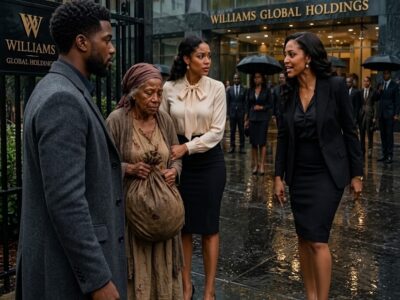
“They Fired the Maid… Little Did They Know the Billionaire Would Fire Everyone Minutes Later”
Part 1: The Three-Word Sentence
The morning sun had not yet broken over the heavy iron gates of the Whitmore estate when Amara arrived, her fingers stiff from the autumn chill as she unlocked the side entrance. For eleven years, she had been the quiet, almost invisible heartbeat of the grand household. She knew which porcelain cup Daniel Whitmore liked his morning espresso in—the one with the slight silver chip near the handle. She knew the exact triple-fold his wife, Clare, demanded for the Egyptian cotton guest towels. Most importantly, she had mastered the difficult art of disappearing into the background while holding a sprawling multi-million-dollar property together.
Nobody in the Whitmore family ever asked about her life beyond the high stone walls. To them, she was simply “the maid”—a pair of highly efficient hands, a presence that kept their world spotless and predictable. They never wondered where she went when her shift ended at nine or what kind of burden she carried when she walked through the front gate every dawn.
But Amara carried a story. It was a quiet, folded-up narrative that she kept tucked away in the deepest corner of her mind, the way one keeps an old, fading photograph in the back of a locked drawer, taken out only when the rest of the world is asleep.
Years ago, before poverty systematically dismantled her family’s life, before her father’s small manufacturing business collapsed under a mountain of medical debt, she had been a child with an uncomplicated future. In those days, she had a childhood friend named Qua. They used to sit beside each other on the broken concrete steps of a tenement building, sharing a single mango between them, talking about the future as if it were a game they were guaranteed to win. Qua had been just as poor, his shoes held together by wire and prayer. They would argue about who would build the larger house, who would drive the faster car, and who would remember the other when they finally made it big.
Then, the world shifted. Her family went bankrupt overnight, her father passed away from the stress, and Amara had to leave school to help her mother keep their remaining belongings out of the rain. Address by address, she drifted away from the old neighborhood, the letters between her and Qua growing fewer until the ink stopped flowing entirely.
While Amara was learning how to survive on nothing, Qua was learning how to build an empire. He was sharp, hungry, and possessed a relentless, almost terrifying work ethic. He worked the night shifts at the docks while studying logistics during the day, failing more times than anyone could count, but always rising back up. Over twenty years, that stubborn boy from the concrete steps became one of the most successful private equity investors in the country, his true name carrying massive weight in rooms where politicians and corporate titans negotiated the future.
One of the companies his firm silently controlled happened to belong to Daniel Whitmore. Daniel ran a mid-sized supply-chain firm that had, for the past two years, been entirely dependent on Qua’s investment capital to survive the shifting market. Qua rarely visited the offices in person, preferring the objective clarity of financial reports and numerical balances. But on this specific Tuesday, a series of discrepancies in the inventory ledger caught his attention, and he decided, almost on a whim, to inspect the facility himself before stopping by Daniel’s private residence for a more candid conversation about the firm’s leadership.
He had no idea that stepping through those iron gates would dissolve the entire illusion of the Whitmore family within minutes.
Inside the mansion, the air had been thick with tension since dawn. Clare Whitmore was frantic. A platinum bracelet, a piece of vintage jewelry gifted to her by her late mother-in-law, had vanished from her dressing table. Clare was a woman who measured her human worth entirely by appearances, and that missing piece represented a significant crack in her curated social armor. When a thorough sweep of her bedroom yielded nothing, her panic quickly turned into a cold, transactional suspicion. And that suspicion landed squarely on Amara.
It didn’t matter that Amara had given eleven years of flawless service without a single missing teaspoon. It didn’t matter that she had once found an envelope containing four thousand dollars in cash left carelessly on the study floor and placed it back exactly where it belonged. In that moment of manufactured crisis, none of her history counted for anything. Clare needed a culprit to balance her anxiety, and the quiet maid was the easiest target in the room.
“You’ve been acting distant all morning, Amara,” Clare said, her voice sharp enough to cut through the hum of the vacuum cleaner. “Where did you put my bracelet?”
Amara stood at the base of the grand marble staircase, her hands still damp from scrubbing the kitchen counters, her face perfectly calm. “I haven’t seen it, ma’am. I can help you check the dressing room safe if you think it might have slipped behind the drawers.”
But Clare wasn’t looking for the bracelet; she was looking to exercise control. She called for Daniel, who came down the stairs with a dark scowl, already irritated by the disruption before his morning brief. Their twenty-one-year-old son, Tyler, leaned against the mahogany doorframe, his thumb moving lazily across his phone screen, treating the destruction of a woman’s life like background noise to his social scroll.
“She’s the only one who has access to that wing while I’m at the club,” Clare said, her arms folded tightly across her silk blouse, her voice rising so the rest of the staff could hear it from the kitchen corridor. “If anyone knows the value of what’s in this house, it’s her. I want her off this property today, Daniel.”
Daniel, distracted by an impending margin call from his bank, didn’t ask for evidence. He didn’t check the drawers. He didn’t ask if the bracelet had simply been left at the jeweler’s. He just wanted the noise to stop so he could prepare for his meeting with his primary investor.
He looked at Amara, his expression empty, and delivered three words that erased eleven years of loyalty in a single second.
“Pack your things.”
Part 2: The Weight of One Bag
Amara didn’t scream. She didn’t drop to her knees or beg for a chance to clear her name in front of the people she had served through sickness, through family scandals, and through the slow grinding erosion of their private peace. She simply looked Daniel in the eyes, saw the absolute finality of a man who looked at an employee like a line item on an expense report, and nodded once.
“Yes, sir,” she said quietly.
She walked down the long, narrow corridor toward the small utility room off the kitchen where she kept her uniform apron and her personal belongings. The space was tiny, smelling of laundry starch and bleach, a stark contrast to the grand mahogany-lined rooms out front. It took her less than five minutes to gather her entire eleven-year history in that house. There wasn’t much to take. A worn wool cardigan for the winter walk to the bus stop, a small, silver-rimmed photograph of her late mother, and a black spiral notebook she used to keep track of the household grocery tallies and delivery schedules.
Eleven years of reliability, and it all fit inside a single, faded canvas bag.
As she walked back through the pristine kitchen toward the rear exit, none of the other staff members looked up from their stations. The cook stared intently at the industrial stove; the junior laundress focused on a silk shirt as if her life depended on the crease. They felt the terror of the moment—the realization that if a veteran like Amara could be discarded without a single question, none of them were safe. Fear held their mouths shut. Nobody wanted to be the next name erased from the registry.
Amara pushed open the heavy side door and stepped into the gravel driveway. The autumn wind caught her hair, pulling it loose from her pins, but she kept her chin high, her spine perfectly rigid as she walked toward the iron front gates.
Before her hand could touch the latch, the low, deep roar of a powerful engine broke the silence of the avenue. A sleek, midnight-black sedan pulled smoothly through the gates, its dark windows reflecting the tall pine trees of the driveway like a mirror. It was the kind of car that commanded automatic posture adjustments from people who understood the hierarchy of wealth.
Daniel, who had stepped out onto the front portico to take an urgent call from his broker, froze the moment the vehicle came to a halt. His breath caught in his throat. He hadn’t expected his silent partner, the head of the equity firm that carried his company’s entire debt baseline, to visit his private home. Not today. Not without an entourage of corporate lawyers.
The car door opened, and Qua stepped out onto the gravel. He was forty-two years old, broad-shouldered, and dressed in a simple, unbranded gray wool coat—the kind of absolute simplicity worn only by men who no longer need to use their clothes to prove their significance to anyone in the room. He gave Daniel a brief, professional nod, but as his eyes scanned the driveway, his gaze bypassed the billionaire entirely.
His eyes locked onto the woman standing near the gate, a faded canvas bag slung over her shoulder.
Qua stopped dead in his tracks. The cold, mechanical focus that usually defined his features vanished, replaced by an expression of profound, soul-deep recognition. The years seemed to fold backward in the space of a heartbeat, dissolving the white stone pillars and the manicured hedges until he was standing on the broken concrete steps again, looking at a girl who always divided the mango evenly, even when her own ribs were showing through her dress.
“Amara,” he said. His voice was lower, quieter than Daniel had ever heard it in a business meeting.
Amara stopped walking. She turned her head slowly, her eyes wide as she looked at the man standing by the car. A violent mixture of disbelief, memory, and old, buried love rushed back into her chest so fast it made her knuckles turn white against the strap of her bag.
“Qua,” she whispered, her voice barely carrying through the wind, as if saying his true name too loudly would break the illusion apart.
Daniel Whitmore stood completely frozen on the steps of his mansion, his phone still held to his ear, his mind fracturing as he watched the most powerful investor in the district look at his fired maid as if she were the only precious object on the property.
“What exactly is going on here, Daniel?” Qua asked, his voice returning to that cold, level register that usually preceded a corporate liquidation. He didn’t look at Daniel; he kept his eyes fixed on the canvas bag on Amara’s shoulder.
Part 3: The Measurement of Decency
Daniel scrambled down the marble steps of the portico, his leather shoes clicking rapidly against the stone, his face losing its color so fast he looked instantly aged under the gray morning light. “Qua… Mr. Qua, I apologize for the confusion. This… this is just an internal household matter. We were just resolving an issue with the domestic staff.”
Clare, hearing the heavy clatter of the car doors, stepped out onto the veranda, her silk shawl clutched tightly around her neck. She still didn’t understand the mathematics of the room; she only saw a man in a gray coat talking to the woman she had just labeled a thief.
“She’s been dismissed, sir,” Clare said, her voice carrying that sharp, aristocratic projection she used at charity galas. “We had a serious security breach this morning. A valuable family heirloom went missing from my dressing room, and since she’s the only one with unsupervised access to that wing, we had to take immediate protective measures. We can’t take risks with people we can’t fully trust.”
Qua listened to her without a single interruption. He didn’t look at Clare, and he didn’t look at Daniel. He stood perfectly still on the gravel driveway, his jaw tightening until a small muscle leaped beneath the skin of his cheek. He let them finish their explanations, letting them dig their own graves deeper into the stone, because he wanted to hear the exact language they used when they threw a human being’s dignity into the dirt without a shred of physical evidence.
“Did you search the house?” Qua asked. His voice was calm, almost conversational, but it held a diamond-sharp edge that made Daniel’s stomach drop into a bottomless pit of instinctual terror.
Clare hesitated, her fingers twisting the fabric of her shawl. “Well… not the entire property yet, but the circumstantial leverage is—”
“So you fired a woman who has given eleven years of her life to your home,” Qua said, cutting her off with a single, flat sentence that silenced the courtyard. “Based on a feeling. Not a ledger. Not a camera report. A feeling.”
“Quaame,” Daniel stepped in, using the formal name listed on the equity trust papers, his hands rising in a frantic gesture of de-escalation. “If she’s someone you know… an old acquaintance from the district… of course we can reconsider the termination. This is clearly a massive misunderstanding between Clare and the staff. We can bring her back into the rotation immediately. We’ll double her baseline rate.”
“It’s too late for that, Daniel,” Qua said, his voice quiet, steady, and completely final. He walked past the billionaire without a glance, stopping directly in front of Amara. He reached out his hand, his long fingers steady as he gently took the faded canvas bag from her shoulder, transferring its small, heavy weight to his own arm.
“You didn’t need to know who she was to me to treat her with basic human decency,” Qua said, looking over his shoulder at the Whitmores. “That’s the piece your calculation is missing. You didn’t respect her because it was the right thing to do; you’re only offering her mercy now because you’re terrified of what her absence might cost your firm.”
He turned back to Amara, his features softening into an expression that belonged entirely to the concrete steps of their childhood. “My car is open, Amara. Sit inside. I have a lot of years to ask you about.”
Amara looked at him through a sudden, hot veil of tears she had held back for eleven hours. She didn’t look at Clare’s frozen face, and she didn’t look at Daniel’s trembling hands. She walked down the path, her boots steady on the gravel, and stepped into the back seat of the black sedan. The heavy door clicked shut, sealing her into a quiet, leather-scented world where the wind couldn’t reach her.
Qua turned back to Daniel. The warmth had vanished from his eyes, leaving behind nothing but the cold, mechanical logic of a man who liquidated companies for recreation.
“I came here today to discuss the extension of our credit partnership for the new shipping corridor,” Qua said, his hands clutched loosely in his overcoat pockets. “I think we’re completely done discussing that.”
Part 4: The Speed of the Collapse
“Qua, please!” Daniel lunged forward, his fingers stopping an inch from Qua’s wool sleeve, his voice cracking with pure panic. “Let’s talk about this in the office. Whatever happened between Clare and the staff this morning has absolutely nothing to do with our corporate relationship. The supply-chain firm is stable. The quarterly margins are exactly where your analysts wanted them to be.”
“It has everything to do with it, Daniel,” Qua said, his voice a smooth, dangerous baritone as he stepped back into his car. “I don’t invest in balance sheets. I invest in the character of the men running the machinery. And I just watched the man running this company throw away eleven years of loyalty in less time than it takes to decide what to order for breakfast. If this is how you treat an asset that has kept your own home spotless for a decade, I have zero reason to believe you won’t dump my capital, my people, or my trust the second the market makes it convenient for you.”
He pulled the car door shut. The dark glass rose smoothly, cutting off Daniel’s frantic face like a guillotine. The sedan pulled out of the driveway, its tires crunching clean against the gravel as it moved through the iron gates, leaving the Whitmore estate behind in a cloud of dust.
By three o’clock that afternoon, the silent machinery of Qua’s firm began to move. Qua didn’t need to shout, he didn’t need to file a public complaint, and he didn’t need to make a scene at the exchange. Quiet, calculated electronic directives from an institution of his size carried far more structural weight than any physical outburst ever could.
Within three hours, the legal paperwork for the immediate withdrawal of the Whitmore Group’s primary credit line was formally filed with the regulatory board. Daniel’s company, which had been operating on a high-leverage model entirely dependent on that capital to fund its inventory pipeline, began to shake at its foundations before the market closed.
The bank called first. A senior loan officer, whose tone had been sycophantic for two years, now delivered a cold, clinical message: due to the sudden restructuring of the secondary investment trust, the firm’s outstanding notes were being called for review within forty-eight hours. Then came the suppliers. Two major manufacturing hubs in the eastern corridor quietly paused their shipments, requesting immediate cash verification before clearing the loading docks.
By Thursday morning, the very board members who had toasted Daniel’s “visionary leadership” at the summer gala were calling for an emergency executive session. They sat around the mahogany table in the glass tower, their faces pale, their eyes fixed on the ledger sheets that showed their equity losing twenty percent of its value by the hour. They didn’t ask about his family; they asked whether he still had the technical capacity to hold the CEO chair at all.
The news spread through their social circle like dye in a basin of water. Clare sat in her morning room, her phone resting on the glass table, completely silent. The invitations to the annual autumn foundation gala—an event she had chaired for three years—had arrived at the neighboring houses, but her mailbox remained empty. Her friends, women who used to spend hours admiring her home, her collection, her carefully curated image, had suddenly developed “scheduling conflicts” the exact second the rumors of Daniel’s financial insolvency hit the local registries.
She discovered, with a sickening, sudden clarity, that much of what she had classified as social respect was simply proximity to his credit line.
Meanwhile, Amara’s reality was changing in ways she had never included in her budget. Qua didn’t offer her a check out of nostalgia or charity; he understood the cold math of her character. He knew that a woman who could manage a four-acre estate for eleven years without a single operational error, and who had once returned four thousand dollars in cash from a study floor, possessed a structural integrity that money couldn’t manufacture.
He offered her the position of Regional Operations Director for his logistics firm, placing her in charge of the entire inventory audit for the southern district.
“You know where the leaks happen, Amara,” Qua told her as they sat in his glass-walled office overlooking the river, a clean, unbranded cup of coffee in her hand. “You’ve spent eleven years watching people who thought they were smart hide their waste behind the help. I need eyes that don’t look at the floor boards when the directors lie.”
For the first time in her twenty-six years of working life, Amara wasn’t just surviving. She was respected, valued, and seen—truly seen—for the iron core she had kept hidden beneath herLight blue uniform. She didn’t return to the Whitmore gate to say a single word about the collapse of their house. She didn’t need to. Karma was already handling the conversation for her, louder and faster than she ever could have.
Part 5: The Found Bracelet
On the final Friday of November, the weather over the city turned entirely gray, a bitter sleet striking the glass panels of the Whitmore tower. Daniel sat alone in his executive suite, his tie completely discarded, his desk covered in margin notices, liquidation options, and a formal notification of a board hearing scheduled for Monday morning to vote on his termination.
The glass door opened with a quiet click, and Clare entered. She looked smaller, her expensive wool coat hanging loose from her shoulders, her face pale and entirely unpolished. She didn’t look like the woman who had stood on the veranda three weeks ago, commanding the driveway.
She walked over to his desk and placed a small, velvet-covered box down on the blotter between them.
Daniel lifted his hollow eyes, his gaze fixing on the fabric. “What is that?”
“The bracelet,” Clare whispered, her voice cracking as she sat down on the leather sofa, her face buried in her hands. “I found it this morning. It… it had slipped into the silk lining of my winter traveling coat. The one I wore to the country club the weekend before the incident.”
Daniel stared at the velvet box. He didn’t pick it up. He didn’t open the latch. A short, jagged sound escaped his throat—a laugh that turned into a dry, heavy sob that filled the empty office with the sound of a total ruin.
“Eleven years,” Daniel muttered, his hands clutched tightly against his forehead as he replayed the gravel driveway in his mind. “We threw away our entire credit baseline, our entire investment security, and our entire name in this city… for a piece of silver that was stuck in your coat lining.”
“We can call him, Daniel,” Clare sobbed, her fingers twisting her rings. “We can call Mr. Qua and show him the bracelet. We can tell him it was a legitimate mistake. He’s a reasonable man. Surely he’ll understand that accidents happen in a household.”
“He won’t answer the wire, Clare,” Daniel said, his voice dropping into a flat, dead register that held no hope at all. “He told us that morning on the gravel—it was never about the jewelry. It was about the fact that we looked at a woman who had kept our world clean for a decade and saw nothing but a pair of disposable hands we could blame to settle our own nerves. We showed him exactly how we treat people when we think nobody powerful is watching.”
He stood up from his leather chair, walked over to the floor-to-ceiling window, and looked out at the sleet falling over the city roofs. Below him, the streets were packed with people—thousands of quiet, unseen workers carrying umbrellas, waiting for buses, moving through the rain to hold someone else’s world together. He had spent his whole life believing that because his name was on the building, he was the one who mattered. Now, looking down at the crowd, he understood the truth: the structure only holds as long as the people at the bottom choose to carry the weight. And he had kicked the foundation out with his own shoes.
Part 6: The View from the Concrete Steps
Six months later, the old neighborhood downtown looked exactly the same as it had during their childhood, save for the red rust that had crept a little further up the iron railings of the tenement buildings. The concrete steps of the old stairs were still cracked, a single dandelion growing through the gap where Amara and Qua used to sit with their mango.
A sleek, black sedan pulled up to the curb, its quiet engine barely disturbing the two neighborhood boys who were kicking a deflated ball against the brick wall. Amara stepped out of the back seat, wearing a sharp, tailored navy suit that fit her frame perfectly, her hair gathered into a neat, professional knot. She carried a small file folder under her arm—the final clearance records for the new logistics hub her firm had just established in the industrial sector.
Qua stepped out from the driver’s side, his hands in his pockets, his gray coat open against the spring wind. He stood by the car, watching her as she walked up to the broken steps, her fingers tracing the rough concrete where they had once carved their initials with a rusty nail.
“The board approved the site development metrics this morning, Qua,” she said, her voice clear, rhythmic, and filled with a profound, quiet confidence. “We’re breaking ground on Monday. The local contractors are already on the registry.”
“I saw the ledger, Amara,” Qua said, a small, genuine smile forming on his lips—the exact same smile he had shared across the mango twenty years ago. “You cut the operational waste by fifteen percent without lowering the baseline wage for the dock workers. The regional directors are wondering how a consultant from outside the network solved an equation they’ve been stuck on for three terms.”
“I told them the truth,” Amara said, turning around to face him, the sun catching the clear, steady light in her dark eyes. “I told them that if you want the machinery to run without leaking, you don’t look at the corporate targets first. You look at the hands of the men grease-stained at the docks. You ensure they have enough bread on their tables to carry your cargo without their fingers shaking.”
Qua walked up the steps and stood beside her, looking out at the narrow street where the children were laughing. “Daniel Whitmore’s property went to the bank registry last Tuesday,” he said quietly. “The estate was liquidated to settle the secondary notes. I heard he took a mid-level consultancy role with a firm in the northern district. He lives in a small flat near the rail line now.”
Amara looked down at her polished shoes, then out at the neighborhood. She didn’t feel a surge of triumph; she didn’t feel the small, ugly satisfaction that smaller people call victory. She felt nothing but a quiet, bone-deep peace.
“I don’t hate them, Qua,” she said softly. “I never did. They just lived in a house where the walls were too thick for them to hear the rest of the world. They thought their money bought them a different kind of sky.”
“The sky is the same for everyone, Amara,” Qua said, his hand closing around hers over the stone railing, his fingers warm against her skin. “Some people just have to climb three flights of broken stairs to see it clearly.”
Part 7: The Unbroken Foundation
The grand boardroom of Ekoja Logistics Plc was a space of absolute clarity—acres of clear glass, unvarnished cedar wood tables, and windows that faced the wide, moving current of the river below. There were no oil portraits of dead patriarchs on the walls, no gold-leaf trimmings, no heavy velvet ropes designed to divide the human variables from the capital.
Amara sat at the head of the long table, her laptop open, her eyes scanning the final compliance charts for the regional transportation initiative. Around her sat twelve directors, men and women with fancy degrees and years of corporate prestige, all listening to her presentation with a quiet, genuine respect that had nothing to do with her family registry and everything to do with the absolute clarity of her data.
“The logistics infrastructure is sound,” Amara said, closing the files with a single, system-clean click. “We have secured the corridors, verified the baseline contracts, and insured the safety protocols for the warehouse teams. We break ground at dawn.”
The directors stood up, exchanging folders and handshakes before moving out the glass doors, their voices low and professional as they cleared the suite.
Qua remained in his chair at the far end of the cedar table, his laptop closed, watching her collect her notes. “You’re doing well, Director Parker,” he said, his voice a low, warm baritone that filled the quiet room.
“I have a good baseline partner,” Amara said, sliding her spiral notebook into her leather briefcase—the same notebook she had used to write down the grocery lists in the mansion six months ago. She looked at him, a small smile crinkling the corners of her eyes. “Are we still on for dinner at the local market? Or do you have an option call with the Lagos trust?”
“The Lagos trust can wait until Friday,” Qua said, standing up and reaching for his gray overcoat. “I’ve had enough of option sheets to last a lifetime. I want a real meal from a real stove.”
They walked out of the glass tower together, their shadows long against the polished floorboards of the lobby. The security guards at the front entrance raised their caps, bowing slightly as they passed, but Amara stopped by the desk to ask the old night watchman if his sister’s fever had broken yet, her voice gentle and genuinely interested in his response.
She had learned from the concrete steps of her childhood, and she had learned from the white marble stairs of her exile, that value isn’t a thing you manufacture with a corporate title or secure with an iron front gate. Value is the choice you make every single morning when you decide how to treat the person standing in front of you when nobody else is recording the metrics.
Kindness should never depend on who a stranger might turn out to be on the board registry. It should simply depend on who you choose to be when the room is dark and the world is waiting to see which way the structure is going to break.
Amara stepped out into the bright spring air, her hand firmly holding Qua’s as they moved through the crowd, two kids from the broken steps who had survived the fire and found their way to the sky without ever forgetting the dirt that held the foundation together.