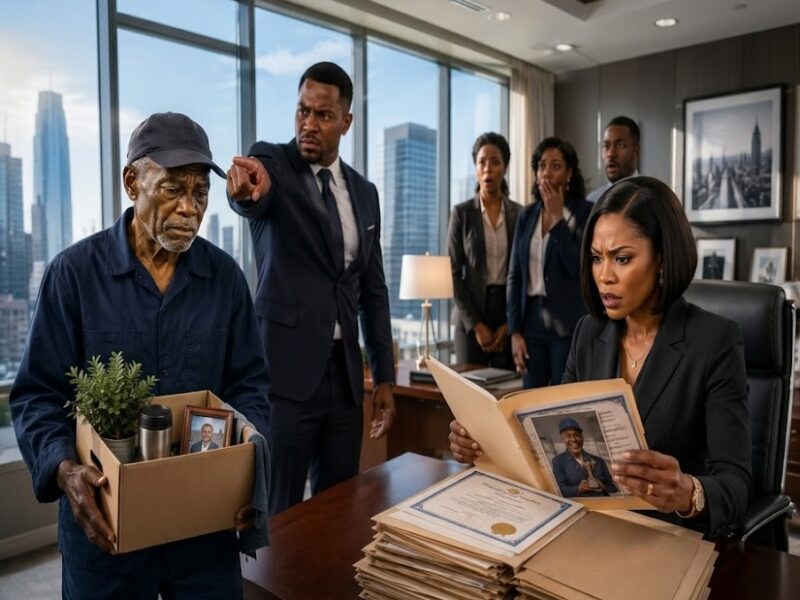
They Fired the Old Janitor After 25 Years With Nothing — Until the New CEO Checked the Files
Part 1: The Envelope
At 7:04 on a Monday morning, the air in the lobby of Thandeka Holdings was cool, smelling faintly of the industrial floor cleaner that had been applied just moments earlier. Fesus, the security guard on duty, sat behind the obsidian-topped reception desk. Without looking up from his monitor, he slid a thick, white envelope across the polished surface. It skidded three inches and came to a stop at the very edge, right near Kad Emanuel Enwosu’s hand.
Fesus didn’t look up. He didn’t say a word. He pushed the envelope with the distaste one reserves for something unclean, his fingers barely making contact with the heavy paper.
Kad, who had been holding his mop handle with his left hand, froze. He looked at the envelope. He looked at Fesus. He looked back at the envelope. Fesus remained intensely focused on the screen, his posture stiff.
Kad stood the mop handle against the wall at the precise, learned angle that prevented it from sliding—a habit born of twenty-five years of careful maintenance. He reached out and picked up the envelope. It was heavy. His name, Kad Emanuel Enwosu, was typed on the front in a stark, sans-serif font.
He opened it. The letter inside was dated the previous Friday. It had been sitting in a drawer while he continued to perform his duties, unaware that his career had been terminated three days prior. His hands, calloused and mapped with the history of a quarter-century of labor, did not shake as he refolded the paper along its original crease. He slid it into the chest pocket of his gray work coat, the fabric pressed and clean.
Then, with a heavy, rhythmic grace, he picked up the mop and returned to the revolving door. Two puddles remained where commuters had tracked in the Johannesburg rain. He couldn’t leave them. Someone would slip. It was simply not done.
High above him, on the fourth floor, a woman sat in a dark office. She had arrived at 6:33 that morning. By 6:48, she had made a phone call that would change everything. She was currently staring at a yellow legal pad, and her expression was so still, so profoundly dangerous, that her new assistant had retreated to the kitchenette, unsure of how to exist in the same room as her silence.
Kad finished the floor. He stepped back, surveyed his work, and felt the sharp, cold weight of the letter in his pocket. He did not know yet that his name was currently underlined twice at the top of a legal pad, or that the woman on the fourth floor was about to turn the building upside down to find out exactly why a man like him had been discarded.
Part 2: The Weight of Years
Kad Emanuel Enwosu was sixty-one years old. He weighed 78 kilograms, but he moved through spaces with a gravity that suggested he occupied more room than his frame allowed. It wasn’t pride; it was the habit of someone who had spent his life moving through the private domains of others with total, unobtrusive attention.
He had started at Thandeka Holdings in January 1999, arriving from a rented room in Yoville, Johannesburg. He had left Lagos with a single reference letter and a dream that had been systematically dismantled by a logistics company closing its doors without warning. He was thirty-six then. He remembered Mrs. Dolores Sithole, the facilities manager who wore her reading glasses on a chain and carried a laminated checklist as if it were a holy text.
“Can you start Thursday?” she had asked.
He had started Thursday.
In the twenty-five years that followed, he had never been late. In the basement supply room, hidden from the gleaming, modern reality of the lobby, sat a physical ledger. Nobody had looked at it in a decade, but it recorded his arrival times in his own, neat handwriting. There were 6,214 entries. The earliest was 6:09 a.m. The latest was 6:31 a.m.
He remembered the morning of July 16, 2007, clearly. His wife, Comfort, had been in surgery for nine hours. He hadn’t taken leave. He had shown up at 6:31 a.m., mopped the floors, emptied the bins, and held his grief behind his teeth until the shift ended. Comfort had died in 2019. They had no children, and Kad carried that absence the way a person carries a chronic injury—quietly, and with total organization.
He lived by the structures of the building. He cleaned the foyers, the corridors, the basement, and the fire exits that everyone else had forgotten existed. He was the one who changed the lightbulbs in the hard-to-reach places. He owned an iron, kept in his locker, because he refused to wear a wrinkled coat.
In his left pocket, he kept a small, folding ruler. He used it to ensure that items in the supply cupboards were stacked at consistent heights. It was a life of small, invisible victories. But as he stood in the basement at 8:31 a.m., hanging his coat for the final time, he didn’t know that the woman on the fourth floor, Dr. Adazi Mensah-Bright, had already begun an inquiry that would reach back through the decades.
She was not just reading files; she was hunting for the truth of why a man who had kept the building standing for twenty-five years had been treated as if he were disposable.
Part 3: The Search for Logic
Dr. Adazi Mensah-Bright was forty-four, brilliant, and possessed a sensitivity to the “bottom” of an organization that bordered on the psychic. Having arrived from Pretoria to clean up the mess left by private equity restructuring, she was not interested in excuses.
At 7:03 a.m., she had asked her assistant, Sipho, where the pre-2009 personnel files were. By 9:15 a.m., three heavy archive boxes sat on the conference table in her office. She dismissed Sipho and dove in.
She found it in the third folder, behind a tab marked FSD-41. It was the original employment contract for Kad Emanuel Enwosu. It was four pages long, signed by Mrs. Dolores Sithole. Adazi’s eyes scanned the text until they locked onto Clause 11, Sub-paragraph C.
Her breath hitched. It was a long-service provision. Any employee with twenty or more years of continuous, satisfactory service was entitled to a significant payout upon termination—unless that termination was for misconduct.
She looked at the termination letter she had pulled from the recent files. It cited “operational reorganization.” It was not misconduct. It was a breach of contract. A massive, potentially litigious, and morally bankrupt breach.
Adazi calculated the figure on her legal pad. She checked the math twice. The number was large—large enough to cripple a smaller company, but entirely earned. It was money meant to bridge the gap between a lifetime of service and a quiet, dignified retirement.
She looked at the signatures. Mrs. Sithole’s hand was steady. She imagined the woman who had written that clause in 1999, a woman who understood that the people who cleaned the mess were the reason the building had a structure at all.
Adazi circled the name of the HR director who had processed the termination, the operations manager who had authorized it, and the external consultancy that had provided the “restructuring” advice. These people had treated a human life as a rounding error.
She looked at her watch. It was 11:30 a.m. She needed to find Kad. She needed to tell him that he hadn’t been forgotten, even if the company had tried its hardest to make it so. She felt a cold fire in her chest—the realization that the system had banked on nobody looking back far enough to see the promise it had made.
Part 4: The Visit
The address was on Claim Street in Hillbrow. It was a fifteen-minute drive from the pristine glass walls of Thandeka Holdings. Adazi drove herself, ignoring the advice of her team. She didn’t want to bring lawyers; she wanted to bring the truth.
The building was old. The elevator was broken. Adazi climbed four flights of stairs, passing landings that were swept with the same obsessive precision she had seen in the building’s basement.
When she reached 7C, the door was already open.
Kad stood in the doorway. He wore a gray jersey and dark trousers. He didn’t look anxious. He looked prepared, as if he were waiting for a delivery. When he saw her, he nodded, his face unreadable.
“Mr. Enwosu,” Adazi said, her voice steady. “I’m Adazi Mensah-Bright. I started at Thandeka this morning.”
“I know,” Kad replied. “I cleaned your floor last week.”
She stepped inside. The apartment was a mirror of his life: organized, sparse, and meticulously clean. A bookshelf held volumes arranged by size. On a table sat a crossword puzzle with a pencil laid parallel to the spine. There was one photograph on the wall—a woman in a green dress, laughing.
He poured her tea without asking. They sat in silence for a moment before Adazi placed the folder on the table between them.
“I read your employment contract this morning,” she began, keeping her voice low. “Clause 11 C. The long-service provision. You qualified for it in 2019.”
Kad looked at the folder, then at the window. The sounds of the city drifted in—taxis hooting, the distant murmur of Hillbrow.
“That is a great deal of money,” he said, his voice finally betraying a hint of emotion.
“It is what the contract says,” Adazi replied. “And it is what you are owed.”
He looked at the photo of his wife on the wall. “Mrs. Sithole wrote that,” he said softly. “She was a good woman. I sent her a card when she retired. I don’t know if she ever got it.”
“I am going to ensure you get what is yours,” Adazi said, leaning forward. “But I have something else to ask you. The company needs someone for the facilities compliance team. Someone who knows the building from the inside. Someone who knows when a floor is about to fail before the report is even filed.”
Kad looked at her, and for the first time, she saw a flicker of something beyond just survival in his eyes. It was the look of a man considering a new chapter.
Part 5: The Reckoning
The aftermath at Thandeka Holdings was swift and brutal. By 4:52 p.m., the legal team had confirmed the calculation. There was no room for negotiation; the contract was ironclad.
The HR director who had signed off on the termination was brought into a meeting at 5:15 p.m. It lasted six minutes. When he walked out, his face was ash-gray, his career at the firm effectively over. The operations manager received a notice of an immediate audit of his department. The external consultancy received a termination notice that laid out exactly why they were being fired: they had failed to disclose a liability that had cost the company its integrity.
On Wednesday, the corrected termination letter arrived at Kad’s apartment by registered post. On Friday, the money was in his account. Full, not in installments. Adazi had insisted.
But the office was still in turmoil. Adazi sat in her chair on the fourth floor, the legal pad in front of her covered in new lines, new circles, and new priorities. The building felt different. The light reflected off the gray composite panels differently, as if the very structure was settling into a new, more honest shape.
She had done the math. She had honored the contract. But she realized that Kad’s value wasn’t in the contract—it was in the 6,214 days of presence. It was in the way he had mopped a wet floor knowing he had already been fired, because he couldn’t bear the thought of someone slipping.
She caught herself looking at the door, waiting for him. She wondered if he would say yes. If he would return to the building that had tried to erase him, not as a cleaner, but as an auditor of its own conscience.
Outside, the rain began to fall again. She thought about the loose tile near the lift lobby on the fourth floor. She had walked over it that morning. She had checked the adhesive. It was loose.
He had been right. He had always been right. And the fact that he was right about a loose tile made her realize that she didn’t just want him back for his sake—she needed him back for the building’s sake.
Part 6: The Return
On Thursday morning at 10:03 a.m., the phone rang on Sipho’s desk. It was Kad.
“I’ve thought about the second part,” he said.
Adazi took the call. “And?”
“I will accept the position,” he said. “On one condition. I will use my own gloves. The company-supplied ones are inferior. I’ve known this for years.”
Adazi smiled, a genuine, tired, relieved smile. “Yes, Kad. And we will reimburse you for the last five years of glove purchases. Just bring the records.”
“I have them,” he said. “In a notebook.”
He started the following Monday. He arrived at 6:27 a.m. He wore the same gray coat, though the logo on the breast now represented something different. It wasn’t just a uniform anymore; it was a badge of someone who had survived the system’s neglect and emerged with his dignity intact.
When he walked into the lobby, Fesus—now replaced by a different guard—looked up. He saw a man who walked with the authority of someone who had been vindicated.
Desmond Kumalo, the founder of Thandeka, heard about the “Enwosu Affair” three weeks later. He sat in his study, looking out over the city, and felt a strange, hollow ache. He remembered Mrs. Sithole. He remembered the long-service clause. He had signed it, and then he had forgotten it, and in that forgetting, he had allowed the foundation of his company to crumble.
He sent a message to Adazi: Right thing. Well done.
Adazi filed it. She didn’t dwell on the praise. She had a building to run, and the fourth floor was still full of loose tiles and deeper, more structural problems. She had opened the files, and she realized that she hadn’t just saved a man’s pension—she had saved the building’s soul.
Part 7: The Unfinished Work
Kad Emanuel Enwosu sat at a desk in the facilities compliance office—a room he had once only entered to change a lightbulb. His notebook was open. His folding ruler lay beside his coffee mug.
He looked at the screen. He was looking at a maintenance report filed by the electrical team. They claimed the server room cable was “inspected and stable.”
Kad frowned. He knew that cable. He had flagged it in 2006. He reached for his phone and called the lead technician.
“The cable,” Kad said, his voice calm, polite, yet utterly firm. “The outer shielding is braided nylon. If it’s stable, the tension should be exactly twelve kilograms of pull. Send me the log for the torque test.”
There was a silence on the other end of the line.
“I’ll have to check,” the technician stammered.
“Please do,” Kad said. “I’ll wait.”
He sat back. He was no longer the man who slipped envelopes across desks. He was the man who ensured the building stood.
Across the city, in a small apartment, the photo of a woman in a green dress watched over the desk. Everything was placed with precision. The crossword was finished. The tea was warm.
Adazi walked by his office an hour later. She stopped and looked through the glass. Kad was working, his small, precise handwriting filling a new ledger. He didn’t look up, but he felt her presence. He gave a single, slow nod—the nod of someone who knows exactly what is coming next.
The building continued to pulse with the life of a thousand workers, but deep inside, the logic had shifted. The invisible was finally visible. The work, always real, was finally acknowledged.
And in the basement, the ledger continued to grow. Only now, it wasn’t just recording the arrival of a cleaner. It was recording the arrival of the man who held the keys to the future of Thandeka Holdings. The past was accounted for, the present was secure, and the future was being built on a floor that, for the first time in twenty-five years, was perfectly, impeccably dry.