They Laughed When She Signed the Divorce Papers — The Silence Came When Her Jet Landed…
Part 1: The Discarded Wife
The air inside the conference room of Sterling and Halloway smelled of expensive espresso and predatory intent. It was raining over Seattle, a gray, miserable drizzle that streaked the floor-to-ceiling windows, but inside, the atmosphere was electric with triumph. Richard Sterling sat at the head of the table, leaning back in his Herman Miller chair, spinning his wedding band on the polished mahogany surface. He watched the ring wobble and fall flat—a perfect metaphor for his marriage, he thought.
Across from him sat Genevieve. She looked small in the oversized leather chair. She was wearing a simple beige cardigan that had seen better days. Her hair was pulled back in a messy bun that Richard’s mother, Beatrice, had often referred to as “the waitress look.”
“Well,” Beatrice barked from the corner of the room. She was sipping champagne despite it being 10:00 a.m. on a Tuesday. “Is she going to sign, or does she need a dictionary to understand the big words?”
Richard chuckled, a low, throaty sound that lacked any warmth. “Easy, Mother. Let her read it. I want her to be fully aware that she’s leaving with exactly what she came in with: nothing.”
Arthur Pendleton, the family’s longtime attorney—a man with a smile like a shark—slid the document across the table. It was thick, over 50 pages of legal jargon designed to intimidate.
“To summarize, Mrs. Sterling,” Arthur said, his voice dripping with faux sympathy, “the prenuptial agreement is ironclad. However, Richard is generous. He is willing to offer a one-time relocation fee of $5,000. In exchange, you waive all rights to alimony, spousal support, and any claim on the Sterling Tech shares. You also agree to a non-disclosure agreement, effective immediately.”
Genevieve didn’t look up. Her eyes were fixed on the paper. She hadn’t spoken a word since entering the room.
“5,000?” Beatrice scoffed, walking over to the window to look down at the city she felt she owned. “That’s too much, Richard. She’ll only spend it on cheap clothes and bad decisions. That’s how people like her are.”
Richard sighed, checking his Rolex. “Just sign it, Genevieve, please. I have a merger meeting with the Rosini Group in an hour. Don’t make this harder than it needs to be. You had a good run. You lived in my house, ate my food, wore the jewelry I bought you. The ride is over.”
Genevieve finally looked up. Her eyes were dry. There was no redness, no puffiness. There was a calmness in her expression that Richard found slightly unsettling, though he quickly dismissed it as shock.
“I don’t want the 5,000,” Genevieve said softly.
The room went silent. Beatrice whipped around. “Excuse me? You want more? You ungrateful little—”
“I don’t want any money,” Genevieve interrupted, her voice steady. “I will sign the divorce papers. I will sign the NDA. I will waive all claims to the Sterling fortune. I only want one thing.”
Richard raised an eyebrow, amused. “And what is that? The Audi? The jewelry? Keep it. It’s used goods anyway.”
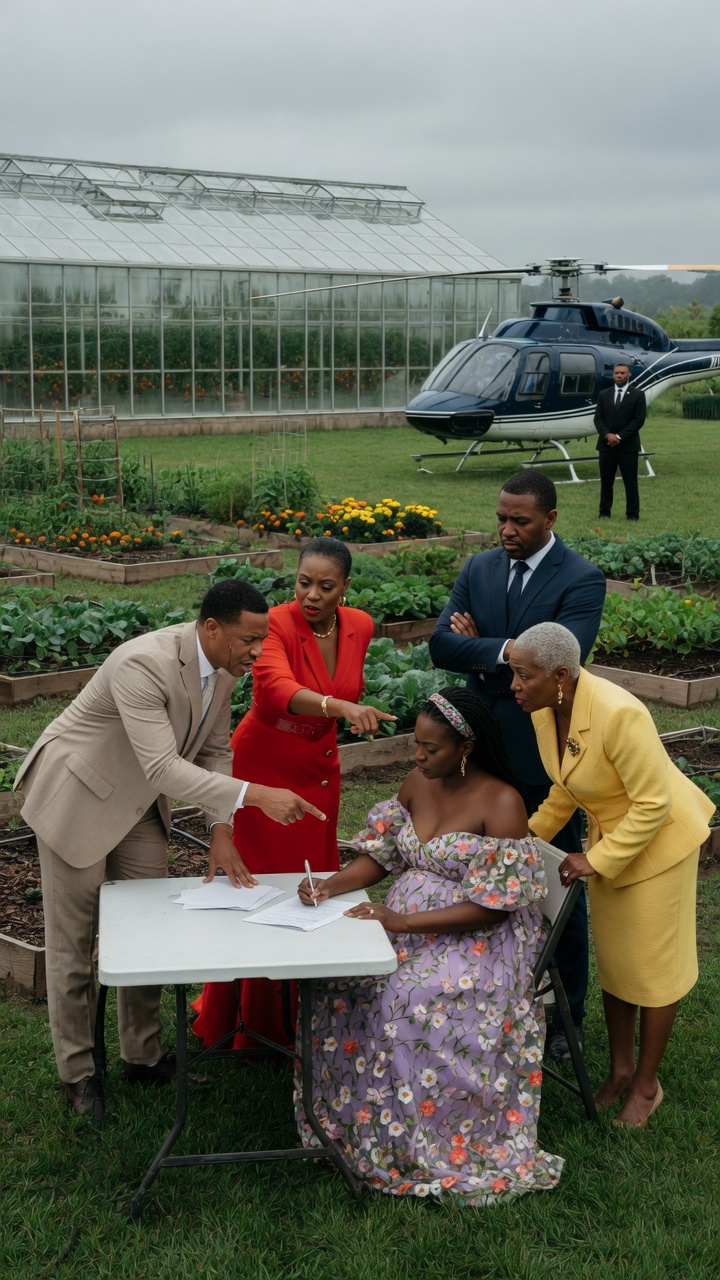
“No,” Genevieve said. She reached into her purse—a worn canvas tote bag—and pulled out a small, folded photograph. It was a picture of the old, dilapidated greenhouse on the far edge of the Sterling estate. “I want the deed to the old greenhouse on the north acre and the quarter-acre of rocky land it sits on. That’s it.”
The silence in the room stretched for a solid ten seconds before Beatrice exploded into laughter. It wasn’t a polite laugh; it was a cackle. She doubled over, clutching her pearls. “The greenhouse?” Beatrice wheezed. “The shack? Richard, she wants the shack!”
Richard smirked, shaking his head. “Jen, that thing is a hazard. We were going to bulldoze it next month to build a new garage for the Ferraris. Why on earth would you want that?”
“Sentimental value,” Genevieve said simply. “I spent a lot of time there when you were working late.”
“Working late” was a generous euphemism for Richard’s notorious affairs, which everyone in the room knew about, including Arthur.
Richard shrugged. “Arthur, can we do that? Carve out that scrap of land?”
Arthur flipped through a file. “It’s irregular, but the land value there is negligible. It’s mostly shale and rock. Strictly speaking, it would cost you more to demolish the structure than to gift it to her. If she takes the land, she takes the tax liability, too.”
“Done,” Richard said, sliding the pen toward her. “Take the dirt, Genevieve. Build a castle of mud for all I care.”
Genevieve picked up the pen. It was a heavy, gold-plated Montblanc that Richard had received as a gift from a senator. She didn’t hesitate. She flipped to the back page. Scratch. Scratch. The sound of the pen on paper was the only noise in the room.
Genevieve A. Sterling.
She capped the pen and set it down gently. Then she reached into her tote bag again and pulled out her wedding ring—a three-carat diamond that Richard had picked out from a catalog in five minutes. She placed it on top of the blue folder.
“You’re free, Richard,” she said. She stood up, smoothing down her cardigan.
“That’s it?” Richard asked, almost disappointed. He had expected begging. He had wanted her to cry so he could feel powerful.
“That’s it,” she replied.
As she turned to leave, Beatrice stepped in her path. The older woman was shorter than Genevieve but carried herself with the bulk of her bank account. She leaned in close, smelling of expensive perfume and rot.
“Don’t you dare come back crawling when you realize you can’t pay rent,” Beatrice hissed. “You were a mistake, Genevieve. A charity case. We’re all laughing at you. You know that, right? The whole city knows you’re walking away with nothing but dirt.”
Genevieve looked down at Beatrice. For a split second, a flicker of something dangerous crossed Genevieve’s eyes. It was the look of a wolf deciding if a rabbit was worth the energy to kill.
“Goodbye, Beatrice,” Genevieve said. “Enjoy the merger.”
She walked out the heavy oak doors. Inside the room, the laughter erupted again. Richard popped the cork on a new bottle of Dom Pérignon. “To freedom!” Richard shouted, raising his glass.
“To getting rid of the trash!” Beatrice cheered.
But Arthur the lawyer was frowning, looking at the signature on the papers. Genevieve A. Sterling. He paused. He realized that after six years, he didn’t actually know what the “A” stood for. He shrugged. It didn’t matter. She was a nobody.
Genevieve walked out of the Sterling and Halloway building and into the Seattle rain. She didn’t open an umbrella. She let the cold water hit her face, washing away the stifling atmosphere of the boardroom. She walked two blocks, turning the corner onto a quiet side street where a black sedan was waiting.
It wasn’t a taxi. It was a Mercedes-Maybach S-Class with tinted windows so dark they looked like oil slicks. The driver, a man with shoulders the size of a refrigerator, stepped out instantly. He held a large black umbrella over her head.
“Mrs. Sterling?” the driver asked.
Genevieve stopped him with a sharp look. She reached up and pulled the hair tie out of her bun. Her long dark hair cascaded down her shoulders, instantly changing her silhouette. She took off the beige cardigan and dropped it into a nearby trash can. Underneath, she wore a black silk blouse that screamed understated power.
“Not Sterling,” she said, her voice different now—the softness gone, the hesitation deleted. It was a voice that commanded armies. “Never Sterling again. It’s Caldwell. Genevieve Caldwell.”
Part 2: The Silent Partner
The ride in the Maybach was wrapped in a heavy, suffocating silence, broken only by the rhythmic thrum of the tires on the wet asphalt. Genevieve sat in the back, her fingers gripping the worn fabric of her coat—a cheap replacement she’d bought at a thrift store after pawning her Burberry trench. The leather seat beneath her felt alien, a ghost of a life she had supposedly left behind.
Mr. Thorne, her driver and security lead, sat opposite her, reading a dossier by the soft glow of a reading light. He didn’t speak, sensing that Genevieve needed the quiet to reassemble the fragments of her reality. When the car glided onto the tarmac of a private airfield, the world outside was a blur of rain and runway lights. But there, gleaming under the floodlights like a silver bullet, sat the Gulfstream G700. It was immense, a machine designed not just for travel, but for dominion over time and space.
“After you, Miss Caldwell,” Thorne said, opening the door.
Genevieve stepped out into the cold drizzle. A flight attendant in a pristine navy uniform was waiting at the bottom of the stairs. As Genevieve ascended, she felt a strange sensation—not excitement, but a terrifying sense of vertigo. She was ascending from the gutter to the stratosphere in the span of an hour.
The interior of the jet was warmer than any room she had been in for months. It smelled of white tea and mahogany. There were no rows of cramped seats. Instead, there was a living area with cream-colored divans, a dining table set with crystal, and a large monitor displaying the flight path to Zurich.
“Can I get you anything, Ma’am? Champagne, scotch?” the attendant asked.
Genevieve looked at the crystal decanters. Richard always drank scotch. He said it made him look like a serious man. “Water,” Genevieve said, her voice raspy. “Ice water, and black coffee. I need to be awake.”
Thorne sat across from her, buckling his seatbelt. The jet began to taxi, the movement smooth and predatory. “You’re wondering why you?” Thorne said gently, closing his dossier. “You’re wondering why the Caldwell Estate would go to this expense for a woman who just signed away a multi-billion dollar empire.”
“It crossed my mind,” Genevieve said, watching the lights of Seattle streak past.
“The Caldwells don’t do favors; they make investments. What is the return on investment on me, Mr. Thorne?”
Thorne smiled. “You are sharper than Mr. Sterling gave you credit for. You are correct. This is an investment. We have been waiting for you to break free for six years. We knew you were building something in the shadows—something that the Sterlings couldn’t even fathom.”
The plane surged forward, the G-force pressing Genevieve back into the leather. Within seconds, the dark, rainy sprawl of the city dropped away, replaced by the velvet black of the night sky. Once they reached cruising altitude, Thorne opened the briefcase again and laid out three photos. The first was of Richard, smiling at a gala, his arm around a woman named Jessica.
“Look at the date,” Thorne commanded.
Genevieve squinted. “October 2016.”
“And look at the author of the code structure in the appendix.”
Genevieve’s breath hitched. “It says… G. Caldwell? That’s my code. I wrote that.”
“He patented your work,” Thorne said, his voice hard as iron. “He claimed sole inventorship. Sterling Tech is built on your intellect, Genevieve. He didn’t just hide assets during the divorce. He built his entire empire on intellectual property theft from his own wife.”
Genevieve felt a wave of nausea, followed immediately by a cold, burning rage. It wasn’t the money. It was the eraser. He had stolen her mind, sold it to the world, and then convinced her she was worthless.
“He told me I was obsolete,” she said, her voice trembling. “He told me I didn’t understand the business anymore. He lied.”
“He was afraid of you,” Thorne said. “He knew that if you ever realized you were the architect, you would own him. That is why he isolated you. That is why he destroyed your reputation. He had to break you so you wouldn’t look at the blueprints.”
Thorne poured her a cup of steaming coffee. “Sleep now, Genevieve,” he said softly. “We land in Zurich in six hours. When you wake up, you are no longer the ex-wife. You are the architect coming to collect her due.”
Genevieve turned her head to the window, staring out at the stars. They looked closer here. Reachable. She didn’t sleep. She sat there for six hours, watching the Atlantic pass beneath her, letting the rage crystallize into something harder, something useful. She was no longer just the woman who had lost everything; she was the woman who had realized she owned everything all along.
Zurich was cold—a crisp, biting cold that cleared the lungs. The Bentley Mulsanne that met them at the terminal drove them away from the city, winding up into the hills overlooking Lake Zurich. They arrived at an iron gate that swung open silently. The estate was vast, a 19th-century shadow that looked like it had weathered wars and revolutions without losing a single slate tile.
Thorne led Genevieve through a cavernous hallway lined with oil paintings of severe-looking men and women. They entered a library that smelled of old paper and burning wood. Sitting in a wheelchair by the fire was Sir Alistair Graeme, the executor of the Caldwell Trust.
“The girl with the red scarf,” Alistair rasped. He didn’t smile, but his expression was one of deep approval. “Life has been bruising you.”
“It has,” Genevieve admitted, stepping closer. “Thank you for bringing me here.”
“Don’t thank me yet,” he waved a hand dismissively. “I haven’t done anything but pay for jet fuel. Sit.”
Part 3: The Architecture of Revenge
Alistair leaned forward, the firelight dancing in his eyes. “Michael Sterling is a fool. A dangerous fool, but a fool nonetheless. He thought that because he had the money, he had the power. He forgot that money is just ammunition. Intelligence is the gun. You, Genevieve, are the gun.”
“He has a team of lawyers, Sir Alistair,” Genevieve said. “The best in New York. Skadden, Wachtell. They will bury me in paperwork.”
“We aren’t going to sue him for the money, Genevieve,” Alistair said, a wicked glint appearing in his eye. “Not initially.”
Clara—no, Genevieve—frowned. “I don’t understand. If we sue for the money now, he will settle. He will write a check and he will win. Is that what you want? A check?”
“No,” Genevieve said, her voice dropping. “I want him to admit it. I want everyone to know he didn’t build it. I want his reputation.”
“Good,” Alistair slapped the armrest. “Then we don’t attack his wallet. We attack the IPO.”
He signaled to Thorne, who stepped forward and placed a thick binder on the table between them. “In two weeks, Sterling Tech goes public on the New York Stock Exchange. The valuation is projected at $20 billion. Michael stands to make 8 billion personally. But…” Alistair paused, tapping the binder. “The company’s valuation is based entirely on the proprietary algorithm, the one you wrote.”
“The one he patented,” Genevieve reminded him.
“Yes, but here is the twist,” Alistair said. “Thorne’s team did a forensic audit of the code Michael is currently using. He introduced a flaw, a dormant bug. If the transaction volume exceeds a certain threshold, the encryption key destabilizes. It’s a ticking time bomb. If Sterling Tech goes public and the volume spikes, the system won’t just crash. It will expose user data. It will be the biggest data breach in fintech history.”
Genevieve stared at the fire. “He doesn’t know. He has surrounded himself with ‘yes men’ and Jessica Vain, who knows nothing of coding. No one dares tell him the foundation is rotten. He thinks it’s perfect because he thinks he’s a genius.”
Alistair leaned back. “You have two choices, Genevieve. Choice A, we sue him now for the assets. He settles. You get rich. He fixes the bug quietly, and he becomes a billionaire. Or Choice B… you let the IPO proceed. You let him walk onto that stage. You let him ring the opening bell. And at the exact moment the market opens, we file a frantic public injunction. We attach the proof of the bug. We prove that you are the only one who knows how to fix it.”
“The stock will tank,” Genevieve whispered. “The IPO will collapse. He will lose everything.”
“Not just the money, the trust, the reputation. The investors will sue him for fraud. The SEC will investigate him. He will be radioactive.”
The room fell silent. It was a nuclear option. It was total war. Genevieve looked at her hands—hands that had scrubbed floors in Astoria, hands that had built a billion-dollar algorithm five years ago.
“He destroyed my name,” Genevieve said softly. “He made the world think I was a leech. If I do this, I prove I was the source.”
“You prove you are the architect,” Alistair corrected. “But you must be ready. The media will descend on you. He will attack you with everything he has left. You need to be armor-plated.”
Genevieve stood up. The fatigue was gone. The hesitation was gone. She felt a cold, jagged clarity. “I don’t have anything to wear for a war, Sir Alistair,” she said.
Alistair smiled. “Thorne has arranged for a stylist from Milan to arrive in the morning and a team of attorneys from Quinn Emanuel is flying in tonight to prep you for the deposition. We have two weeks to turn you into the CEO you should have been.”
Genevieve looked at the fire one last time. She imagined Michael’s face, smug and confident, holding his glass of scotch. “Let’s get to work,” she said.
For ten days, the heavy oak tables were buried under mountains of depositions, code printouts, and forensic accounting reports. The air was thick with the scent of stale coffee and expensive paralegal cologne. Genevieve sat at the head of the table. She hadn’t slept more than four hours a night. Her eyes were rimmed with red, but the fog of depression was gone. In its place was a sharp, vibrating focus.
“Do it again,” Veronica Sharp commanded, not looking up from her notes.
“I signed the divorce papers because I just wanted to leave,” Genevieve said, her voice steady.
“Objection. Weak,” Sharp snapped. “If you say that in front of a judge, you look like a woman who made a bad deal. You are the architect, Genevieve. Stop talking like the tenant.”
By the end of the week, Genevieve wasn’t just remembering the code; she was inhabiting it. She realized that Sterling Tech wasn’t Michael’s machine; it was her mind, digitized. Seeing how he had corrupted it with his clumsy updates made her sick.
Then came the visual transformation. Sir Alistair didn’t believe in makeovers for vanity; he believed in semiotics. When Genevieve stepped out of the dressing room, she barely recognized the reflection in the gilded mirror. The suit was white—a blinding, stark white wool crepe. The jacket was tailored sharply at the waist with structured shoulders that gave her a silhouette of power. She looked like a CEO.
“How do you feel?” Thorne asked.
“I feel like a demolition expert,” she said.
On the final evening, Sir Alistair handed her a final file. “This is the kill switch,” he said. “Once this is entered into the public record, the stock exchanges will halt trading on Sterling Tech immediately. The moment you file this, Michael is finished.”
“He will hate me for the rest of his life.”
“He already hates you, Genevieve,” Alistair said softly. “He hates you because he needs you. And for a man like Michael, need is the ultimate humiliation. Go and show him that he was right to be afraid.”
Part 4: The Sound of the Bell
New York City on the morning of the IPO was a frenzy of anticipation. The sun hit the facade of the New York Stock Exchange, bathing the columns in gold. It was a perfect day for a coronation. Banners hung from the street lamps: Sterling Tech—The Future of Money. Inside the VIP balcony, Michael Sterling was vibrating with adrenaline. He checked his reflection in the glass partition. His Brioni suit was flawless. His teeth were white. He looked down at the trading floor where traders were already gathering, eyeing the screens. The opening price was set at $45 a share.
“You look like a trillion dollars,” Jessica whispered, sliding her arm through his. She was wearing a red dress, aggressive and bright. “It’s happening, Michael. We won.”
Michael took a deep breath. “Did you hear anything from the lawyers about Genevieve?”
Jessica laughed, a tinkling, dismissive sound. “Not a peep. She’s gone, Michael. Forget her.”
Michael nodded, but a tiny knot of anxiety tightened in his stomach. It was too quiet.
“Five minutes to the bell,” a floor manager shouted.
Michael stepped up to the podium. The cameras flashed—a blinding wall of white light. He waved. He felt like a god. Meanwhile, at Teterboro Airport, the Gulfstream G700 touched down with a screech of tires. The moment the stairs lowered, two black SUVs pulled up to the wing.
Genevieve descended. The wind whipped her white trousers, but she didn’t flinch. Thorne was right behind her, carrying the briefcase containing the injunction and the evidence.
“We have 45 minutes to get to the courthouse,” Thorne said, checking his watch. “Traffic is heavy on the FDR.”
“Get us there,” Genevieve said, sliding into the back of the lead SUV.
The driver activated a siren, and they tore out of the airport gate. Inside the car, Genevieve opened her iPad. She pulled up the live stream of CNBC. There was Michael, smiling, holding the gavel.
“Look at him,” Genevieve whispered. “He has no idea. He’s standing on a trap door,” Thorne said. “And you’re about to pull the lever.”
The Southern District of New York courthouse. 9:28 a.m. The SUV screeched to a halt in front of the massive stone steps. A small army of photographers was already there, tipped off by an anonymous source that something historic was about to happen. When Clara—no, Genevieve—stepped out, the crowd went silent for a split second. The white suit was luminous against the gray stone of the city.
“Who is that?” a photographer shouted. “Is that… is that the ex-wife?”
“It’s Genevieve Caldwell!”
Genevieve ignored them. She walked up the steps with a stride that ate up the ground. Thorne flanked her, using his briefcase to gently part the sea of reporters.
“Mrs. Sterling, are you here to stop the IPO?”
A reporter thrust a microphone in her face. Genevieve stopped. She turned to the camera, her face calm, her eyes piercing. “My name is Genevieve Caldwell,” she said, her voice clear and amplified by the microphones. “And I am not here to stop the IPO. I am here to report a crime.”
She turned and marched through the revolving doors.
9:30 a.m. Clang, clang, clang. Michael brought the gavel down. The bell rang out across the trading floor. Confetti rained down from the ceiling. The room erupted in cheers. On the big screen, the ticker symbol STER appeared. Open at 48.
“To us,” Michael shouted over the roar. “To the empire!”
He looked up at the giant monitor that displayed CNBC, expecting to see his own face. Instead, the feed cut away. The breaking news banner flashed in urgent red. The anchor’s face was pale.
“We are interrupting the coverage of the Sterling Tech IPO with breaking news from the Southern District of New York. A massive emergency injunction has just been filed against Michael Sterling and Sterling Tech Holdings.”
Michael froze. The champagne glass slipped from his fingers and shattered. On the screen, Genevieve was walking toward the courthouse, looking like an avenging angel.
“The plaintiff, Genevieve Caldwell, former wife of Mr. Sterling, alleges that the core source code of Sterling Tech was stolen from her,” the anchor continued. “The filing includes a technical audit claiming the software contains a catastrophic security flaw. The presiding judge has granted an immediate temporary restraining order.”
On the floor below, the cheering stopped. Silence spread from the traders near the screens to the back of the room.
“Trading halted,” a floor official bellowed. “Code red. Trading halted on STER.”
The numbers on the big board froze. The graph, which had been shooting upward like a rocket, flatlined. Michael stared at the screen. He saw Genevieve’s face. She wasn’t smiling. She was looking directly into the camera lens, and it felt like she was looking right into his soul.
“It’s a lie,” Michael screamed, grabbing the railing. “It’s a lie! She’s crazy! She’s broke!”
Jessica pulled away from him, her face draining of color. She checked her phone. “Michael, the news… it’s trending. Our ‘Genevieve Caldwell’ pay-fraud scandal. They’re posting the patent documents. They’re posting the code comparisons.”
Michael fumbled for his phone. His hands were shaking so badly he dropped it. “She can’t do this,” he wheezed. “She signed the NDA!”
But deep down he knew. He looked at the faces of the bankers surrounding him. A minute ago they looked at him with adoration. Now they looked at him with horror. They were backing away, physically distancing themselves from the blast radius.
The elevator doors behind the podium opened. Two men in dark suits stepped out. They weren’t bankers. They were FBI agents from the Financial Crimes Division, accompanied by SEC regulators.
Michael turned back to the screen. Genevieve was walking away from the microphones, disappearing into the courthouse. She hadn’t just stopped the money. She had burned the temple to the ground.
Jessica’s phone buzzed. It was a notification from the bank. Alert: Assets frozen pursuant to federal court order.
Michael slumped against the railing, the confetti still settling around his feet like gray ash. The party was over.
Part 5: The Aftermath
Three weeks had passed since the IPO imploded on live television. The world had turned upside down. The SEC investigation had frozen Michael Sterling’s personal assets. The board of directors of Sterling Tech, facing a class-action lawsuit from investors, had voted unanimously to oust him as CEO.
Michael sat on the same bespoke Italian sofa, but the room around him was changing. Movers in blue coveralls were systematically packing away the life he had built. They wrapped the crystal vases in bubble wrap. They took the paintings off the walls, leaving rectangular ghosts on the plaster.
The elevator chimed. Michael didn’t look up, expecting his attorneys. Instead, the clicking of high heels announced the arrival of Jessica Vain. She wasn’t wearing the designer gowns of the charity gala; she was in a practical trench coat, her hair disheveled, her eyes bloodshot.
“The cards are declined, Michael,” she spat, not bothering to look at the room. “All of them. The black card, the platinum, even the joint account.”
“It’s a temporary freeze, Jess,” Michael said, his voice hollow. “The lawyers are filing a motion on Monday. Once we clear the fraud charges…”
“There is no ‘we’,” Jessica screamed, her composure shattering. “You told me you wrote the code! You told me she was a nobody! Now I’m being subpoenaed. My face is on every news channel as an accomplice to corporate fraud. I can’t even get a table at Le Bernardin!”
She signaled to the mover to take her bags.
“Jessica,” Michael stood up, his voice cracking. “You said we were partners.”
“I was a partner in a billion-dollar company,” she said coldly, pulling her sunglasses down to look at him with pure disgust. “Not a partner in a federal indictment. You’re radioactive, Michael. You’re done.”
She turned and walked into the elevator. Michael was alone in the empty apartment. The view of the city, once his kingdom, now looked like a prison of glass and steel. Two days later, the final act played out in a conference room on the 45th floor of the Quinn Emanuel building.
The table was long and polished. On one side sat Michael, flanked by a court-appointed attorney. On the other side sat Veronica Sharp, Elias Thorne, and at the head of the table sat Genevieve. She wore a navy suit today. Business, serious, commanding.
She watched Michael enter. He looked smaller, his shoulders were slumped, his suit ill-fitting, as if he had lost 20 lbs of ego in 20 days. He couldn’t meet her eyes.
“Let’s make this simple,” Sharp began, sliding a document across the table. “The SEC is willing to offer leniency on the criminal fraud charges if you admit that the intellectual property belonged to Ms. Caldwell and that you knowingly filed a false patent.”
“If I admit that,” Michael whispered, his voice raspy, “I lose the company. I lose the patent rights. I lose everything.”
“You have already lost the company, Mr. Sterling,” Thorne said calmly. “The only thing you are negotiating for now is whether you spend the next ten years in a federal prison or a summer house.”
Michael looked up, confused. “What?”
Genevieve spoke for the first time. Her voice was not loud, but it commanded the room instantly. “I am taking control of Sterling Tech. The investors have agreed to reinstate the IPO under a new name: Caldwell Systems. I will fix the code. I will secure the user data.”
She leaned forward. “But I don’t want to destroy you, Michael. That requires energy I’d rather spend on my business. This is a settlement agreement. You transfer all IP rights to me. You admit to the fraud publicly to clear the company’s name. In exchange, I will drop the civil suit for the stolen assets. I will not press for jail time.”
Michael looked at the paper. It was a lifeline—a humiliating, devastating lifeline. And Genevieve continued, a small, ironic ghost of a smile touching her lips. “I am feeling generous. I will grant you a monthly stipend for three years, and you can have the summer cottage in Maine.”
Michael froze. It was the exact offer he had made her six months ago. The summer cottage, the stipend. The pity.
“You can’t be serious,” he whispered.
“I am very serious,” Genevieve said, picking up her pen. “It’s a fair offer, Michael. You can fight this. Drag it out and watch me bury you in legal fees until you’re selling your watch to buy groceries. Or you can sign. Take the house in Maine. Disappear quietly. Keep your dignity.”
The words hit him like physical blows. She was mirroring him perfectly, reflecting his own cruelty back at him with dazzling precision. Michael looked around the room. He saw no sympathy. He saw only the cold, hard reality of the world he used to think he owned. He picked up the pen. His hand shook. He signed the document.
“It’s done,” Sharp said, snatching the paper away before the ink was dry.
Michael stood up. He looked at Genevieve one last time. He wanted to say something—to apologize, to scream, to beg—but he found he had no words left. He was obsolete. He walked out of the conference room, a man erased by his own arrogance.
Part 6: The Architect’s Restoration
With the legal battles behind her, Genevieve focused on the revitalization of what was now Caldwell Systems. The company was no longer the sleek, cold predator of the tech world; it was a transparent, community-driven entity that prioritized stability over exponential, dangerous growth. Genevieve stood at the podium in the middle of their new, open-plan office, looking out at a team of people who actually believed in what they were doing.
“We are not here to manipulate the market,” she said, her voice echoing through the bright, airy space. “We are here to build systems that people can trust. We are here to create tools that make life easier, not more complex.”
The room erupted in applause—not the polite, forced applause of Michael’s board meetings, but the enthusiastic, genuine applause of a team that had a stake in the future.
After the meeting, Genevieve walked to her office—a small, functional space that reflected her commitment to the work rather than the status. She sat at her desk, the file of the company’s current projects open before her. She had done it. She had survived the fire, dismantled the machine, and built something that actually mattered.
Her phone buzzed. It was a notification from her assistant. The legal team has confirmed that Michael Sterling’s final asset transfer is complete. You now hold 100% of the voting shares.
She stared at the screen, not feeling a sense of triumph, but a deep, quiet sense of peace. She had all the power, all the control, and all the wealth, but the only thing that felt real was the work.
She stood up and walked to the wall where she had hung a single piece of art—the first painting she had ever restored herself, a small, vibrant landscape she had found in an attic years ago. It wasn’t worth millions, but it was worth everything to her.
She heard a knock at the door. It was Brandon. He walked in, holding two cups of coffee, looking at her with a mix of pride and admiration.
“You did it,” he said, handing her the coffee.
“We did it,” she corrected.
They walked out onto the balcony, the city spreading out before them. It wasn’t the cold grid she had looked at from the penthouse; it was a vibrant, living city filled with people who had their own stories, their own struggles, and their own blueprints.
“What now?” Brandon asked.
Genevieve looked at the sky, the sun beginning to set in a cascade of orange and gold. “Now,” she said, “we build the next one.”
She realized that the struggle had never been about winning. It had been about finding the strength to walk out of the dark and into the light. She had been the architect of her own escape, and now she was the architect of her own future. And as the stars emerged above the skyscrapers, she knew that the blueprint for her life was finally complete. She didn’t need the penthouse, the jet, or the prestige. She had the one thing that made all the difference: she had the truth, and she had the freedom to be exactly who she was meant to be. The journey was over, the story had been written, and they were finally, together, at the very beginning of the rest of their lives.
Part 7: The Final Blueprint
The final transition of Caldwell Systems was completed on a Tuesday in late spring. The company was no longer the sleek, cold predator of the tech world; it was a transparent, community-driven entity that prioritized stability over exponential, dangerous growth. Genevieve stood at the podium in the middle of their new, open-plan office, looking out at a team of people who actually believed in what they were doing.
“We are not here to manipulate the market,” she said, her voice echoing through the bright, airy space. “We are here to build systems that people can trust. We are here to create tools that make life easier, not more complex.”
The room erupted in applause—not the polite, forced applause of Michael’s board meetings, but the enthusiastic, genuine applause of a team that had a stake in the future.
After the meeting, Genevieve walked to her office—a small, functional space that reflected her commitment to the work rather than the status. She sat at her desk, the file of the company’s current projects open before her. She had done it. She had survived the fire, dismantled the machine, and built something that actually mattered.
Her phone buzzed. It was a notification from her assistant. The legal team has confirmed that Michael Sterling’s final asset transfer is complete. You now hold 100% of the voting shares.
She stared at the screen, not feeling a sense of triumph, but a deep, quiet sense of peace. She had all the power, all the control, and all the wealth, but the only thing that felt real was the work.
She stood up and walked to the wall where she had hung a single piece of art—the first painting she had ever restored herself, a small, vibrant landscape she had found in an attic years ago. It wasn’t worth millions, but it was worth everything to her.
She heard a knock at the door. It was Brandon. He walked in, holding two cups of coffee, looking at her with a mix of pride and admiration.
“You did it,” he said, handing her the coffee.
“We did it,” she corrected.
They walked out onto the balcony, the city spreading out before them. It wasn’t the cold grid she had looked at from the penthouse; it was a vibrant, living city filled with people who had their own stories, their own struggles, and their own blueprints.
“What now?” Brandon asked.
Genevieve looked at the sky, the sun beginning to set in a cascade of orange and gold. “Now,” she said, “we build the next one.”
She realized that the struggle had never been about winning. It had been about finding the strength to walk out of the dark and into the light. She had been the architect of her own escape, and now she was the architect of her own future. And as the stars emerged above the skyscrapers, she knew that the blueprint for her life was finally complete. She didn’t need the penthouse, the jet, or the prestige. She had the one thing that made all the difference: she had the truth, and she had the freedom to be exactly who she was meant to be. The journey was over, the story had been written, and they were finally, together, at the very beginning of the rest of their lives.