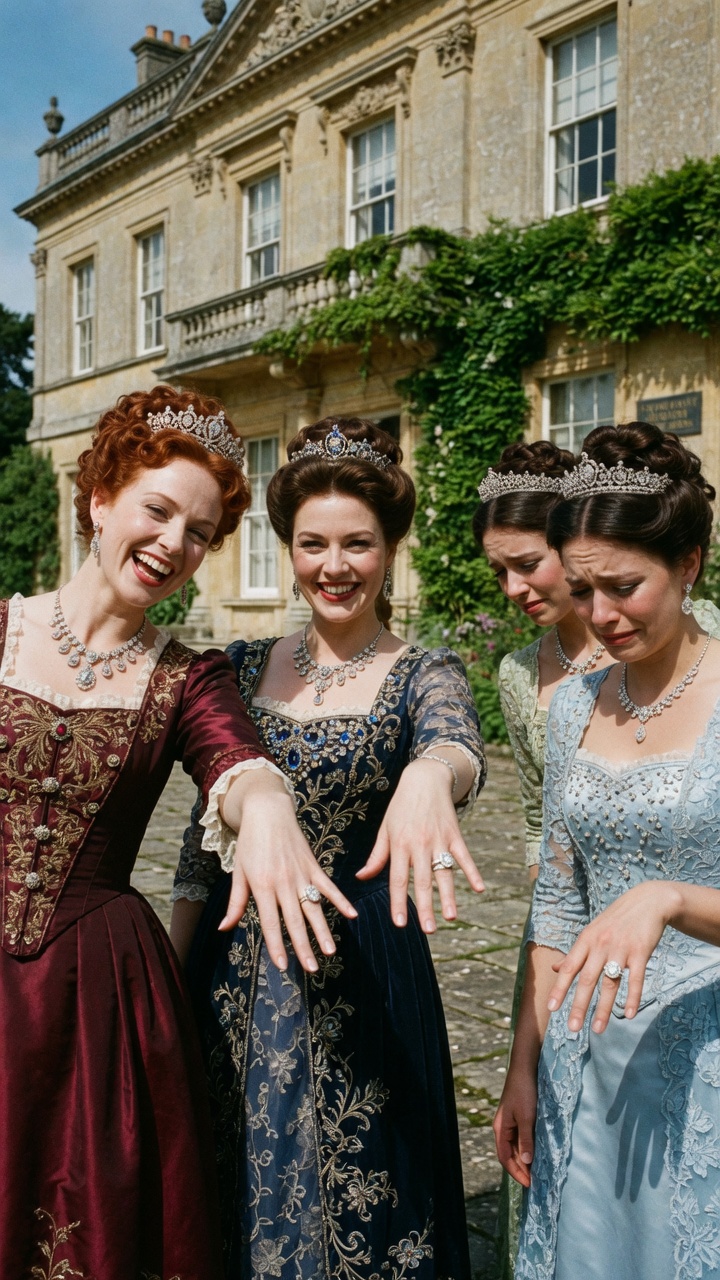
They Mocked Their Elder Sister For Being Unmarried… Until A Mysterious Duke Approached Her At The Ball
Part 1: The Invisible Daughter
The Veilrest Manor stood as one of the grandest aristocratic homes in Northland, its towering marble fireplaces, endless corridors lined with golden portraits, and polished black staircases curving beneath painted ceilings designed to intimidate any visitor. Yet, for Odora Veilrest, the thirty-one-year-old eldest daughter of the manor, the grandeur was merely a cage of gold and cold stone.
This evening, the manor overflowed with guests. Noble women in embroidered gowns glided through the ballroom carrying crystal glasses, while gentlemen discussed politics beside the fireplaces. Platters of roasted pheasant, glazed carrots, buttered potatoes, and sugared pastries covered the dining tables beneath the soft, mocking glow of the chandeliers. Odora stood near the wall, her plain, dark-blue gown making her nearly invisible among the brighter colors surrounding her.
Three years earlier, she would have been seated beside her sisters. Three years earlier, men had asked for introductions during every social gathering. Now, people looked past her as though she had slowly faded into the wallpaper of the estate itself. Lord Cedric, her father, guarded the family reputation with an almost religious obsession. Every dinner, every guest, every marriage discussion inside the manor revolved around status, and Odora had become the family’s greatest disappointment.
At thirty-one, her unmarried status followed her everywhere. During church visits, women lowered their voices the moment she passed. Younger girls secretly studied her with nervous pity, as though she represented a terrible future waiting for them if they failed to marry in time. Older women were crueler. “She was beautiful once,” Odora overheard one whisper after Sunday service. “It is sad what age does to a woman’s chances.”
Odora continued walking, her expression schooled into pleasant emptiness. Pain had become a companion she carried silently. That afternoon, while guests drank wine inside the drawing room, Odora had slipped into the kitchen to help calm a maid’s young daughter who had burned her hand. Moments like that were the only times Odora still felt useful inside the manor.
Lady Rowena, her mother, entered the kitchen minutes later, elegant in dark emerald silk trimmed with pearls. Her sharp eyes immediately landed on Odora, crouched beside the child.
“There you are. Guests are asking for you.”
“I was helping Claraara,” Odora said, standing quickly.
“Yes. Well, try not to disappear during gatherings,” Rowena replied, her tone calm but sharp enough to cut. “People already ask enough questions.”
The words stung, but Odora was used to the burn. Later that evening, while passing her father’s study, she heard her own name spoken with chilling detachment.
“Selmira’s marriage will strengthen our position considerably,” Lord Cedric said to a wealthy guest.
“And your eldest daughter?” the gentleman asked carefully.
A brief silence followed. “We no longer discuss unrealistic expectations,” Lord Cedric replied coldly.
Odora stopped walking. She stood frozen in the dim hallway, staring down at the silver tray trembling in her hands. The weight of her father’s disdain pressed against her ribs. But as she stood there, the enormous ballroom door opened, and a royal servant’s voice thundered across the estate, changing the trajectory of the night.
“His Grace, Duke Allaric Ravenshade!”
The entire ballroom froze. Odora’s breath hitched. She had heard of the Duke—the wealthiest man in England, a man whose presence usually meant a shift in the political tides. Why would he be here?
Part 2: The Duke’s Shadow
The ballroom went deathly silent as Duke Allaric Ravenshade entered. He was thirty-seven, tall, with striking, natural white hair and icy blue eyes that seemed to strip away the pretense of everyone he looked at. He was the wealthiest Duke in the country, feared and admired in equal measure.
Lord Cedric hurried forward, practically bowing, his usual arrogance replaced by a frantic desire to please. Lady Rowena followed, her face flushed with a mix of excitement and anxiety. They led him toward the center of the room, oblivious to the way the Duke’s gaze kept drifting, searching the room with a cold, analytical intent.
Odora stayed near the wall, wishing she could vanish entirely. She didn’t want the Duke’s attention. She didn’t want the family’s sudden, frantic interest in her existence. She watched as her sisters, Selmira, Kalista, and Odette, began to preen. They whispered among themselves, adjusting their bodices and smoothing their hair, competing for the Duke’s notice like hawks circling prey.
Then, the accident happened. A frightened servant girl carrying a tray of champagne stumbled beside a table. Crystal shattered. Pale liquid pooled over the expensive carpets. The girl froze, her face pale with terror.
“How careless!” one noblewoman shrieked.
Odora moved without thinking. She knelt beside the girl, ignoring the wine soaking her own silk gown. “It is all right,” she whispered gently. “You are bleeding.” She wrapped her own handkerchief around the girl’s finger, her touch cooling the panic.
She didn’t realize the Duke had stopped. He was standing only a few feet away, watching her. He didn’t look at the spilled wine. He didn’t look at the indignant noblewoman. He was looking at Odora, his blue eyes unreadable, yet intense.
For the rest of the evening, she felt his presence like a physical force. She noticed how he moved through the room, polite but detached, rejecting every advance from the noble mothers pushing their daughters toward him. Then, during supper, Selmira decided to strike.
“To Kalista,” Selmira announced, lifting her glass. “The final daughter bringing honor through marriage.”
She glanced toward Odora. “Though perhaps miracles still await our eldest sister someday.”
The room chuckled. Odora lowered her eyes, the humiliation burning. She pushed back her chair to leave, but before she could stand, the ballroom went silent again. The Duke had risen. He was walking toward her.
He stopped directly before her chair. The room held its breath.
“Miss Odora Veilrest,” he said, his voice carrying clearly to the back of the hall. “Would you honor me with a dance?”
Odora felt as if she had stopped breathing. The air in the room was electric. She stood, her hand resting on his arm, and together they moved to the floor. As they waltzed, the whispers were frantic. Why her? Why the “failure”?
“You seem uncomfortable,” he said, his voice low.
“I am unaccustomed to becoming the center of a ballroom,” she whispered.
“Then get used to it,” he said, and for the first time, he smiled—a small, private movement that made the world around them fall away.
Part 3: The Duke’s Vow
The waltz didn’t just end the evening; it incinerated the Veilrest family’s social standing. As the music faded, the Duke didn’t return Odora to her seat. He walked her toward the terrace, ignoring Lord Cedric’s desperate attempts to intervene.
“They treat you poorly,” the Duke said, his voice hard. It wasn’t a question.
“They treat me as an investment that didn’t pay off,” Odora replied, surprised by her own candor.
The Duke stopped at the edge of the terrace, looking out at the dark, rolling hills of the estate. “I was betrayed once. By someone who cared more about status than the person she claimed to love. I stopped believing in fairy tales a long time ago.”
Odora looked up at him. “Why are you here, then?”
“I am here because I saw you on your knees in the wine,” he said. “I saw who you were when you thought no one was watching. That is the only version of a person that matters.”
In the weeks that followed, the visits became frequent. Ravenshade Manor began sending carriages to the Veilrest gates, laden with gifts—not of jewelry, but of books, rare teas, and once, a violin that belonged to a master artisan. Lord Cedric and Lady Rowena were frantic, swinging between confusion and desperate opportunism. They began introducing Odora as their “most beloved daughter,” a performance so transparent it made Odora’s skin crawl.
But Odora found her own strength. She started speaking up at dinner, correcting her parents when they spoke over her, and refusing to participate in the charade of the “marriage market.”
The sisters, meanwhile, were unraveling. Selmira’s husband, Hadrien, had lost a fortune at the tracks. Odet’s husband, Lucian, spent his nights in Parliament and his days ignoring her. Kalista’s husband, Phineas, had revealed a controlling, jealous streak that made her golden cage look like a prison. They watched Odora—the “failure”—bloom under the Duke’s quiet attention, and their jealousy turned into a toxic, festering wound.
“She manipulated him,” Selmira hissed one afternoon in the drawing room. “Men like that don’t fall for women like Odora unless they’ve been tricked.”
Odet sat silently, her hands trembling. She knew her own marriage was a hollow shell, and seeing Odora finally being treated with respect was more than she could bear.
Then came the invitation to the Royal Banquet at Kensington Hall. It was the event of the season, a glittering affair where England’s elite would determine the political and social climate for the next year. Lord Cedric was convinced that one of his daughters would secure a place at the Duke’s side.
“You must wear the emerald silk,” Lady Rowena insisted to Odora, her voice tight with ambition. “The Duke notices elegance.”
Odora looked at the dress, then at the mirror. She didn’t want the silk. She didn’t want the pearls. She wanted the life she was finally starting to believe she deserved.
Part 4: The Banquet of Whispers
The royal banquet was a crushing spectacle of excess. Beneath the painted clouds of the ballroom, diamond-draped noblewomen and tuxedo-clad men moved with the practiced ease of those born into power. Odora felt like a ghost haunting her own life, draped in silver silk that felt heavy and pretentious. Her sisters, Selmira, Kalista, and Odet, clung to the periphery, their eyes scanning the room for any opportunity to eclipse her.
When Duke Allaric Ravenshade entered, the room didn’t just go quiet; it seemed to hold its breath. He was dressed in black silk, his white hair standing out against the gold-leafed pillars. Mothers pushed their daughters into his path, their desperate smiles fixed. Lady Vivien Ashborn, the woman the Duke had once almost married, glided toward him, her emerald velvet gown sweeping the floor. She had the air of a woman returning to her rightful throne.
Odora stood near the edge, her glass of sparkling water untouched. She expected nothing. She had come because she had to, but she was already planning her exit.
“Why her?” a voice whispered near her. “He has ignored every debutante in London. Did you see Vivien’s face?”
Odora turned her gaze to the center of the room. Allaric was walking. He wasn’t looking at Vivien, or the debutantes, or the political figures. He was walking directly toward the wall where she stood.
The silence that followed was visceral. The Duke stopped before her, reaching into his pocket. He didn’t offer a dance. He produced a small, velvet box and opened it. The ring inside—diamonds and sapphires, brilliant and cold—caught the light, sparking like frozen fire.
“Miss Odora Veilrest,” he said, his voice carrying to the back of the room. “I have spent years surrounded by people who value status above character. But you possess something far rarer.”
He looked at her, his icy eyes warming for the first time. “You possess dignity without pride, and kindness without expectation. Will you do me the honor of becoming my Duchess?”
The ballroom erupted in a collective gasp. Vivien stood frozen, her face drained of color. Lord Cedric looked as if he’d been struck by lightning.
Odora felt the tears burn behind her eyes. All the years of being the “unmarried daughter,” the “disappointment,” the “invisible servant” of the manor—it all vanished. She nodded, her lips forming the word yes before her voice could manage it.
He slid the ring onto her finger. It felt light, perfect, and real. The applause that followed wasn’t just polite; it was confused, begrudging, and electrified. She was a Duchess. She was his. And as she looked up at him, she knew the Veilrest family would never look at her—or themselves—the same way again.
Part 5: The Fall of the Sisters
In the aftermath of the engagement, the social hierarchy of Northland collapsed and rearranged itself. The Veilrest estate was flooded with gifts and visitors, all of them desperate to curry favor with the new Duchess-to-be.
Lord Cedric and Lady Rowena found themselves scrambling to maintain their dignity, acting as if they had always cherished Odora. But the damage to the sisters was done.
Selmira’s husband, Hadrien, had been ruined by his gambling debts, his estate seized by creditors. Selmira, who had once mocked Odora for her unmarried status, now found herself begging her parents for a place to stay. Odet’s husband, Lucien, was embroiled in a political scandal that saw him stripped of his parliamentary status. Kalista, meanwhile, found herself trapped in a marriage that had become increasingly abusive as Phineas’s debts and jealousy grew.
The sisters blamed Odora. They blamed her for “stealing” the Duke, for “tricking” him, and for making them look small. They held secret meetings in the manor’s garden, their voices sharp and filled with a toxic, impotent envy.
“She was always a schemer,” Selmira spat one afternoon. “She just waited for the right moment to strike.”
“She’s ruined us,” Odet whispered. “Every house we enter, they ask about her. They want to know why we weren’t invited to the wedding.”
One afternoon, all three sisters confronted Odora in the library.
“You think you’re better than us?” Kalista demanded, throwing a book onto the table. “You’re just a lucky girl who trapped a powerful man.”
Odora didn’t flinch. She was standing by the fireplace, her back straight, her gaze steady. “I didn’t trap him,” she said calmly. “I simply refused to disappear. You were all so busy mocking me that you never realized I was the only one in this house who was actually building anything of value.”
“We built reputations!” Selmira shrieked.
“You built facades,” Odora corrected. “And now, the wind is blowing, and you have nothing left to stand on.”
They left her, furious and shaking, but Odora felt only a profound sense of closure. She wasn’t their victim anymore. She was the woman who had survived the cage and found her way to the light.
Part 6: The Winter’s Shadow
Winter arrived early that year, cloaking the Ravenshade estate in heavy, relentless snow. The Duke’s manor, once a cold fortress, began to change under Odora’s influence. She filled the halls with fresh lilies, opened the heavy curtains to let in the winter sun, and insisted on hosting charity dinners for the families who struggled in the valley below.
Allaric watched her with a quiet, growing reverence. He was learning that a home wasn’t just a collection of artifacts, but a place where a life could be tended to.
But not everyone was pleased with the change. There were those within the Ravenshade circle—old family allies and business partners—who viewed Odora as a threat to their influence. They missed the days when Allaric was a cold, detached ruler they could easily manipulate.
One evening, while Odora was walking through the gallery, a shadow moved near the portraits. It was a man she recognized—one of the Duke’s advisors.
“The Duke is distracted, Duchess,” he said, his voice oily. “He’s becoming weak. He cares too much about these… charity projects.”
Odora turned, her expression turning to stone. “He is becoming human. Perhaps you should try it.”
The advisor stepped back, his eyes flashing with malice. “The nobility will not stand for a Duchess who spends more time with servants than with them.”
“Then let them fall,” she replied.
She realized then that her position wasn’t a static seat of power. It was a frontline. The same people who had mocked her in her father’s house were here, wearing different faces and different titles, still trying to keep her small.
She went to Allaric, who was working in his study.
“They’re coming for us,” she said.
Allaric didn’t look up from his papers. “I know. Let them.”
“They don’t know who I am yet,” she said, a dangerous glint in her eye.
“No,” he agreed, setting his pen down. “They haven’t seen the fire yet.”
They held hands in the firelight, two people who had once been broken and were now the strongest force in the country. The storm was coming, but they were ready.
Part 7: The Inheritance of Kindness
The final test of Odora’s transition arrived with the spring. Lord Cedric Veilrest, her father, lay on his deathbed in the manor where he had once ruled with such cold, clinical pride. He had been ill for months, his estate failing, his reputation in tatters following the scandal of his daughters’ failed marriages.
The three sisters were there, bickering over the inheritance, their voices echoing through the grand, now-dusty halls. They were broken, impoverished, and desperate.
Odora entered the room alone. She walked past her sisters, past the solicitors, and toward the bed where the man who had traded his daughters like currency lay dying. He looked at her, his eyes clouded with a lifetime of cold decisions.
“You survived,” he whispered.
“I did,” she said.
“I have nothing left to give you,” he muttered.
“I don’t need anything from you,” she replied. She reached down and took his hand. It was thin, fragile—the same hand that had refused to listen to Thomas Everwin years ago.
“You taught me that status doesn’t matter,” she said gently. “You taught me that by showing me what happens when you prioritize it above everything else. You taught me the value of being seen.”
She stayed with him until the end. When he died, the sisters turned to her with open palms, expecting her to save them.
“You’re a Duchess,” Selmira pleaded. “You have the power. You can pay our debts.”
Odora looked at them. She looked at the sisters who had mocked her, the mother who had treated her like a servant, the father who had traded her happiness for a political alliance.
“I will help you,” she said, “but not because I owe you. I will help you because that is what a Duchess does. But you will never again be allowed to treat anyone—including me—as if they are invisible.”
She used her wealth to stabilize their lives, but she did it on her own terms. She became the woman who broke the cycle. She didn’t seek their love; she demanded their respect.
In the end, Odora Ravenshade became the most influential woman in the country. She lived her life with grace, she loved Allaric with a fierce, honest passion, and she never once forgot the girl with the silver tray, the girl who had been told she was too old and too plain, the girl who had learned that the most important seat at the table is the one you build for yourself. She had been the disappointment, the failure, the unwanted daughter—but she had become the truth, the light, and the legacy.