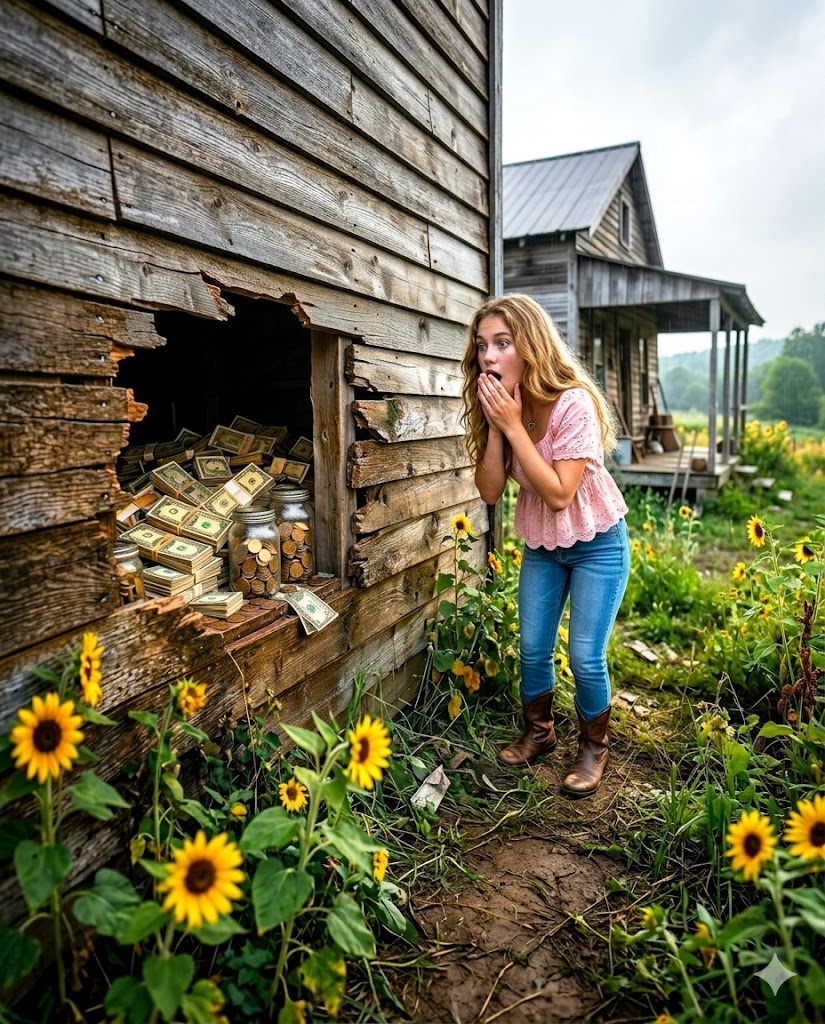
Thrown Out at 18, She Inherited Grandpa’s Forgotten Cabin — What Was Hidden in the Walls Made Her Rich
Part 1: The Garbage Bag Inheritance
The morning sunlight in the Ashford household was always sharp, but on Lily’s eighteenth birthday, it felt like an interrogation. Craig, her stepfather, stood in the doorway of the bedroom she had occupied for eleven years. He dropped a black industrial-sized garbage bag—the kind meant for yard waste and debris—onto the foot of her bed with a dull thud.
“Pack,” he said. He didn’t use her name. He hadn’t used her name in years, preferring to refer to her as ‘it’ or ‘she’ when he spoke to Denise, Lily’s mother, as if Lily were a stray cat they’d accidentally taken in. “Clothes and personal items only. Leave the furniture.”
Lily didn’t look up immediately. She had been expecting this since she was fourteen. Craig had been counting down the days to her eighteenth birthday with the same fervor most parents reserve for a family vacation.
“I know the rules, Craig,” Lily said, her voice steady despite the tremor in her hands.
“You have until noon,” he muttered, turning on his heel. He didn’t look back. He didn’t care where she was going, and he certainly didn’t care that she had nowhere to go.
Lily stood and walked to her closet. She pulled out her duffel bag, the one she’d bought at a thrift store in middle school. It took less than ten minutes to pack. Two pairs of jeans, a handful of t-shirts, her work uniform from the Wendy’s on Route 9, and the photograph of her father. The picture was the only thing she truly cherished—Tom Ashford, handsome and tired, holding her as a baby in a yellow blanket. She slid it into the front pocket of her bag, her fingers lingering on the faded edges.
She walked downstairs. Denise was in the kitchen, washing a pan that was already spotless. She was scrubbing in slow, rhythmic circles, her back to the room.
“Mom?” Lily said.
Denise didn’t stop. The sound of the water was the only noise in the house.
“Mom, look at me.”
Denise turned off the faucet. She dried her hands on a dish towel with agonizing slowness. When she finally turned around, she looked at Lily for a single, fleeting second before her eyes dropped to the floor. “You’ll be fine,” Denise said, her voice completely flat. “You’re an adult now. You have your job at Wendy’s.”
“I have $34, Mom. That’s all I have.”
Denise folded the towel and set it on the counter, then picked it up to refold it again. “Craig’s right, Lily. It’s time.”
There was no cruelty in Denise’s face, which was almost worse. It was a blank slate of indifference. She was relieved. Lily grabbed her bag, walked past the couch where she’d done her homework for a decade, and opened the front door. She didn’t look back. She walked to her 2004 Honda Civic, an $800 wreck with a check engine light that glowed like a malevolent eye. She threw the bag in the back, sat in the driver’s seat, and stared out at the suburban street. She didn’t know it yet, but she was driving away from a life that had been designed to erase her.
Part 2: The Loneliness of the Road
The first night was a lesson in survival. Lily parked at a Walmart on the edge of town, leaning the seat back until it hit the rear cushions. She used a wadded-up sweatshirt as a pillow. Every sound outside the car—the rumble of an idling truck, the crunch of gravel under footsteps, the distant slam of a car door—sent a jolt of panic through her chest. She woke up four times, each time staring into the darkness, wondering if someone was looking through the glass.
The second day was spent at a gas station. She filled the tank with $9 worth of gas and bought a single dollar-menu cheeseburger. She spent hours scrolling through job listings on her phone, but her battery was dying, and the charging cord only worked if she twisted it at an impossible angle. Nobody was hiring someone with no address, no references, and no way to shower before an interview.
She held the photograph of Tom Ashford on her lap. Her mother had told her he died in a construction accident when she was three. That was all she knew. As for her grandfather, Walter Ashford, Denise had sworn he died before Lily was even born. But as Lily stared at the dashboard, she felt a strange, inexplicable pull toward the north.
Then, her phone rang. It was an unknown number. “Miss Ashford? This is David Chen from Harrison and Associates. I’m calling regarding the estate of Walter Ashford.”
Lily’s heart stopped. “My grandfather died a long time ago.”
“Walter Ashford passed away six months ago,” the lawyer corrected. “He lived in Cedar Falls. He named you as the sole beneficiary of his estate.”
“That’s impossible,” Lily stammered. “My mother said he died before I was born.”
“I can assure you he was alive until last October,” Chen said. “He came to my office every year to update his will. He always asked the same question: whether I’d been able to find you.”
Lily hung up the phone, her hands trembling so violently she dropped it into the passenger seat. She sold her high school textbooks for $18 to afford the gas, and without a second thought, she turned the key in the ignition. The engine groaned, sputtered, and finally caught. She was driving north toward a town she’d never heard of, to a man her mother claimed was a ghost.
Part 3: The General Store
Cedar Falls was small—the kind of place where the population sign had faded into illegibility. It was a main street with a hardware store, a diner, and a post office that looked like it belonged on a movie set. Lily pulled into the only parking spot in front of a general store and turned off the engine. The silence of the town felt heavy, almost expectant.
She walked into the store. A woman with gray hair braided tight and reading glasses perched on her forehead looked up from her shelf-stocking. She watched Lily for three seconds, and then her hands went completely still.
“You’re Walter’s granddaughter,” the woman said. It wasn’t a question.
Lily stopped. “How did you know?”
“You look exactly like your father.”
The woman, May Perkins, came around the counter. Her eyes were warm and steady. “I was Walter’s neighbor and closest friend for twenty years. He talked about you every single day.”
Lily couldn’t speak. She felt the tears stinging her eyes. May didn’t offer a hug; she offered a brown paper bag. Inside were bread, peanut butter, apples, and water. “I can’t pay for this,” Lily said.
“Walter paid for them a long time ago,” May replied. “He left money here every month. Said it was for when you finally came.”
Lily took the bag. “What was he like?”
“He was a carpenter,” May said, leaning against the counter. “He built houses. After your father died, he had a rough stretch, but he pulled himself out. He built a cabin out on Old Creek Road with his own hands. He spent every year working on it, making it ready for you.”
Lily drove to the cabin with May’s directions. It sat at the end of a dirt road, tucked beneath the trees. It was a one-story structure with hand-carved trim—leaves and branches cut into the wood with obsessive detail. She unlocked the heavy brass door and stepped inside. It smelled of cedar and dust. Everything was level, smooth, and perfect.
As she swept the floors, she found a gap in the baseboard near the fireplace. Behind it was a hidden compartment containing three envelopes. She opened the first one: Lily, age six. I hope this reaches you. She sat on the cabin floor, the sunlight turning the room gold, and wept. Her grandfather hadn’t forgotten her. He had been waiting for her, writing cards for a girl who wasn’t there, and keeping them safe in the walls.
Part 4: The Letters in the Walls
Lily opened the remaining envelopes, one by one. By the time she finished with the birthday cards, her heart was a raw, aching thing. Walter had tried. He had filed for visitation, hired lawyers, and begged courts for a chance to see her, only to be shut down by Denise’s ruthless legal team.
She checked the kitchen next, finding a compartment under the sink that held more envelopes. Ages nine through fourteen. And then, at the very back, she found a small wooden box. It contained birthday money—$47,000 in savings bonds, one bought every year.
At the bottom of the box was a single letter on yellowed legal paper. It wasn’t a card. It was a confession.
Dear Lily, it began. I know you’re reading this because you found the cabin. I hid these in the walls because your mother couldn’t steal what she didn’t know existed. Your father, Tom, died because of me. He took a dangerous job to pay for my heart surgery because my insurance was worthless. He promised me he’d be careful. Three weeks later, the scaffold gave out.
Lily sat on the kitchen floor, her back against the cabinet, reading the words that had haunted her grandfather’s final years. Tom Ashford hadn’t just died in an accident; he had died to save the man who had then spent fifteen years trying to pay back a debt he couldn’t cancel.
She didn’t hear May Perkins enter, but when she looked up, the neighbor was standing there, watching her with eyes that had seen the entire arc of this tragedy. “He never forgave himself,” May said softly. “But he never gave up on you, either.”
Lily looked at the music box she’d found—a handmade gift with I made this for you burned into the lid. She realized that her mother hadn’t just lied about her father and grandfather; she had erased the only people who had ever truly loved her. The walls of the cabin weren’t just wood; they were a sanctuary of a man’s broken heart.
Part 5: The Confrontation
A car crunched onto the gravel driveway. Lily didn’t need to look to know who it was. She saw the silver sedan, the same car Denise had driven away from their house in a week ago.
Lily walked out onto the porch, her hands still stained with the wood stain she’d been using to sand the railing. Denise stepped out of the car, looking around at the cabin with an expression that shifted between shock and cold detachment. Craig stayed in the driver’s seat, staring at his phone.
“We need to talk,” Denise said, stepping onto the porch.
Lily stood her ground. She didn’t offer a seat. She didn’t offer an explanation. “How did you find me?”
“The lawyer’s office,” Denise said. “They called the house.”
Lily watched her mother’s eyes flicker across the hand-carved trim, the porch she had just repaired, and the general state of the property. “You told me he was dead,” Lily said. “You looked me in the eye and lied about everything.”
“I was protecting you,” Denise snapped, her mask of coldness failing for a moment. “He was an alcoholic. He was a menace.”
“He was sober for thirteen years,” Lily replied. “He wrote me every year. He tried to see me.”
Denise’s hands were shaking. “You don’t know what it was like. Being twenty-four, with a dead husband and a father-in-law who showed up drunk at midnight. I shut the doors. I had to.”
“You didn’t have to lie about him being dead,” Lily said. “You didn’t have to steal the birthday money.”
Denise went white. She sat in the wooden chair, looking smaller than Lily had ever seen her. “I used the money for the house. We needed it. Craig doesn’t make that much.”
“Craig made enough to keep me in the Wendy’s uniform while you lived in a house you didn’t own,” Lily said.
Craig stepped out of the car, his face reddening. “This place is a shack. I told you it wasn’t worth the gas.”
Lily looked at him, then at her mother. She saw the pathetic desperation of a man who had built his life on someone else’s misery and a woman who had used her own daughter as a pawn.
“Get off my porch,” Lily said.
Part 6: The Reclamation
The sedan drove away, leaving a plume of dust in the twilight. Lily stood on the porch, her breathing ragged, feeling the sudden silence of the woods. May Perkins had watched from her truck the entire time, now stepping out to join Lily on the steps.
“You handled that better than he would have,” May said.
“I don’t feel like I handled it. I feel like I’m still just reacting.”
“Give it time,” May said. “Walter waited fifteen years. You’ve got time.”
Lily spent the next three months transforming the cabin. She took classes at the community college, learning design and carpentry. She worked at May’s store, becoming the heartbeat of the town. She wasn’t the girl in the Wendy’s uniform anymore. She was a woman who was building a life on her own terms, brick by brick, board by board.
The bonds she’d found in the floor were her seed money. She didn’t spend them on frivolous things. She used them for tuition, for tools, for the materials to build a deck that was solid and level. She learned the feel of every chisel and the weight of every hammer.
One day, a girl came into May’s store—thin, scared, and clearly struggling with the same choices Lily had once faced. Lily remembered the garbage bag, the $34, and the cold nights in the Honda. She didn’t ask questions. She gave the girl a sandwich, a bottle of water, and her phone number. She sat the girl on a stool by the window and let her eat in silence.
“You’re doing it, aren’t you?” May asked later.
“Doing what?”
“Building a place worth coming to.”
Lily realized then that Walter hadn’t just built a cabin; he had built a philosophy. He had taken his grief and turned it into shelter. She was doing the same.
Part 7: The Last Foundation
Spring arrived in Cedar Falls with a rush of color. The garden Lily had planted was beginning to bloom. The porch was solid, the house was clean, and the envelopes were organized into a permanent, precious collection on the bookshelf.
She was sitting on the porch when Denise called again. It had become a weekly ritual—a brief, awkward conversation that was slowly becoming the foundation of a new understanding.
“The tomatoes are coming in,” Denise said.
“The beans, too,” Lily replied.
There was a silence on the other end, but this time, it felt like a beginning rather than an ending. “I mailed you a box,” Denise whispered. “Pictures of you and Tom. I thought you should have them.”
“Thank you, Mom.”
“I’m sorry, Lily.”
“I know.”
Lily hung up and leaned back in the chair Walter had built. She looked at the oak tree in the backyard, its branches stretching toward the sky. She had arrived here with a garbage bag and a broken car, but she was leaving the old Lily behind.
She reached into the bookshelf and took out the letter. She read the final lines, the ones about love and promise. She realized that she wasn’t just a daughter or a granddaughter; she was the architect of her own future, standing on a foundation that had been laid for her long before she ever knew she needed it.
She turned off the cabin lights, letting the moonlight pour into the rooms, and finally, for the first time in her life, Lily Ashford felt entirely at home. She had found her way back to herself, and in the quiet of the woods, she knew that whatever storms came next, she was finally strong enough to build through them.