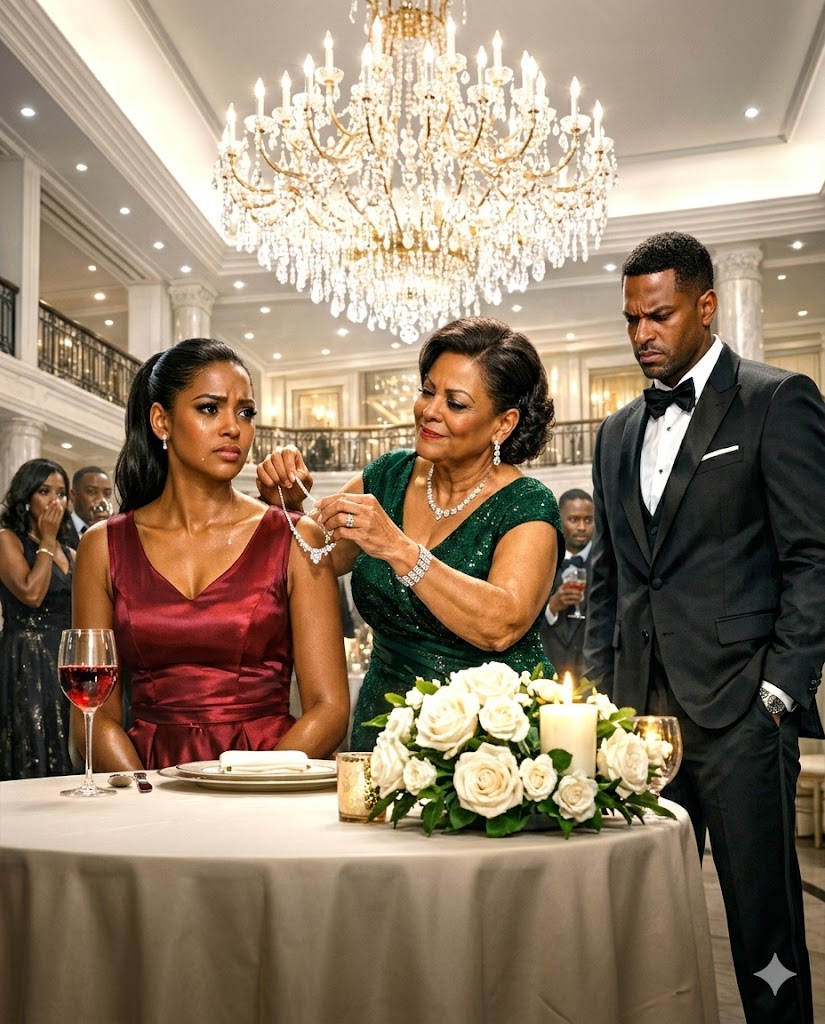
“Unaware His Wife Just Signed A $30B Deal, His Mother Made Her Return All Her Jewelry ‘Since You Didn’t Earn It’ — When She Opened The Safe…”
Part 1: The Weight of Glass
That morning, Dia Monroe had sat in a room made of glass and steel, overlooking the Manhattan skyline. The air had been pressurized, filtered, and silent. Across from her sat three men whose net worth could stabilize the economies of small nations. She had extended her hand, her grip firm and dry, and closed a deal worth thirty billion dollars. It was the culmination of twelve years of invisible work, of being the smartest person in rooms that didn’t want her there. She had felt like a titan.
That evening, the air was different. It was heavy with the scent of roasted lamb, expensive mahogany polish, and the suffocating perfume of the Atlanta elite.
Dia sat near the middle of the long oak dining table at the Caldwell estate. The house was a monument to old-money arrogance—three stories of brick and iron on the north side of the city. It was the kind of house that told you what it wanted you to think before you even stepped through the door. It said, “We have arrived.” It said, “Do not come in here unless you understand your place.”
Dia understood her place just fine. She had understood it for seven years.
She wore a simple burgundy dress, her back straight, her face carrying the particular kind of calm that takes a lifetime to perfect. Around her neck was a diamond pendant necklace. On her left wrist, a thin gold bracelet. On her ears, pearl drops. Her husband, Zaki Caldwell, had chosen them himself the week before their wedding. She wore them every day, not because they were the most expensive pieces in her collection, but because he had given them to her when he still looked at her like she was a person, not a social accessory.
Across the table, Zaki was laughing. He was a tall, handsome man with a laugh that filled a room and a charm that acted as a shock absorber for his lack of actual substance. He was leaning back, telling a story to his uncle about a golf game, the same story Dia had heard four times this month. Beside him, Celeste Webb was leaning in just a bit too close. Celeste was “family friend” in the way people in Atlanta use that term for ex-girlfriends who refuse to exit the orbit. She was loud, adorned in gold, and wore a smile that stayed a moment too long after her words ended.
Dorothy Caldwell, the matriarch, stood up. The room shifted immediately. Dorothy was sixty-four and had never once been described as “soft.” She tapped the side of her crystal glass with a manicured nail, and the table fell into an attentive hush.
She began to speak about legacy. She talked about the Caldwell name, the generations of sacrifice, and the “standards” of the women who entered this family. Her voice was warm and ceremonial, but Dia felt the sudden drop in temperature.
“It has always been important to me,” Dorothy said, her eyes finally landing on Dia, “that the women in this family represent our history with dignity. That they earn the right to wear our legacy.”
Dorothy paused, a small, cold tilt to her head. “Dia, dear. Those pieces you are wearing… they were part of the Caldwell collection long before you arrived. Given the current… shifts in our family’s focus, I think it’s time for those pieces to come home. Tonight.”
The room went deathly silent. Not a fork moved. Dia felt the heat of two dozen stares. She looked at Zaki. This was the moment. This was when a husband says, “No, Mother. That is my wife’s jewelry.”
Zaki looked down at his plate. He picked up his wine glass, took a sip, and said absolutely nothing.
Dia sat still for five full seconds. She felt the diamond pendant against her skin. She felt the weight of seven years of apologizing for being an outsider. Slowly, without a word, she reached up. She unclasped the necklace and set it on the white linen. She removed the bracelet. She took off the pearls. She placed them in a neat pile in front of Dorothy’s empty seat.
“Of course, Dorothy,” Dia said, her voice so steady it sounded like a verdict. “I wouldn’t want to wear anything that doesn’t belong to me.”
She stood up, took a small sip of water, and excused herself. She walked out through the side door into the cool night air of the back garden. As the door clicked shut behind her, her phone vibrated in her clutch.
She opened the message from her lead counsel. Congratulations, Mrs. Caldwell. The Monroe Capital Group acquisition is officially closed. $30.4 billion signed and sealed. You are now the majority landholder for the Southside Corridor.
Dia looked up at the stars. She had just been stripped of a few thousand dollars’ worth of jewelry in front of the people she had tried to love. But in her hand was the power to buy the very ground the Caldwell estate sat on.
She didn’t smile. She just breathed. She was halfway to her car when she realized she had left her car keys on the dining table, right next to the heap of discarded diamonds. She had to go back in.
But as she reached the door, she heard Zaki’s voice through the glass, loud and clear. “She’ll get over it, Mama. She knows she’s lucky to even be at this table.”
Dia froze, her hand on the brass handle.
Part 2: The Red Dirt Road
Dia didn’t open the door. She stood on the darkened porch, listening to the muffled laughter of the people who thought they had just won a war. “Lucky to be at the table.” The words played on a loop in her mind, but they didn’t sting. They clarified.
To understand Dia Monroe Caldwell, you had to leave the manicured hedges of Buckhead and travel three hundred miles south to a red dirt road outside of Meridian, Mississippi.
Her father, Wade Monroe, fixed engines. He was a man of few words and broad, oil-stained hands. He could listen to the knock of a motor and tell you exactly which bolt was loose. He read philosophy by the light of a single bulb in his garage. Her mother, Claudette, grew tomatoes that tasted like summer sunshine and never once complained about the thinness of their walls.
They had nothing, yet Dia grew up feeling like she owned the horizon.
“Dia,” her father had told her when she was twelve, watching her scrub grease from her fingernails. “People will try to tell you your value is a number. They’ll try to tell you it’s a name. But your value is the thing you can do that no one else can. Don’t ever let them borrow your silence.”
She had carried that. She had carried it through Spelman, then through Harvard, and then into the shark-infested waters of New York private equity. She had built Monroe Capital Group under a pseudonym for the first five years, using a shell corporation to hide her identity. She didn’t want the world to see a young black woman from Mississippi; she wanted them to see a predator. By the time they realized who was behind the signatures, she was already too big to kill.
When she met Zaki Caldwell, she was tired of the fight. He was charming, easy, and seemed to offer a life where she could just… be. She had hidden her success from him, not out of malice, but out of a desperate hope that he loved the woman, not the balance sheet. She had told him she worked in “investment consulting.” He had never asked for details. He had seen a quiet, beautiful woman and assumed she was a blank slate.
Dorothy Caldwell had seen an interloper. For seven years, Dorothy had treated Dia like a charitable project—a girl from the “wrong side of the tracks” who should be grateful for the scraps of the Caldwell legacy.
Dia walked back into the dining room. The quartet was playing a light Gershwin tune.
The table went quiet as she approached. Zaki looked up, a flicker of guilt crossing his face before he masked it with an annoyed sigh. “Dia, don’t make this awkward. Just sit back down.”
Dia didn’t sit. She walked to the head of the table where the jewelry lay in a sad, tangled pile. She picked up her car keys, which were resting an inch away from the pearls.
“I’m not making it awkward, Zaki,” Dia said. She looked at Dorothy, who was watching her with a smug, cat-like satisfaction. “I’m making it official.”
“Official?” Dorothy asked, her voice dripping with condescension. “Dear, you’ve returned the family pieces. There’s nothing more to discuss.”
“Actually, there is,” Dia said. She reached into her clutch and pulled out a simple, embossed business card. No title. Just her name and the logo of Monroe Capital Group. She set it on top of the diamond pendant.
“Monroe Capital Group?” Zaki frowned, picking up the card. “I’ve heard of them. They just bought the entire downtown development project from the city. Why do you have their card?”
“I don’t have their card, Zaki. I am Monroe Capital.”
Dia looked around the room, taking in the confused faces of the aunts, the cousins, and Celeste Webb. “That morning handshake I had? It wasn’t a meeting. It was a closing. I now own fifty-one percent of the debt your family’s firm carries on the Buckhead Plaza.”
Dorothy’s glass hit the table with a sharp clink. “That’s impossible. That’s a billion-dollar position.”
“Thirty billion, actually,” Dia corrected gently. “And since the Caldwell firm is currently sixty days past due on the restructuring agreement, I’ve decided to move for a full audit. Starting Monday morning at eight.”
She turned to Zaki, who looked as if the chair beneath him had suddenly turned into ice. “You were right, Zaki. I am lucky to be at this table. Because it’s the last time I’ll ever have to look at the people sitting around it.”
She turned and walked out. This time, she didn’t stop.
As she drove her modest SUV—the one Zaki always told her was “embarrassing” for a Caldwell—she felt a strange weight in her pocket. She reached in and pulled out a white envelope. It was the letter her father had given her fifteen years ago when she left for college. He had told her to open it only when she felt she had completely lost herself.
She pulled over under a streetlamp. Her hands were shaking as she tore the seal.
The letter was short, written in her father’s careful, slanted hand.
Dia, if you’re reading this, someone tried to make you feel small. I want you to look at your hands. They are your own. I want you to look at your mind. It is your own. You didn’t come from nothing. You came from us. And we are giant. Walk forward, baby girl. Just walk forward.
Dia let out a ragged sob, the first tear she had shed in seven years. She wiped her face, put the car in gear, and drove.
She didn’t go to the house she shared with Zaki. She went to the hotel she had booked that afternoon. She had a board meeting in twelve hours, and for the first time in a decade, she was going to use her real name.
But back at the Caldwell estate, the panic was just beginning. Zaki was staring at the business card, his phone ringing. It was his father, the one person Dorothy feared.
“Zaki!” his father’s voice boomed from the speaker. “The Monroe Group just issued a freeze on our operating accounts. Who the hell did we piss off?”
Zaki looked at the jewelry on the table. He looked at his mother. “I think,” he whispered, “we just lost the only thing that was keeping us alive.”
Part 3: The Cold Audit
Monday morning in Atlanta arrived with a sky the color of unpolished silver. At the headquarters of Caldwell Realty & Development, the atmosphere was usually one of hushed, self-important activity. But today, the air was electric with dread.
Zaki Caldwell stood in his glass-walled office, his tie loosened, his third cup of coffee cold on his desk. He was watching the elevators. His father, Arthur Caldwell, had been in the building since 5:00 AM, screaming at the legal team.
“How could you not know?” Arthur’s voice echoed through the hallway as he stormed into Zaki’s office. He was a man built like a bulldog, all shoulders and rage. “You’ve been sleeping next to the woman for seven years! You didn’t know she was the Monroe behind Monroe Capital?”
“She never said, Dad!” Zaki shouted back, though his voice lacked conviction. “She said she was a consultant. She kept her life separate.”
“Because you let her!” Arthur slammed a hand on the desk. “You and your mother treated her like a maid. I told you, Zaki. I told you that girl had steel in her spine. You just liked that she didn’t talk back.”
The elevator chimed. The double doors of the executive suite opened.
A group of six people stepped out. They were all dressed in black or charcoal grey, carrying slim laptops and the kind of expressions that implied they were there to perform an autopsy. At the lead was a woman in a navy tailored suit. She wasn’t wearing a single piece of jewelry—not even a watch.
It was Dia.
She looked different. The “Dia” Zaki knew moved with a quiet, apologetic grace, always trying to take up as little space as possible. This woman commanded the air around her. Her hair was pulled back, her eyes were sharp, and she moved with a terrifyingly efficient purpose.
She didn’t go to Zaki’s office. She walked straight to the main conference room.
Zaki and Arthur followed her, stumbling like schoolboys called to the principal’s office.
“Dia,” Zaki said, catching the door before it closed. “Can we talk? Privately?”
Dia didn’t look up from her laptop as she synced it to the room’s massive display screen. “You can address me as Ms. Monroe, Zaki. Or as the Lead Trustee. We are here for the forensic audit mandated by the debt-holder. Which is me.”
“Dia, come on,” Zaki pleaded, stepping into the room. “The dinner… my mother… she’s old-fashioned. She didn’t mean it that way. I’ll make her apologize. We can fix this.”
Dia finally looked at him. Her gaze was clinical. “You stood there, Zaki. For seven years, you watched me be diminished by millimeters every single day. You didn’t stay silent because you were ‘neutral.’ You stayed silent because you believed she was right. You believed I was lucky to be a Caldwell.”
She leaned forward, her voice dropping to a level that made the hair on Zaki’s neck stand up. “I was never a Caldwell. I was a Monroe playing a role. The role is over.”
“Ms. Monroe,” Arthur interjected, trying a more professional tone. “We are willing to negotiate a buy-back of the debt position. We can offer a premium over the market rate.”
Dia tapped a key. The screen behind her lit up with a complex web of red numbers and downward-trending graphs. “You don’t have the liquidity to buy a cup of coffee, Arthur. Your firm has been over-leveraged on the Southside projects for three years. You’ve been using investor deposits to cover the interest on your primary loans. In some circles, that’s called a Ponzi scheme. In my circle, it’s called an acquisition opportunity.”
The room went cold. Arthur’s face turned a deep, dangerous purple. “You’re going to destroy us? Over a necklace?”
“No,” Dia said, standing up. “I’m going to settle the account. You didn’t recognize my value when I was a person at your table. Now, you’ll recognize it as the person who owns your chairs.”
She turned to her team. “Begin with the 2022 ledger. I want every offshore transfer flagged.”
As Zaki was escorted out of the room by a security guard who had previously been on his own payroll, he saw Celeste Webb standing in the lobby. She had come to “check on him,” but she was already looking at her phone, her expression shifting as she saw the news alerts breaking on the Atlanta business wires.
MONROE CAPITAL MOVES FOR HOSTILE TAKEOVER OF CALDWELL EMPIRE.
Zaki realized then that Celeste wasn’t there for him. She was there for the winner. And for the first time in his life, he was looking at the woman he had lost, and she looked like a mountain he would never be able to climb.
Dia spent the next fourteen hours in that room. She didn’t feel tired. She felt fueled by a decade of swallowed words. Around 11:00 PM, she was alone in the office, looking out at the city. Her phone buzzed. It was a call from a number she recognized but hadn’t seen in years.
“Dia?” a soft, hesitant voice asked. It was her mother, Claudette.
“Hey, Mama,” Dia said, her voice finally softening.
“Your father’s been sitting on the porch all night, honey. He saw your name on the television. He didn’t say much, just… he said to tell you the engines are running smooth.”
Dia closed her eyes. “Tell him I hear him, Mama.”
“Are you coming home soon?”
Dia looked at the “Caldwell” logo on the glass door. She reached out and peeled the ‘C’ off the film. “Soon, Mama. I just have a little more trash to clear out first.”
She hung up and opened a new file. It was the personal financial records of Dorothy Caldwell. She found what she was looking for in minutes: a series of “consulting fees” paid to Celeste Webb over the last three years, totaling nearly half a million dollars.
Dorothy hadn’t just disliked Dia. She had been paying Zaki’s ex-girlfriend to stay in their lives.
Dia’s eyes narrowed. Monday was over. Tuesday was going to be much, much worse for the Caldwells.
Part 4: The Price of a Secret
Tuesday morning found the Caldwell estate in a state of siege. Dorothy Caldwell sat in her solarium, her hands trembling so much she couldn’t hold her teacup. The news trucks were parked at the iron gates. The “Caldwell” name, which she had spent forty years polishing into a shield, was currently being dragged through the dirt of every financial blog in the country.
Zaki burst in, looking like he hadn’t slept in forty-eight hours. “Mama, did you pay Celeste?”
Dorothy stiffened, her chin lifting out of habit. “I don’t know what you’re talking about. I gave her small gifts for her help with the foundation.”
“Five hundred thousand dollars isn’t a gift, Mama! Dia found the records. She has the receipts!” Zaki paced the room, his hands in his hair. “She’s not just taking the company. She’s going to the District Attorney. She says it’s ‘misappropriation of corporate funds’.”
“She wouldn’t,” Dorothy whispered. “She was part of this family.”
“She was a servant to you!” Zaki roared. “And now she’s the landlord!”
The front door chimes rang—not the melodic tune they were used to, but a sharp, insistent demand.
Dia didn’t wait to be announced. She walked into the solarium followed by two men in suits and a woman carrying a digital recorder.
“Get out of my house!” Dorothy screamed, finally snapping.
“It’s not your house, Dorothy,” Dia said. She held up a folder. “The estate was put up as collateral for the 2021 expansion loan. A loan that was defaulted on at midnight. Monroe Capital purchased the deed from the bank at 6:00 AM.”
Dia sat down in the wicker chair opposite Dorothy, the very chair where Dia had been told she “didn’t have the grace” for the Caldwell family.
“I’m giving you twenty-four hours to pack,” Dia said. “I’ve already arranged for a moving crew. They’ll take anything that belongs to you personally. But the furniture, the art, and that jewelry you made me return on Saturday? Those stay. They are assets of the corporation now.”
“You heartless… you’re a monster,” Dorothy hissed.
“I’m a Monroe,” Dia corrected. “We pay our debts. And we collect what’s owed.”
She turned to Zaki. “The apartment in the city? The one you used for your ‘late-night meetings’ with Celeste? I’ve already had the locks changed. Her things are in trash bags on the sidewalk.”
Zaki slumped against the glass wall. “Dia, please. I loved you. In my own way.”
“That’s the problem, Zaki. Your ‘way’ was only possible when I was small. You didn’t love me. You loved the ego boost of having a woman you thought was beneath you.”
She stood up and looked at the house. It was beautiful, but it felt like a tomb. “I don’t actually want this place. It smells like rot. I’m donating the land to the Southside Housing Initiative. By next month, this mansion will be a community center.”
Dorothy let out a ragged, strangled cry of pure horror. To a woman whose entire identity was built on exclusive walls, the idea of “community” was the ultimate insult.
As Dia walked back toward her car, Celeste Webb was waiting by the gates, trying to look composed despite the cameras. She stepped in front of Dia’s path.
“Dia, wait,” Celeste said, her voice hushed. “I have information. About Zaki’s father. About the shell companies in Panama. I can help you bury them if you… if you make sure my name stays out of the audit.”
Dia stopped. She looked at Celeste—really looked at her. She saw a woman who had spent her life trading her dignity for a seat at someone else’s table. She saw the version of herself that could have been if she hadn’t remembered her father’s voice.
“I don’t need your help to bury them, Celeste. I’ve already done the digging.”
Dia reached into her purse and pulled out a small, round pearl—one of the earrings she had returned on Saturday. She had found it in the crevice of her car that morning.
“Here,” Dia said, dropping the pearl into Celeste’s hand. “A Caldwell piece. Dorothy always said the women in this family have to earn what they wear. I think you’ve earned exactly one half of a pair.”
Dia got into her car and drove away, leaving Celeste standing in the rain, clutching a single, worthless pearl.
Dia drove straight to the airport. She had a private jet waiting. She wasn’t going to New York or London. She was going to Meridian.
She landed as the sun was setting, the air smelling of pine and damp earth. She drove the rental car down the red dirt road, her heart beating a steady, rhythmic drum.
The house was exactly as she remembered. Small, sturdy, and full of light.
Her father was sitting on the porch. He didn’t stand up. He just closed his book and watched her walk up the steps.
“You look tall, Dia,” he said.
“I feel tall, Daddy.”
She sat down on the steps next to him. “I gave it all back. The name, the jewelry, the house. I took the company, but I’m turning it into something else.”
“Good,” Wade said, his voice a low rumble. “A name is just a sound people make. But what you build? That’s the truth.”
“I missed you,” she whispered, leaning her head on his shoulder.
“We never went nowhere, baby. You were just busy learning how to walk.”
They sat in the quiet for a long time. But Dia knew the world wasn’t done with her yet. Her phone buzzed. It was a message from Zaki.
Dia, the audit found the trust. The one your father set up thirty years ago. The one I never knew about. My father is asking… how did a mechanic from Mississippi own ten percent of the state’s timber land?
Dia looked at her father. He was looking out at the trees, his face calm and unreadable.
“Daddy,” she said softly. “The Caldwells found the timber trust.”
Wade Monroe smiled, a slow, knowing grin. “I figured they would eventually. I guess it’s time to tell them the rest of the story, isn’t it?”
Part 5: The Timber King
The porch of the Monroe house felt like the center of the universe that evening. The crickets were a rhythmic choir in the tall grass, and the sky was a deep, velvet purple.
Dia looked at her father. Wade Monroe, the man who spent his days covered in engine oil and his evenings in old paperbacks, was suddenly a stranger.
“Ten percent of the state’s timber land?” Dia asked, her voice hushed. “Daddy, we struggled. I remember you fixing the roof with scrap tin. I remember Mama stretching a chicken for three days.”
Wade leaned back, his wide boards of the porch creaking under him. “We didn’t struggle, Dia. We lived. There’s a difference.”
He took a slow breath. “My grandfather was a Freeman. He bought a hundred acres of ‘useless’ swamp land in 1870. Everyone laughed at him. But he knew the trees. He knew that if you let them grow, they become gold. He passed it to my father, and my father passed it to me.”
“But why the secrecy?”
“Because,” Wade said, his eyes sharpening. “A black man with that much land in Mississippi in 1960? I wouldn’t have lived to see you born. I put it in a blind trust, managed by a firm in Chicago that didn’t care about the color of my skin, only the quality of the pine. I used the dividends to buy more land, quietly. I didn’t want the money to change us. I wanted it to be a floor for you to stand on, not a ceiling to keep you in.”
Dia felt the world shifting beneath her feet. “All those years I was fighting in New York… I thought I was doing it alone. I thought I was the first one to break through.”
“You were the first one to do it in the light, Dia,” Wade said. “I just provided the foundation. Every scholarship you got? I didn’t fund them directly, but I made sure the Monroe Capital Group—the one I started in 1982—was the primary donor to the Spelman fund. I wanted you to earn it, but I wanted the road to be paved.”
Dia was speechless. The “Monroe Capital” she thought she had built from scratch was a seed her father had planted before she could even read. She had simply taken over a ghost ship and given it a crew.
“So when I shaking hands across that thirty-billion-dollar table…”
“You were using the leverage of five generations of Monroe trees,” Wade finished. “The Caldwells? They’re new money, baby. They’ve only been arrogant for forty years. We’ve been patient for a hundred and fifty.”
The next morning, Dia was back in Atlanta. But she wasn’t at the Caldwell headquarters. She was at the state capitol.
She met with Arthur Caldwell in the hallway outside the Governor’s office. Arthur looked like a man who had been hollowed out. His skin was grey, his suit didn’t fit, and his eyes were full of a frantic, animal fear.
“Dia,” he whispered, grabbing her arm. “Your father… he’s the one? He’s been the silent partner in the state forestry commission for twenty years?”
“He’s the majority shareholder, Arthur,” Dia said, removing his hand from her arm. “And he’s decided that Caldwell Realty is no longer a ‘preferred vendor’ for the state land projects. Which means your company is now technically insolvent.”
“You can’t do this! We’ll be in the streets!”
“My father built a legacy in silence because he had to,” Dia said. “You built yours on noise because you wanted to feel big. Now, the noise is gone. All that’s left is the debt.”
She walked past him into the Governor’s office. She spent the morning signing a partnership agreement that would turn the Southside Corridor into a sustainable green-tech hub, powered by Monroe timber and Dia’s vision.
She returned to her hotel to find Zaki waiting in the lobby. He had a small box in his hand.
“I found these,” he said, holding the box out. “In my mother’s safe. The other pearl earring. The watch. The bracelet. She… she had them hidden.”
Dia didn’t take the box. “Keep them, Zaki. Sell them. Use the money to find a job. Or a soul. Whichever is cheaper.”
“Dia, I didn’t know about the trust. I didn’t know about your father. If I had known…”
“If you had known, you would have been even more of a coward,” Dia said. “You would have stayed for the money, not the woman. That’s the tragedy, Zaki. You had a titan at your table for seven years, and you were only looking at the jewelry.”
She walked to the elevators.
“Where are you going?” he shouted after her.
“I’m going to a meeting,” she called back. “I’m buying the Atlanta Business Chronicle. I want to make sure the headline on Friday is accurate.”
Friday morning, Dorothy Caldwell opened the paper. She was sitting in a small, cramped apartment in a part of town she used to call “the slums.”
The headline was a full-page photo of Dia Monroe. She was standing on her father’s porch in Mississippi, wearing a simple denim shirt and the silver watch.
The headline read: THE MONROE ERA BEGINS: THE SILENT TITAN OF THE SOUTH REVEALS HER FACE.
Underneath, in a smaller font, was a quote: “Value is never recognized by those who believe they are the ones giving it.”
Dorothy looked at her hands. They were bare. She had pawned her own rings the day before to pay the retainer for Zaki’s defense lawyer.
But the story wasn’t over.
Dia was standing in the middle of the Caldwell ballroom—the same room where she had been humiliated. The furniture was gone. The chandeliers were covered in plastic.
She was with a group of architects. “I want this floor to be a library,” she said, pointing to the spot where Dorothy had stood. “I want the shelves to be made of Monroe pine. And I want the entrance to be open to everyone.”
One of the architects, a young man, looked at her with awe. “And the name of the center, Ms. Monroe?”
Dia looked at the business card she was holding. She turned it over. On the back, her father had written one more thing that morning: Build it loud, Dia. We’re done being quiet.
“The Wade and Claudette Monroe Center for Resilience,” she said.
As she walked out of the building, a black car pulled up. The door opened, and Arthur Caldwell stepped out. He wasn’t angry anymore. He was desperate.
“Dia,” he said. “There’s one more thing. The audit… it found a transfer from thirty years ago. A transfer from my father to yours. A million dollars. Why would a Caldwell pay a Monroe a million dollars in 1996?”
Dia’s heart skipped. She thought of her father’s garage. She thought of the “エンジン (engine)” he was always fixing.
“I don’t know, Arthur,” she said. “But I think it’s time I asked my mother.”
Part 6: The Mechanic’s Debt
The flight back to Mississippi felt longer this time. The mystery of the million-dollar transfer hummed in Dia’s mind like a faulty wire. 1996. She had been ten years old. That was the year her father had “broken his leg” and couldn’t work for six months. She remembered the tension in the house, the way her mother had stayed up late at the kitchen table with a calculator.
She arrived at the house at midnight. The lights were on. Her mother, Claudette, was sitting in the kitchen, shelling pecans.
“I knew you’d be back, Dia,” Claudette said, not looking up. “Arthur Caldwell called here an hour ago. He’s a man who don’t know how to let a fire die out.”
Dia sat across from her. “Mama, what happened in 1996? Why did Arthur’s father pay Daddy a million dollars?”
Claudette stopped shelling. She looked at her daughter, her eyes clouded with a memory she had spent thirty years burying.
“Your father wasn’t just a mechanic, Dia. He was a genius. He developed a fuel-injection system that was twenty years ahead of its time. He called it the ‘Monroe Flow.’ It could make a tractor run on half the fuel.”
“And he sold it to the Caldwells?”
“He didn’t sell it,” Claudette hissed. “Arthur’s father, old Silas Caldwell, stole it. He came here as a ‘client.’ He sat on that porch, drank your father’s tea, and looked at the blueprints while Wade was under his truck. Two weeks later, Silas filed a patent in his own name. That patent is what built the Caldwell Realty empire. It gave them the seed money for their first ten developments.”
Dia felt a cold rage blooming in her chest. “Then why the million dollars?”
“Because your father found out,” Claudette said, her voice trembling. “He went to Atlanta to confront Silas. He didn’t want money; he wanted the name. He wanted the world to know a Monroe had built it. But Silas… he had your father followed. He had men jump him in an alley. That ‘broken leg’ your father had? It wasn’t an accident. They beat him until he couldn’t walk for a year.”
Claudette reached across the table and took Dia’s hand. “The million dollars was blood money, Dia. Silas sent it a month later with a note saying that if Wade ever spoke a word of the truth, he’d come back for the wife and the daughter. Your father wanted to burn it. But I told him no. I told him we’d use it to build a wall around you. We put it in the timber trust. Every cent of the Monroe Capital Group was built on the pain your father endured in that alley.”
Dia stood up, the chair screeching against the linoleum. She walked out to the garage.
Wade was there, sitting in the dark, the smell of grease and cedar surrounding him.
“You knew,” Dia said. “You knew they were the ones who hurt you.”
“I knew,” Wade said quietly. “And I knew that one day, you’d be the one they couldn’t jump in an alley. I didn’t want you to carry my anger, Dia. I wanted you to carry my victory.”
“You let them treat me like a disgrace for seven years, Daddy. You let me sit at that table and be humiliated.”
“No,” Wade said, standing up. He was taller in the dark. “I let you see who they were. If I had told you the truth, you would have been fighting for a patent. I wanted you to fight for yourself. I wanted you to see that even with all their ‘stolen gold,’ they were smaller than you.”
He walked over and touched her face. “Saturday night, when you took off that jewelry and walked away… that was the Monroe Flow, Dia. That was the engine finally running right.”
Dia took a deep breath. The rage was still there, but it was being converted into something else. Something industrial.
“Arthur Caldwell is coming here, Daddy. He wants to negotiate.”
“Let him come,” Wade said. “I’ve been waiting thirty years to show him my latest project.”
Saturday morning, a black car pulled up the red dirt road. Arthur and Zaki Caldwell stepped out. They looked out of place, their polished shoes sinking into the Mississippi mud.
Wade Monroe walked out of the garage. He wasn’t wearing his overalls today. He was wearing a sharp, dark suit that Dia had bought for him in Atlanta. He looked like the king of the forest.
“Arthur,” Wade said, his voice like rolling thunder.
“Wade,” Arthur replied, his voice small. “I… I came to apologize. For my father. And for myself.”
“An apology is a sound, Arthur,” Wade said. “I’m a mechanic. I deal in results.”
Dia stepped out of the house. She was holding a single document.
“This is a rescission of patent,” Dia said. “And a confession of intellectual property theft. You sign this, and Monroe Capital will allow the Caldwell firm to go through a structured bankruptcy instead of a criminal liquidation. Your family keeps their personal freedom. But the ‘Caldwell’ name comes off every building in Atlanta.”
Arthur looked at the paper. He looked at the modest house. He looked at the man he had once thought was a “nobody.”
“And if I don’t?”
Wade stepped forward. “Then I go to the press with the medical records from 1996. I go with the photos of the alley. And I tell the world that the Caldwell empire wasn’t built on ‘real estate genius.’ It was built on the back of a black man they thought they could break.”
Arthur took the pen from Dia’s hand. His signature was shaky, the ink bleeding into the page.
Zaki looked at Dia, his eyes pleading for one last look of the woman who used to make him coffee. Dia didn’t give it to him. She didn’t even look at him. She was looking at her father.
As the Caldwells drove away, their car kicking up a cloud of red dust, Wade Monroe let out a long, slow breath.
“You okay, Daddy?”
“I’m fine, Dia. Just fine.”
He looked at the sky. “You know, Dia, those trees out there… they don’t care about patents. They just grow. They stay quiet for fifty years, and then one day, they’re the only thing left standing after the storm.”
“I’m going to rebuild the firm, Daddy. Under the Monroe name. But I’m moving the headquarters.”
“Where to?”
Dia smiled. “Meridian. I think it’s time this town had a thirty-billion-dollar skyline.”
Part 7: The Southside Horizon
A year later.
The city of Atlanta was still the same—too big, too loud, and too busy. But on the south side, the horizon had changed. Where there had once been abandoned lots and crumbling warehouses, there was now a forest of glass and timber.
The Monroe Innovation Center was the jewel of the corridor. It was a masterpiece of sustainable design, built from the very pine Wade Monroe had spent his life protecting. It wasn’t a wall to keep people out; it was a bridge to bring them in.
Dia Monroe sat in her office on the top floor. She was wearing a simple burgundy dress—the same color she had worn to the Caldwell dinner. Around her neck was a simple gold locket. Inside was a photo of her parents on their wedding day.
She didn’t wear the diamond pendant anymore. She had sold it at a charity auction for three times its value and used the money to start the “Wade Monroe Engineering Scholarship.”
There was a knock on her door. It was her lead architect.
“Ms. Monroe? The guests are arriving for the ribbon-cutting. And there’s a woman in the lobby. She doesn’t have an invitation, but she says she knows you.”
Dia walked to the glass balcony and looked down.
Standing in the lobby was Celeste Webb. She was dressed simply, her “loud” jewelry gone. She was holding a book. She looked up and saw Dia. She didn’t wave. She just nodded—a gesture of recognition from one survivor to another.
Dia turned back to the architect. “Tell her she’s welcome. And tell her the library is on the second floor. She might find what she’s looking for there.”
Dia walked down the grand staircase. The lobby was full of people from Meridian, people from Spelman, and people from the southside neighborhoods who finally felt like the city belonged to them.
She saw her mother, Claudette, laughing with a group of young women. She saw her father, Wade, standing by the main support beam, his hand resting on the wood as if he were checking the pulse of the building.
Dia stepped to the microphone. The cameras flashed, but she didn’t blink.
“A year ago,” Dia said, her voice clear and carrying across the hall, “I was told that my value was something that could be given to me or taken away. I was told that I was lucky to have a seat at a table that didn’t want me.”
She looked at her father. He was smiling.
“But value isn’t a gift. It’s a foundation. It’s the dirt beneath your feet and the trees above your head. It’s the truth you hold in your heart when the world is trying to make you lie. My name is Dia Monroe. And I’m not just sitting at the table anymore. I built it.”
The applause was a roar, a sound like a forest in a high wind.
In a small apartment across town, Zaki Caldwell was watching the livestream on his phone. He was wearing a uniform for a security firm. He looked at the screen, at the woman who had once been his wife, and he finally saw her. He saw the titan. He saw the strength. And he saw the thirty billion dollars of grace that had walked away from him forever.
He turned off the phone and went to work. He had a shift to start.
Dia walked off the stage and into her father’s arms.
“You did it, baby girl,” Wade whispered.
“No, Daddy,” Dia said. “We did it. The engine’s finally running right.”
As the sun set over Atlanta, the gold light hit the Monroe building, making it glow like a beacon. The red dirt was far away, but the roots were right here.
And for the first time in her life, Dia Monroe wasn’t just walking forward. She was home.
The End.









