A CEO Was Tired of Men Chasing Her — Until a Poor Single Dad Defended Her From an Arrogant Man
Part 1: The Chandelier and the Fuse
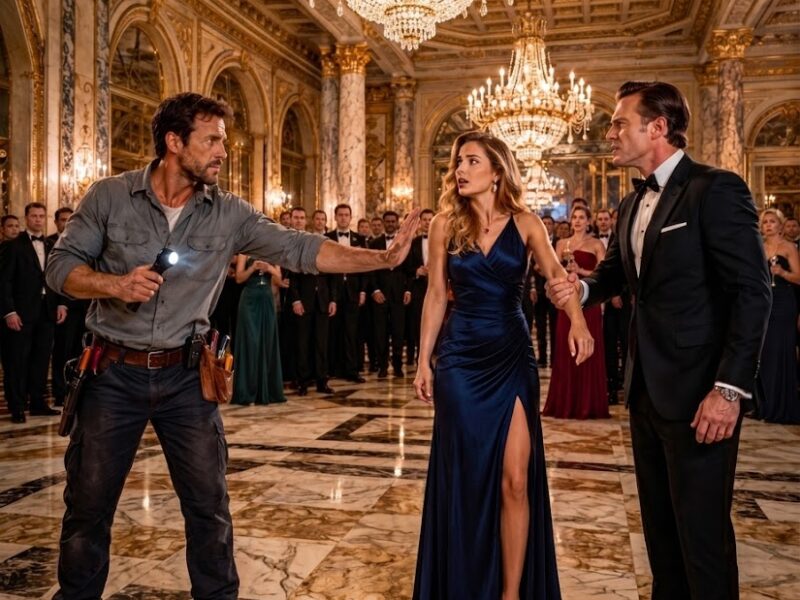
“Let go of her hand.”
The words were not delivered as a shout. They were not thrown with the desperate, cracking volume of a man seeking a public brawl. Instead, they were spoken with a quiet, flat density that cut cleanly through the cavernous expanse of the grand Ellison ballroom—a sound far sharper than the hundreds of silver fish forks currently resting beside untouched dinner plates.
The immediate effect was absolute. Every overlapping conversation ground to a sudden, jagged halt. Every heavy crystal wine glass paused halfway to someone’s opened mouth. Under three massive crystal chandeliers that cast a blinding, diamond-bright glare over four hundred elite corporate donors, international venture capitalists, and society photographers, the social landscape of the evening completely froze.
Preston Blake still had his manicured fingers wrapped tightly around Meline Harper’s wrist. He held her as if her clear refusal were merely a minor, bureaucratic delay in their evening, rather than an absolute decision.
Meline stood perfectly still within the shimmering fabric of her midnight-blue evening gown. Her face remained entirely calm, but it was the specific, terrifying calm of a Midwestern thunderstorm viewed from forty miles away—pale, unblinking, and loaded with a tremendous, hidden voltage. She was thirty-five years old, the chief executive officer of the Harper Meridian Group, and the sole owner of commercial skyscrapers that literally touched the clouds in Chicago, Dallas, Denver, and New York City.
Men of immense wealth and political standing had chased her across three continents ever since the first national business magazine had stamped her photograph on the cover, labeling her America’s most eligible corporate businesswoman. Some of them chased the sheer velocity of her capital; some chased the generational weight of her family name; others simply chased the pathetic vanity of being seen beside her under the flashbulbs of the media grid.
Preston Blake had spent the last eight months chasing all three. But tonight, under the pressure of a critical third-quarter investment cycle, he had completely stopped pretending that his pursuit had anything to do with romance.
“Meline,” Preston said through a rigid, practiced smile engineered specifically for the society cameras tracking the room. “Do not embarrass yourself in front of the board. Everyone in this room knows you arrived at this gala entirely alone.” His thumb tightened imperceptibly over the heavy platinum links of her designer bracelet, his voice dropping into a low, patronizing purr. “You are exhausted, Meline. Your metrics are slipping. I am offering you absolute financial stability.”
A few prominent investors standing near the high-end refreshments table discreetly turned their faces away. In rooms of this caliber, immense wealth often possesses a strange, chemical ability to make cowardice look exactly like good manners.
Meline pulled back her arm once—gently, methodically, giving him a single chance to salvage his public reputation. Preston refused to let go. He leaned his face closer to her ear, his breath smelling of expensive bourbon. “Stop pretending you possess better options, Meline. Without my venture capital, your north-side tower project doesn’t clear the ground.”
That was the precise micro-second the man from the edge of the stage stepped forward.
He didn’t look like he belonged within a three-mile radius of the Grand Ellison’s marble ballroom. He wore a heavy, faded gray industrial maintenance shirt with a frayed blue name patch stitched over the left pocket. His dark canvas work pants were dusted with white sheetrock plaster at the knees, and a heavy leather tool belt hung low against his right hip, clinking with the utilitarian weight of wrenches, pliers, and circuit testers. In his left hand, he held a small, professional steel flashlight. In his right, he carried a burned-out, blackened commercial electrical fuse.
He was a man built for the hidden anatomy of the building—the dark spaces behind the drywall, the narrow crawlspaces under the concrete stairwells, the roaring, humid basements of the boiler rooms. He was built for anywhere but the open air between a billionaire venture capitalist and the primary woman he believed he could publicly claim.
His name was Caleb Donovan. Though almost no one among the four hundred elite guests in that ballroom knew his name, or cared to ask for it. To the corporate board, he was merely an invisible asset—the silent man who fixed the lights when the grid flickered. But to his six-year-old daughter currently waiting upstairs in a small employee breakroom beside a cardboard model of this exact hotel, he was absolutely everything.
Preston turned his head slowly, his eyes narrowing with an irritation that was rapidly hardening into an elite offense. He didn’t release Meline’s wrist as he glared at the worker. “Excuse me?”
Caleb stopped his advance exactly six feet away. It was a calculated distance—close enough to ensure his voice could be clearly heard over the hum of the air conditioning, yet far enough to demonstrate that he wasn’t looking for a physical confrontation. His eyes were a steady, clear gray, entirely devoid of the standard, panicked deference that working-class men usually display when cornered by a board member. His voice remained low, steady, and almost incredibly gentle.
“She asked you to let go of her hand, sir,” Caleb said.
A visible ripple of shock moved through the front row of the ballroom. A woman in a silk dress gave a short, nervous laugh that she immediately smothered with her napkin. Someone else in the background whispered in a harsh, urgent hiss, “Is that… is that a maintenance worker? Where is hotel security?”
Meline looked at Caleb for the very first time all evening. She really looked at him.
She had spent her entire adult life analyzing human faces across oak conference tables, tracking the tiny micro-expressions of predators, sycophants, and competitors. But as she looked into Caleb’s gray eyes, she found absolutely no hunger. There was no calculation, no desperate hope that this sudden intervention might transform into a media headline, a financial favor, a corporate promotion, or a golden door into her exclusive world.
There was only a quiet, unshakeable dignity. It was the specific, powerful brand of human currency that the most influential men in America spent millions trying to imitate in front of mirrors, and never could quite master.
Preston slowly released his grip on Meline’s wrist, but only so he could use both hands to ostentatiously smooth down the lapels of his custom tuxedo jacket. He stepped toward Caleb, his chest puffing out under his silk shirt. “Do you have even the slightest concept of who I am, boy?”
Caleb’s face didn’t change color. He didn’t drop his hands to his sides. “I know what I saw, sir.”
“You saw a highly private, highly critical corporate conversation between two executive partners,” Preston sneered, his voice rising to reclaim the room.
“No,” Caleb said, his voice cut through the silence like a clean blade. “I saw a woman say no.”
High above them, the three crystal chandeliers gave a sudden, microscopic hum as the building’s voltage auto-corrected. Somewhere near the main stage audio system, a live microphone picked up the frequency, emitting a soft, electrical crackle that sounded like a warning.
Meline felt the residual warmth of Preston’s fingers slowly fade from the skin of her wrist. But as the physical contact disappeared, something entirely unfamiliar and almost painful rushed into her chest.
It was relief.
Preston let out a short, sharp laugh, but the sound came out thin, rattling against the high ceiling of the ballroom. He looked around at the staring board members, trying to recruit their collective arrogance. “You are throwing away your entire employment contract, your reference, and your livelihood over a woman who won’t even remember the spelling of your name by tomorrow morning.”
Caleb didn’t look at Preston’s checkbook. He glanced down at the old digital sports watch buckled to his left wrist, then turned his gaze toward the heavy brass elevators near the lobby exit.
“Sir,” Caleb said quietly, his gray eyes returning to Preston’s face. “My daughter is currently presenting her science showcase project on the second floor in exactly twelve minutes. I would rather not waste any more of them on this conversation.”
And that was the precise moment the grand Ellison ballroom went completely quiet for the right reason. Not because of the leverage of money, not because of the paralyzing fear of a corporate scandal, but because a poor, single father in a faded gray uniform had just defended the richest woman in the state—and somehow looked like the only man in the entire structure who understood the definitions of respect.
Preston’s practiced smile returned slowly to his face, but the polish was entirely gone now. It was no longer the charming, paternal mask of a prominent philanthropic donor under the crystal light. It was the raw, desperate smile of a man trying to physically claw back a perimeter of power before anyone else in the room noticed he had completely dropped it.
He looked Caleb up and down, his eyes moving with a calculated disgust from the frayed blue name patch on the gray shirt down to the scuffed, heavy leather work boots dusted with construction debris. He let out a soft, condescending laugh meant to explicitly invite the four hundred silent donors back onto his side of the line.
“Maintenance staff,” Preston said, his voice carrying an artificial kindness that made the text of the insult infinitely uglier. “Well, that certainly explains the reckless confidence. People who do not understand the architecture of rooms like this often mistake a lady’s silence for an invitation to speak.”
Caleb didn’t lower his gray eyes. He didn’t take a defensive step backward toward the service corridor. He simply lifted his right hand, squeezed the small spring-clip on his tool belt, and placed the blackened, burned-out electrical fuse into one of the small leather pouches on his hip. He handled the motion with the absolute precision of a master technician—treating Preston’s public insult as if it were merely one more piece of broken, useless hardware that didn’t require a single extra movement to be properly managed.
“I understand enough, sir,” Caleb said, his voice remaining level. “A woman asked to be left alone. The rest of the data doesn’t change the load on that beam.”
Preston’s jaw tightened until the muscles along his cheek began to twitch violently. “A woman?” He turned sharply toward Meline, his hand swinging out in a grand, theatrical gesture that encompassed her entire midnight-blue gown. “This is Meline Harper! She is not some anonymous stranger waiting at a public bus stop, you idiot! She is a national public figure, a global business leader, a woman whose daily administrative decisions affect billions of dollars of city infrastructure! Men like me protect women like her from men like you!”
A few nervous, sycophantic chuckles rose from the back row of investors, but they died out almost instantly against the high marble walls.
Meline felt those tiny laughs land like cold dust on her skin. For fifteen years, that had been the exact, suffocating language that had constructed a cage around her life. Protect. Guide. Advise. Secure. Stabilize. It was a dictionary of concern, always delivered by powerful men in expensive suits who desperately wanted to place their own manicured hands on the steering wheel of her multi-billion-dollar corporation and call it chivalry.
Caleb looked at her then. He looked at her just once, his gray eyes holding hers for a fraction of a second—not long enough to presume a single thing about her world, but long enough to verify the reality of the situation.
“Ma’am,” Caleb asked, his voice plain and unhurried. “Do you want me to leave the room?”
The question was so entirely simple that it completely disarmed her. It wasn’t “Should I stay?” It wasn’t “Do you need my protection?” It wasn’t “Will you remember my name in the morning?” It was simply a clean, structural choice, handed back to her quietly in a room where every other human being had spent the last three hours trying to take her choices away.
Meline swallowed the dry tightness in her throat, her chin lifting as her voice returned—calmer now, but thinner than it had been before the lights flickered. “No,” she said.
Preston blinked, his chest flatting.
Caleb nodded once, a sharp, professional drop of his chin. “Then I will stay right here until you say otherwise, ma’am.”
The entire ballroom shifted on its axis once more. A prominent woman sitting near the dessert table slowly lowered her smartphone, her camera lens clicking off. An older gentleman from the city arts board stopped pretending to read his program pamphlet, his focus locking onto the maintenance shirt. Somewhere behind the high-end ice sculptures, a young waiter stood absolutely frozen, a silver tray of champagne flutes held out in both hands like a statue.
Preston stepped nearer—not toward Caleb, but into the narrow physical space between Caleb and Meline, as if the sheer momentum of his wealth could cast a wider, more intimidating shadow across the cedar floorboards.
“Listen to me very carefully, you pathetic piece of trash,” Preston whispered, his voice vibrating with a lethal, quiet fury. “By tomorrow morning at seven, you will not hold a job in this hotel. By noon, you will not possess a professional reference in this entire state. By dinner, you will wish you had stayed down in the basement crawlspaces where men of your caliber belong.”
Caleb heard every single syllable of the threat. So did Meline. So did the four hundred silent donors tracking the room.
And still, Caleb’s face remained completely steady, touched by something infinitely older than petty professional pride and significantly stronger than basic human anger.
“I have been poor before, sir,” Caleb said, his gray eyes looking through Preston as if he were made of clear glass. “I have been unemployed before. I have been completely exhausted before tonight. None of those realities ever taught me to be cruel to a woman.”
The words fell softly into the room, but they possessed a structural weight that traveled to the absolute furthest corners of the ballroom.
Preston let out a sharp, ragged breath through his nose, his fists clenching at his sides. “You think that sounds noble, boy? You think these people care about your philosophy?”
“No, sir,” Caleb said, adjusting his tool belt by half an inch. “I think it sounds like something I would not be entirely ashamed for my daughter to hear.”
That specific word—daughter—changed the very chemistry of the air around Meline Harper. It softened the violent landscape of the gala without weakening the line Caleb had drawn in the dirt. She suddenly saw the man standing before her not as an employee interrupting a high-society scandal, but as a father watching the old digital sports watch on his wrist, meticulously measuring every single precious minute against a sacred promise he had manufactured upstairs.
Before Preston could construct an executive reply, the heavy double doors near the service corridor burst open, and the hotel’s general manager hurried across the marble floor. His face was entirely pale, sweat glistening beneath the collar of his black tuxedo.
“Mr. Blake, Miss Harper… I am terribly, deeply sorry for this disruption,” the manager gasped, his voice trembling as he immediately turned his shoulder toward Caleb, lowering his tone into a harsh, professional warning. “Donovan, remove yourself from this floor instantly. Return to your post in the basement utility grid before I have you walked out in handcuffs.”
Preston smiled again, a cold, triumphant expression returning to his eyes as he watched the established chain of command arrive like a rescue boat to reclaim the room.
But Meline Harper did not move a single inch.
She lifted her head, her voice ringing out—not loudly, not dramatically, but with the quiet, structural authority of a woman who had spent her entire life learning exactly which rooms in America obeyed the momentum of money, and which rooms obeyed the absolute clarity of truth.
“No,” Meline said, her eyes locking onto the general manager’s pale face. “He stays right where he is.”
The manager froze solid, his breath catching in his throat. Preston’s smile vanished instantly from his lips. Caleb looked over at Meline, a brief flash of genuine surprise crossing his gray eyes for the very first time all evening—and as she caught that look, Meline realized with a strange, sharp ache behind her ribs that this poor single father had defended her dignity without even knowing that her corporate group owned the entire marble building beneath his scuffed work boots.
For a long, agonizing moment, no one in the grand Ellison ballroom seemed to know exactly where to place their eyes. The general manager stood with one hand half-raised in the air, completely trapped between the billionaire investor who donated millions to the hotel’s charity fund, and the chief executive officer whose parent company owned the very stone under his polished shoes.
Caleb remained absolutely still, but his gray eyes flicked once more toward the wide mezzanine staircase across the lobby, where a large canvas banner for the local children’s science showcase hung in soft, gold-painted letters.
Twelve minutes had just become ten.
And Meline noticed it. She cataloged the movement with the precision of a master structural engineer. That was the eternal problem with the men who wanted something from her life—they always watched her face, her diamonds, her corporate signature, her public market value.
Caleb Donovan was only watching the time, because a child was waiting for him at the top of the stairs.
“Mr. Donovan,” Meline said, testing the weight of the name she had just read from the frayed blue patch on his gray shirt. “Walk with me.”
Preston let out a harsh, bitter laugh behind her. “Meline, you cannot possibly be serious. You are walking out of your own signature gala with a utility worker?”
She didn’t look back at him. She didn’t give his synthetic world a single extra second of her focus. “I am entirely serious,” she said.
Caleb hesitated for half a second—not out of fear of Preston’s checkbook, but to make it perfectly clear to the room that he wasn’t following her corporate power blindly. “Ma’am,” he said quietly, “my daughter is upstairs in the exhibition hall.”
“Then we will walk in that direction together,” Meline said.
The answer surprised him. It surprised her too. They turned their backs on the three crystal chandeliers, moving away from the center of the court under the low, suffocating murmur of four hundred expensive people frantically pretending not to gossip about the collapse of the evening.
Part 2: The Second Floor Showcase
The moment they cleared the heavy mahogany doors of the grand ballroom, the toxic noise of the gala softened into the wide, carpeted expanse of the hotel’s main residential hallway. Here, the lighting was different—vintage brass wall lamps threw a warm, amber glow over framed black-and-white photographs of the Grand Ellison during its glory days in the 1920s.
Caleb carried his heavy steel toolbox in his left hand, the metal joints clinking softly against his leg with every step. Meline walked directly beside him, her fingers unconsciously rubbing the faint, red mark Preston’s grip had left on the skin of her right wrist—not because the tissue actually hurt anymore, but because the physical sensation reminded her too clearly of how many polite cages had been built around her life under the guise of concern.
Near the base of the grand mezzanine elevators, she came to a halt. The carpet beneath her heels felt thick, masking the sound of the world below.
“You should not have had to step out like that, Mr. Donovan,” she said, her voice dropping into a sincere, unedited register.
Caleb gave a small, loose shrug of his shoulders, his steel toolbox shifting slightly. “Maybe not, ma’am. But somebody in that room should have.”
“You knew who he was?” she asked, analyzing his profile.
“No,” Caleb said, looking at her directly.
“Then… you knew who I was?”
“No,” Caleb said again, his voice flat and plain. “I didn’t recognize either of your names until the manager started shouting them.”
That single, two-letter answer landed harder in Meline’s chest than any expensive corporate compliment she had heard in the last ten years of her life. It was a structural revelation. He hadn’t stepped between her and a predator because she was the billionaire CEO of Harper Meridian Group; he had stepped in simply because she was a human being who had said no.
Meline opened her small, designer evening clutch, her fingers automatically reaching for the custom leather checkbook tucked inside the gold silk lining. She clicked her fountain pen with the rapid, cold efficiency of an executive woman who had solved ninety percent of her life’s uncomfortable, messy moments using a baseline of currency.
“Then let me thank you properly for your time, Mr. Donovan,” she said, her pen hovering over the clean paper page.
Caleb looked down at the leather checkbook, then looked back up at her face. He didn’t look insulted; he didn’t look tempted; his gray eyes didn’t widen with greed. He just looked profoundly, structurally tired in a way that had absolutely nothing to do with a bank account.
“Please do not do that, ma’am,” Caleb said, his voice dropping into a quiet, firm line.
Meline paused, her fountain pen freezing in the air. “You do not even know the amount I am drafting, Mr. Donovan. It is enough to clear whatever liability Preston Blake just threatened you with.”
“That is not the issue, Miss Harper,” he said.
“Most people in this city would completely disagree with your logic,” she countered, her brow furrowing.
“Most people are allowed to,” Caleb said softly.
The grand elevator shaft behind them chimed with a soft, electronic bell, the gold arrow pointing upward, but neither of them made a single movement to step inside the car.
Meline studied his face under the amber light of the wall lamps. There were deep, distinct lines carved around the corners of his eyes and across his wide forehead—but they weren’t the bitter, toxic lines of a man who hated his position in the world. They were the weathered marks of late nights, outdoor construction projects, unpaid utility bills, and promises kept when absolutely no one was standing around to clap for the performance.
“Are you always this entirely difficult to reward, Mr. Donovan?” she asked, a small, genuine curiosity breaking through her professional mask.
A faint, ghostly smile touched the corner of Caleb’s mouth before it vanished back into his gray eyes. “Only when the reward feels exactly like a receipt, ma’am.”
The statement sent a sudden, burning flush of embarrassment straight to Meline’s neck. The words hit her because they were entirely, undeniably true. She had been operating on executive instinct—trying to manually file his raw, human decency into a clean, financial transaction to make the situation feel safer, cleaner, and easier for her corporate mind to categorize. She was trying to buy her way out of feeling indebted to a man who wore a tool belt.
“Then what exactly is it that you want from this evening, Caleb?” she asked, dropping the formal title for the very first time.
Caleb turned his head, his gaze drifting past her shoulder toward the sweeping curve of the mezzanine staircase, where the bright, chaotic sounds of children’s voices were echoing faintly from the second-floor exhibition hall.
“I want to see my daughter explain to a panel of local teachers why her cardboard hotel can survive a category five power outage,” Caleb said, a sudden, quiet pride illuminating his gray eyes.
Meline blinked, her fountain pen lowering back into her clutch. “That is her science project?”
“Emergency electrical infrastructure design,” Caleb nodded, his shoulders relaxing for the first time all night. “Backup floor lighting, independent relay routers, safe evacuation path markers. She built the entire model out of old cereal boxes, blue masking tape, and significantly more confidence than my engineering school ever gave me at her age.”
The pride in his voice was quiet, but it possessed a brilliant, luminous quality that warmed the long hallway far more effectively than the vintage brass lamps could ever manage.
“What is her name?” Meline asked softly.
“Ellie,” Caleb said, checking his old sports watch once more, the digital screen flashing in the shadow. “She gets incredibly nervous if she can’t see my gray shirt standing in the very front row of the audience. She thinks the judges won’t believe her data if her dad isn’t there to verify the metrics.”
Meline closed her leather checkbook with a slow, deliberate click of the snap. For the first time in fifteen years of public life, she didn’t feel chased down by an agenda. She didn’t feel cornered by a predatory contract, measured by her stock valuation, or priced like a piece of high-end real estate. She felt entirely witnessed by a man who possessed absolutely zero interest in owning the moment.
“Then let us not keep Ellie waiting a single second longer,” Meline said, gesturing toward the stairs.
Caleb nodded, turning his massive frame toward the staircase, but before his boot touched the first carpeted riser, his eyes flicked once back toward the heavy mahogany doors of the ballroom.
Preston Blake was standing there in the narrow three-inch opening of the doorway. He was watching them through the dark glass, his handsome face completely stripped of its philanthropic charm, his jaw set into a flat, dangerous line of absolute calculation.
Caleb didn’t see the specific corporate promise in that dark stare. But Meline Harper did. She knew the exact language of men like Preston Blake when they were publicly defeated—they didn’t walk away into the night; they went looking for a darker, more unmonitored room to manually set the trap.
Part 3: The Blueprint of Injustice
The wide staircase to the second floor curved above the main hotel lobby like a quiet concrete bridge between two entirely separate worlds. Below them, the grand Ellison gala continued its superficial trajectory with intermittent bursts of nervous laughter, the distant clinking of heavy crystal flutes, and the low hum of a jazz trio trying to drown out the scandal.
But above, the air was completely filled with the bright, uneven, and chaotic energy of the children’s science showcase. The second-floor exhibition hall was lined with rows of folding tables covered in trifold presentation boards, paper mache volcanoes emitting white smoke, solar system mobile units spinning from strings, and bright green marker drawings of renewable energy grids.
Caleb’s physical pace changed the absolute instant his boots cleared the top step. The heavy, defensive posture of the hotel utility employee completely slid off his shoulders. He didn’t walk like an unranked worker anymore; he walked like a father running late for a critical milestone, his eyes scanning the chaotic room for a single patch of yellow wool.
Meline followed close beside him, remaining entirely unnoticed by the crowd of parents and teachers for the first time in her public life. Her multi-carat diamond earrings were tucked away beneath the soft, fallen layers of her hair, and her midnight-blue gown simply looked like an elegant choice by a supportive mother attending a school function.
At the absolute far end of the row, a small girl wearing a bright yellow cardigan and two messy pigtails was standing beside a large, intricate cardboard model of the Grand Ellison Hotel. The building’s tiny rectangular windows had been meticulously cut from old product boxes, its emergency evacuation routes were explicitly traced with bright red marker arrows, and its flat roof structure was carefully patched with strips of shiny silver duct tape.
Ellie Donovan was frantically searching the crowded aisle with wide, brave gray eyes that were just beginning to lose their structural courage as the lead judge approached her table with a clipboard.
Then, her eyes caught the frayed blue name patch on the gray shirt.
Her entire face opened up like a flower hitting the sun. “Daddy! You made it!”
Caleb set his heavy steel toolbox down on the linoleum floor with a loud clang and immediately dropped into a deep crouch, completely unconcerned with who might be watching his scuffed boots or his dusty knees. “I told you I would clear the grid in time, sweetheart,” he said, his voice dropping into that gentle, private register reserved entirely for her.
“The head judge was already at table four,” Ellie whispered, her fingers nervously twisting the bottom hem of her yellow cardigan. “You were late, Daddy. I thought the lights in the basement had trapped you.”
“I know, honey,” Caleb said, his large hand reaching out to gently smooth a stray hair back behind her ear. “I was delayed by a bad fuse down in the main ballroom line. But I am not gone. I am never gone from your presentations, Ellie. You know the structural math on that.”
Meline turned her face away for a brief second, a sudden, tight ache forming deep behind her ribs before the emotion could become visible to the room. She had spent the last fifteen years of her life sitting in luxury restaurants and country club lounges, surrounded by influential men who promised her a version of forever with expensive champagne in their manicured hands and sophisticated exit clauses written into their prenuptial contracts.
Caleb Donovan promised absolute presence with industrial grease under his fingernails and a tired, twelve-hour-shift smile—and somehow, under the buzzing fluorescent lamps of a children’s science fair, it felt infinitely more stable than any legal contract she had ever authorized.
Ellie’s gray eyes suddenly noticed Meline standing beside her father’s shoulder. She straightened her posture with a sudden, beautiful flash of school-age politeness. “Hello, ma’am. Are you one of the regional engineering judges for the showcase?”
Meline opened her mouth, a corporate definition of her executive titles automatically rising to her tongue, but she caught herself at the last second. She looked at Ellie’s brave, hopeful face and found herself answering simply as a woman. “I think I am just a student of your design tonight, Ellie. Can you show me how your system operates?”
Ellie’s face brightened with an intense, academic excitement. “My hotel model can stay completely safe during a citywide blackout,” she announced, pointing her small finger through one of the cut-out cardboard windows. “See, if the main electrical utility line fails, these tiny independent copper backup strips glow along the baseboards of the hallways so the guests don’t panic or trip over their own luggage during an evacuation.”
Caleb reached out his hand, his thick fingers gently adjusting one of the miniature paper stairwells inside the model that had tilted slightly during the transport. “She designed the entire secondary routing infrastructure herself, ma’am,” he said to Meline, his voice quiet but blazing with that bright fatherly pride. “She calculated the voltage drop across the copper wire lines using a twelve-volt cell battery.”
“The idea is the absolute most critical parameter of the blueprint, Daddy,” Ellie reminded him, tilting her chin up fiercely. “You always tell me that the hardware is simple, but the human idea is what keeps the building from falling down.”
“That’s exactly right, sweetheart,” Caleb smiled.
But down below them, behind the polished mahogany doors and velvet ropes of the grand ballroom, a completely separate brand of engineering was currently being executed. Preston Blake was manufacturing a blueprint of his own—with the cold, calculated cruelty of a man who knew exactly how to transform a public social rejection into a mountain of devastating administrative paperwork.
Preston had pulled the hotel’s general manager into a narrow, unmonitored service corridor right behind the kitchen line, his voice dropping into a low, metallic hiss that cut through the sound of the dishwashers.
“Your primary maintenance technician deliberately accessed the high-voltage stage panel during a private corporate donor event tonight,” Preston said, his fingers tracing the silk lapel of his tuxedo.
The general manager swallowed hard, his face glistening under the bare utility bulb of the corridor. “Mr. Blake… Caleb was explicitly assigned to that quadrant by the evening shift supervisor. The ballroom line suffered a major fuse failure right before the dinner service.”
“Then you will assign the blame to his file correctly,” Preston cut him off, his practiced, philanthropic smile returning to his face—colder now, sharper, and completely stripped of its social polish. “The main hotel security monitoring system went entirely dark for two critical minutes tonight during that disruption. The international donors saw an executive crisis. Miss Harper was placed in an incredibly vulnerable, dangerous position by a rogue employee with a tool belt. I am highly certain your commercial insurance carrier would be profoundly interested in whether an employee exceeded his technical authorization limits.”
The general manager’s face lost every remaining ounce of its color. “Caleb Donovan is a master technician, Mr. Blake. He would never intentionally alter or damage the hotel’s integrated security loops. He’s a single father… his kid is upstairs right now—”
“Intention is a completely sentimental metric, manager,” Preston said, his voice dropping into a flat, legal density. “Liability, however, is exceptionally useful. Either you clear that worker out of this building by midnight, or my investment fund pulls its five-million-dollar renovation credit from your parent company’s balance sheet before the banks open on Monday morning.”
Within seven minutes flat, the corporate machinery was moving. Two senior hotel security supervisors were explicitly ordered to pull Caleb Donovan’s digital access locks from the central server room.
A technical specialist loyal directly to Preston’s investment group slipped through a lower utility entrance near the old laundry corridor. He reached into the primary electrical hub cabinet and deliberately unplugged a critical system relay token from the main security routing board—leaving behind just enough physical evidence of tool scraping to make the intervention look like an act of gross employee carelessness, rather than a premeditated corporate frame-up.
An official incident report was already forming on the manager’s digital terminal before Caleb even knew an accusation had been drafted against his character.
Upstairs in the exhibition hall, Ellie tapped a small plastic rocker switch mounted to the side of her cereal box model. The tiny cardboard Grand Ellison instantly illuminated along its miniature corridors, a soft, beautiful amber glow radiating through the paper windows.
A few surrounding parents and teachers clapped warmly for the demonstration. Caleb clapped the absolute loudest, his large hands creating a booming sound in the narrow aisle. Meline clapped too—quietly, deeply touched by the simple, uncorrupted grace of a little girl building safety out of household scraps.
Then, the heavy black radio casing mounted to Caleb’s leather tool belt gave a sudden, harsh squawk.
“Donovan. Report to the central security office on the lower level immediately. This is an administrative command.”
Ellie’s bright smile faded from her face in an instant, her gray eyes darting up to her father’s patch. Caleb reached down and unclipped the radio unit, pressing the side button. “This is Donovan. I am currently attending the science showcase presentation at table twelve. Can this request wait ten minutes until the judging cycle terminates?”
There was a long, static-laced pause on the line. Then, the general manager’s strained, audibly panicked voice answered over the speaker grid: “No, Donovan. It cannot wait a single metric second. Report to the lower security office right now.”
Meline felt the residual warmth of the children’s fair instantly leave the hallway, replaced by that cold, familiar weight of corporate reality. She looked over Caleb’s shoulder toward the grand mezzanine stairwell, and as she caught sight of Preston Blake waiting near the base of the risers with his arms folded over his silk vest, she understood everything before the worker did.
The arrogant man hadn’t walked away into the night defeated. He had simply gone looking for a darker room to manually set the trap around Caleb’s life.
Part 4: The Blind Spot Matrix
Caleb walked down the winding concrete staircase of the Grand Ellison with the absolute, unhurried calm of a man who had been blamed for structural failures before in his life, and had learned through hard experience that panic only makes an innocent person look guilty to the board.
Meline followed exactly three steps behind his shoulder, her evening heels clicking sharply against the tile, her eyes fixed entirely on Preston Blake. Preston was standing near the frosted-glass entrance of the lower security office, his hands folded elegantly in front of his tuxedo coat like a theater director waiting for his opening scene to begin.
The primary lobby of the hotel had completely transformed over the last twenty minutes. The warm, philanthropic gold of the Harper Meridian gala no longer felt elegant or welcoming; it felt watching, heavy, and intensely hostile. The hotel front desk staff were whispering in tight, frantic clusters near the register line, and two uniform security supervisors stood rigid outside the office door, intentionally avoiding Caleb’s gray eyes as he approached the threshold.
Preston looked at the gray maintenance shirt and smiled, a smooth, polished expression that looked as clean as stone. “Ah, Mr. Donovan,” he said, his voice carrying a dark, patronizing satisfaction. “What an incredibly unfortunate evening for a displays of working-class heroism.”
Caleb didn’t offer a verbal reply. He didn’t look at Preston’s face. He simply pushed the heavy glass door open and stepped inside the central security monitoring room.
The hotel’s general manager was pacing frantically across the linoleum floor, his tuxedo jacket wrinkled from sweat. “Caleb… we have a catastrophic situation here,” the manager stammered, pointing a trembling hand toward the central server terminal. “The regional engineering inspectors have identified a severe, unauthorized intervention inside the ballroom stage panel and the lower security relay box. The relay cabinet was manually opened using your unique digital employee access code at exactly 7:54 p.m.”
Caleb’s brow tightened by a fraction of an inch, his gray eyes locking onto the system log on the monitor screen. “That is structurally impossible, manager. I was balancing the voltage line on the secondary circuit breakers in the west utility shaft until eight o’clock flat. My tools haven’t touched the relay cabinet since Tuesday’s inspection.”
Preston let out a soft, elegant sigh from the doorway, leaning his shoulder against the metal frame. “Of course it is impossible in your version of the timeline, Mr. Donovan. Rogue employees rarely log their acts of workplace sabotage accurately on their timecards.”
Meline turned sharply, her midnight-blue gown catching the harsh fluorescent glare of the terminal room as she stepped between them. “Preston, stop this pathetic theater right now. Everyone in that ballroom saw you lose your grip on reality tonight. This frame-up is so glaringly obvious it borders on an administrative insult.”
Preston lifted both his manicured hands in a mock gesture of surrender, his eyes turning to ice as he faced her. “Meline, I am only standing in this office because your personal safety, your corporate guests, and your global reputation were placed at catastrophic risk tonight by an unranked worker. The hotel infrastructure was compromised while this man was assigned to the quadrant. The metrics do not lie.”
Caleb bypassed the corporate argument entirely. He stepped up to the massive monitor wall, where eighty independent camera feeds glowed in small, pale blue squares across the grid. His eyes swept across the shifting timestamps at the bottom of the screens, his technical training tracking the patterns of the data feed until he hit the absolute fracture in the timeline.
“There are two minutes of missing video data on the primary ballroom loop,” Caleb said, pointing his steel flashlight at the corner monitor. “Two quiet minutes erased completely from the server storage, like breath wiped off a cold window pane right before the security relay tripped. Someone didn’t override the system using a badge; they manually forced a hardware loop delay from inside the physical service corridor.”
“Show me the historical access logs for the service corridor,” Meline commanded, turning her shoulder toward the security supervisor sitting at the terminal keyboard.
The supervisor hesitated, his fingers hovering nervously over the keys as he turned his face toward the general manager for authorization. Preston let out another low, rattling chuckle from the back of the room. “You are in absolutely no position to issue operational commands to this staff, Meline. This is a private hotel infrastructure matter, not a Harper Meridian board session.”
Caleb’s voice remained entirely low, plain, and steady. “Then let me ask the question as the senior technician on duty. Pull the terminal alignment log for the secondary routing cabinet.”
Before the supervisor could execute the keystroke, the glass office door creaked open behind them, and a small, clear voice cut through the digital hum of the server room.
“My dad fixes things,” Ellie Donovan said. “He does not break them.”
The entire room turned around instantly. Ellie was standing at the base of the security corridor entrance, her small fingers clutching the edge of her yellow wool cardigan with one hand, while her right hand held a small, three-inch strip of exposed copper wire she had taken from her science presentation board. Her face was pale under the facility lights, but her chin was lifted high in that brave, trembling way of a child trying to stand inside an adult storm.
Caleb’s granite expression changed in an instant, every line of technical defense leaving his face as he took two fast steps toward her. “Ellie… sweetheart, what are you doing down here? I explicitly told you to stay with your presentation table until the judging cycle terminated.”
“The teachers said… they said you did something very bad down in the ballroom, Daddy,” Ellie whispered, her voice cracking violently on the last word as a single tear escaped her gray eyes. “They said you were going to lose your uniform.”
Caleb crouched down until their eyes were level, his hand reaching out to catch her shoulder, but one of the uniform security guards shifted his boots awkwardly, stepping forward as if to intercept the physical contact under the manager’s general orders.
That single, microscopic hesitation—the sight of a uniform security guard treating a poor single father like a liability in front of his own daughter—wounded Meline Harper far deeper than Preston Blake’s physical grip had ever managed to do in the ballroom. It was a structural insult to human dignity.
Ellie saw the guard’s movement too. Her eyes filled with fresh tears, but she refused to step backward into the corridor line. Instead, she turned her face directly toward Meline, as if her childhood intuition had instantly decoded exactly where the real authority resided in that crowded room.
“He taught me how to wire the backup floor lights, ma’am,” Ellie said, her small voice ringing out clearly against the steel server cabinets. “He told me that buildings are exactly like people. When the main power utility fails, the safe path out of the dark still has to glow for the guests. My dad would never turn off the cameras. He spends his whole life making sure the exits are safe.”
The words landed softly in the concrete office, but they went incredibly deep into the marrow of the situation. Meline looked from Ellie’s brave chin over to the monitor wall, then turned her gaze squarely onto Preston Blake. Preston’s polished, philanthropic smile had tightened significantly at the edges, his right hand subtly shifting deeper into the pocket of his tuxedo coat.
“Who told you how to find the path down to this secure corridor, Ellie?” Caleb asked gently, his fingers checking the knot of her pigtail.
Ellie lifted her folded hotel map pamphlet—the one she had salvaged from her science presentation trifold board. “Nobody told me, Daddy. I saw the emergency stairwell routing layout on my cereal box model, and then I remembered the real architecture of the hallway you showed me last month during the maintenance shift. The old corridor near the laundry room.”
She pointed her small copper wire toward the corner monitor screen. “The automated cameras over there point the completely wrong direction. They leave a wide blind spot right outside the hub cabinet.”
The entire server room went absolutely, violently stationary. Caleb’s gray eyes sharpened instantly—not with a flash of personal fear, but with the cold, absolute recognition of an experienced design engineer.
“What did you just say, Ellie?” Caleb asked, his voice dropping into a razor-sharp whisper.
“The blind spot matrix, Daddy,” Ellie swallowed, wiping her face with her yellow sleeve. “You told me last week that every building in the city possesses at least one blind spot where the lenses can’t track the data, but good engineers never hide the fault. They mark it on the layout so the people can remain structurally safe.”
Meline turned her shoulder violently toward the security supervisor at the keyboard, her voice dropping like a heavy steel girder onto the desk line. “Pull the active recording log from the temporary renovation unit in the old laundry corridor right now.”
“Miss Harper, please… that specific camera link has been entirely inactive for three consecutive months due to the moisture damage from the washers,” the general manager said quickly, his hands waving in a desperate attempt to minimize the data trail.
Caleb shook his head, his voice cutting through the manager’s panic. “No, sir. It was fully replaced last Thursday morning with an independent temporary digital unit for the sub-contracting renovation crew. Pull the buffer storage file from server card four.”
Preston Blake’s jaw moved once—an almost invisible, metric twitch of the muscle beneath his skin. Meline caught the movement for the very first time all evening. She felt the immediate, profound difference between the arrogant momentum of a man holding a checkbook, and the cold, hollow weight of a predator who realized the trap was starting to slide backward toward his own ankles.
“Pull the file,” Meline said.
The security supervisor typed with stiff, trembling fingers, the plastic keys clattering against the silence. The pale blue monitor screen flickered once, twice, and then a grainy, low-light video feed appeared on the display. It was a narrow, dim utility corridor lined with heavy steam pipes along one wall and a locked electrical hub cabinet at the far end of the frame.
The digital timestamp at the top of the glass rolled backward through the hour. 7:51 p.m…. 7:52 p.m…. 7:53 p.m.
Then, a man wearing a dark, custom-tailored evening suit walked smoothly into the frame. He didn’t swipe an employee access badge against the sensor; he reached into his pocket and utilized a physical brass manual override key card that had been checked out from the executive management safe. He carried a small pair of insulated wire snips in his right hand.
His face was turned away from the lens as he bent over the relay panel, but as his wrist cleared the shadow of the steam pipe, his heavy platinum cuff links caught the bright halogen light of the corridor, emitting a sharp, unmistakable silver flash across the resolution of the video.
Meline Harper knew those specific cuff links perfectly. She had spent the last three hours staring at them across the white tablecloth at dinner. They belonged to Preston Blake.
Ellie leaned closer to the monitor screen, her small finger pointing at the dark suit. “See, ma’am? That is not my daddy. That man doesn’t even know how to hold a pair of wire snips correctly.”
No one in the central security office offered a verbal response to her data. No one needed to. The absolute truth of the evening hadn’t arrived with a loud, theatrical shout; it had come quietly through the cardboard model of a six-year-old girl’s hotel project, a forgotten temporary camera installation, and the unshakeable, structural faith of a daughter who simply refused to let the vocabulary of wealth rename her father.
Part 5: The Forgotten Stairwell
Preston Blake recovered his public composure far faster than an innocent man ever should have managed to do. He stepped away from the doorway, moving toward the monitor screen with his chin lifted, his expression shifting smoothly from cold calculation into a wounded, highly offended dignity—as if the security footage on the glass had somehow betrayed his character personally.
“That grainy video proves absolutely nothing of a legal nature, Meline,” Preston said, his voice returning to that smooth, polished cadence that sounded like marble. “Plenty of corporate men in this city own dark evening suits. Multiples of prominent donors wear silver cuff links to a high-society charity gala.”
Caleb Donovan slowly stood up from his crouch, his six-foot-three frame instantly dominating the narrow space of the server room. He looked at the video screen, then turned his steady gray eyes down to Preston’s wrists.
“Not plenty of corporate men leave their right hand buried deep inside their jacket pocket while they are attempting to utilize a key card override, sir,” Caleb said, his voice flat and unhurried.
The entire security staff automatically followed the line of Caleb’s gaze. Preston’s right hand was still hidden inside the lining of his tuxedo coat, his fingers clenched tightly around a small, sharp shape that absolutely no one in the room could see.
Meline felt the tiny, delicate hairs rise along the back of her neck. She had spent her entire corporate life navigating hostile boardrooms, predatory international negotiations, and high-stakes municipal contract disputes where a single smile could cost more than a multi-million-dollar lawsuit. But this situation felt fundamentally different. This wasn’t ambition dressed up in a tuxedo anymore. This was control slipping completely out of a predator’s fingers—and control, when violently cornered in a dark room, often reaches for infinitely darker tools to re-secure its parameters.
The general manager cleared his throat with a loud, frantic hack, desperately attempting to minimize the corporate damage before it cleared the building. “Perhaps… perhaps we should take this data file and review all subsequent footage privately in the executive conference suite upstairs.”
“No,” Meline Harper said, her voice dropping with the absolute finality of an iron vault door closing. “We review the data right here, right now, in front of the witnesses.”
Preston turned his face toward her, a sudden, artificial softness entering his eyes that didn’t even come close to reaching the cold ice of his pupils. “Meline, listen to reason. You are completely exhausted from the quarter evaluations. You are embarrassed by a minor social dispute. Do not permit a utility worker and a little child with a school project to transform a dignified Harper Meridian donor evening into a cheap piece of local theater.”
Ellie took a small, hesitant step closer to her father’s canvas trousers. Caleb gently placed his large hand behind her shoulder line—not pushing her back into the dark corridor, but simply reminding her marrow that she was not standing alone against the storm.
“My daughter is completely done being a part of your corporate presentation, sir,” Caleb said to Preston, his gray eyes turning entirely to stone. “She should return upstairs to her exhibition table.”
Meline nodded instantly to a young hotel supervisor standing near the counter. “Please take Ellie Donovan back up to the science showcase hall immediately. Stay beside her table until the judging cycle terminates completely.”
Ellie looked up at Caleb’s face, her fingers tightening around his gray sleeve, afraid to leave the perimeter of his shirt. “Daddy…”
Caleb dropped back down onto his knee for a brief second, his face softening as his eyes met hers. “You executed the blueprint perfectly, Ellie. You found the structural fault before anyone else cleared the floor. Now let me finish the manual repairs down here.”
She swallowed hard, looking at Meline once, then gave her father a brave, determined nod. As the hotel supervisor led her back toward the mezzanine stairwell, the fluorescent tube lights in the ceiling of the security office gave a sudden, violent flicker—not cutting out entirely, but dropping low enough for every adult in the room to instinctively look up at the wiring.
Caleb heard the microscopic sound before the others even understood the data. It was a faint, low-frequency click emitting from the main relay hub cabinet on the monitoring wall, followed instantly by the flat, dead tone of three separate camera feeds dropping out of the matrix simultaneously. One pale blue screen went completely black, then another, then a third.
Preston’s face didn’t change color at the disruption, and that absolute lack of surprise was exactly what gave his hand away to the room.
Inside Meline’s designer evening clutch, her personal phone gave a sharp, vibrating buzz against the gold silk lining. She clicked the latch open and pulled out the screen. A text message from an unlisted, international routing number appeared on the glass:
“Lower garage level. Quadrant four. Come down alone right now, Meline, unless you want the safety certification failure logs for your north-side tower project hitting the morning news feeds before your board assembles.”
She stared at the text for half a second too long, her breath catching in her throat. Caleb tracked her face, reading the sudden shift in her expression with the precision of an engineer checking a stress fracture.
“Do not go down into that lower garage level, Miss Harper,” Caleb said quietly, his voice cutting through the hum of the dead monitors.
Meline looked up from the screen, her jaw setting into a flat line. “You saw the text over my shoulder, Caleb?”
“I didn’t need to read the screen,” Caleb said, adjusting the strap of his heavy steel toolbox. “I saw the calculation change on your face. And I saw the camera feeds for the lower garage quadrant drop out of the system five seconds ago.”
Preston Blake lifted his chin, smoothing his silk tie with a flawless, unbothered motion. “This entire conversation borders on absolute absurdity. I am returning to the gala floor to address my investment partners.”
But Meline Harper had already started walking—not toward the central passenger elevators that led back to the safety of the four hundred donors, but straight toward the narrow, concrete service corridor that sat directly behind the security office desk.
Caleb didn’t offer a verbal argument to stop her advance. He simply picked up his heavy toolbox and followed three steps behind her midnight-blue gown.
“Miss Harper,” Caleb said as their boots hit the utility flooring. “I am not planning on hiding from a threat inside a building that your family name authorized.”
“That is not hiding, Caleb,” Meline said, her voice carrying a cold, fierce momentum that was rapidly replacing her fear. “That is choosing the specific door that allows us to see the trap before the teeth close.”
The utility corridor behind the security station was narrow, uncarpeted, and smelled faintly of industrial floor polish, warm copper wiring, and decades of accumulated dust behind the drywall. The overhead fluorescent tubes hummed in an uneven, irritating rhythm that telegraphed the systemic strain on the building’s secondary transformers.
Meline moved quickly, her silk train whispering against the bare concrete, her anger carrying her faster than her heels were designed to travel—until Caleb suddenly caught sight of a small dome camera housing mounted above the laundry sorting turn and came to an absolute stop.
The small green indicator light on the camera’s base was entirely dead.
“Wait,” Caleb said, his large hand reaching out to catch the fabric of her coat sleeve, his grip firm and instantly halting her momentum. “Stop right here, Miss Harper.”
Meline blinked, looking up at his stone-faced profile. “What is it, Caleb? We are less than fifty yards from the garage exit door.”
He pointed his steel flashlight toward the dark lens on the ceiling ceiling. “That specific dome unit was fully operational when we cleared the security desk three minutes ago. The relay line didn’t trip from a fuse failure. Someone inside this hallway manually severed the control cable within the last sixty seconds.”
A heavy metal door clicked open somewhere ahead of them in the dark turn of the corridor. A series of footsteps sounded—slow, measured, and deliberate—advancing directly from the space just beyond the bend that led to the lower garage elevator shaft.
Meline’s breath caught violently in her throat, her fingers locking onto Caleb’s gray uniform sleeve.
Caleb didn’t touch her arm, and he didn’t launch into a panic. He simply reached out his right hand, caught the heavy brass handle of an old, unmarked fire stair door at his immediate left, and pulled it open without a single sound.
“This way, ma’am,” he whispered into her ear.
“That stairwell is completely closed for internal structural renovations, Caleb,” she whispered back, her heart thumping against her ribs. “The manager said the interior steps are unlit.”
“It’s not closed, Miss Harper,” Caleb said, his gray eyes looking down at her through the dim lighting of the utility line. “It’s just entirely forgotten by men like Preston Blake. Follow my boots.”
They slipped inside the narrow concrete shaft just as two large men wearing dark event security jackets passed the corner of the corridor beyond them, their low, muffled voices speaking rapidly into their personal phone lines. Absolutely nothing happened loudly—there was no dramatic shouting, no cinematic chaos, no alarms throwing echoes down the lane. There was only the terrible, absolute quiet of a corporate trap missing its primary mark by less than three inches of masonry.
Part 6: The Philosophy of the Core
Caleb guided Meline down one flight of raw, unpainted concrete steps, the beam of his small steel flashlight painting a neat circle of white light over the dusty risers in front of her evening shoes. They crossed a narrow maintenance landing that was lit only by a single, bare amber utility bulb hanging from a conduit pipe.
For the very first time in fifteen years of corporate governance, Meline Harper—a woman who owned cloud-touching towers in four different states and commanded thousands of corporate employees with a single stroke of her pen—willingly allowed another human being to lead her path through the dark. She did it because she recognized the structural calculations of his mind. He wasn’t trying to possess her life; he wasn’t trying to claim a favor or secure an administrative advantage; he was simply trying to keep a human being safe from a predatory machine.
At the absolute base of the forgotten stairwell, Caleb reached out his hand and popped the internal panic bar of a narrow metal door. It opened with a soft hiss, leading them directly out into the gravel-lined employee parking lot at the rear of the Grand Ellison.
The cold night air rushed in violently from the expanses of Lake Michigan, carrying the sharp scent of oncoming rain, wet asphalt, and the distant hum of the Chicago skyline trembling across the dark pavement.
Meline leaned her back against the wet brick wall of the hotel structure, her lungs expanding as she took in the cold air, her hands still shaking slightly against her midnight-blue gown. She looked at Caleb, who was calmly setting his toolbox down on the gravel line.
“How did you know the configuration of that stairwell, Caleb?” she asked, her voice breathy but returning to its steady, core register. “The hotel manager didn’t even have that door marked on his primary facility layout board downstairs.”
Caleb looked back toward the dark masonry of the utility tower, his gray eyes unblinking under the amber light of the exterior loading dock. “Because good buildings always tell the absolute truth to an engineer, Miss Harper, even when the people inside them are spending thousands of dollars trying to make them lie.”
She stared at his face, seeing past the faded gray uniform shirt, past the frayed blue name patch, past the scuffed leather work boots. She saw a man whose mind moved through tactical danger with an immense, structural discipline and a quiet grace that money could simply never purchase from the market.
“You keep saying that,” Meline said, pulling her silk coat tighter around her shoulders as the lake wind picked up. “The building tells the truth. Most hotel maintenance workers in this city do not analyze corporate risk using architectural metaphors, Caleb. Who are you?”
A faint, ghostly shadow of an old sadness crossed Caleb’s face as he leaned against the metal frame of the door. “Most maintenance men in this city know significantly more than the board members think they do, ma’am. That’s just part of the local labor ledger.”
“That is an exceptionally elegant dodge, Mr. Donovan,” she said, stepping closer to his shoulder. “But it is not an answer to my question.”
Caleb gave a small, respectful nod of his chin, accepting her validation. For a long moment, only the wind moved between them across the gravel lot, carrying the low rumble of the city’s third-quarter infrastructure. Then, he looked down at the heavy steel tools hanging from his hip.
“Twelve years ago, my name was stamped at the bottom of the integration blueprints for half the commercial safety systems in this state,” Caleb said, his voice entirely plain, devoid of any desperate desire to impress her. “Integrated safety networks, automated access control configurations, camera routing algorithms, emergency backup power infrastructure. I designed the systems for hospitals, schools, regional transport hubs, and a few high-security government facilities down in Springfield.”
Meline’s eyes widened slightly in the dark. “You were a systems design engineer? I know the firms that handle those contracts. The entry margins are immense.”
“I had my name on three separate utility patents that corporate groups fought for years to get into their portfolios,” Caleb nodded.
“Then why on earth are you working twelve-hour night shifts with a grease pencil and a tool belt inside a commercial hotel, Caleb?”
Caleb looked down at his own calloused hands, his fingers tracing the worn leather of his tool pouch. “Because my wife, Rebecca, got diagnosed with an aggressive terminal illness six years ago, Miss Harper. And the high-level consulting firm I co-founded back then didn’t understand things like emergency school pickups, unexpected oncology appointments, missed structural deadlines, or a frightened three-year-old girl who needed her father to be sitting at the edge of her bed far more than I needed a senior partner title on my office door.”
Meline said absolutely nothing. The total, unedited honesty of his answer was far too structural to interrupt with a polite social platitude.
“After Rebecca passed away,” Caleb continued, his voice dropping into a softer, more distant register, “Ellie completely stopped sleeping unless she knew for an absolute fact that my gray shirt was inside the walls of our apartment. Senior engineering contracts meant constant flights to Denver, late-night board sessions in New York, twenty-story structural evaluations in other time zones. I realized I couldn’t rebuild her sense of safety from a hotel room three states away.”
He looked up, his clear gray eyes locking onto hers under the loading dock light, and there was absolutely zero shame residing in his face. None.
“The men in your world call that falling behind the matrix, Miss Harper,” Caleb said. “I call it keeping a promise to a child. I chose smaller local work, night shifts at the hotel, basic component repairs—enough to clear the rent line, and enough to ensure I am standing in the kitchen when she wakes up in the morning. It wasn’t a loss of momentum. It was simply sacrifice without an audience standing around to clap for the performance.”
Meline felt those words settle deep into a corner of her heart where no corporate compliment, no board evaluation, and no romantic declaration had ever managed to penetrate in her thirty-five years of life. All her adult life, the men surrounding her had presented their frantic, predatory ambition as the absolute proof of their human worth. Caleb Donovan had given up global applause for bedtime stories; he had traded board seats for school pick-up lines, corporate recognition for presence. It wasn’t failure. It was human integrity with its sleeves rolled up to the elbow.
Inside her clutch, her phone gave another sudden, vibrating buzz. This time, the text notification was from her chief legal compliance officer at Harper Meridian headquarters.
“Emergency board session just initiated via the private link. Preston Blake’s legal representatives are formally claiming systemic executive instability and personal misconduct on your part regarding the ballroom incident. He is officially petitioning the board for temporary administrative control authority over the north-side tower project funds.”
Meline stared at the glowing glass screen, the cold steel of her business mind instantly snapping back into alignment. The strategic trap was fully deployed now. “He is utilizing the confusion from tonight to execute a hostile takeover of the primary project,” she said, her voice turning to ice.
Caleb’s eyes hardened, not with an outburst of personal anger, but with an absolute, computational clarity. “Then he required tonight’s incident to function perfectly on three levels, Miss Harper. He needed you to look emotionally unstable in front of the donors, he needed me to look like a dangerous facility liability, and he needed the hotel infrastructure to appear entirely unsafe under your current management.”
“Yes,” Meline said, her jaw setting.
The narrow metal service door behind them hissed open once more, and the hotel’s general manager appeared on the concrete landing, his black bow tie completely undone, his chest heaving as he stared out into the rain.
“Miss Harper… thank god you’re out here,” the manager gasped, terrified to step fully onto the gravel lot. “Mr. Blake is currently addressing the board members in the executive conference suite upstairs. He’s demanding your immediate presence. He says either you address the safety breach logs now, or his fund will file an immediate operational injunction against your group before midnight.”
Meline closed her phone screen with a single, sharp motion of her fingers. She stood perfectly straight against the wet brick wall, the tired, chased look entirely leaving her eyes—replaced by the absolute, unyielding clarity of a woman who had spent her entire life learning exactly how to break a predator across an oak table.
“Caleb,” she said, turning her face toward the utility worker. “Can your tablet extract the original relay timestamps from that hub cabinet before his technicians delete the buffer?”
Caleb looked up at the second-floor windows where the amber lights of Ellie’s science showcase were still glowing faintly through the drizzle. “With the temporary camera’s validation file and the manual logging logs? Yes, ma’am. I can prove the systemic override signature in less than four minutes flat.”
“Will you walk back into that boardroom and stand directly beside me?” she asked.
He hesitated for half a second—not because he feared Preston Blake’s multi-million-dollar attorneys, but because a father always measures his immediate civic duties against the safety of a child waiting at the top of the stairs.
Meline understood the calculation before he could even format the sentence. “Ellie can come into the boardroom too,” she said, her voice softening into a rare, beautiful warmth. “Her cereal box model found the structural blind spot before any of our high-priced corporate safety consultants did. She belongs near the data.”
Caleb looked at her, a profound surprise crossing his gray eyes as he recognized the respect offered entirely without a single trace of condescension. He picked up his steel toolbox from the gravel line.
“All right, Miss Harper,” Caleb said, his voice dropping into a steady, reliable rumble. “But we tell the corporate truth completely calmly. That’s the only way the beam handles the weight.”
Meline allowed a small, brilliant smile to touch her lips for the very first time all night. “Is there any other way to break a lie, Caleb?”
“There is,” Caleb said, popping the panic bar of the door to let her pass back into the warmth of the structure. “But that is the language men like Preston Blake use when they’re about to lose the building.”
Part 7: The Absolute Calibration
The executive boardroom of the Harper Meridian Group sat behind a massive wall of dark smoked glass directly above the grand Ellison ballroom—positioned high enough to comfortably overlook the glittering crystal chandeliers below, yet far enough away to pretend its corporate decisions were entirely untouched by the human mess of the world.
By the time Meline Harper entered the room, the fourteen primary board members were already securely seated around the twenty-foot walnut conference table. Some were still wearing their formal galas tuxedos, some had loosened their silk collars in panic, but all of them wore that heavy, careful expression of people who spent their entire lives calculating financial risk factors on a digital screen.
Preston Blake stood at the absolute far end of the walnut table, positioned directly beside the main presentation monitor screen. He looked completely calm again, completely polished, his manicured fingers adjusting his silver cuff links under the recessed LED spotlights. He looked almost impossibly handsome in the way that exceptionally expensive lies always manage to look clean until someone checks the structural engineering underneath the text.
He paused mid-sentence as the glass door slid open, his eyes narrowing to ice as he saw Caleb Donovan enter the boardroom directly behind Meline—the steel utility toolbox held in his left hand, and his six-year-old daughter Ellie walking bravely beside his canvas trousers, clutching her cardboard model tightly against her yellow wool cardigan.
Preston let out a short, mocking laugh that rattled against the smoked glass. “Meline, please… surely this pathetic display is not your official executive response to a critical infrastructure emergency. You’ve brought the hotel maintenance staff and a toddler into an extraordinary board session?”
Meline Harper didn’t take her designated leather seat at the head of the table. She remained standing near the entryway, her posture straight as an iron girder. “It is the only response this room requires tonight, Preston,” she said.
Preston turned his face toward the fourteen silent board members, inviting a collective expression of wealthy disbelief. “Look at this chaos, gentlemen. She has permitted an unranked manual worker to interfere with an international donor event, followed him through the service crawlspaces, and now brings his child into a closed-door governance meeting. The data suggests severe executive impairment under pressure.”
Ellie’s small fingers tightened around the tape-patched edges of her cereal boxes, her lower lip trembling slightly under the weight of fourteen staring adult faces. But Caleb calmly leaned his massive frame down, his hand resting gently against her shoulder blade as he whispered into her hair, “Stand tall, sweetheart. Your blueprint is the one that tracks the truth.”
She lifted her chin, her gray eyes locking onto the screen, and that tiny, fierce display of childhood courage did something extraordinary to the atmospheric pressure of the boardroom. It reminded every wealthy adult sitting around that walnut table that innocence doesn’t require a corporate title to belong near the data.
Preston clicked his digital remote control, and Caleb’s company identification photograph instantly flashed onto the presentation monitor screen beside a list of red system access alerts.
“The system logs are absolute, gentlemen,” Preston announced, pointing his finger at the data lines. “At exactly 7:52 this evening, Mr. Donovan’s code accessed the restricted stage panel. At 7:54, the hotel’s central security routing feeds mysteriously failed. At 8:06, Miss Harper vanished from monitored areas during a critical fundraising cycle. These facts explicitly demand a temporary suspension of her control authority over the north-side tower funds to protect our primary capital assets.”
Meline felt the familiar, suffocating language of the corporate cage begin to close around her shoulders one final time. Protect. Stabilize. Control.
But before the board chair could call for a formal vote, Caleb Donovan stepped forward past the edge of the mahogany table. He set his heavy steel toolbox down with a muted, solid thud against the carpet and looked up at the presentation screen.
“May I utilize the central interface cable, ma’am?” Caleb asked, looking at Meline.
Preston smiled coldly from the far end of the room. “Absolutely not. This is a closed executive session, worker. You possess zero standing to touch that presentation hardware.”
Meline Harper turned her face toward the gray-haired board chair at the center of the table, her voice dropping into a clear, absolute density that cut through the digital hum of the server lines. “He has my explicit authorization. Let the technician connect his terminal.”
A heavy, absolute silence passed through the boardroom like a key turning smoothly inside an ancient lock.
Caleb reached into his gray canvas tool pouch, pulled out a small, professional engineering tablet, and snapped the interface cable into the table’s central hub port. He executed three rapid, precise keystrokes with his thumb, and the monitor screen instantly split into three independent high-resolution windows: the hotel’s central access logs, the temporary renovation camera timestamps, and a detailed three-dimensional wiring schematic of the Grand Ellison’s electrical core.
“This is my unique employee access code,” Caleb said, pointing his steel flashlight at the first red window on the screen. “But as you can clearly see from the secondary hardware register, this specific service corridor door reader was entirely offline and losing power when the log entry was manufactured. A dead card reader cannot authenticate a living badge, gentlemen. The system log is a digital vector fabrication.”
The gray-haired board chair leaned his chest forward over the walnut table, his eyes narrowing as he adjusted his reading glasses. “Explain the missing video minutes on the ballroom feed, technician.”
Caleb tapped the second window on the glass screen, and the low-light, grainy footage from the temporary laundry corridor flashed into view. “The temporary loop recorded the real physical intervention,” Caleb said, his voice remaining level, plain, and entirely technical. “The individual didn’t utilize an employee badge; they utilized a manual master override card checked out from the executive management safe. Look at the timestamp alignment.”
The video track rolled forward through the frame. The man in the dark evening suit entered the utility hallway, his right hand buried deep inside his tuxedo coat pocket as his left hand utilized the override key. As his left wrist cleared the shadow of the steam pipes, the platinum cuff links emitted that sharp, unmistakable silver flash across the monitor resolution.
Preston Blake’s handsome smile went entirely thin, his fingers clenching into white knots at his sides. “This is nothing but baseless visual speculation, Meline! You are trying to ruin an investment fund’s reputation over a blurry silver reflection from a basement utility pipe!”
“That is exactly why my daughter’s science model matters to this board session, sir,” Caleb said quietly, stepping back to let Ellie approach the walnut table.
Ellie placed her cardboard Grand Ellison model flat onto the dark wood, directly between two high-end corporate pitchers of ice water. Her small voice came out incredibly clear, unhurried, and entirely unbothered by the wealth in the room.
“The main security camera lens leaves a wide blind spot right outside the laundry hub cabinet, gentlemen,” Ellie said, pointing her piece of copper wire through the cut-out rectangular windows of her model. “But the emergency backup path light strip along the floor sees the absolute reflection from the polished brass fire door panel at the end of the lane.”
Caleb gently adjusted the miniature battery switch on the side of her cereal boxes. The tiny amber LED strips along her paper corridors instantly illuminated, casting a soft, golden reflection against a small strip of mirror tape she had mounted to the paper exit frame.
“Ellie recreated the physical layout of the hallway accurately enough to demonstrate exactly what the central digital security system missed when the relay was severed,” Caleb explained to the silent board. “When the main token was pulled from the cabinet, the independent backup path lights stayed operational for exactly twelve seconds before the system auto-corrected. Long enough to project the face of the individual directly into the polished brass door panel outside the hub room.”
Caleb executed one final, decisive keystroke on his tablet. The grainy laundry hall footage zoomed into the reflective brass surface of the fire door, the digital resolution automatically stabilizing through his alignment software.
The image sharpened with absolute, forensic clarity. Preston Blake’s pale, sweat-glistening face appeared in the reflection—his eyes wide with a manic, desperate focus as his right hand used the wire snips to sever the central camera link.
Absolutely no one spoke a single word. Not the gray-haired board chair. Not the general manager standing frozen by the glass entryway. Not a single one of the fourteen influential investors.
The room that had measured Caleb Donovan entirely by the frayed blue name patch on his gray uniform five minutes ago, now measured Preston Blake entirely by the absolute, crushing architecture of his silence.
Meline Harper looked down the long expanse of the walnut table, her face completely calm, her voice returning to that steady, powerful depth that had built towers across four different states.
“Mr. Blake deliberately attempted to frame a master technician, manually manufactured a safety incident inside my building, and attempted to utilize the social confusion to execute a fraudulent hostile takeover of my primary project funds,” Meline said, her eyes locking onto Preston’s freezing face. “The data sheet is fully calibrated, Preston. The beam cannot hold your weight anymore.”
Preston opened his mouth, his lips moving in short, silent jerks, but absolutely zero sentences came out of his throat. He looked around the walnut table at the cold, unyielding faces of his fellow board members, and he realized with a sudden, suffocating finality that his checkbook had completely run out of currency in this room.
Caleb Donovan calmly disconnected the interface cable from his tablet, folded the wire link, and placed the device securely back into his heavy steel toolbox. He didn’t gloat; he didn’t demand an apology; he didn’t look down at the defeated billionaire with a single trace of petty triumph. He simply reached down his large hand and caught Ellie’s small fingers where they were waiting against his canvas work pants.
And in that quiet corporate conference room, high above the glittering glare of the high-society gala, the absolute power of the empire finally changed hands. It didn’t slide from one wealthy checkbook to another; it didn’t default to a superior financial asset; it simply returned straight to where it belonged—back to human integrity, back to a father’s kept promise, and back to the quiet, unshakeable architecture of the truth.
Meline Harper walked with Caleb and Ellie back to the second-floor exhibition hall long after the statements had been formalized, the digital security access tokens had been re-encrypted, and the grand Ellison gala below had ended significantly quieter than it had begun.
Most of the children’s science presentation tables had already been packed away into boxes by the teachers, but Ellie’s cardboard hotel model still sat proudly in the center of row four, its miniature amber emergency corridors glowing faintly under the soft facility lights. A wide blue achievement ribbon had been neatly taped to the trifold presentation board by the head judge, who had written in bold black marker across the card: “Best Real-World Structural Engineering Design.”
Caleb knelt down on the linoleum floor beside his daughter, and this time, when his gray eyes filled with a sudden, warm fatherly pride, he didn’t make a single movement to hide the moisture from the room. Ellie hugged his neck with all her might, her pigtails burying into his gray uniform shoulder. “We fixed the fault, Daddy,” she whispered.
“You fixed the most critical part of the core, Ellie,” Caleb said softly, kissing the top of her hair. “The part that the main system completely forgot to track.”
Meline stood exactly three feet away from their circle, her evening heels resting on the bare floor. She no longer felt like the richest, most influential businesswoman in the building; she simply felt like a woman who had finally learned how warmth looked from the outside of a polite cage.
Ellie turned her head around, her gray eyes shining as she held out the blue achievement ribbon toward her. “Miss Harper! Do you want to come closer and see exactly how the backup copper strips handle the voltage drop?”
Meline Harper stepped forward, dropping into a slow crouch directly beside Caleb’s scuffed leather boots, her midnight-blue gown trailing smoothly through the dust of the children’s fair without her caring a single bit about the silk fabric.
“I would absolutely love to see the blueprint, Ellie,” Meline said, her voice dropping into a rare, beautiful, and completely unchased peace.
Six weeks later, Caleb Donovan formally accepted a executive position leading the structural safety design infrastructure team for the entire Harper Meridian Group. But he authorized the contract only after Meline personally updated the corporate human resources bylaws to guarantee flexible, unmonitored hours for elementary school pick-up lines, regional science showcases, and spontaneous pancake mornings.
Respect came first on their balance sheet; the corporate work came a distant second.
And somewhere between early morning coffee cups in her high-rise office, the quiet rush of the Chicago rain outside the hotel lobby, and Ellie’s endless, brilliant questions about copper wire metrics, Meline Harper completely stopped feeling chased down by the world. She started feeling entirely seen—not owned, not managed, not rescued by a checkbook. Because real love, the structural kind that heals a foundation instead of taking a piece of the asset, doesn’t always arrive with the public flashbulbs of a gala event.
Sometimes, it simply wears a pair of scuffed leather boots, carries a heavy steel toolbox, keeps its baseline promises in the dark, and teaches the most powerful woman in the city that true dignity is never loud—but it can safely hold up the weight of the entire world.