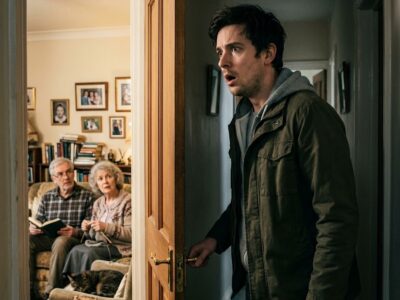
At My Engagement Party, My Best Friend Pulled My Fiancé Into a Back Room—So I Followed Them…
Part 1: The Anatomy of a Perfect Evening
The bathroom mirror at the Magnolia Ballroom doesn’t lie. I stood there in white and gold, the same colors I’d hot-glued onto sixty centerpieces the night before. I looked at myself the way I look at a finished event, checking for the thing that’s slightly off. Nothing was off. My dress was right. My hair was pinned exactly where I wanted it. My lipstick was the color I’d spent three Saturdays finding. I looked like a woman who had built something beautiful and was finally standing inside it. I almost believed that.
I’d been engaged six weeks. Damon had proposed on a Tuesday. Not a special Tuesday, just one where the light was coming through the kitchen window and he was standing there holding two cups of coffee and he said, “I want to do this right. Will you let me?” I’d said yes before I even processed the ring. That’s how you know it’s real—when the answer is faster than your brain.
I walked back out to my own engagement party because nobody else was going to run it. I’ve been running things since I was twenty-nine, the day my first marriage ended. I built Caldwell Events from a folding table pushed against a wall. I had a reputation now, a client list, and tonight, I had a room full of people I’d personally invited, standing under lights I’d sourced and strung myself.
The catering timeline was running four minutes ahead of schedule. I noticed that the way I notice everything—quietly, without breaking my smile. I worked the room. I hugged Damon’s college friend and covered the fact that I had no idea who he was with warmth. I redirected the bartender. I laughed at the right moments, squeezed hands, and accepted congratulations with both of mine wrapped around whoever was offering them. I was very good at this.
What I was actively managing, however, were two things I kept filing to the back of my mind. First, Damon hadn’t introduced me to his four colleagues as I’d asked. They were near the bar, laughing together, and I was the woman of the hour in a room I had designed, yet his co-workers didn’t know my name. Second, Tanya Briggs. My best friend of twelve years. She had walked in forty-five minutes late and drifted immediately to Damon’s crowd, sliding into the circle like she had a place there. I watched her laugh, her hand settling on someone’s arm—easy, practiced. I thought about the night I stayed up until 3:00 a.m. helping her cram for her real estate exam. That was who we were to each other. I still believed it was real.
I excused myself to look for Damon. I did a slow, professional sweep of the room. He wasn’t there, and neither was Tanya. I set my glass down and started moving, keeping my face easy. I saw them before they made the corridor. It was the hand that caught me first—Tanya’s hand curling around Damon’s wrist. It wasn’t a grab; it was the kind of touch that already knows its welcome. She leaned up toward his ear, and he checked the room, efficient and practiced, before following her down the catering corridor. I followed them. I opened the door to the small office at the end of the hall. He had his hand on her jaw, and they were kissing with a particular, unhurried quality that had nothing to do with accidents.
Part 2: The Silent Record
They didn’t hear the door open. They didn’t stop. I watched for three seconds. I counted them. I memorized the angle of his hand and the way her fingers were pressed flat against his chest. I pulled the door closed softly and walked back to my party. My hands went still at my sides, but everything else—my pace, my posture, the expression on my face—remained exactly what it had been before.
I went to the bathroom, turned the lock, and opened my phone. I recorded ninety seconds, describing the date, the venue, the room number, and exactly what I had seen. I air-dropped the file to myself twice. Then, I fixed my lipstick and walked back out. For the next two hours, I was the most charming woman in that room. I danced with Damon’s 82-year-old uncle and gave a toast that made people cry.
I clocked Tanya when she came back, and Damon three minutes later, straightening his jacket. Three minutes is not a coincidence; three minutes is a plan. I drove home, Damon talking about how proud he was of “us,” while I watched the streetlights move across the window like film strips. When he was asleep, I lay in the dark and started counting backwards. Every Sunday afternoon she’d stayed for three hours, every casual question about Damon’s weekend. I counted fourteen of those moments before I stopped.
I was up at 5:00 a.m. I didn’t try to sleep. By the time Damon’s alarm went off at 7:15, I had made three decisions. He came into the kitchen, easy and bright. He made eggs, put on jazz, and touched my arm when he reached for the salt. He looked completely unbothered, as if whatever he did last night cost him nothing.
When he went to shower, I opened his laptop. I knew his password from a request he’d made months ago. I typed one word into the search bar: Tanya. There were forty-three results. I sorted by date and found a thread with no subject line. Her message was eleven words: She’s working Saturday. I’ll be home by noon. I screenshotted it, closed the app, and put the laptop back exactly where it had been.
Standing there while the coffee brewed, I remembered him saying, “She’s just easy, not complicated like you.” I had taken that as a compliment—a woman with standards, with a full life. Now, I saw the comparison. And I knew I was losing, but I was also just beginning to see the board. I didn’t confront him. I needed the scope of this. I called my Aunt Vera. She was my mother’s younger sister, a retired teacher with zero patience for foolishness. She told me to come to dinner on Sunday and bring a lawyer. She’d already written a name on a piece of paper before I even arrived: Patricia Okafor.
Part 3: The Documents of Deceit
I booked the consultation from Vera’s driveway, the moths circling the porch light. As I sat there, I pulled up Tanya’s public social media. I scrolled back three months until I found it—a check-in at a woman’s health clinic two towns over, on a Wednesday afternoon, the same week she’d canceled our Cancun trip. She had switched to sparkling water and never looked back. The pieces were rearranging themselves into one clear, sharp shape.
I arrived home at 8:15. I spent the next two weeks performing the perfect fiancée. I kept my face open, my mouth soft, and my eyes on everything. I learned that Damon went to the gym every Saturday morning for ninety minutes. The Saturday after the party, I waited until his car cleared the end of the block. I went to the closet and entered our anniversary date into his fireproof lock box.
It opened on the first try. I lifted the lid and stood still. Inside, I found a beneficiary update form—my name had been removed, and Tanya Briggs was listed in my place. I found a lease agreement for an apartment across town, signed eleven months ago—one month before he proposed to me. And I found a small pink card, the handwriting unmistakable. I know it’s not the right time, but I can’t stop thinking about what we’re building.
I photographed everything. I replaced the items, closed the box, and went to the kitchen to wash the dishes by hand. He had proposed to me while he was paying rent on an apartment for her. He had moved her into his future while I planned our wedding. I stood at that sink until the water went cold, but I didn’t break. I didn’t have the luxury of breaking.
Monday morning, I sat in Patricia Okafor’s office. She was precise, unhurried, and devoid of wasted warmth. She looked at the photos, set the phone down, and said, “Document everything. Maintain normal behavior. Call me when you’re ready.”
I walked out feeling steadier than I had in weeks. My phone rang immediately. Tanya. She wanted a girls’ day. “I miss you, girl,” she said, her voice warm and easy. “Let’s have lunch.” I said yes. As I hung up, I saw Damon sitting at the kitchen table that night, asking me to consider closing my business to be a “traditional” wife. I gave him a warm, specific answer. I’d think about it. But I was already thinking about Saturday, and exactly what I was going to ask my best friend.
Part 4: The Brunch of Lies
Saturday morning, I arrived at the restaurant first. I always do. You arrive early, you read the room, you know every exit before the guests arrive. Tanya walked in at 11:03, looking flawless in a camel coat, her smile wide. She moved like she belonged in every room. She hugged me, I hugged her back, and we sat down.
For the first twenty minutes, she was perfect. She leaned forward when I talked, nodded in the right places, and held my attention. She ordered sparkling water. I ordered a mimosa and watched her. She told me she was on a sixty-day cleanse. I smiled and said, “Good for you.”
I watched her work. She was a professional at lying, but she was a woman who didn’t know that I had already seen behind the curtain. After a while, I tilted my head and asked about her apartment. “Still loving the location?” I asked. A flash of something crossed her face—a half-second of panic—before she smoothed it over. “It’s fine,” she said. “Might be looking at something new soon.” I heard what she didn’t say.
As we were leaving, she took my hands, looked me in the eye, and delivered the coup de grâce. “Can I be honest with you? I worry you settled for Damon because you were scared after the divorce. I want you to be with someone who really chooses you.”
She had dressed concern in cashmere and delivered it like a gift. I looked at her, covered her hands with mine, and squeezed. “You’re such a good friend,” I said. She smiled, thinking she’d successfully gaslit me once more. She had no idea she’d just handed me the last piece of the puzzle I needed.
I drove home and called my attorney. “I’m ready,” I said.
When I arrived home, Damon’s car was in the driveway, but there was a second car I didn’t recognize. A silver sedan. I walked inside. Damon was sitting in the living room with a couple in their mid-forties. “Babe, these are old friends,” he said. The woman smiled. “It’s so nice to finally meet you, Renee. Damon says you do events.”
I hadn’t told her my name. Damon hadn’t said it. I shook her hand, went to the kitchen, and brought back water. I sat down and started listening to every single word they said, filing it all away. I was ready to dismantle the performance.
Part 5: The Unraveling
Two days later, I cooked a perfect dinner: salmon, roasted asparagus, lemon butter. It was the kind of meal that said nothing is wrong. Damon was relaxed, easy, a man with no reason to think the foundation of his life was about to collapse. I watched him eat, thinking about how he could be so unbothered after all he had orchestrated.
I cleared the plates. I went to the bedroom and took the manila folder from my bag. The photographs, the lease, the card—everything was clean, dated, and timestamped. I set the folder on the coffee table and sat in the chair across from the couch. I folded my hands and waited.
He looked at the documents, his jaw shifting, but he caught himself quickly. He started talking, building a story, laying out planks of excuses. It was physical, it was stupid, it was “already over.” He loved Renee. She was overreacting. She needed to calm down. He talked for a long time, weaving a narrative where he was the victim of a misunderstanding.
I let him finish. When the silence returned, I said, “I’m not here to negotiate.”
I set a demand letter on top of the photographs. “Two years of professional consulting services,” I said. “Billable at my standard rate. $12,000. You have seventy-two hours to remove my name from anything you’ve attached it to without my consent.”
I took off the engagement ring. It didn’t feel like a sacrifice; it felt like putting down a heavy bag. I set it on the demand letter. “I’m staying at Vera’s,” I said. “When I come back, I expect you to be gone.”
He shifted, deciding to use his last weapon. “You know,” he said, his voice cold, “Tanya’s always been the woman I actually wanted. You were just easier.”
My hand was already on the door handle. I turned, looked at him sitting in his own mess, and said, “Then I did you a favor by leaving.”
I walked out. The night air was clean. I drove to Vera’s, the highway dark and quiet. I didn’t look back. I’d been driving for forty minutes when my phone lit up. Tanya. I looked at her name for two seconds, then answered. She’d talked to Damon. She was defensive, then sharp, then frantic. She claimed she was sorry it came out this way, but that didn’t make it wrong. She said she couldn’t blame herself for loving a man who wasn’t being loved right.
“How far along were you?” I asked. The silence on the other end was deafening. “I know about the clinic, Tanya.”
I laid out the timeline—the appointments, the professional references I had built for her, the church elders who trusted my word about her character. “Those women are going to know exactly who you are,” I said. “Not from gossip. From documentation.”
“You wouldn’t,” she whispered. “Renee, we’re friends.”
“I already did,” I said, and hung up.
Part 6: The Architect of Freedom
Revenge isn’t anger. Anger burns fast and messy. Revenge is cold, precise, and quiet. I had built it in parking lots and attorney offices. I didn’t want to burn her life down; I wanted to make sure the people who trusted my word had the information I had. What they did with it was their business.
Damon didn’t contest the financial demand. The settlement was signed in six weeks. I called the ballroom where I’d held the engagement party and booked the main hall for the same date next year. “What’s the occasion?” the coordinator asked.
“A client’s 20th anniversary,” I said.
I entered it into my calendar: Harrove Anniversary, Main Hall, Full Production. That date had carried heavy baggage for weeks. Now, it had a job to do. It was something I built, something that belonged entirely to me.
Eight months later, I signed the lease for my new studio. 1,200 square feet, big windows, east-facing light. I signed it with full knowledge of what I was committing to and no one else’s name anywhere near the page. The gold vinyl letters of my business name were installed in eleven minutes. I stood on the sidewalk and watched, the door finally belonging to the woman I had become.
Sundays are still at Vera’s. Potato salad, complaints, sweet potato pie. One afternoon, one of Vera’s grandbabies fell asleep in my lap. I didn’t move for an hour. I was just there, in the noise, holding a child who didn’t know what the last eight months had cost me. That’s what it feels like to actually be in your life instead of managing it from the outside.
A few weeks ago, I caught myself in the mirror before a big client event. I was wearing the same dress I’d worn the night of the party, but the uncertainty behind my eyes was gone. I looked at myself and I genuinely liked the woman looking back.
Word traveled the way it always does. Damon and Tanya were together, but there was tension. Money issues. Tanya’s client list had thinned, and new referrals were slow. Reputation, once it shifts, shifts permanently. I felt nothing when I heard it. No satisfaction, no ache. I had stopped needing their suffering around the time I signed my own lease. I wasn’t trying to watch them. I was trying to be free. And I am free.
Part 7: The Final Calculation
Tonight, the venue is full. The room is hummed with the sound of two hundred people, the clinking of champagne flutes, the soft murmur of conversation. It’s a 20th-anniversary celebration for one of my oldest, most loyal clients. The lighting is perfect—amber and soft, hitting the centerpieces I sourced myself.
I stand in the back, the clipboard in my hand, scanning the room. Everything is running on time. The catering team is moving with fluid efficiency; the sound technician has the levels set exactly where I requested. I don’t have to manage them; I hired the best, and they are doing their jobs.
I walk through the crowd, my heels clicking softly on the floor. I stop to check on the cake table, the white icing smooth and unbroken, the topper elegant and simple. A guest smiles at me, and I smile back. It’s a real smile. I’m not performing tonight. I’m producing. There is a world of difference between the two.
I look at the clock. It’s time for the toast. I give the signal to the sound technician. The music dims. The room grows quiet, the energy shifting toward the stage. The client steps up, a glass of champagne in hand, and begins to speak about his wife, about the two decades they’ve shared, about the things that actually last.
I stand by the exit, listening. I think about the corridor in the Magnolia Ballroom. I think about the lock box, the pink card, the lease, the lawyer’s office, the quiet Sundays at Vera’s. Those things feel like they happened to a different person, a character in a book I once read. They aren’t me. They are just the path I had to walk to get to this room, to this light, to this silence.
The toast ends. The room erupts into applause. My client catches my eye from the stage and gives a subtle, appreciative nod. I nod back. I have built this. I have maintained this. I am the architect of my own environment.
I walk out onto the terrace. The night air is cool and smells of jasmine. I take a slow, deep breath, my lungs filling with the weight of my own existence. There are no empty spaces waiting to be filled, no version of myself I have to maintain. There is just the work, the success, and the peace of knowing exactly who I am.
My phone vibrates in my pocket. It’s a notification from my assistant. The planning for next month’s gala is ahead of schedule. I smile, tuck the phone away, and look out over the city. It’s wide and bright and full of opportunities that belong to me.
I walk back inside, toward the noise, toward the work. I am exactly where I need to be. And for the first time in my life, I don’t need anyone to tell me that I’ve done a good job. I know it. And that, I realize, is the only calculation that ever really mattered. I am the event. I am the plan. I am the woman who finished the story.
The evening is perfect. And tomorrow, I will start a new one. I wouldn’t have it any other way. Everything is in order. Everything is mine. The room is quiet, the stage is set, and I am finally, finally standing in the middle of a life I actually built myself.