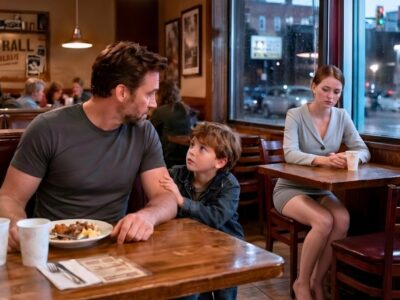
Billionaire Sat Alone at the Airport on New Year’s Eve—Until His Ex Walked Past Holding Their Son
Part 1: The Ghost at Gate B7
The December thirty-first cold had settled into Denver International Airport the way it always did at the end of the year: heavy, indifferent, and patient, as if it had nowhere else to be.
Gate B7 was quieter than the rest of the terminal. Most flights had already boarded. Most families were already reunited or bitterly separated. Most tears were already cried and dry. The champagne at the airport bar was overpriced and lukewarm, and the television bolted to the corner of the waiting area was silently counting down the final hours of the year. Nobody was watching.
Adrien Wolf sat with his long legs stretched out in front of him, a battered leather carry-on bag wedged beside his seat like a companion he hadn’t asked for. His flight to London had been delayed two hours due to de-icing issues on the tarmac. He could have waited in the private, soundproofed lounge on the upper level; his black card would have gotten him in without a second glance from the concierge. But he hadn’t gone up.
He didn’t know why. Maybe he wanted the hollow, white noise of regular people around him. Maybe he was tired of rooms that were too quiet, too clean, and too empty of everything that used to matter. At forty-two, Adrien had the kind of sharp, angular face that made people look twice in boardrooms. He possessed a sharp jawline, dark, penetrating eyes, and a faint silver threading through his dark hair that his PR team had once suggested he dye back before major television interviews.
He had laughed at them. The silver had started the year he turned forty—the exact same year the valuation of Wolf Capital crossed eleven billion dollars. He had decided to wear the gray like the scar it was.
He wasn’t reading the glowing Forbes profile they’d published about his hedge fund three weeks ago. He wasn’t checking the global currency markets on his phone. He was staring at the electronic departures board the way a man stares at something he can see but doesn’t really register—the way you look at a blank wall when what you’re actually doing is drowning in memories.
Three years and four months.
He caught himself counting the time again and stopped. He had promised himself he would stop doing that. He had promised his therapist, his business partners, and his own reflection in the mirror that he was done counting the days since she had walked out of his life.
The heavy glass doors of the gate bridge across from him opened with a soft, electronic click. Adrien didn’t look up at first. He had long ago learned to tune out the rhythmic machinery of an airport. Arrivals and departures, people coming back, people leaving forever—the entire relentless routine had turned into white noise somewhere around his two-hundredth corporate flight.
And then he heard a laugh.
It was small, high-pitched, and completely unselfconscious—the kind of pure, bubbling laugh that a child produces before they learn that the world is watching them.
Adrien looked up.
A woman was coming through the terminal walkway. She was rolling a scuffed navy suitcase in one hand while balancing a little boy on her opposite hip, his tiny sneakers barely clearing her thigh. The boy was pointing at the flickering flight board with the absolute authority of someone who had very strong opinions about destinations. He was perhaps two years old, with dark, unruly curls and the round, serious eyes of a child taking in a vast, overwhelming world.
Adrien’s chest stopped working. The air trapped in his lungs turned to ice.
Not because of the boy. Because of the woman.
She was wearing a camel-colored wool coat he didn’t recognize. Her dark hair was pulled back in a loose braid that had started coming undone at the edges during her journey. She looked different. There was a steadiness to her posture now, something settled and self-sufficient that hadn’t been there when she used to wait for him in his minimalist penthouse. But her profile was unmistakably the same. The slight upward tilt of her chin when she was navigating something difficult. The way her free hand moved instinctively to adjust the heavy strap of the diaper bag over her shoulder.
Celeste.
The name formed in his chest long before it could reach his lips.
She hadn’t seen him yet. She was talking softly to the boy, pointing out the bright gate numbers, nodding seriously at whatever baby babble he was directing back at her. The boy reached up, grabbing a handful of her loose braid, and she winced, laughed softly, and reached up to gently uncurl his tiny fingers without breaking her stride.
Adrien stood up. He didn’t decide to stand; his body simply reacted, pulled forward by a gravity he had spent forty months trying to deny.
She turned toward the seating area, scanning for an open row. Her eyes passed over the empty chairs, over the tired business travelers, over the departures board.
And then her gaze landed on him.
Celeste went completely still. The rolling suitcase halted beside her. The little boy continued babbling, oblivious to the sudden freeze in his mother’s frame, patting her cheek with one small, warm palm.
“Adrien,” she said.
The word was barely a whisper, swallowed by the cavernous terminal. The airport kept moving around them. A rolling suitcase clicked past on the carpet, an automated boarding announcement echoed overhead, and a child down the corridor whined for a pretzel. But the ten feet of linoleum separating them felt like an abyss that would take a lifetime to cross.
“Hello, Celeste,” Adrien said. His voice came out steadier than he deserved, though every nerve in his body was screaming.
She shifted the boy to her other hip—a movement that was entirely instinctive, protective, and defensive. Adrien’s gaze moved from her face down to the child.
The boy looked back at him. He stared with the frank, unblinking curiosity that only toddlers possess. He had a round face still soft with baby fat, dark curls clinging to his forehead, and eyes—eyes that were the exact, striking shade of charcoal gray that Adrien saw in his own mirror every single morning.
Adrien felt the ground beneath his expensive leather shoes tilt. The breath left his chest in a ragged gasp. He looked back up at Celeste.
She was watching him with an expression he couldn’t fully read. It wasn’t quite fear, nor was it anger. It was something far rarer—something that had clearly been rehearsed in late-night silence for a scenario she had desperately prayed would never arrive.
“Is he…?” Adrien started the question, but the words withered in his throat.
Celeste’s chin lifted just a fraction of an inch. “His name is Tobias,” she said quietly. “He’s twenty-two months old.”
Adrien did the math. He had always been exceptionally fast with numbers; it was the precise trait that had made him an eleven-billionaire and a terrible partner in equal measure. The math was not complicated. The math was, in fact, utterly devastating.
Slowly, deliberately, Adrien crouched down. He brought himself to eye level with the little boy sitting on Celeste’s hip. Tobias studied him with the same intense, focused scrutiny that Adrien brought to every hostile corporate takeover he had ever managed.
“Hi,” Adrien whispered, his voice cracking slightly.
Tobias considered him for a long, silent moment. Then, apparently satisfied by whatever secret criteria a toddler uses to evaluate strangers, the boy pointed a tiny finger at Adrien’s wrist.
“Tick,” Tobias announced clearly. “Tick.”
“Tick,” Adrien agreed, his vision blurring at the edges as he looked at his own silver watch, then back at his son. He straightened up, his legs feeling strangely weak, and met Celeste’s guarded gaze.
Her knuckles were white against the handle of her suitcase. “Adrien… we should find seats,” she said, her voice dropping into a flat, professional tone. “He needs to eat before our flight boards.”
“Where are you going?” Adrien asked, his heart hammering against his ribs as he stepped closer.
Celeste swallowed hard, looking toward the empty seats at the edge of the gate. “We’re going home, Adrien. And you… you have a plane to catch.”
Part 2: The Math of Absence
Adrien didn’t move toward his own gate. Instead, he stepped into the aisle, blocking the gentle flow of foot traffic around them.
“Let me carry the bag,” Adrien said softly, reaching toward the heavy leather diaper bag slung over her shoulder.
“You don’t have to do that,” Celeste replied instantly, pulling back half an inch.
“I want to,” he said.
She looked at him for a long, heavy moment—the kind of look that carried three years of unanswered phone calls, silent nights, and unpayable debts. Then, without a word, she allowed the heavy strap to slide off her shoulder and into his grip.
They walked in silence to a quiet row of blue plastic chairs near the floor-to-ceiling windows overlooking the tarmac. Snow was beginning to fall outside, thick white flakes swirling in the yellow glow of the airport floodlights.
Celeste sat down, setting Tobias on the seat between them. The diaper bag hit the carpet with a soft thud. With practiced, single-handed efficiency, Celeste unzipped a side pocket, pulled out a small plastic container of cut fruit, and handed Tobias a blue sippy cup. The boy took it eagerly, settling back against the plastic chair with the supreme confidence of a child who knew he was adored. He picked up a piece of mango with his tiny fingers, chewing seriously while his dark, charcoal eyes remained fixed on Adrien.
“You never came back to Portland,” Adrien said quietly, his voice low enough that only she could hear over the hum of the terminal’s ventilation system.
“I moved to Boise eight months ago,” Celeste said, keeping her eyes firmly on her son. “I needed… I needed to start over somewhere smaller.”
Adrien looked down at his hands. His knuckles were raw from the cold air.
Boise.
Eighteen months ago, when he realized he couldn’t erase her memory with work, he had quietly started a charitable foundation in Portland. He had anonymously donated millions to three community art organizations in the Pearl District neighborhood where she used to live, secretly hoping his lawyers or accountants might drop her name in a routine status report. He had explicitly forbidden himself from calling her or sending investigators. He had told himself that was out of respect for her boundaries.
Sitting here, watching his son eat mango from a plastic container, he finally understood the truth. It hadn’t been respect. It had been cowardice. He had been terrified of finding out that she was happier without him.
“Why were you going to London?” Celeste asked suddenly, her voice cutting through his thoughts.
“A New Year’s Eve acquisition meeting,” Adrien replied. The words felt hollow, almost absurd, as they left his mouth. “The London office needed me to oversee the final signatures on a tech merger. We were finalizing terms at midnight GMT.”
“It’s New Year’s Eve,” Celeste said softly.
“I know.”
She finally turned her head and looked at him directly. The exhaustion in her face was profound—not the temporary fatigue of a long flight, but the deep, bone-weary exhaustion that sleep could never fix.
“I used to try to explain to people what it was like loving you, Adrien,” she said. She didn’t say it with anger or bitterness; she said it as a simple, undeniable matter of fact that she had long since made peace with. “You were always somewhere important. Something always needed you more than I did. A board meeting, a hostile bid, a flight to Tokyo. You lived in the atmosphere, and I was grounded.”
“That wasn’t…” He started to defend himself, but the words died on his tongue.
“It was,” she corrected gently. “You didn’t mean for it to be that way, but it was. Your mind was always three steps ahead in some boardroom, even when you were sitting right across from me at dinner.”
Tobias held out a small, sticky piece of cantaloupe toward Adrien, breaking the heavy silence between them. “Eat,” the boy commanded solemnly.
Adrien blinked back a sudden sting in his eyes. He reached out and carefully took the fruit from his son’s small fingers. “Thank you, Tobias,” he said, his voice husky.
Tobias gave a single, satisfied nod and returned to his snack, completely unaware of the magnitude of the moment.
Adrien swallowed the fruit, then looked back at Celeste. “Why didn’t you tell me?” he whispered. The question was a raw bleed from his soul. “Celeste… my God. Why didn’t you tell me you were pregnant?”
Celeste was quiet for a long time. Over the intercom, a chime rang out announcing a gate change for a flight to Chicago. She waited until the echo faded before she spoke.
“I found out six weeks after I walked out of your apartment,” she said quietly. “I packed my bags while you were in Munich, remember? You came home to an empty closet.”
“I remember,” Adrien said, the memory hitting him like a fresh physical blow. “I called you fifty times.”
“And I didn’t answer because every time I looked at my phone, I remembered that I had spent three years coming second to your calendar,” she replied. “But when the doctor confirmed I was pregnant, I panicked. I set aside my pride. I called your personal line twice. It was disconnected or changed. So I called your main office at Wolf Capital.”
Adrien froze. “What?”
“Your executive assistant answered,” Celeste continued, her voice unnervingly calm. “I told her it was urgent. I told her I needed to speak to you directly. She told me you were in a high-stakes negotiation in Tokyo, then flying straight to Singapore, and that you had explicitly requested no personal interruptions unless it was a family emergency.”
Adrien’s hands clenched into tight fists on his lap. “I never… I didn’t…”
“I knew what ‘family’ meant to you back then, Adrien,” Celeste said. “It meant your firm. So I left a message. I asked her to have you call me the second you landed. Three days went by. Nothing. So I sent a direct email to your private address, subject line: Please call me.“
Adrien closed his eyes, his mind wildly racing back through the fog of thirty-four months ago.
He remembered Tokyo. He remembered the brutal, eighty-hour work week. He remembered telling his executive team to aggressively filter his communications because he was sleeping two hours a night and running on sheer adrenaline.
“I got a reply four days later,” Celeste whispered. “Three sentences. It said you received my message, that you were extremely busy managing the Asian market expansion, that you wished me well in my next chapter, and that your legal team would handle any lingering lease obligations for the Portland apartment.”
Adrien felt as if the room had just been deprived of oxygen. “No,” he breathed, turning to her, his face pale with horror. “Celeste, no. I never wrote that email. I swear on my life, I never saw your message!”
Celeste looked at him with a sad, weary expression. “It came from your verified email address, Adrien.”
“I had an assistant!” Adrien said, his voice rising in desperate panic. “During the Tokyo deal, I had three temp secretaries managing my personal inbox because my primary assistant was on maternity leave! They had auto-templates for former associates and… God, Celeste, I told them to send standard sign-off notes to non-business contacts so I wouldn’t be distracted!”
He buried his face in his hands, a jagged sob escaping his chest. He had paid people sixty dollars an hour to filter out his life so he could make another hundred million dollars. And in doing so, he had handed away his own son.
“I was twenty-nine years old, Adrien,” Celeste said quietly, her voice trembling slightly for the first time. “I was living in a rented apartment I couldn’t afford alone. I was standing in a bathroom looking at a positive pregnancy test, knowing that the man I loved was somewhere in Southeast Asia building his corporate legacy, and he couldn’t even be bothered to write more than three template sentences to a woman he’d lived with for three years.”
Adrien raised his head. His eyes were red, filled with an agony so profound it felt as if his heart were physically tearing apart inside his ribs.
He looked down at Tobias. The little boy had finished his fruit and was now meticulously stacking the empty plastic container on top of his blue sippy cup, testing the balance with intense concentration.
“He has your hands,” Celeste whispered softly, looking at the boy’s tiny, agile fingers. “He has your exact fingers. Every time he builds something out of blocks, I see you.”
Adrien couldn’t speak. The grief in his throat was a physical obstruction.
“I didn’t keep him from you out of malice, Adrien,” she said, her voice dropping lower. “I kept him because I was terrified. I was terrified that if I brought him into your world, he would grow up just like I lived—waiting by the door for a father who was always on a jet to somewhere more important.”
“I want to know him,” Adrien choked out. The words were raw, unpolished, and desperate. “Celeste… please. I want to be a father to him. I want to be here for both of you.”
Celeste stared at him for a long, painful moment. The snow continued to lash against the glass behind them.
“Don’t,” she whispered firmly. “Don’t make promises in an airport on New Year’s Eve, Adrien. You’ve been sitting here for fifteen minutes. You’re feeling shock and nostalgia.”
“I’ve been thinking about you every single day for three years!” he shouted softly, leaning toward her.
“Thinking about me isn’t the same as being there!” Celeste snapped back, her eyes flashing with a sudden, fiery intensity. “You missed the ultrasounds! You missed the midnight trips to the ER! You missed his first steps! You don’t get to walk into an airport gate and claim a life you weren’t brave enough to build!”
Before Adrien could answer, the gate loudspeaker crackled to life above them.
“Final boarding call for Flight 1142 to Boise. All remaining passengers, please report to Gate B7 immediately.”
Celeste stood up. She reached down, picked up Tobias, and settled him securely against her hip. She grabbed her rolling suitcase.
Adrien stood up instantly, his heart slamming against his ribs. “Celeste, wait. Please.”
She stopped, looking back at him. Tobias looked over her shoulder, waving his sticky little hand at Adrien. “Bye-bye, tick-man,” the boy chirped happily.
Celeste’s eyes were full of unshed tears. “Goodbye, Adrien. Go to London. Go build your empire.”
She turned and began walking toward the boarding line.
Adrien stood frozen for two seconds. He looked at the departures board. His flight to London was boarding at Gate A12 in twenty minutes. Twelve board members were waiting for him. A two-hundred-million-dollar deal was hanging in the balance.
Then he looked at the camel-colored coat moving toward the jetway.
Adrien reached into his pocket, pulled out his boarding pass to London, ripped it in half, and threw it into a trash can.
“Celeste!” he called out, striding past the waiting passengers.
Part 3: The Boarding Pass in the Trash
Celeste stopped just short of the ticket scanner. She turned around, her eyes widening in disbelief as Adrien caught up to her, breathing heavily.
“What are you doing?” she asked, her voice hushed. “They just called your flight to London.”
“I’m not going to London,” Adrien said firmly.
“Adrien, don’t be absurd. You have a multi-million-dollar deal—”
“I don’t care about the deal,” he interrupted, his dark gray eyes locking onto hers with a fierce, absolute clarity she had never seen in him before. “I don’t care about London. I don’t care about Wolf Capital. I am not getting on that plane.”
“You can’t just abandon your life on a whim!”
“It’s not a whim, Celeste,” he said, stepping closer, though he kept his hands respectfully at his sides. “It’s the first sane decision I’ve made in forty-two years. I am done letting business meetings dictate whether I get to be a human being.”
Celeste stared at him, searching his face for any sign of hesitation, any flicker of the corporate titan who used to check his watch during dinner dates. She found none.
“I’m coming to Boise,” he added softly.
“No, you’re not,” she said immediately, her defensive posture returning. “You can’t just buy a ticket and follow us home like… like some grand romantic gesture! This isn’t a movie, Adrien. This is a child’s life. You can’t just drop in for a weekend when you feel guilty and then fly back to Manhattan when the novelty wears off.”
“I’m not buying a ticket for your flight,” Adrien said. He pulled his phone from his pocket, opened his messaging app, and typed out a rapid message to his managing partner, Marcus:
Cancel London. I’m stepping away indefinitely. Manage the closing without me. Do not call unless the building is on fire.
He hit send, then turned the screen toward Celeste so she could read the text.
“I’m taking a later flight,” Adrien said quietly. “I’ll stay at a hotel in Boise. I won’t invade your space. I won’t show up at your house uninvited. But I am going to be in the same city as my son. And tomorrow morning, if you allow it, I would like to buy you both breakfast.”
Celeste looked at the text on his phone, then looked up into his eyes. Her jaw worked silently. “You’re serious,” she whispered.
“I have never been more serious about anything in my entire life,” Adrien replied. “I spent three years mourning my absence in your life, Celeste. I am not going to spend the rest of my life being absent from his.”
Tobias reached out from Celeste’s hip, grabbing at the lapel of Adrien’s dark coat. “Daddy?” the boy asked suddenly, his little voice bright and clear in the quiet gate area.
Celeste went rigid. The color drained completely from her face. “He… he calls everyone that,” she stammered quickly, her voice cracking. “It’s a phase! He said it to the TSA agent thirty minutes ago. Don’t… don’t read into it.”
Adrien felt a tear slip down his cheek, but he didn’t wipe it away. He looked directly at Tobias, offering his index finger to the boy. Tobias gripped it tightly with his small, warm hand.
“I know it’s a phase,” Adrien whispered, his voice thick with emotion. “But I’m going to spend every day proving to him that I deserve the title.”
Celeste closed her eyes for three long seconds. When she opened them, the anger had faded, replaced by a profound, cautious vulnerability.
“One week,” she said softly. “You come to Boise for one week. You stay at a hotel downtown. You meet us at the public park. No grand gestures. No expensive gifts. Just… show up. On time. Without your phone in your hand.”
“I’ll be there,” Adrien said instantly. “Name the time.”
“Saturday morning. Ten o’clock. Ann Morrison Park,” she said. “If you’re five minutes late, or if you reschedule because of a meeting, I’m blocking your number, and this conversation never happened.”
“Ten o’clock,” Adrien repeated. “I’ll be standing by the gate at nine-forty-five.”
Celeste looked at him for one last, long moment. Then she handed her boarding pass to the gate agent, turned, and walked down the jetway with Tobias. The boy looked back over her shoulder one last time, giving Adrien a small, sloppy wave with his free hand.
Adrien stood at the gate long after the glass doors closed. He watched the regional jet push back from the terminal, taxi down the snow-covered runway, and lift up into the dark Indiana night sky.
When the red tail lights vanished into the clouds, Adrien turned and walked back toward the main terminal. He didn’t feel the cold anymore. For the first time in three years, the hollow, crushing void in his chest had been replaced by a fierce, blazing purpose.
Thirty-six hours later, Adrien was standing in a small, carpeted hotel room in downtown Boise, Idaho.
He had stripped off his thousand-dollar suit jacket and rolled up the sleeves of a plain white linen shirt. On the desk lay two laptops, both closed. His phone was sitting face down on the nightstand, set to silent for every caller except one.
It was Saturday morning. Nine-thirty AM.
The temperature outside was twenty-eight degrees, but the sky was a pale, clear blue. Adrien pulled on a heavy wool coat, shoved his hands into his pockets, and began walking toward Ann Morrison Park.
He arrived at nine-forty-two AM.
The park was quiet, covered in a thin blanket of fresh snow that crunched satisfyingly under his boots. A few dog walkers were out, and near the playground, a few children were clambering over the frozen metal climbing frames.
Adrien stood near the wooden entrance gate, his breath pluming in the crisp air. His heart was hammering against his ribs harder than it had during the IPO of his first company.
At nine-fifty-eight AM, a familiar red Subaru pulled into the parking lot.
The door opened, and Celeste stepped out, wearing her camel coat and a thick blue scarf. She walked around to the back, unbuckled the car seat, and lifted Tobias out. The boy was bundled up in a puffy red snowsuit that made him look like a tiny, adorable marshmallow.
Adrien took a deep breath and stepped forward.
Tobias spotted him instantly. The boy’s eyes lit up, and he pointed a mitten-clad hand. “Tick-man!” he squealed.
Celeste set him down on the snowy path, and Tobias immediately took off toward Adrien, his tiny boots waddling clumsily through the snow.
Adrien dropped to one knee on the frozen ground, opening his arms. “Hey, buddy,” he whispered.
Tobias plowed straight into his chest, clutching Adrien’s coat collar with his mittens. Adrien wrapped his arms around his son, burying his face in the boy’s neck, breathing in the scent of baby lotion, cold air, and wool.
When he looked up, Celeste was standing a few feet away, her hands tucked into her coat pockets, watching them with a quiet, unreadable expression.
“You’re early,” she said softly.
“I told you,” Adrien replied, slowly standing up while holding Tobias securely against his hip. “I’m done being late for the things that matter.”
Celeste looked at him, then looked down at his empty hands. “Where’s your phone?”
“In the hotel room,” Adrien said. “Locked in the safe.”
A tiny, subtle shift occurred in Celeste’s posture—a microscopic lowering of her guard. “He likes the blue slide,” she said, nodding toward the playground. “Don’t suggest the red one. The red one is ‘too fast,’ and we’ll be stuck negotiating with him until noon.”
“Noted,” Adrien smiled, his dark eyes warm. “Blue slide only.”
For the next two hours, the eleven-billion-dollar hedge fund manager didn’t think about interest rates, stock portfolios, or corporate acquisitions. He spent two hours catching a twenty-two-month-old boy at the bottom of a plastic slide, lifting him onto swing sets, and learning the precise, complex language of a toddler’s laughter.
When Tobias finally began rubbing his eyes, exhausted from the cold air, Celeste stepped closer. “It’s time for his nap,” she said.
Adrien carefully handed the sleepy boy back to her. Tobias immediately tucked his head into Celeste’s shoulder, his small thumb finding his mouth.
“Thank you,” Adrien said quietly to Celeste. “For today.”
“He had fun,” Celeste admitted, her voice low. She looked at Adrien, her eyes searching his face. “Are you really staying in Boise for the whole week?”
“I bought a temporary lease on an apartment downtown,” Adrien confessed gently. “Three months. Just so I have a place to stay when I’m here.”
Celeste blinked, stunned. “Three months?”
“I’m not going anywhere, Celeste,” Adrien said. “I’m going to prove to you, one day at a time, that I can be the man you both deserve.”
Celeste didn’t answer right away. She adjusted the heavy, sleepy boy on her hip, looking out over the frozen park.
“One day at a time, Adrien,” she whispered finally. “That’s all you get.”
“One day at a time,” he agreed. “That’s all I need.”
Part 4: The Physics of a Block Tower
The first three weeks in Boise were an exercise in slow, painful calibration.
Adrien had spent his entire adult life operating in a world where money, authority, and sheer willpower could force any outcome. If a merger was failing, he worked twenty-hour days until it succeeded. If an executive was underperforming, he replaced them. He was used to instantaneous results and absolute control.
Parenting a twenty-two-month-old boy was the exact opposite of everything he knew.
You couldn’t negotiate with a toddler who had decided that his socks were “too spicy.” You couldn’t throw capital at a meltdown caused by a broken banana. And most importantly, you couldn’t buy forgiveness from a woman who had spent two years learning how to survive without you.
Celeste set strict boundaries. Adrien was allowed to visit every Tuesday and Thursday afternoon for two hours, and on Saturday mornings for four. He was not allowed inside her house past eight PM. He was not permitted to bring expensive toys or lavish gifts.
“He doesn’t need a father who buys him a motorized miniature Ferrari, Adrien,” Celeste told him bluntly on his second week when he showed up with a massive wooden train set. “He needs a father who sits on the floor and builds a wooden track with him.”
So Adrien sat on the floor.
He traded his tailored Italian suits for jeans and soft flannel shirts. He learned that Tobias’s world operated on strict, inviolable rules: apple slices had to be cut into quarters, not halves; the yellow truck was always the leader of the convoy; and bedtime required three specific picture books read in the exact same sequence.
One rainy Tuesday afternoon in February, Adrien was sitting on the rug in Celeste’s living room. Tobias was sitting between his legs, intensely focused on building a tower out of brightly colored plastic blocks.
Celeste was in the kitchen, wiping down the counters. The quiet hum of the dishwasher filled the cozy house. It was a modest, three-bedroom home with worn hardwood floors and mismatched furniture, but to Adrien, sitting on that rug, it felt infinitely more real than his six-thousand-square-foot penthouse in Manhattan.
“Up!” Tobias declared, carefully stacking a green block on top of a red one. “High!”
“Very high, buddy,” Adrien whispered, placing his hands lightly around the base to stabilize it. “Careful now.”
Tobias reached for a blue block, his tiny fingers trembling with focus. He balanced it precariously on the top. The tower wobbled dangerously, defying gravity for a split second, before collapsing in a chaotic shower of plastic across the rug.
Tobias froze. His tiny lower lip began to quiver. His dark gray eyes filled with sudden, dramatic tears.
Adrien panicked internally. In the boardroom, a collapsing deal meant emergency conference calls and legal threats. He had no idea how to handle a toddler on the verge of a total emotional breakdown.
“Hey, hey,” Adrien said quickly, leaning down. “It’s okay, Tobias! Look, we can rebuild it! We can—”
“Let him feel it, Adrien,” Celeste’s quiet voice interrupted from the kitchen doorway.
Adrien looked up. Celeste was leaning against the frame, holding a dish towel, watching them with a calm, steady gaze.
“Don’t try to fix it instantly,” she said gently. “He’s allowed to be disappointed that it fell.”
Adrien paused. He looked back down at Tobias, who was currently letting out a small, dramatic sigh, staring at the scattered blocks.
Adrien sat back on his heels. He didn’t rush to rebuild the tower. Instead, he simply reached out, opened his hand, and laid it palm-up on the carpet next to his son.
“It’s bummer when things crash down, isn’t it?” Adrien said softly.
Tobias looked at Adrien’s large, open hand. He sniffled, wiped his nose with the back of his sleeve, and then reached out, placing his tiny, warm hand inside Adrien’s palm.
“Crash,” Tobias whispered.
“Yeah,” Adrien murmured, his throat tightening. “Crash. But we can always start over. One block at a time.”
Tobias sat there for a moment, holding his father’s hand. Then, with the short-lived grief typical of a child, he picked up a yellow block and slapped it onto the rug. “Again!” he chirped.
Adrien let out a long breath, smiling softly. “Again.”
Celeste watched them from the doorway. Something in her expression shifted—a subtle melting of the guarded reserve she had maintained for months. She walked into the living room, set down two mugs of hot tea on the coffee table, and sat down on the far end of the sofa.
“He likes you,” she said quietly, watching Tobias hand Adrien a red block.
“I like him too,” Adrien replied, his voice rough. He kept his eyes on the blocks. “I… I love him, Celeste. More than I thought it was possible to love anything.”
“I know,” she whispered.
Silence settled over the room—a comfortable, unhurried silence. The rain tapped rhythmically against the windowpanes.
“How is the firm?” Celeste asked suddenly.
Adrien blinked, caught off guard. “Wolf Capital? It’s… fine. Marcus is running the day-to-day operations. I check in via email for thirty minutes every morning at six AM, and then I shut the computer off.”
Celeste studied him. “You really stepped back?”
“I promoted Marcus to Managing Partner,” Adrien said. “I took a seventy percent pay cut and resigned from four corporate boards. The financial press thinks I’m having a mid-life crisis.” He let out a soft, dry laugh. “They published an article last week speculating that I was secretly ill.”
“Are you?” she asked, her tone turning cautious. “Ill?”
“No,” Adrien said, meeting her eyes directly. “For the first time in my life, Celeste… I think I’m actually healthy. I spent fifteen years building a net worth, and I never realized that I was completely bankrupt on the inside.”
Celeste looked at him for a long time. The harsh afternoon light filtered through the rain-streaked window, highlighting the silver in his dark hair and the deep lines of exhaustion around his eyes—lines that weren’t from stress anymore, but from the hard, honest work of showing up.
“My mother asked about you yesterday,” Celeste said softly, shifting on the couch.
Adrien’s heart skipped a beat. “What did she say?”
“She saw the news about Wolf Capital. She asked if you were really in Boise.” Celeste looked down at her tea mug. “I told her you were. I told her you haven’t missed a single Saturday.”
“I will never miss a Saturday,” Adrien said fiercely. “Ever.”
Celeste nodded slowly. “She’s flying in from Charlotte for Tobias’s second birthday next month. She asked if… if you were going to be there.”
Adrien held his breath. “What did you tell her?”
Celeste looked up, her charcoal eyes meeting his with a clear, unwavering gaze.
“I told her you were bringing the cake,” she said.
A profound wave of relief washed over Adrien, so strong he felt almost lightheaded. He smiled—a genuine, uncalculated smile that reached his eyes. “I’ll get the best cake in Idaho.”
“No,” Celeste warned, a tiny smile touching her own lips. “No fancy bakery cakes with gold leaf, Adrien. He likes dump trucks. Get a simple chocolate cake with a plastic yellow dump truck on top.”
“Simple chocolate,” Adrien repeated, writing it down on the mental ledger of his new life. “Yellow dump truck. Got it.”
As Tobias happily banged two blocks together, Adrien looked at Celeste. The wall between them hadn’t completely vanished—the memories of three lost years were still there, heavy and real. But for the first time, there was a doorway in that wall.
And Adrien was more than willing to walk through it.
Part 5: The Weight of Three Years
By late April, spring had finally arrived in Boise. The snow melted from the foot of the mountains, replacing the stark white winter landscape with vibrant green grass and blooming apple trees.
Adrien’s life had settled into an entirely new rhythm. The man who used to fly across three continents in a single week now spent his Tuesday afternoons learning how to push a toddler on a park swing without causing motion sickness. The man who had negotiated billion-dollar credit facilities now knew the exact lyrics to every song on Cocomelon.
He had rented a permanent house four blocks away from Celeste’s—a modest, craftsman-style home with a large backyard where Tobias could run around safely. He hadn’t bought it to show off; he had bought it so Tobias could have a room of his own whenever he stayed with his father.
It was a quiet Friday evening. Tobias was fast asleep in his crib at Celeste’s house.
Adrien and Celeste were sitting on her back porch, drinking glasses of lemonade as the dusk settled over the neighborhood. A warm breeze rustled the leaves of the old oak tree in the yard.
For the past two months, their interactions had been strictly focused on Tobias. They talked about his eating habits, his speech development, his pediatrician appointments. They were excellent co-parents, maintaining a polite, friendly cadence.
But tonight, the air felt different. Thicker. Laden with the unsaid weight of their shared past.
“He called me ‘Dad’ today,” Adrien said softly, staring into his glass of lemonade. “Not ‘tick-man.’ Not ‘Daddy.’ He looked right at me when I opened the door and said, ‘Hi, Dad.'”
Celeste smiled gently, leaning back against the porch chair. “I heard him. He’s been practicing it for three days.”
Adrien swallowed hard, feeling a lump form in his throat. “I didn’t deserve that word, Celeste. Not yet.”
“Adrien,” Celeste said quietly, her voice dropping into a serious register. “You’ve been here every day for four months. You haven’t cancelled a single visit. You haven’t taken a work call in front of him. You bought a house four blocks away so you could walk him to preschool next year. You deserve the word.”
Adrien looked over at her. The twilight cast long shadows across her face, highlighting her sharp cheekbones and the delicate curve of her neck. She was wearing a simple gray sweater, her dark hair tumbling over her shoulders in loose waves.
“Do you still hate me?” Adrien asked. The question was raw, stripped of all corporate diplomacy.
Celeste turned her head to look at him. She was silent for a long moment, watching the fireflies begin to glow near the fence line.
“I never hated you, Adrien,” she said softly. “That was the hardest part. When I walked out of your apartment in Portland three years ago, I didn’t leave because I stopped loving you. I left because loving you was slowly erasing me.”
Adrien felt the words cut deep into his chest, precise and painful.
“I was twenty-six when we met,” Celeste continued, her voice reflective. “I was an ambitious interior designer with my own dreams. But slowly, imperceptibly, my life became entirely about accommodating yours. Your schedule dictated our vacations. Your mood dictated our weekends. Your career was the sun, and I was just a tiny planet orbiting in your gravity.”
She turned her full gaze onto him. “When I realized I was pregnant, I knew I had a choice. I could stay, raise a child in the shadow of your empire, and watch him learn that his father’s attention was something he had to earn between corporate flight schedules… or I could leave, protect my dignity, and give him a mother who was whole.”
“I was a fool,” Adrien whispered, his voice cracking. “I thought… God, Celeste, I thought building that wealth was how I protected you. My father lost everything when I was twelve. We were evicted. We lived out of a car for six months. I swore to myself that if I ever loved someone, I would build a financial wall so high that nothing could ever hurt them.”
Celeste’s eyes softened. She reached out, her fingers gently touching his arm for the first time in months.
“I know,” she murmured softly. “I knew where the drive came from, Adrien. But you built the wall so high that you trapped yourself on the outside.”
Adrien looked down at her hand resting on his sleeve. The warmth of her touch felt like an electric charge, grounding him to the present moment.
“Is the wall down now?” he asked, his dark eyes desperate for an answer. “Or am I still on the outside?”
Celeste withdrew her hand slowly, though her expression remained tender. “The wall is down for Tobias, Adrien. You are a wonderful father. He adores you. But…”
“But what about us?” Adrien finished the thought, his voice barely audible.
“Us is complicated,” she said quietly. “We aren’t the same people we were three years ago. I’m not that twenty-six-year-old girl who waited by the phone, and you aren’t the ruthless CEO who lived on a jet. We’re strangers who happen to know every intimate secret about each other’s past.”
“Then let me court you again,” Adrien pleaded gently, leaning toward her. “No luxury trips. No expensive jewelry. Just let me take you to dinner. Let me listen to your day. Let me learn who you are now.”
Celeste looked at him, her heart beating rapidly against her ribs. She saw the absolute sincerity in his dark gray eyes—the same gray eyes that looked back at her every time Tobias smiled. She saw the silver in his hair, the humility in his posture, and the profound transformation that four months of relentless effort had wrought.
She opened her mouth to answer, but before she could speak, the baby monitor sitting on the glass table between them suddenly crackled to life.
A sharp, ragged cough echoed through the speaker, followed immediately by a frantic, breathless cry.
Celeste stood up instantly, her maternal instincts taking over. “Tobias,” she gasped.
Adrien was on his feet in a second. “What is it?”
“That’s his croup cough,” Celeste said, her voice laced with sudden panic as she rushed toward the back door. “He had it last winter—it constricts his airway!”
Adrien followed her into the house, his heart pounding in his chest.
They ran up the stairs and burst into the nursery. Tobias was sitting up in his crib, his face bright red, gasping for air between harsh, barking coughs that sounded like a small seal. He was terrified, his tiny arms reaching out blindly through the wooden slats.
“Mama!” the boy choked out, stridor whistling sharply in his throat as he struggled to breathe. “Mama!”
Celeste scooped him into her arms, pulling him close, her face pale with terror. “Shh, baby, I’ve got you, I’ve got you,” she cried, her hands shaking uncontrollably as she tried to soothe him. “Adrien… his throat is closing! He can’t get air!”
Adrien stepped forward, his instincts kicking into high gear. He didn’t panic. For fifteen years, he had been trained to execute flawless decisions in high-stress emergencies.
“Steam first,” Adrien commanded calmly, his voice steady and authoritative. “Celeste, take him into the bathroom. Turn the shower on hot. Let the room fill with steam. I’m calling 911.”
Celeste looked at Adrien, catching the absolute rock-solid stability in his eyes. Her panic receded just enough for her to act. “Okay,” she sobbed, rushing down the hallway to the master bathroom.
Adrien pulled out his phone, dialed 911, and gave the operator their precise address, detailing Tobias’s symptoms calmly and clearly. “Pediatric croup, severe stridor, respiratory distress. We need an ambulance immediately.”
He hung up, sprinted down the hall, and stepped into the bathroom. The room was already thick with hot steam. Celeste was holding Tobias near the shower, rubbing the boy’s back while he whimpered, his breathing still labored and tight.
Adrien knelt beside them. He reached out, gently taking Tobias’s tiny, frantic face in his hands.
“Look at me, buddy,” Adrien said softly, his voice a warm, reassuring anchor. “Look at Dad. Deep breaths, Tobias. In and out. I’m right here. I’m not going anywhere.”
Tobias focused his tear-filled gray eyes on Adrien. Hearing his father’s steady voice, the boy’s breathing slowly began to regulate, the cool steam soothing his swollen vocal cords.
Outside, the faint, wailing siren of an approaching ambulance echoed through the quiet neighborhood streets.
Celeste looked at Adrien through the thick haze of steam, tears streaming down her cheeks. In that terrifying, chaotic moment, as he knelt beside her, holding their son’s hand, she knew with absolute certainty that the man standing before her would never leave them again.
Part 6: The Emergency Room at Midnight
The pediatric emergency room at St. Luke’s Boise Medical Center was a blinding blur of fluorescent lights, cold linoleum, and the distant, sterile beep of heart monitors.
By eleven-thirty PM, the crisis had passed. The ER physician had administered a nebulized epinephrine treatment along with a dose of oral steroids to reduce the inflammation in Tobias’s airway. The harsh, frightening barking cough had quieted down to a soft, rhythmic snuffle.
Tobias was fast asleep in a hospital crib, a small oxygen monitor wrapped around his big toe, his chest rising and falling smoothly.
Adrien sat in a vinyl armchair beside the crib. He hadn’t left his son’s side for a single second since the paramedics loaded them into the back of the ambulance. His white shirt was rumpled, his hair messy, and his eyes bloodshot with sheer exhaustion, but his hand remained lightly rested on Tobias’s small stomach, feeling the comforting rhythm of his breathing.
Celeste returned to the room carrying two styrofoam cups of lukewarm hospital coffee. She looked exhausted, her face pale, but the overwhelming terror that had gripped her two hours ago had finally vanished.
She handed a cup to Adrien and sat down in the chair beside him.
“The doctor said we can go home in an hour,” she whispered, her voice hoarse. “His oxygen levels are back to ninety-nine percent.”
“Thank God,” Adrien breathed, closing his eyes for a moment, letting the hot styrofoam cup warm his cold fingers. “Thank God.”
They sat in silence for a few minutes, listening to the steady, reassuring beep… beep… beep of the monitor.
“You were incredible tonight,” Celeste said softly, breaking the quiet.
Adrien opened his eyes, looking over at her. “I was terrified.”
“You didn’t show it,” she said, offering a small, tired smile. “When he couldn’t breathe… I completely froze, Adrien. Two years ago, when he got croup for the first time in Portland, I sat on the bathroom floor alone at two in the morning, holding him, crying so hard I could barely see the phone to dial 911. I felt so utterly, terrifyingly alone.”
She reached out, placing her hand gently over his on the armrest.
“Tonight… when I looked up and saw you standing there in the steam, taking charge, keeping him calm… I realized I wasn’t alone anymore.”
Adrien turned his hand over, entwining his fingers with hers. Her hand was soft, warm, and fitting perfectly into his grip, just as it used to.
“You will never be alone again, Celeste,” Adrien said, his voice thick with raw, quiet conviction. “I swear to you, as long as I have breath in my body, neither of you will ever have to handle a terrifying night by yourselves.”
Celeste squeezed his hand tightly. A single tear escaped her eye, tracing a quiet path down her cheek, but this time, it wasn’t a tear of grief or exhaustion. It was a tear of release.
“I believe you,” she whispered.
Four hours later, they were back home.
The emergency was over, the house was quiet, and Tobias was tucked safely into his own crib, sleeping deeply under the cool mist of a humidifier Adrien had set up in the corner of the nursery.
Adrien stood in the hallway outside the nursery door, his coat slung over his arm, preparing to leave for his own house down the street.
“You don’t have to go back to your place tonight,” Celeste said softly, standing near the top of the stairs. “You can stay on the couch in the living room. Just in case he wakes up.”
Adrien looked at her, his dark eyes tender. “Are you sure?”
“I’m sure,” she said.
She walked over to him, reaching out to gently adjust the collar of his shirt. “Thank you, Adrien. For everything.”
“You don’t need to thank me, Celeste,” he replied gently. “It’s my job. I’m his father. And I want to be…” He paused, hesitating for a fraction of a second. “…I want to be your partner again. If you’ll let me.”
Celeste looked up into his face. The moonlight streaming through the hallway window lit up his features—the sharp jaw, the silver in his hair, the absolute devotion in his eyes.
She didn’t answer with words. Instead, she stood on her tiptoes, reached up, and gently pressed her lips against his.
The kiss was slow, soft, and laden with the sweetness of a second chance earned through fire. It wasn’t the passionate, impulsive kiss of two twenty-somethings starting a romance; it was the deep, grounded kiss of two adults who had suffered, grown, and chosen each other despite the wreckage of the past.
When she pulled back, Adrien’s breath hitched. He rested his forehead against hers, his eyes closed, his heart soaring higher than any financial success had ever taken it.
“One day at a time?” he whispered softly against her skin.
Celeste smiled, her hands resting against his chest, feeling the strong, steady beat of his heart.
“One day at a time,” she murmured. “And today was pretty good.”
Fourteen months later, the crisp October air settled over a quiet neighborhood in south Boise.
Adrien Wolf pulled his SUV into the driveway of a charming, four-bedroom craftsman home. The backseat was filled with bags of groceries, a set of plastic lawn chairs, and the particular, low-grade anxiety that came with attempting to make a toddler’s birthday cake entirely from scratch.
He had watched four separate YouTube tutorials. He had called his mother in Phoenix twice. He had still, somehow, managed to forget the blue food coloring.
Tobias was turning three years old today. The cake was supposed to be in the shape of a bright blue dump truck.
It was definitely not going to be in the shape of a blue dump truck. It was going to be a beige rectangle with wheels.
Adrien parked the car, gathered the heavy grocery bags, and walked up the front steps. The house they lived in now was modest by any standard that had once applied to an eleven-billionaire. The kitchen dishwasher made a strange squeaking sound, the backyard fence needed a fresh coat of paint, and the living room rug was permanently stained with washable purple crayon.
He had offered to buy a million-dollar estate on the Boise riverfront last spring. Celeste had smiled, taken his hand, and said she loved this house because it felt like a real home. Adrien had learned that her sense of home was built on entirely different coordinates than his old life—and that following her map had turned him into a man he actually respected when he looked in the mirror.
He opened the unlocked front door and stepped inside.
“Daddy!”
A tiny tornado in jeans and a red shirt launched himself across the entryway with complete disregard for the laws of physics.
Adrien caught Tobias easily, groceries and all, swinging the laughing three-year-old up into his arms and hoisting him high into the air.
“Hey, birthday boy!” Adrien laughed, pressing his nose against his son’s cheek, making Tobias giggle hysterically. “Look at you! You’re huge!”
“I’m three!” Tobias announced proudly, holding up three sticky fingers. “I get cake!”
“You do get cake,” Adrien agreed, carrying him into the sunlit kitchen. “Even though it’s beige.”
Celeste stepped out from the pantry, holding a pot of fresh coffee. She looked stunning in a yellow summer dress, her dark hair pinned up, her face glowing with happiness.
She looked at Adrien, then looked at the grocery bags, her eyes sparkling with amusement. “You forgot the blue food coloring, didn’t you?”
Adrien winced sheepishly. “I went to three stores, Celeste. They were completely sold out. So… we’re having a beige dump truck.”
“A beige dump truck,” Celeste repeated, shaking her head with a warm, bubbling laugh that filled the kitchen. She walked over, set her coffee mug down, reached up, and kissed him deeply on the lips. “It’ll be the best beige dump truck in Idaho.”
“Daddy made it!” Tobias chimed in happily from Adrien’s hip. “It’s awesome!”
Adrien smiled, holding his wife close with one arm while balancing his son with the other. The financial press didn’t matter. The eleven years he had spent building an empire didn’t matter.
What mattered was the specific, precious weight of the child in his arms, and the love of the woman standing beside him.
Part 7: The Unbroken Circle
By four o’clock that afternoon, the birthday party had winded down.
The beige cake had been declared an absolute masterpiece by everyone present, including Tobias, who had eaten his slice with his hands in a manner that suggested he had not entirely absorbed the concept of forks. The plastic dump truck candles had been blown out after three enthusiastic attempts, and the yard was now strewn with wrapping paper, toy trucks, and colorful balloons.
Celeste’s mother had fallen asleep in the living room recliner with a tired, happy smile, holding a sleeping Tobias draped across her lap like a warm, content blanket.
Adrien walked out onto the back wooden porch, carrying two glasses of iced tea.
Celeste was standing near the railing, looking out at the yard where the autumn leaves were slowly falling onto the grass. The afternoon sun cast a warm, golden glow across her shoulders.
Adrien stepped up beside her, handing her a glass. “Here you go, Mom.”
Celeste smiled, taking the glass, her fingers brushing against his. “Thank you. For today. You drove to four different stores for those dump truck candles, you know.”
“He needed three candles,” Adrien said simply, leaning his hip against the railing. “I wasn’t going to let him blow out two.”
Celeste let out a soft, genuine laugh—the kind of laugh that contained no residual caution or hidden grief. It was the laugh of a woman who felt completely safe, completely cherished, and entirely present in her life.
Adrien set his glass down on the wide wooden railing. He reached into his jacket pocket and pulled out a small, black velvet box.
Celeste paused, her breath catching slightly as she turned to look at him.
“I promised myself I wouldn’t do this at an airport,” Adrien said, his dark gray eyes locking onto hers with a quiet, profound intensity. “And I promised I wouldn’t do it until I had earned every single inch of your trust back.”
He opened the velvet box.
Inside sat a simple, breathtaking platinum ring holding a brilliant, clear diamond. But set subtly into the inside band was a tiny, delicate raw emerald—the stone for May, the month Tobias was born.
“Adrien…” Celeste whispered, tears instantly welling in her dark eyes.
“I don’t care about corporate valuations anymore, Celeste,” Adrien said softly, taking her hand in his. “I don’t care about legacy or stock portfolios. My entire universe is standing on this back porch. You and Tobias are my home.”
He looked down at her hand, his voice dropping into a tender, trembling pitch.
“Will you marry me, Celeste? Will you let me spend the rest of my life showing up for both of you?”
Celeste looked at the ring, then looked up into his face. She saw the silver in his dark hair, the depth of his devotion, and the absolute, rock-solid certainty of a man who had finally discovered what truly mattered in this world.
“Yes,” she whispered, her voice cracking with pure emotion. “Yes, Adrien. Of course.”
Adrien slid the ring onto her finger. It fit perfectly.
He pulled her into his arms, wrapping his hands tightly around her waist, and kissed her under the golden canopy of the autumn trees. She wrapped her arms around his neck, burying her face in his shoulder, holding him as if she would never let go.
Through the glass patio door, the quiet house hummed with warmth. Tobias stirred in his sleep on the recliner, letting out a small, contented sigh before settling back down against his grandmother’s sweater.
Outside, the distant thrum of a commercial airplane echoed high in the sky, heading toward some far-off, urgent destination.
Adrien didn’t look up at the plane. He didn’t check his watch. He didn’t think about London, Tokyo, or Manhattan.
He held his wife tight in his arms, feeling the warm, steady beat of her heart against his chest, knowing that some things in this life could never be bought with billions of dollars.
They could only be earned—slowly, imperfectly, and beautifully—by showing up when it mattered most.