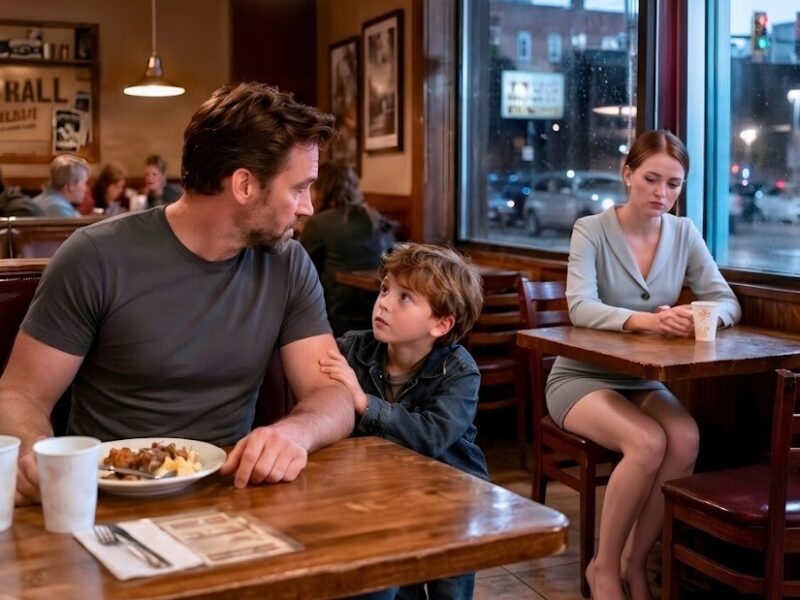
“Dad, Can She Eat With Us?” The Boy Asked—Then the Single Dad Stood Up and Did The Unexpected
Part 1: The Measurement at Mason’s
The rain had thinned to a slow, persistent drizzle by the time Ryan Carter pulled his gray truck into the gravel lot outside Mason’s Diner on a Tuesday evening. He killed the engine and sat in the dark for two seconds—a habit born of long years, taking those brief moments to switch off his mind as a commercial real estate broker and prepare for whatever came after the workday. Beside him, nineteen-year-old Noah unbuckled his seatbelt with a quiet sigh. Noah was lean, slow-spoken, and home from his second year of college, still occupying his old bedroom because rent in town was higher than common sense allowed.
They had been coming to Mason’s once a week for nearly six years. They started the habit right after the funeral, when their own kitchen stopped feeling like a place where two people could sit down and eat a meal without feeling the hollow weight of a missing chair.
Inside, the diner smelled of burnt coffee, grease, and seared onions. The vinyl booth by the front window was open, as it usually was on weeknights. Ryan slid into it with the practiced ease of a regular. He ordered the meatloaf without looking at the plastic-laminated menu, and Noah asked the waitress for the same.
At forty-seven, Ryan ran a small commercial real estate firm two towns over—nothing flashy, but steady, built on twelve years of meticulous contracts and a rigid habit of never owing anyone a favor. He balanced his business ledgers every Sunday night and refused to leave a problem unfixed past midnight. People in his office called him fair, but nobody ever called him warm. Ryan had decided long ago that warmth and clarity rarely fit in the same room, and clarity paid the mortgage.
Noah saw her first. She was sitting at a two-top near the back wall where the lighting was poorest. Her posture made it obvious she had chosen the seat specifically because it was dark. Her brown hair was pulled into a loose knot that had frayed over the course of a long day. In front of her sat a single bowl of chicken noodle soup and a glass of tap water. Nothing else. She held her spoon carefully, the way a person holds something they are trying desperately to make last.
“Don’t look right away,” Noah murmured, leaning over his water glass. “The woman behind you. Two tables back.”
Ryan waited half a minute, then reached casually for the salt shaker, letting his eyes drift past her without lingering. He saw what Noah had seen: the thinness of the meal, the way her purse was tucked tight against her hip like someone who had learned not to set things down, and a deep, bone-weary exhaustion that went far beyond needing sleep. He had seen his late wife wear that exact same look during the months they were figuring out how to pay for medical treatments without losing the house.
“She was already at that table when we pulled into the lot,” Noah said softly. “I watched her through the window. She hasn’t ordered anything else.”
Ryan took a slow sip of his water, keeping his voice level. “She came in to get out of the rain.”
“Maybe she didn’t come in for the rain, Dad,” Noah said. “You know she didn’t.”
Ryan didn’t answer. He turned his fork over once and set it back on the paper napkin. A part of him wanted to do what he always did in situations like this: nothing. Not because he lacked empathy, but because caring without thinking things through was how a man got dragged into other people’s complicated lives. He had built his entire adult life on a strict principle—you helped your own, and you left strangers their privacy. That was the line. That was how a man kept his head above water.
The waitress stopped by the woman’s table and asked if she wanted a pie slice or a coffee refill. The woman shook her head and gave a polite, strained smile—the kind of smile that meant the answer had been decided long before the question was asked. Ryan watched her hand reach briefly toward the side pocket of her purse, then pull back empty, as if she had checked a wallet she already knew was bare. She returned to her soup, dipping her spoon even more slowly now because the bowl was nearly empty.
Noah set his glass down on the Formica table with a soft thud. He looked his father straight in the eyes.
“Dad,” Noah asked, his voice dropping low. “Can she eat with us?”
The question hung in the air between them, heavy and sharp. Ryan felt a sudden tight knot in his chest. He knew his son. He knew that when Noah asked something that quietly, it wasn’t a casual request; it was a measurement. Noah was watching to see what kind of man his father was when no one important was looking. Ryan had spent years trying to be a man his son could respect, and he couldn’t afford to fail the test now over the price of a diner dinner.
“It’s not that simple,” Ryan said, keeping his face entirely still.
“It’s a meal,” Noah replied, his tone gentle but unyielding. “It’s not complicated.”
“You don’t know her situation,” Ryan said.
“That’s why I’m asking,” Noah said.
Ryan let out a slow breath through his nose. The analytical part of his brain—the part that had steered his business through a brutal recession without missing a single payroll—began running through the angles. She might be embarrassed. She might feel insulted. She might think he was hitting on her, or worse, she might see it as condescending charity. There were eight ways this could go wrong, and only one way it could go right. That wasn’t the kind of math he usually staked anything on.
But Noah was still watching him, and across the room, the woman was tilting her bowl, scraping the very last spoonful of broth from the bottom. In another sixty seconds, she would set her spoon down, pay her small bill, and walk out into the cold drizzle.
Whatever Ryan was going to do, he had less time to decide than he wanted.
“Wait here,” Ryan said suddenly.
He stood up from the booth. He didn’t smooth his jacket or pause to think. He simply stepped out into the aisle and began walking toward the back of the diner. Across the room, the woman noticed his approach, and her shoulders visibly tightened as her green eyes locked onto his.
Part 2: The Line in the Sand
As Ryan crossed the linoleum floor, the diner carried on around him—forks scraping plates, low country music filtering through the kitchen pass, a man two booths down laughing at something on his phone. Nobody paid him any mind. He walked with his hands loose at his sides, adopting the posture he used when entering high-stakes business negotiations, though he was painfully aware that this was no business deal.
He stopped a polite three feet from her table. Up close, her eyes were a tired, guarded green.
“Ma’am,” Ryan said, keeping his tone soft and non-threatening. “I’m sorry to bother you.”
She didn’t speak immediately. She just sat there, waiting, her hand resting over her purse.
“My name is Ryan Carter,” he continued, gesturing vaguely over his shoulder. “I’m sitting over there with my son, Noah. We were about to order our dinner. I noticed you were just finishing up, and… well, we’d like to buy you a real meal. We’d like it if you’d come sit with us.”
She studied his face for a long, heavy moment. The guard in her eyes didn’t drop; it flared up tighter.
“That’s kind of you,” she said, her voice dry and thin. “But I’m fine.”
“I’m sure you are,” Ryan said steadily. “I’m not asking because I think you aren’t.”
Her response came back faster and harder than he anticipated. “Then why are you asking?”
The sharp question caught him off guard. He had expected either a quick acceptance or a polite, embarrassed refusal. He hadn’t expected her to demand an accounting of his motives. She wasn’t going to take the easy out. She wanted to know what he expected to get from her.
“Because my son asked me to,” Ryan admitted truthfully. “And he was right to ask.”
The woman looked past Ryan’s shoulder toward the window booth. Noah didn’t smile, nor did he put on an act of performative pity. He simply met her eyes across the room with a calm, honest gaze. Whatever she saw in the boy’s face seemed to do what Ryan’s polished words could not.
She looked back up at Ryan. “My name is Emily,” she said. “Emily Hayes.”
“Emily,” Ryan repeated with a brief nod. “It’s just dinner. No strings. You can leave whenever you want.”
Emily looked down at her empty soup bowl, then toward the rainy glass door, and finally back at him. He could practically see her running the exact same risk assessment he had conducted a minute prior, except her math involved different stakes, different vulnerabilities, and things she couldn’t afford to lose.
“I’ll pay for my own,” Emily stated firmly.
Ryan shook his head. “That’s not the offer.”
“It’s the only offer I’ll accept,” she said without an ounce of hesitation.
Ryan almost pushed back. The instinct of a man accustomed to footing the bill and controlling the room urged him to insist. But Noah was watching from the booth, and something in Emily’s steady, quiet voice made it clear that this wasn’t empty pride. This was a boundary she had drawn during very hard times, and she wasn’t going to erase it for a stranger in a dry coat.
“All right,” Ryan conceded. “You pay for your own. Come sit with us.”
She hesitated for one more second, then gathered her purse, tucked it under her arm, and stood up. Ryan led the way back to the booth. Behind him, her footsteps were light and careful, trying not to draw any attention.
When they reached the table, Noah quickly slid over against the window to make room. Emily sat down across from Ryan, keeping her purse firmly on her lap with both hands rested on top of it. She picked up the plastic menu, reading it with the focused intensity of someone who hadn’t allowed herself to glance at options in a very long time.
Ryan watched her and felt, for the first time in years, that he had stepped past a line he had spent a lifetime reinforcing. He didn’t know what lay on the other side of that line. He only knew that his son had asked him a question, and the answer he had given could no longer be undone.
When the waitress returned, Emily ordered a grilled cheese sandwich and a small tomato soup—the cheapest warm meal listed on the menu. Before the waitress could even turn away, Emily laid a crisp, creased twenty-dollar bill on the edge of the table.
Ryan saw the bill and kept his mouth shut. Noah saw it too and gave his father a subtle nod, warning him not to argue.
The dinner passed in relative quiet. Emily answered questions in short, economical sentences. She kept her purse on her lap the entire time, eating her sandwich with deliberate, slow bites. When the check arrived, she slid her twenty across the table to cover her portion without ceremony, refusing to wait for change.
She stood up before either of them had finished their coffee. “Thank you,” she said softly—a phrase that sat somewhere in the delicate space between genuine gratitude and a firm warning.
Ryan watched her through the diner window as she stepped out into the cold parking lot. Instead of walking toward the rows of parked cars, she turned left on foot, pulling her light coat tight around her shoulders against the rain.
Noah watched her vanish into the dark stretch of the road. “She walked here,” he said quietly.
Ryan set his paper napkin on his plate. He understood what his son meant without needing another word.
For the next three weeks, Ryan tried not to think about Emily Hayes. He threw himself into his work, reviewing lease agreements and managing client portfolios. Yet, no matter how hard he tried to lock the thought away, her face kept returning to him—the tired green eyes, the creased twenty-dollar bill, the proud posture of a woman refusing to be saved.
And then, on a bright Saturday morning a month later, he ran into her again.
He was standing in the plumbing and paint aisle of the local hardware store, picking up air filters, when he saw her. She was holding a small notebook, staring at two cans of paint primer on the bottom shelf—weighing the price of the cheap brand against the price of an even cheaper brand.
She looked up when his boots crunched on the dusty floorboards. The moment she recognized him, her shoulders instinctively tightened, as if she had been caught doing something she shouldn’t.
“Mr. Carter,” she said, her voice defensive.
“Ryan,” he corrected gently. He looked down at the paint cans in her hands, then back at her face. “Doing some painting?”
Emily set one of the cans back onto the shelf with a metallic clink. “The bathroom in my apartment has water damage,” she explained, her voice flat. “The property manager said I could fix it myself or wait six months for his crew to get to it.”
Ryan could hear the unspoken math behind her words—the painful arithmetic of a woman choosing to spend forty dollars she didn’t have just so she wouldn’t have to spend the next half-year staring at black mold and peeling drywall.
The automatic instinct rose up in Ryan like a flood. He almost offered to send over one of his firm’s maintenance contractors. He almost said he knew a guy who could patch and paint the whole room in an hour for free. The offer was right on the tip of his tongue, well-meaning and ready to launch.
Then he remembered the creased twenty-dollar bill sitting on the diner table, and he forced his mouth shut.
Part 3: The Quiet Invasions
“It’s a good brand,” Ryan said instead, gesturing toward the cheaper can of primer. “I’ve used it on a few of my commercial rental properties. It holds up well against moisture.”
Emily looked at him carefully, her green eyes searching his face to see if his comment was mere politeness or a subtle insult. Finding no condescension in his eyes, she relaxed her shoulders just a fraction.
“Thanks,” she said.
They stood together in the aisle for a moment longer than was entirely natural. Then, as if she couldn’t stop the words from spilling out, Emily spoke again. “My mother has been sick for a while now. She’s in an assisted living facility on the south side of town. I’m the only one looking after her.”
She didn’t elaborate, and Ryan understood that the sentence wasn’t a plea for help. It was a piece of her life she had placed carefully on the ground between them—a key set down on a counter to prove she had nothing hidden in her hands.
“I’m sorry to hear that,” Ryan replied gently. It was the only response he could offer that didn’t overstep her boundary.
After that Saturday, they began running into each other with uncanny frequency. They met at the grocery store near the bargain produce rack, at the laundromat on Tuesday evenings, and near the bus stop by her apartment building. None of these encounters were planned, but Ryan realized he had stopped avoiding those places. He knew the rhythm of the small town, and he had unconsciously adjusted his own routine to match hers.
He didn’t call it intention. He didn’t call it anything at all.
Noah was the one who finally brought it into the light. They were driving home from Mason’s one Friday night after a quiet dinner when Noah reached over and turned down the truck radio.
“You keep finding her,” Noah remarked, looking out the passenger window.
Ryan kept his eyes glued to the dark road ahead. “It’s a small town, Noah.”
“Sure,” Noah said softly. “It’s a small town.”
There was no accusation in the boy’s voice, but there was no agreement either. Ryan found himself pressing down on the brake pedal a little harder than necessary at the next stop sign.
The fourth time they saw Emily at Mason’s, she was standing near the register waiting for a takeout order. Noah immediately stood up from their booth and waved her over. She walked over with her usual guarded step, but this time, when Noah invited her to sit, she didn’t refuse. She sat down, ordered a bowl of soup, and laid her money on the table.
Noah handled most of the conversation that evening. He asked her about the paperback book tucked under her arm, the route she walked to work, and whether she had seen the meteor shower the previous weekend. He kept the mood light and easy. By the time the meal ended, Emily had laughed once—a short, quiet sound that seemed to surprise even her. The waitress, noticing the shift, brought Emily a water refill without being asked.
Bit by bit, Emily began letting them in.
She revealed that she worked two jobs: answering phones at a dental office in the mornings, and cleaning a small medical building near the highway late at night. She explained that her mother’s care facility was raising its monthly rates, making it nearly impossible to keep up. She spoke without an ounce of bitterness, stating the brutal financial facts as if she were simply reading a weather report.
She never mentioned how close she had come to being evicted back in February, but Ryan pieced it together from a passing remark about her landlord and the way her hand froze on her coffee cup when she mentioned back rent.
The first real crack in their fragile dynamic appeared on a rainy Wednesday.
They were eating dinner at the diner when a man in a tailored navy suit stopped by their booth on his way out. The man clapped Ryan heavily on the shoulder.
“Ryan! Excellent work on the Henderson deal,” the man said loudly. “Closing on that whole commercial block was a massive win for your firm.”
Ryan offered a polite, brief response—the kind of standard corporate pleasantry he delivered a hundred times a year—and the man walked away.
When Ryan looked back at the table, Emily had set her spoon down. The warmth that had been slowly building between them over the past few weeks vanished instantly.
“Whole block,” Emily repeated softly.
Ryan kept his voice steady. “It’s commercial real estate. It’s what my firm does.”
Emily gave a slow, cold nod. “I know what you do. You told me you ran a small firm.”
Her tone wasn’t angry; it was far worse. It was the tone of a person who had just realized she had misread a situation entirely.
“I do run a small firm,” Ryan explained. “Seven employees. The Henderson property was a unique deal.”
Emily looked at him for a long, uncomfortable moment. “Right,” she said quietly, picking up her spoon and returning to her soup.
The dinner continued, but the air at the table had turned icy. After that night, Emily’s guards went back up with a vengeance. She started paying for her food the second it arrived at the table. She flatly refused the rides Ryan offered when it rained, insisting on walking to the bus stop. She used the word “fine” to answer every question.
Ryan, who had spent twenty years reading the subtle shifts of people across negotiation tables, recognized exactly what she was doing. And he decided to ignore it.
Because somewhere along the way, Ryan had made up his mind: he was going to fix her life, whether she wanted him to or not.
He didn’t tell Noah. He didn’t tell anyone. He simply began operating in the dark.
The first thing he targeted was her rent. Emily had mentioned that her landlord agreed to waive a late fee from January if she stayed current for the rest of the year. On Monday morning, Ryan called the property management company. Using his firm’s account, he paid off her late fee anonymously and instructed the receptionist not to reveal where the money had come from.
“Are you sure about this?” the receptionist asked, hesitating.
“I’m sure,” Ryan said in the authoritative tone people rarely questioned. “Just mark her ledger clear.”
When he hung up the phone, he felt no guilt whatsoever. He felt useful—a feeling he trusted far more than emotion.
Next, he went after her employment. A long-time business associate named Margaret ran a prosperous accounting firm in the neighboring town and had been searching for an administrative assistant. Ryan called Margaret, described Emily’s work ethic without giving her name, and urged her to hire her.
“Pay her well, Margaret,” Ryan insisted over the phone. “Treat her like any other employee, but whatever you do, do not tell her I called you.”
Margaret chuckled softly over the line. “Ryan, I haven’t heard you sound this invested in a person in ten years. What’s going on?”
“Just do it as a favor to me,” Ryan said, ignoring the question.
The third intervention was the largest. Emily mentioned in passing that her mother’s care facility was implementing another rate hike, and that her mother was talking about moving back into Emily’s tiny one-bedroom apartment to save money.
The next morning, Ryan called the billing department of the assisted living facility. He arranged to anonymously pay the difference between the old rate and the new rate for the next twelve months, setting up an automatic monthly transfer from his private bank account.
“We see donor arrangements like this occasionally,” the billing officer told him. “We can keep your name entirely off the statements.”
“Good,” Ryan said. “Keep it clean.”
For three weeks, Ryan’s secret plan worked like a charm. Emily landed the job at Margaret’s accounting office, quitting her late-night cleaning gig. She came to dinner at Mason’s one Friday night with a rare, bright smile, telling Ryan and Noah about her new position. Ryan ate his meatloaf, smiled back, and told her he was happy for her.
He told himself that her happiness justified the deception.
Across the table, Noah watched his father silently, his eyes dark with unspoken concern.
Then, on a Sunday afternoon, Emily called Ryan’s cell phone, her voice trembling with relief. She told him that the care facility had suddenly contacted her to announce that an “internal policy adjustment” had cleared her mother’s rate hike.
“I can’t believe it, Ryan,” she said, her voice cracking slightly over the line. “It’s like a weight has been lifted off my chest.”
“That’s incredible news, Emily,” Ryan lied smoothly, adopting a tone of pleasant surprise. “I’m really glad to hear it.”
He hung up the phone convinced he had pulled off a masterclass in quiet generosity. He was a man who had spent his career closing complex real estate deals in silence, and he had come to mistake stealth for kindness.
He had no idea that his arrogance was about to destroy everything.
Part 4: The Unraveling at the Booth
The collapse happened on a Thursday evening, born from a administrative mistake so small it was almost laughably absurd.
The billing department at the assisted living facility sent out its quarterly donor acknowledgment letters. A automated form letter was mailed to Emily as her mother’s primary family contact. The letter expressed gratitude for the facility’s ongoing operations and, near the bottom, listed a specific dollar amount contributed on her mother’s behalf by a “private donor.”
When Emily read the letter at her small kitchen table, the exact dollar figure hit her like a physical blow. It matched a figure Ryan had mentioned weeks ago when describing a charitable tax deduction his real estate firm made every quarter.
She didn’t need a detective to solve the puzzle. She had spent her entire adult life learning to recognize the specific shape of conditional help, and this help bore Ryan Carter’s exact fingerprints.
She didn’t call his phone. She didn’t text him.
She went straight to Mason’s Diner on Friday night, arriving an hour earlier than usual. When Ryan and Noah walked through the door at seven o’clock, she was already sitting in their usual window booth, waiting for them.
The moment Ryan saw her face, his stomach dropped into a cold abyss. The exhaustion was gone from her eyes, replaced by a hard, searing fury.
Ryan and Noah slid into the booth. Emily didn’t raise her voice. She didn’t need to. The diner was packed with weekend customers, the air thick with the noise of clattering silverware, loud chatter, and jukebox music.
“I want to ask you something,” Emily said, her voice terrifyingly flat. “And I want a straight answer.”
Ryan set his truck keys on the table with a soft clatter. “All right.”
She slid the facility’s letter across the Formica table, pointing a finger at the printed dollar amount. “Was this you?”
Ryan looked at the paper. For a fraction of a second, his instincts yelled at him to deny it, to fabricate a story about a hospital grant or a state subsidy. But the half-second pause was all the confession she needed.
“Yes,” Ryan admitted quietly.
Emily gave a slow, deliberate nod, as if confirming a tragic truth she had suspected for weeks.
“The late fee on my apartment rent back in February,” she continued, her voice unwavering. “Was that you?”
“Yes,” Ryan said.
“The job at Margaret’s accounting firm?”
“I made a phone call,” Ryan confessed, looking down at the table. “Margaret made the hiring decision. You earned the job on your own merit, Emily.”
“But I wouldn’t have even been in the room if you hadn’t pulled the strings,” she countered instantly.
Ryan had no answer for that. He sat paralyzed under her gaze.
Emily looked at Noah for a brief moment, her expression softening slightly at the sight of the boy’s distressed face, before turning her icy green eyes back to Ryan.
“I told you on the very first night we met that I would pay my own way,” Emily said, her words slicing through the noise of the diner like a blade. “Do you remember that?”
“I remember,” Ryan whispered.
“I gave you my boundary,” she said, her voice dropping lower, vibrating with intense emotion. “And you decided that my boundary didn’t apply to the parts of my life I wasn’t looking at.”
“I was just trying to help you, Emily,” Ryan said, desperation creeping into his tone.
“I know,” Emily replied, her voice breaking slightly. “And that’s what makes it so much worse.”
She grabbed her purse from the seat. A waitress approached the booth holding menus, but Emily held up a single finger, and the waitress quickly backed away. Emily slid out of the vinyl booth and stood in the aisle, looking down at him.
“You didn’t give me a meal that night, Ryan,” Emily said, her eyes burning with tears she refused to let fall. “You wrote a story in your head where I was a helpless victim who needed saving. And the worst part is, I didn’t even get to read the story before you showed it to everyone else.”
“Emily, please…” Ryan started, reaching toward her hand.
She shook her head sharply, stepping out of his reach. “I was surviving, Ryan. I was handling my life, piece by piece. And every time you secretly stepped in, you took a little bit of my dignity away from me.”
She paused, taking a ragged breath. “And it didn’t mean anything to you… because it cost you nothing.”
She didn’t slam the door when she walked out into the night. She simply pushed it open and vanished into the darkness.
Inside the diner, the jukebox transitioned to a new country song. Across the table, Noah stared at his father. For the first time in his life, Ryan couldn’t read the expression on his son’s face.
Ryan looked down at his own hands resting flat on the table—holding onto the empty air where his control used to sit.
The drive home was suffocatingly quiet. Ryan kept both hands glued to the steering wheel, while Noah stared out the passenger window at the passing streetlights.
They were turning onto their residential street when Noah finally spoke.
“Dad,” Noah said, his voice quiet and level. “Did you actually help her, or did you just make her feel worse?”
Ryan didn’t answer. The question wasn’t meant to be answered aloud; it was meant to be carried like a stone in his chest.
That night, after Noah went upstairs to his bedroom, Ryan sat alone in his dark living room for hours. He thought about Emily’s scorching words. He thought about his own arrogance, his obsession with control, and his habit of treating human beings like real estate problems to be solved.
And then, his mind drifted back to his late wife.
He remembered the final year of her illness, when he had taken over every single aspect of her life—managing the bills, scheduling the doctors, making every decision without consulting her. He remembered how she had looked at him from her hospital bed one evening, her voice weak and tired.
“You’re so good at taking over, Ryan,” she had whispered back then. “I almost can’t tell which parts of my life are still mine.”
At the time, Ryan had taken it as a compliment. Now, sitting alone in the dark, he finally understood the terrible truth: he had been erasing the people he loved for years, calling it kindness.
Part 5: Dismantling the Engine
For the next three weeks, Ryan lived in a state of quiet, agonizing self-reflection. He didn’t call Emily. He didn’t drive past her apartment building or the laundromat. When Friday night arrived, he and Noah went to Mason’s Diner alone, sitting in their usual window booth in complete silence.
When their regular waitress asked if “their friend” would be joining them, Ryan simply shook his head and said, “Not tonight.”
During those three weeks, Ryan realized that fixing his mistake wasn’t going to be as simple as apologizing. He needed to undo the hidden control he had built around her life.
His first call was to Margaret at the accounting office. He sat at his mahogany desk in his office, took a deep breath, and laid out the entire truth—confessing that he had pushed Margaret to hire Emily to satisfy his own savior complex.
“I wanted you to know,” Ryan said, his voice flat. “If you hired her just to do me a favor, you can let her go. She deserves to know where she stands.”
Margaret was silent on the line for a long moment. Then, she let out a soft sigh.
“Ryan, listen to me,” Margaret said firmly. “Emily is the most meticulous, hardworking assistant I’ve hired in five years. Whatever selfish reason you had for introducing us, she earned this job on her own merit. She stays.”
A heavy knot in Ryan’s chest loosened slightly. “Thank you, Margaret.”
Next, he called the billing office at the assisted living facility. He instructed them to immediately terminate his monthly donor contributions at the end of the current billing cycle. He demanded that they remove his name entirely from their records and cease sending any letters regarding private donations.
Finally, he called Emily’s property manager.
“If Emily Hayes is ever late on her rent again,” Ryan said into the phone, “do not accept money from me or anyone else unless she explicitly hands you my contact info herself.”
The property manager—a tired woman who dealt with landlord disputes all day—sounded baffled. “Let me get this straight. You’re calling me to take away a favor?”
“Yes,” Ryan said firmly. “I had no right to step in.”
He didn’t contact Emily to tell her what he had done. He didn’t send a text boasting about his newfound humility. He understood, finally, that real change wasn’t about seeking forgiveness or looking like the good guy; it was about stepping back and letting people own their lives.
Four weeks after the blowout at the diner, Ryan ran into Emily at the local grocery store.
She was standing in the produce section, holding a bag of long-grain rice, studying the nutrition label the same way she had once studied the prices of paint primer.
When she looked up and saw him standing at the end of the aisle, her shoulders instantly tensed. The guard returned to her face, though it seemed less like an attack and more like a heavy coat she was forced to wear.
Ryan stopped ten feet away. He kept his hands in his pockets and made no move to bridge the gap between them.
“Emily,” Ryan said, his voice quiet and respectful. “I’m not here to bother you. I just wanted to say… I heard you. That night at the diner, I really heard what you said.”
Emily stood frozen, holding the bag of rice against her chest. She didn’t offer a dramatic response. She simply looked at him, searching his face for any sign of his old arrogance.
“All right,” she said softly.
Ryan gave her a brief nod, turned on his heel, and began walking toward the exit.
“Ryan,” her voice called out behind him.
He stopped and turned back. Emily was looking down at the rice in her hands, her expression unreadable.
“If I ever need help,” Emily said, her tone absolute and clear, “I will ask for it. Until then, please just be a person I see sometimes.”
Ryan looked at her, understanding the profound weight of her condition.
“All right,” Ryan answered.
It was the only answer that respected her dignity, and he gave it back to her without reservation.
Part 6: The Broken Sedan
Two months passed.
The rainy season returned to the valley, painting the town in slick shades of gray and blue. Ryan kept his word. He saw Emily occasionally—at the hardware store, at the gas station, across the street near the bank. When their eyes met, he offered a polite nod, she offered a small nod in return, and they both moved on with their days.
Then, on a stormy Sunday afternoon, Ryan’s cell phone rang while he was sitting at his kitchen table reading the paper.
He looked at the caller ID. It was an unfamiliar number. He swiped the screen and pressed the phone to his ear.
“Hello?” Ryan said.
“Ryan?” Emily’s voice came through the speaker, accompanied by the heavy sound of rain hammering against metal and the swoosh of passing highway traffic. “It’s Emily.”
Ryan sat up straight, his instincts instantly sharpening. “Emily. Are you okay?”
“My car broke down,” she said. Her voice was strained, but completely composed. “The sedan finally gave out on Route 9, about two miles outside of town. The alternator died.”
Ryan reached for his truck keys on the counter. “I can call a tow truck for you—”
“No,” Emily interrupted firmly, stopping him in his tracks. “I’m not calling you to fix my car, Ryan. And I don’t want you to pay a mechanic.”
Ryan paused, holding his breath, waiting for her terms.
“I am calling to ask if you can give me a ride home,” she said, her voice dropping into a quiet, vulnerable register. “That’s all I’m asking for. A ride.”
A wave of profound relief and respect washed over Ryan. She was asking on her own terms, holding the reins of her own life.
“I’ll be there in fifteen minutes,” Ryan said.
He drove his truck out onto the rain-slicked highway, finding her fourteen-year-old sedan pulled onto the muddy shoulder. Emily was sitting inside with the hazard lights blinking weakly.
Ryan pulled up behind her, popped open his passenger door, and held an umbrella over her as she climbed into the warm cab. She smelled of rain and cold air.
The drive back to her apartment building was quiet, but it was a comfortable, peaceful quiet—entirely different from the icy silence that had plagued them weeks ago. Ryan kept his hands on the wheel, drove at a safe speed, and refrained from making any grand declarations or offers to pay for auto repairs.
When he pulled up to the curb outside her apartment, Emily reached for the door handle. She paused, turning to face him.
“Thank you, Ryan,” she said softly.
Ryan met her green eyes, offering her a warm, genuine smile. “Anytime you ask, Emily.”
She smiled back—a real, unreserved smile that reached her eyes—and stepped out into the rain.
After that Sunday, the walls between them began to dissolve naturally. Emily started joining Ryan and Noah at Mason’s Diner again. She didn’t come every week, but she came often enough that her presence felt natural.
Every single time they ate together, Emily laid her money on the table to pay for her meal. And Ryan never argued. He had finally learned that the creased twenty-dollar bill she laid down wasn’t a display of stubborn pride; it was the price of admission to sit at the table as an equal, and he had no right to take that away from her.
Part 7: The Room at the Table
Almost a year to the day after Ryan had first approached Emily’s dark corner table, the three of them were sitting together in the exact same window booth at Mason’s Diner on a rainy Tuesday evening.
The rain was thinning to a slow drizzle outside, mirroring the weather from twelve months prior. The diner was humming with activity—clattering plates, sizzling grill onions, and low music playing from the kitchen speakers.
The glass front door chimed as a new customer walked in.
It was a young woman, no older than twenty-five, wearing a soaked coat. She walked timidly toward the back wall, choosing the small two-top in the darkest corner of the room—the seat where the overhead light was burned out. She sat down, pulled her wet purse tight against her hip, and ordered a single bowl of vegetable soup from the waitress.
She held her spoon tightly, dipping it into the broth with careful, slow movements, trying to make the small meal last as long as humanly possible.
Noah saw her first. He paused mid-bite, looking across the booth at his father. This time, Noah didn’t lower his voice or act like he was hiding a secret.
“Dad,” Noah said clearly, gesturing subtly toward the back wall. “Can she eat with us?”
Ryan looked across the room at the young woman sitting alone in the dark corner. Then, he looked at Emily, who was sitting across from him.
Emily had already noticed the woman. She was watching her with deep, knowing eyes—the eyes of someone who had once occupied that exact dark seat, clutching a purse and counting pennies.
A year ago, Ryan would have jumped up from the booth alone. He would have walked across the floor like a corporate executive closing a deal, offering condescending charity to feel good about himself.
He didn’t do that tonight.
Ryan set his fork down on his napkin. He looked at Noah, then at Emily, offering them both a calm, steady smile.
“Let’s ask her,” Ryan said softly. “All three of us.”
Emily looked at Ryan, and the last remaining shadow of guard in her face vanished completely, replaced by a soft, beautiful warmth.
They stood up together—Ryan, Noah, and Emily—and walked across the linoleum floor as equals. They didn’t walk with the grand posture of rescuers bringing an unwanted favor. They walked like ordinary people sharing a quiet evening.
When they reached the dark table in the corner, the young woman looked up, her tired eyes filled with the same guarded, cautious fear Ryan had seen a year ago.
Ryan stopped a respectful distance away, smiled gently, and gestured toward their bright booth by the window.
“Excuse me, ma’am,” Ryan said softly, his voice devoid of pity, carrying only simple, human respect. “There’s plenty of room at our table if you’d like to join us. You order whatever you want, and we’ll just share the company.”
The young woman looked at Ryan, then at Noah, and finally at Emily.
Emily offered her a gentle, knowing nod. “Come sit with us,” Emily said softly. “The food tastes better over there.”
The young woman looked at the three of them, the fear in her eyes slowly melting away into quiet relief. She gathered her purse, stood up from the dark corner, and walked with them toward the light.