Healing the Ghost of the Underworld: A Contract Signed in Blood
Part 1: The Anatomy of a Threat
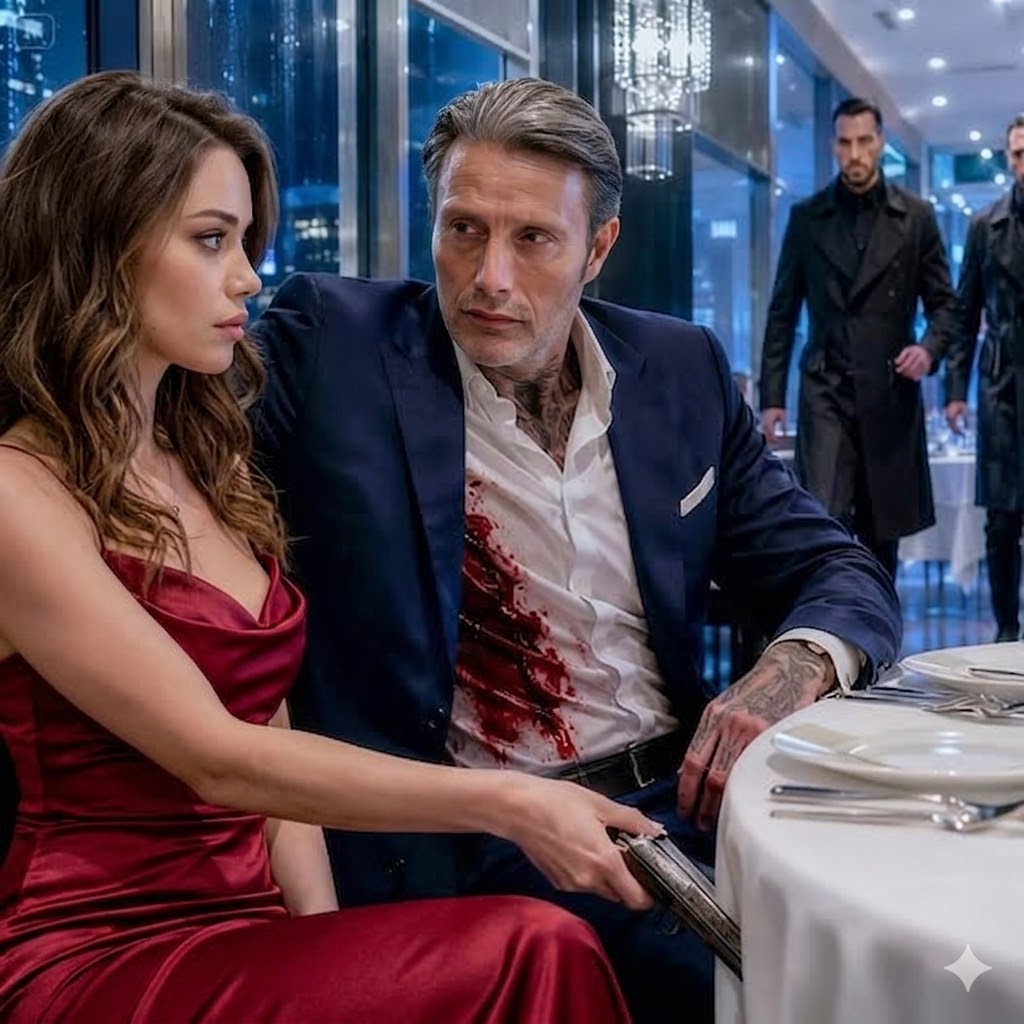
The night should have ended with an awkward goodbye, an overpriced check, and Genevieve Caldwell promising herself she would never let her sister set her up again. Instead, it ended with a bleeding mafia boss sliding into her booth, rival hitmen closing in from across the dining room, and Genevieve calmly reaching into her Hermès bag to hand him the one thing everyone believed was gone forever: his own stolen weapon.
Most people would have screamed. Genevieve did not. She did not freeze. She did not gasp. She did not make a scene in the middle of Le Bernardin, one of Manhattan’s most polished, expensive, untouchable restaurants, where even panic seemed expected to arrive in a tailored jacket and speak in a whisper. She simply looked at the man bleeding beside her, looked at the three predators hunting him from the front of the room, and decided the evening had finally become interesting.
Before that moment, the most dangerous thing at the table had been Richard Element’s ego. Richard had spent the evening making absolutely sure Genevieve understood how expensive everything was. The tasting menu. The wine. The reservation. He had mentioned the cost before the second course arrived. Then he had mentioned it again. With the proud little smile of a man who thought money was a personality, he had made sure she knew the evening was costing him approximately eight hundred dollars.
Genevieve had listened with the serene expression of a woman who had survived far more frightening men than a finance bro with slicked-back hair and a Rolex Submariner he kept angling toward the candlelight. Richard talked about offshore crypto portfolios. He talked about his recent real estate acquisitions in the Hamptons. He talked about contractors, marble, leverage, supply chains, and all the ways he believed successful men were supposed to dominate everyone beneath them.
Genevieve took a slow sip of her Caymus Special Selection Cabernet and let the rich, dark notes settle on her tongue while her mind drifted far away. On paper, she was a senior appraiser at Cromwell and Hayes, a discreet boutique auction house on the Upper East Side. To the respectable world, Genevieve handled rare antiquities. She authenticated pieces. She appraised private collections. She spoke gently to widows with inherited paintings and sternly to heirs who believed every dusty vase in a grandfather’s library was priceless.
But the respectable world was only half the truth. The other half lived under the city, behind private doors, in back rooms where people paid in cash and favors and threats. In that world, Genevieve Caldwell was not merely an appraiser. She was the woman who could tell you whether a diamond was clean or soaked in blood. She could look at a stolen Renaissance painting and know not only its value, but how quickly it could move and who would be desperate enough to buy it. She knew which antiques had been looted. She knew which families had private vaults. She knew what people hid when police, creditors, wives, husbands, and governments came looking. Most importantly, she knew how to keep her mouth shut.
That skill had made her valuable. It had also kept her alive. But tonight, Genevieve was not trying to negotiate with syndicates or smugglers; tonight, she was trying to survive a blind date arranged by her well-meaning, catastrophically oblivious sister.
Across from her, Richard cut into his seared tuna like he was punishing it. “So I told the contractor,” he said, pleased with himself before the sentence had even finished, “if the marble isn’t imported directly from Carrara, I’m pulling the funding.” He scoffed, as if the very idea of compromise offended him. “You have to show these people who holds the leash. You know, Jen.”
Genevieve’s eyes lifted from her wine glass. “It’s Genevieve,” she said softly.
There was no anger in her voice. No visible irritation. Just a cool, even correction, delivered with the calm precision of a blade being placed on a table. Richard barely registered it. He was already preparing to launch into another speech. Then the restaurant changed. Not loudly. Places like Le Bernardin did not erupt. They tightened.
The noise dipped. Forks still touched porcelain. Voices still murmured. But the easy rhythm of the dining room faltered, as though everyone had taken half a breath and forgotten to release it. Genevieve noticed immediately. Her eyes shifted toward the entrance. The maître d’ had taken one nervous step back. That was the first sign. The second was the three men who had just entered. They wore dark, heavy trench coats despite the mild October weather. Their eyes moved across the dining room with cold intent, not curiosity. Genevieve’s gaze caught the tattoo peeking from the collar of the lead man: a jagged crown. The Calabresi faction. Brooklyn. Ruthless.
Genevieve’s pulse rose by the smallest fraction. Her hands stayed folded on the white tablecloth. Richard did not notice anything. He was currently explaining the intricacies of tax-exempt property trusts.
“Richard,” Genevieve said, her voice dropping into a tone that was suddenly, sharply authoritative. “Look at the entrance. Do not turn your head. Just look.”
Richard blinked, annoyed. “What? Is there a celebrity?”
“The men in the trench coats. The one with the crown tattoo on his neck. Don’t look at them again.”
Richard finally glanced up. His face went pale. “Who… who are they?”
“The people who just bought your debt,” Genevieve whispered. “And they aren’t here for a table.”
Suddenly, the man bleeding beside the booth slumped. He hadn’t just appeared; he had materialized from the shadows of the nearby pillar, his hand pressed firmly against his side, his face a mask of gray agony. He stumbled, catching the edge of their booth, and then, without a word, he slid onto the bench seat beside Genevieve, his movements pained and frantic.
Richard gasped, his chair scraping loudly against the floor. “Hey! What are you—”
The man grabbed Richard’s lapel with surprising strength. “Shut up,” he hissed. Then, he looked at Genevieve. His eyes were dark, haunted, and rimmed with blood. He pulled a heavy, compact pistol from his waistband and tucked it under his coat, his hand still gripping his side. “They’re coming,” he whispered to her, ignoring Richard entirely.
The men in the trench coats were moving faster now, pushing past a waiter who tripped and dropped a tray of water glasses. The shattering glass was the signal. The room erupted into organized, terrifying chaos.
—
Part 2: The Item in the Bag
Genevieve didn’t scream. She didn’t gasp. She watched the man beside her—the mafia boss, she realized with a start—his face tight with agony, his breathing coming in ragged, wet hitches. He was bleeding profusely. The dark stain on his coat was spreading, reaching for the white upholstery of the booth.
“You’re hit bad,” Genevieve noted, her voice as flat as if she were appraising an inkwell.
“I’m fine,” he growled, though his head lolled back against the booth’s leather.
Across the room, the three men with the crown tattoos were systematically scanning the patrons. They weren’t shooting yet; they were hunting. They moved with a military lethality that told Genevieve they didn’t care about the collateral damage—only the target.
“Richard,” Genevieve said, her eyes never leaving the gunmen. “Stand up. Walk toward the kitchen. Do not run. Do not look back.”
“What? Are you crazy? Those guys have guns!” Richard hissed, his face slick with sweat.
“I know,” Genevieve replied, her voice cooling by another degree. “That’s exactly why you need to leave. If you stay, you are simply a bullet trap.”
The man beside her let out a dry, rattling laugh. “Smart girl.”
Genevieve reached into her oversized Hermès bag. Her fingers brushed past her wallet, her makeup kit, and finally, the heavy, cold weight she kept tucked into a false-bottom lining. It was a Beretta 92FS, silver and ornate, inlaid with mother-of-pearl grips—a relic she had appraised two months ago for a private collector who had turned out to be a fence for the very people currently walking toward them. The fence had been arrested; the weapon had stayed with Genevieve, a “consultation fee” she’d kept for moments exactly like this.
She pulled it out, her movement so fluid and shielded by the tabletop that Richard didn’t even see the metal flash. She pressed the weapon into the mafia boss’s palm.
“It’s yours,” she whispered. “I know the history. You dropped it in the safe house last month when the police raid happened. It’s balanced, it’s clean, and the magazine is full.”
The man blinked at the gun, then at her, a flicker of pure shock in his dying eyes. “You?”
“I’m an appraiser,” she said simply. “I know where things end up.”
The lead gunman was now only two tables away. He held his weapon at his side, waiting for a clear line of sight. He looked at Genevieve’s booth, his eyes narrowing as he saw the movement of the man slumped beside her.
“There he is!” the gunman shouted.
The restaurant finally exploded into true terror. Screams tore through the air. The lawyer at the next table dove under his chair. The maître d’ scrambled for the phone.
Genevieve leaned into the man’s ear. “They’re ten feet away. If you don’t take the shot, we’re both corpses.”
Nikolai—for she knew the name now, the man they called the Ghost of Brooklyn—heaved himself upright. With a grunt of pain that would have felled a lesser man, he swung his body around.
*Pop-pop-pop.*
The sound was muffled, professional. The lead gunman flew backward, crashing into a dessert trolley, a spray of red painting the pristine white napkins. The other two men ducked behind a pillar, returning fire.
The air above the booth filled with flying porcelain and shattered glass. Richard had already disappeared, crawling toward the kitchen like a terrified worm, his expensive suit ruined by the grime of the floor.
Genevieve stayed where she was. She picked up her wine glass, held it out of the line of fire, and watched. She noticed the bullet hole in the wall, perfectly positioned where her head had been a second before. She didn’t flinch. She watched Nikolai, who was now leaning over the back of the booth, his eyes tracking the remaining two gunmen.
“You’re not going to make it, are you?” Genevieve asked, taking another sip of her wine. It was surprisingly good, even under these circumstances.
Nikolai looked at her, his face turning an alarming shade of gray. “I’ve been in worse spots.”
“Liar,” she countered. “You’re shock-y. Your blood pressure is crashing. You need a pressure point, not a shootout.”
“Do you have a plan, nurse?” he asked, his voice strained.
“Appraiser,” she corrected, then pointed to the tablecloth. “Rip the center of the cloth. Use it as a tourniquet for your ribs. If you keep losing blood like that, you’ll pass out before you can finish them.”
He actually followed her advice. With a grunt of pain, he tore a long strip from the tablecloth and jammed it against his side, his hands moving with the grim efficiency of someone who had stitched himself up a dozen times.
“That’s better,” she said. “Now, they’re pinned by the pillar. They expect us to stay here. They expect us to try to run for the door.”
“And?”
“And,” Genevieve said, reaching back into her bag and pulling out a small, heavy ceramic item she’d had wrapped in a silk scarf—a 17th-century decorative paperweight she had been carrying to the office. “And we give them something else to look at.”
She tossed the paperweight toward the opposite side of the room. It shattered against a wine rack with a sound like a grenade.
The gunmen swiveled toward the noise, their focus breaking.
“Now,” Genevieve said.
Nikolai didn’t hesitate. He stood up, ignored the screaming pain in his side, and leaned out.
Two more shots. Two more bodies.
The room went still. The only sound was the distant siren of an NYPD cruiser and the ragged, wet breathing of the man beside her.
—
Part 3: The Price of Silence
The police sirens were getting louder, a rhythmic wail that signaled the end of one nightmare and the beginning of another. The restaurant was a graveyard of broken glass and overturned tables. Richard Element had long since vanished, likely having called his lawyers from the safety of a pantry. Nikolai Vulov, however, was still sitting in the booth, his hand clutching the makeshift tourniquet, his face a pale mask of fading consciousness.
“You need a hospital,” Genevieve said. She was standing now, adjusting her dress, her movements as calm as if she had just finished a routine auction.
“No hospital,” Nikolai rasped. “The police… they are bought. If I go to a public hospital, I am dead before they remove the bullet.”
Genevieve looked at him. She saw the man, not the myth. She saw the sheer, grinding agony behind his eyes, and she saw the terrifying reality of his situation. He was the head of a syndicate that had been betrayed from within. He was bleeding out in a Michelin-starred restaurant, and she was the only person who knew how to save him.
“You won’t survive the night in this state,” Genevieve said. “You have a punctured lung, judging by the wet sound of your breath. You’re going to drown in your own blood.”
“Then I drown,” Nikolai said, his voice fading.
“No,” Genevieve countered, her tone sharp. “I didn’t work this hard to save you just to let you go out like a coward.”
She reached out, grabbing his good arm and hauling him upward. He was heavy, his body sagging, but she was stronger than she looked. She braced herself, taking his weight, and together they began to shuffle toward the back exit.
“The kitchen staff will call the police,” she muttered. “We have to be gone before they secure the scene.”
“Why?” Nikolai asked, his head resting heavily on her shoulder. “Why help me? You don’t know me.”
“I know what you are,” she whispered. “And I know who the Calabresi are. They’re a stain on this city. If you’re going to die, it shouldn’t be because of them.”
They stumbled out the back door into the cold Manhattan night. The alleyway was wet with trash and rain. A dark sedan was idling at the end of the block—likely Nikolai’s backup.
“Silas!” Nikolai groaned, his voice barely audible.
A man stepped out from the shadows—the same man who had walked in with the gunmen? No, she realized, this man was wearing a suit. He moved toward them with a panicked efficiency, his face tightening as he saw Nikolai’s state.
“Boss! God, boss, we had to peel off when the shooting started—”
“Get me to the safe house,” Nikolai ordered, cutting him off.
Silas grabbed Nikolai, pulling him into the sedan. He looked at Genevieve, his eyes cold and assessing. “And her?”
Nikolai grabbed Genevieve’s hand, pulling her toward the car. “She comes with us.”
“Boss, that’s a security risk—”
“She stays,” Nikolai said, his voice returning to that low, lethal growl. “She’s the only reason I’m breathing.”
Clara—no, Genevieve—hesitated. She looked at the car, then at the restaurant, then at the empty alleyway. She was a senior appraiser at an Upper East Side auction house. She had an apartment, a cat, a sister who set her up on disastrous dates, and a life she had spent years building to be perfectly ordinary. If she stepped into that car, she was leaving it all behind.
She was stepping into a world where people were fed to pigs and where the only rules were those written in blood.
But then she looked at Nikolai. He was dying. He had no one. The men who had been his soldiers were either dead or had turned on him. He was alone in a world he had conquered, and she was the only thing standing between him and the darkness.
“Get in,” Silas said, his voice impatient.
Genevieve took a breath. She looked at her ring, her nails, the simple, boring life she had cherished. Then, she stepped into the sedan.
As they sped off into the night, she realized that the most dangerous thing about the evening wasn’t the bullets. It was the fact that she didn’t want to leave.
She looked at Nikolai, who was now slumped against the window, his breathing shallow and erratic.
“I’m going to need medical supplies,” she said, pulling her phone from her bag. “And if you want to live, you’re going to listen to exactly what I tell you.”
Nikolai opened one eye, the blue ice catching the streetlights. A faint, painful smile touched his lips. “I told you, I like stubborn.”
—
Part 4: The Safe House
The safe house was a brownstone in the back alleys of Hell’s Kitchen—a place that seemed to exist outside the maps of Manhattan. It was cold, dark, and smelled of dust and old wood. Silas led them inside, the house feeling more like a bunker than a residence. He moved with a practiced, lethal efficiency, checking every room before gesturing for them to enter the living area.
“It’s secure,” Silas said, his face grim. “But we need to move the boss to the basement. It’s the only room with a reinforced door.”
They helped Nikolai down the narrow, creaking stairs. The basement was surprisingly well-equipped. It was a makeshift infirmary, complete with a surgical table, a sink, and cabinets stocked with more medical supplies than some small clinics.
“Lay him down,” Genevieve ordered.
She was back in her element. The auction house had taught her how to handle pressure, how to manage chaos, and how to spot a fake from a mile away. But this… this was different. This was life and death.
She began to strip the bandages, the blood already soaking through them. The wound was deep, the tissue around it angry and inflamed. She would have to drain the infection before she could even think about closing it.
“Silas,” she said, not looking up. “I need hot water, antiseptic, and as much clean gauze as you can find. And don’t you dare give him any more whiskey.”
Silas nodded, his eyes wide as he watched her work. She wasn’t acting like a hostage. She was acting like she owned the room.
Nikolai was drifting in and out of consciousness, his words a jumbled mess of Russian and English.
“Clara,” he muttered.
“Genevieve,” she corrected automatically, her hands moving with steady, rhythmic purpose.
“Genevieve,” he repeated, his voice softened by the drugs. “Why are you here? You could have walked away.”
She paused, her hands covered in his blood. She looked at him, his face pale, his features softened by his vulnerability.
“Because you were the only one who didn’t lie to me tonight,” she said softly.
He laughed, a dry, rasping sound. “That’s the most honest thing anyone has ever said to me.”
She worked for hours. She drained the wound, she irrigated the infection, she stitched the tissue. She was exhausted, her fingers cramped and numb, but she didn’t stop. She was a woman possessed by the need to finish what she had started.
When she was finally done, Nikolai was sleeping—a heavy, drug-induced slumber. She wiped the blood from her hands and leaned against the counter, her mind racing.
She was in a basement in Hell’s Kitchen. She was the personal nurse to the head of the Brooklyn Bratva. And she had effectively committed a crime by helping him escape the police.
There was no going back to the auction house. There was no going back to the Upper East Side. There was no going back to the woman who used to worry about the cost of a tasting menu.
She stood up and walked to the small, barred window near the ceiling. Outside, the city was waking up. The first light of morning was beginning to touch the skyline. She felt a strange, chilling sense of clarity.
She had spent her life appraising things—finding their value, determining their history, deciding what they were worth. She had always thought she knew exactly what her life was worth.
She was wrong.
Her life was worth exactly what she was willing to fight for.
And tonight, she had fought for him.
She turned back to the room, her gaze resting on Nikolai. He looked younger in his sleep, the mask of the monster stripped away. She wondered who he had been before the crown tattoo, before the ports, before the blood.
“Who are you, Nikolai Vulov?” she whispered.
But there was no answer. Just the quiet hum of the basement and the knowledge that, for the first time in her life, the path ahead was hers to write.
—
Part 5: The Unseen Watcher
The morning brought with it a different kind of danger. The city didn’t know about the shootout at Le Bernardin yet, but the underworld did. Rumors spread through the city like a virus—talk of a failed hit, of a wounded boss, and of a mysterious nurse who had turned the tide.
Genevieve sat in the kitchen, nursing a cup of black coffee that tasted like burnt rubber. Silas was pacing the room, his phone glued to his ear, his voice a low, constant murmur. He was coordinating the defense, pulling in loyalists, and setting up perimeters.
“We need more men,” Silas said, hanging up the phone. “The Calabresi are moving fast.”
Genevieve looked at him. “How fast?”
“They’re scrubbing the restaurant CCTV. They’re tracking the sedan. They know you were there.”
Genevieve felt a cold knot in her stomach. “If they know who I am, they know where I work.”
“They know,” Silas confirmed. “They’ve already burned your apartment. Your auction house? They’ve got men parked outside.”
Genevieve closed her eyes. It was gone. All of it. Her life, her things, her history. She was a ghost.
“I need to talk to him,” she said, standing up.
“He’s still sleeping.”
“Then wake him up. We don’t have time for him to recover on his own schedule.”
She marched to the basement stairs, her steps firm. Silas didn’t try to stop her.
Downstairs, Nikolai was awake. He was sitting on the edge of the surgical table, his shirt off, his side heavily bandaged. He looked better—the color was coming back to his skin, and the fever had broken.
“You’re awake,” Genevieve said.
“I’m awake,” Nikolai confirmed, his voice stronger. “And I’m hungry.”
“You’re in danger,” she snapped, stepping into his space. “The Calabresi know everything. They know I was there. They know where I worked. They know where I lived. They’re going to come for us.”
Nikolai looked at her, his eyes cold and calm. “Let them come.”
“That’s not a plan, Nikolai! That’s a death wish!”
He stood up, his movements still stiff but purposeful. He grabbed his coat, slipping it on over his shirt. “You’re right. It’s not a plan. It’s an invitation.”
“What are you talking about?”
“They want a war? I’ll give them one. But I need you to stay out of it.”
“I’m not staying out of anything,” Genevieve said, her voice rising. “I’m in this as deep as you are now.”
Nikolai stepped toward her, his eyes searching hers. “If you stay, you might die. This isn’t a game, Genevieve. This is a blood feud that’s been going on for generations.”
“Then let it end with us,” she said.
For a moment, he seemed to waver. His gaze softened, the ice in his eyes replaced by something that looked remarkably like respect.
“I can’t protect you,” he whispered.
“I don’t need you to,” she said. “I need you to let me help.”
He studied her, a long, searching look. “Very well, partner. But if we do this, there’s no turning back.”
“I already crossed that line at the restaurant,” she reminded him.
He leaned in, his lips brushing her forehead, a brief, fleeting touch that felt like a secret promise. “Then we move tonight.”
He moved to the rack of weapons, pulling out a submachine gun and checking the chamber. “Silas has a lead on where the Calabresi leader is meeting his associates. A private club in midtown. If we strike now, we can decapitate the head of the snake.”
Genevieve felt a strange sense of purpose. She wasn’t just surviving anymore; she was fighting.
“What do I do?”
“You do what you do best,” he said, handing her a small, sleek pistol. “You observe, you analyze, and you find the weakness.”
She took the gun, its cold weight feeling entirely natural in her hand. She had spent her life appraising the value of things. Now, she was going to appraise the cost of a war.
—
Part 6: The Midtown Strike
The city was a blur of rain and neon as they drove toward midtown. The sedan cut through the traffic like a shark through water, the engine a low, menacing growl. Genevieve sat in the back, her fingers tracing the grip of the pistol she had been given. She felt a cold, hard focus—a sensation she had only ever experienced during the most intense high-stakes auctions.
“The club is at the end of the block,” Silas said, peering through the window. “There’s heavy security at the entrance.”
Nikolai checked his watch. “We go in through the service door. Silas, you take the front. Genevieve, you stay with me.”
They moved with a synchronized, lethal grace. The service door was locked, but Nikolai blew the hinges with a single shot from his weapon. They slipped inside, the club a chaotic explosion of sound and color. The music was a pulsing, rhythmic beat that felt like a heartbeat. The lights were strobing, creating a dizzying, disorienting atmosphere.
They moved through the crowd like ghosts, the music drowning out their footsteps.
“There,” Nikolai whispered, pointing to a VIP lounge at the back of the club.
The Calabresi leader—the man with the crown tattoo—was sitting at a table surrounded by his lieutenants. They were drinking, laughing, completely oblivious to the danger that was closing in on them.
“Now,” Nikolai said.
They stepped into the lounge. The music seemed to stop, the room falling into a dead, suffocating silence.
The lieutenants scrambled, their hands reaching for their weapons, but they were too slow.
*Bang! Bang! Bang!*
Nikolai took them down with clinical precision, his movements fluid despite his wound.
The leader stood, his face a mask of shock. “Vulov? You’re supposed to be dead!”
“I’m a hard man to kill, Declan,” Nikolai rasped.
He raised his weapon, the barrel leveled at the man’s chest.
“You broke the peace,” Nikolai said, his voice a low, lethal growl. “And you made the mistake of involving someone who belongs to me.”
Declan reached for his gun, but he was too late. Nikolai fired, the shot echoing through the club, the leader falling to the floor.
It was over in seconds.
The crowd in the club was screaming now, people diving for cover, the music still pulsing—a surreal, discordant soundtrack to the violence.
“Let’s go,” Nikolai said, grabbing Genevieve’s hand.
They ran through the club, the crowd parting before them like water. They reached the exit, the cool, rain-slicked air of the city hitting their faces like a blessing.
They jumped into the car, Silas hitting the gas before the doors were even closed.
They sped off into the night, the sirens of the police finally beginning to wail.
They were gone.
Evelyn leaned back, her heart hammering against her ribs, the pistol still heavy in her lap.
“We did it,” she whispered.
“We did,” Nikolai said, his voice ragged with exhaustion.
He leaned his head back, his eyes closing, his hand still holding hers.
They had crossed the line, burned the bridges, and fought through the storm. And as the city blurred past them, a chaotic, neon-drenched masterpiece of their own making, Genevieve looked at Nikolai and felt a sense of peace she hadn’t known was possible.
She wasn’t a victim anymore. She was a partner.
She was a ghost, a nurse, an appraiser, and a queen.
And as the city lights shimmered against the windows, she knew that the real journey—the one that really mattered—was only just beginning.
—
Part 7: The Final Horizon
The fallout was like a nuclear blast. By the following week, the Calabresi faction was a shell of its former self, its assets frozen, its leaders in custody, and its reputation permanently stained by the revelations that had unfolded. Nikolai Vulov emerged from the wreckage not as a ghost, but as a man who had finally found his purpose. He withdrew from the ports, the dockside wars, and the brutal grind of the underworld, his reach retreating to the few, loyal holdings that allowed for a different kind of life.
Evelyn, meanwhile, began the long process of rebuilding. She stayed in a quiet, secluded house on the edge of the Adirondacks, far from the city, far from the life she had once known. The auctions, the stolen paintings, the dangerous collectors—it all felt like a dream from another life.
One evening, as the sun dipped low, painting the world in shades of fire and gold, she sat on the small back porch, the sound of the wind in the pines a soft, enduring melody.
“You’re quiet tonight,” Nikolai said, his voice soft as he stepped out onto the porch.
“I’m thinking,” she admitted.
“About the past?”
“About the future.”
He looked at her, his face marked by the scars of his past, but his eyes bright with a sense of accomplishment. “It’s done,” he said. “The new order is in place.”
Evelyn nodded, her hands folded in her lap. “You’re really going through with it?”
“I’m retiring,” he said, his voice full of a wonder that mirrored her own. “I’ve had enough of the ghosts.”
He looked at her, his expression a mix of sorrow and resolve. “I didn’t think I deserved this.”
“You didn’t,” she agreed, a small smile on her lips. “You had to earn it.”
He laughed, a genuine, hearty sound that filled the space between them. “I think I did.”
She leaned in, her forehead resting against his. “What now?”
“Now,” he said, taking her hand, “we start over.”
“For real?”
“For real.”
They stood there, two people who had found a connection in the chaos of a life they hadn’t chosen. They weren’t the people they had been. They were new, forged in the fire of their own choices, and ready to face the world as it was.
As the first stars began to twinkle in the darkening sky, Genevieve looked at Nikolai and felt a sense of peace she hadn’t known was possible. She had lost the auction house, the Upper East Side life, and the woman she had once been. But she had kept her soul. She had kept her life. And she had found the man who made her whole.
The struggle was over. The redemption was earned. She was Genevieve, he was Nikolai, and together, they were finally, truly, something else.
She turned one last time to the horizon, a small, sad, and beautiful smile on her lips, and walked toward the future she was finally ready to face.
The dark was gone, the fire had burned out, and ahead of her lay a horizon that was finally, unequivocally, her own. She walked back into the house, closing the door on the night, and looked forward to the dawn. It was a new world, and she was finally ready to live in it.