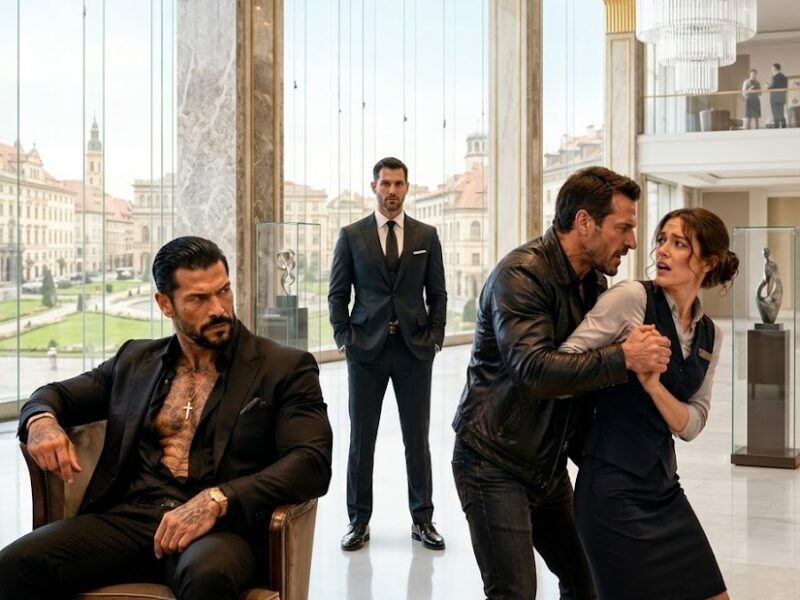
Her Stalker Cornered Her at Work — Unaware the CRIME BOSS Was Watching Every Floor
Part 1
The night he showed up at the hotel, I was carrying a tray of crystal champagne flutes toward the penthouse elevator, calculating whether I had enough in my checking account to cover both my half of the rent and my younger sister’s twenty-first birthday dinner. That is the kind of quiet, desperate math you run in your head when you work the evening concierge shift at the Ashford.
You spend eight hours surrounded by a level of wealth so extreme it stops feeling like real money, and somewhere in the back of your mind, you are deciding whether you can afford the three-dollar bus fare home or if you need to walk the forty blocks in the biting rain.
I had been at the Ashford for eleven months. Long enough to know which regular guests tipped in crisp hundred-dollar bills and which ones treated the staff like invisible furniture. Long enough to know that the man staying in Suite 1401—the shadow who had booked the entire fourteenth floor for three solid weeks—was not someone I was ever supposed to interact with directly.
His reservation was flagged in our system with three red asterisks, a code that meant corporate management handled his stay personally. His name appeared on the internal manifest simply as Mr. Harlow. That was all the front desk staff knew. That, and his standing orders: a specific vintage of single-malt scotch, meals delivered exclusively by our executive chef, and two men built like granite pillars stationed outside his suite doors twenty-four hours a day.
I had barely caught a glimpse of him once, three weeks prior, coming off the service elevator at midnight. Tall, draped in a dark wool coat, possessing the kind of absolute stillness that makes a wide corridor instantly feel smaller. He had glanced in my direction for a single second, his dark eyes unreadable, before walking away. That was the extent of it.
To understand why that night broke me, I have to explain about Derek.
Derek was my ex-boyfriend. We had been together for almost three years, and I had ended it eight months before I ever took the job at the Ashford. For a while, I honestly believed the breakup had taken hold the way these things are supposed to—with a quiet, painful conversation, a few weeks of crying, and then a slow return to normal life.
In the beginning, Derek was the kind of partner who seemed impossibly attentive. He was charming. He remembered tiny, obscure details about my day. He would show up at my apartment with the exact coffee order I had mentioned offhandedly three weeks prior, and back then, I thought to myself: This is what it feels like to be truly known.
What I didn’t understand until much later was that his remembering wasn’t tenderness. It was inventory.
By the end of our second year, the air in our apartment felt thin. I couldn’t make a simple decision without justifying it. I couldn’t have a quick dinner with a coworker without him calling three times before I even paid the bill. When I finally found the courage to speak the words I had been practicing in the mirror for months—I need to end this, Derek, we are done—he didn’t shout. He didn’t cry. He just sat very still on the edge of our bed, looked at me with cold, pale eyes, and said, “You’ll change your mind.”
He said it like a natural law. Not a threat. A fact.
For eight months, I lived with a new phone number, a new apartment, and the kind of constant, exhausting hypervigilance that eats away at your nervous system. You are always scanning the street. You learn which subway exits have working lights. You notice when a dark sedan sits idling on your block for ten minutes too long. I thought I had been careful enough. I thought I was safe.
It was a chilly Thursday in late October. The wind off the lake was biting, turning the wet pavement outside the glass doors slick and dark. I was standing behind the massive marble concierge desk, covering for a colleague who had gone on break.
I saw Derek the second he stepped through the revolving door.
He was wearing a dark jacket, carrying himself with that calm, pleasant demeanor he always adopted when he had made up his mind about something. My body recognized the danger before my brain could articulate it. The blood drained from my face. My hands went ice-cold. I carefully set down the silver pen I was holding, terrified that if I dropped it, the sound would shatter whatever fragile reality was keeping me upright.
He caught my eye across the dark marble floor. The smile that spread across his face was the exact nightmare I had been running from for eight months. It was the pleasant, satisfied smile of a man who had finally found a set of mislaid keys.
“There you are,” he said softly, walking straight toward the desk as if he owned the floor beneath his feet.
“Derek,” I whispered, stepping back until my spine hit the mahogany mail slots behind me. “You need to leave. Right now.”
“I just want to talk, Clara,” he said, moving around the side of the counter, stepping into the staff-only space without hesitating. “You haven’t returned my messages. You changed your number. That wasn’t very fair to us, was it?”
“I don’t want any contact with you,” I said, my voice shaking despite my desperate attempt to keep it firm. “I have made that completely clear. Step back, or I’m pressing the silent alarm for security.”
He let out a soft, almost affectionate laugh, leaning closer. “Come on, Clara. Don’t be dramatic. You’ve always been so dramatic when you’re overwhelmed.”
There it was. The old reframe. The subtle, psychological twist where my terror was turned into a hysterical performance for an audience of one.
Before I could reach for the button under the counter, his hand shot out. His fingers wrapped tightly around my left wrist, squeezing until the bone hurt.
A sharp, involuntary sound hitched in my throat—something between a choked gasp and a sob.
In that exact second, a heavy, suffocating silence fell over the lobby. It wasn’t that the room emptied out; it was that the atmosphere changed so violently that everyone within fifty feet simply stopped moving.
The private elevator at the far end of the lobby opened with a quiet chime.
Mr. Harlow stepped out. He wasn’t running. He walked with the slow, unhurried weight of a man who has never in his life had to raise his voice to be heard. One of his granite-built security guards walked a pace behind his left shoulder. A second man—one I hadn’t seen before—was already gliding silently across the polished marble, cutting straight across the lobby toward the concierge desk.
Derek was still gripping my wrist, completely oblivious to the room around him.
Mr. Harlow stopped ten feet away. His dark eyes flicked down to Derek’s hand on my arm. Then his gaze drifted slowly up to Derek’s face. It was a look so brief, so utterly devoid of warmth, that it sent a shiver straight down my spine.
Then Mr. Harlow looked at me.
I don’t know what he saw in my eyes. I was pale, trembling, pinned against the wood, fighting for air. But something in his posture shifted. It was subtle—a slight square of his shoulders, a darkening of his brow—but the air in the lobby felt suddenly thin, compressed under an immense, invisible pressure.
He leaned slightly toward the guard beside him and spoke a single, low word. The guard nodded once.
Derek finally noticed them. He turned his head, his pleasant expression flickering, calibrating to the sudden presence of three imposing men in tailored black suits surrounding him.
“Is there a problem here?” Derek asked, trying to sound casual, though his grip on my arm loosened slightly.
Mr. Harlow didn’t raise his voice. He didn’t step closer. He simply looked at Derek with the detached, terrifying focus of a man deciding how to dispose of an inconvenience.
“I believe,” Mr. Harlow said softly, “the lady asked you to leave.”
Part 2
The quiet intensity of Mr. Harlow’s voice seemed to vibrate through the marble beneath my feet. He hadn’t shouted. He hadn’t made a scene. But the absolute authority carrying those seven words made the air in the lobby feel heavy enough to choke on.
Derek attempted a confident smirk, but I felt his fingers tremble against my skin. “Look, man, this is a private matter between me and my girlfriend. It’s got nothing to do with you.”
“She is not your girlfriend,” Mr. Harlow replied, his tone chillingly flat. “And you are currently trespassing on private property while assaulting an employee of this establishment.”
Before Derek could respond, the second guard stepped into his space—so close that Derek was forced to tilt his head back to look at the man’s jawline. The guard didn’t touch him; he simply occupied the physical universe so completely that Derek had nowhere left to stand.
“There is a black town car waiting at the curb outside,” Mr. Harlow continued, his voice remaining unhurried, almost conversational. “I strongly suggest you step into it. If you choose not to, my security personnel will escort you to the basement until the precinct officers arrive to process your arrest for felony harassment.”
Derek looked from the guard’s stone face to Mr. Harlow’s unblinking eyes. The pleasant, controlling facade he had worn for three years shattered into tiny, pathetic pieces. He let go of my wrist so fast it felt like a burn.
“This is ridiculous,” Derek muttered, stumbling backward out from behind the concierge desk. “Clara, you’re crazy. You’re out of your mind.”
He turned and practically ran through the revolving doors, disappearing into the dark, rain-slicked street outside.
I stood behind the counter, gripping the edge of the polished wood so hard my knuckles turned white, trying desperately to regulate my breathing. My heart was hammering against my ribs like a trapped bird. My wrist still throbbed where Derek’s fingers had dug in.
The lobby returned to its normal rhythm. Guests continued checking in at the main desk fifty feet away; the lounge pianist struck a low, mellow chord; the bellhops carried leather luggage toward the elevators. The world kept moving, completely unaware that my personal nightmare had just crossed the threshold.
Mr. Harlow remained standing ten feet from the desk. His guards had stepped back into the shadows, but he hadn’t moved. He was looking at me with an expression I couldn’t quite decipher. It wasn’t pity. It wasn’t the awkward, uncomfortable distance people usually put between themselves and someone who has just caused a scene. It was a direct, unvarnished attention.
“Are you all right?” he asked softly.
The standard hospitality response rose to my lips automatically—Yes, sir, thank you, I’m perfectly fine, how may I assist you this evening?—but the words died in my throat. Looking at him, I realized he would see right through the lie.
“I will be,” I said instead, my voice barely above a whisper. “I’m… I am so sorry you had to deal with that.”
“Do not apologize,” he said instantly. Something in his tone was so commandingly absolute that it made me freeze. “You did nothing wrong.”
He held my gaze for one more second, nodded briefly, and turned back toward the private elevators. The doors closed behind him, taking him back up to the fourteenth floor, back to the mysterious, elevated world he inhabited that had nothing to do with mine.
I worked the remaining four hours of my shift in a state of hyper-focused shock. I answered calls, booked dinner reservations, printed guest folios, and did my job flawlessly. But inside my head, the tape played over and over: Derek’s hand on my arm, the shadow of Mr. Harlow stepping out of the elevator, the terrifying efficiency with which the danger had been neutralized.
I went home to my tiny studio apartment, double-locked the deadbolts, pushed a heavy wooden chair under the door handle, and didn’t sleep a single minute.
When I arrived for my evening shift the next day, there was a plain white envelope waiting in my staff mailbox. My name—Clara—was written on the front in dark, precise ink. No title. No last name. Just my first name, which I had spoken aloud to the security guard the night before.
I took the envelope to the breakroom, my hands shaking slightly as I broke the wax seal. Inside was a heavy piece of cream cardstock.
If you require assistance regarding last night’s visitor—legal, personal, or protective—it can be arranged immediately. – H.
I stared at the note for ten minutes. Handled was a word that could mean a thousand different things depending on who was speaking it. Coming from a man who stayed in a penthouse suite with armed guards, it carried a weight that terrified me almost as much as it relieved me.
I pulled out a sheet of standard hotel stationery, took a breath, and wrote a brief reply:
Mr. Harlow, thank you for your incredible intervention yesterday. I have filed an official incident report with hotel security and the local precinct. I believe the situation is being managed. Respectfully, Clara.
I folded it, placed it in an envelope, and asked the shift supervisor to ensure it reached Suite 1401 during the evening meal service.
Less than forty-five minutes later, a reply came back down the service elevator.
Good. But inform me if that changes. – H.
I slipped both notes into the inner pocket of my coat. I didn’t let myself analyze why I kept them close.
Over the next week, the atmosphere at the Ashford shifted in ways that were almost imperceptible to anyone else. Mr. Harlow didn’t seek me out. He didn’t come to the concierge desk or manufacture flimsy reasons to speak with me. But I became acutely aware of a quiet, hovering umbrella of protection that had been opened over my head.
The route his security detail took through the lobby during their evening shifts seemed to line up precisely with my desk hours. Once, on a Tuesday, an intoxicated guest became belligerent with me over a canceled theater reservation—raising his voice, leaning over the counter, stepping into my physical space the way men do when they think loudness equals compliance.
Before I could even reach for the manager’s bell, one of Mr. Harlow’s granite-built guards materialized silently at the edge of the marble pillar ten feet away. He didn’t utter a word. He simply stood there, six-foot-four of stone and dark suit, folding his arms.
The belligerent guest’s voice dropped an octave within two seconds. He apologized, took his corrected receipt, and practically hurried toward the bar. The guard gave me the faintest, almost invisible nod, turned, and disappeared back toward the elevators.
We never spoke about it. I told myself I was imagining a pattern. I told myself I was being paranoid.
I was not imagining it.
On Friday evening, a chaotic mix-up in the main kitchen delayed the dinner service for the fourteenth floor. The head chef, frantically plating dishes for a two-hundred-person banquet in the main ballroom, grabbed my arm in the hallway.
“Clara, please,” he pleaded, gesturing to a silver-covered tray on the counter. “Run this up to 1401 right now. My usual room service staff are completely pinned down. Just drop it at the door with the guards.”
“I’m not supposed to go up there,” I hesitated.
“It’s fine, I’m authorizing it, just go!” he urged.
I took the heavy silver tray, stepped into the service elevator, and pressed the button for the fourteenth floor. My heart was pounding against my ribs as the elevator rose.
When the doors slid open, the corridor was dead silent. The plush carpet swallowed the sound of my shoes. One of the guards I recognized stood outside the double doors of Suite 1401.
“Concierge delivery for Mr. Harlow,” I said softly.
The guard looked at me, his expression softening slightly. He didn’t take the tray; instead, he tapped twice on the heavy oak door, opened it, and stepped aside, gesturing for me to enter.
I stepped over the threshold into a space that completely redefined my understanding of luxury. Floor-to-ceiling glass windows wrapped around the perimeter, offering a breathtaking, dizzying view of the city skyline stretching out toward the black, endless expanse of the lake. The lamps cast a warm, golden glow across rich leather furniture and dark wood paneling.
A long dining table in the center of the room was covered in thick stacks of legal documents, blueprints, and leather-bound ledgers—not thrown about carelessly, but arranged in a strict, terrifyingly organized grid.
Mr. Harlow was standing by the window, looking out at the city lights. He wasn’t wearing his suit jacket or coat. He wore a simple, charcoal-gray cashmere sweater with the sleeves pushed up his forearms, holding a crystal glass of dark amber scotch.
He turned around as the door closed.
“Set it on the side table, please,” he said. His voice was low, deep, and smooth, echoing in the quiet suite.
“Of course, sir,” I whispered, carefully placing the silver tray on the designated mahogany sideboard. “I apologize for the delay. The main kitchen was overwhelmed this evening.”
I turned to leave, placing my hand on the brass door handle.
“Clara.”
I froze. My name on his lips felt strange, heavy, and intensely personal. I turned back around slowly.
He hadn’t moved from the window. He was watching me with that same direct, undecorated attention that made everything else in the room fade into background noise.
“The man from the lobby,” Mr. Harlow said quietly. “He has been parked across the street from the hotel entrance twice this week.”
Part 3
The air in the suite suddenly felt thin. A cold wave of dread washed over me, starting at the base of my neck and pouring down my spine.
“How… how do you know that?” I stammered, my fingers tightening on the brass door handle behind my back.
“My people pay attention,” Mr. Harlow replied simply. He took a slow sip of his scotch, the amber liquid catching the ambient light from the city below. “He sits in a blue sedan near the alleyway from six PM until your shift ends at ten. He follows your bus line for four blocks before turning back.”
My breath caught in my throat. I had spent eight months looking over my shoulder, scanning every crowd, convincing myself that I was being absurdly paranoid. And all the while, Derek had been sitting in the dark fifty yards from where I worked, watching my routine, mapping my movements.
“He’s not going to stop,” I said. It wasn’t a question meant for Mr. Harlow. It was a realization spoken out loud to myself for the very first time.
“No,” Mr. Harlow said softly, stepping away from the glass window, moving slowly toward the center of the room. “He isn’t. Men like that do not stop until they are forced to confront a reality that is larger and more dangerous than their own obsession.”
I looked down at the plush carpet, trying to fight off the suffocating feeling rising in my chest. “I went to the police last week. They told me that sitting on a public street isn’t a crime. They said unless he physically approaches me again or makes an explicit written threat, there’s nothing they can do.”
“The legal system is designed to process damage after it occurs,” Mr. Harlow said, stopping a few feet away from me. “It is rarely designed to prevent it.”
He set his crystal glass down on the table alongside the stacked legal papers. He looked at me with an expression that possessed no pity, no false comfort, but a terrifying, solid certainty.
“There are options available to you,” he continued quietly. “If you want them.”
In any other situation, coming from any other man, an open-ended statement like that would have set off every alarm bell in my head. A powerful, wealthy stranger offering vague “options” to a broke concierge working the night shift sounded like the plot of a bad thriller or the beginning of an entirely different kind of trap.
But looking at Mr. Harlow—a man who had stepped off an elevator and dismantled Derek’s control in ten seconds flat without ever raising his voice—it landed differently. It felt like standing on the edge of a cliff and having someone hand you a solid steel handrail.
“I’m not asking you to do anything illegal,” I said, my voice trembling slightly.
The corner of his mouth twitched—a microscopic movement that was as close to amusement as I had ever seen on his face.
“I am not proposing anything illegal, Clara,” he said. “I own several security firms and employ a team of civil litigation attorneys who specialize in high-risk harassment cases. A restraining order carries very little weight when it is printed on court paper and served by a local deputy. It carries an extraordinary amount of weight when it is drafted by a top-tier law firm and backed by a private security detail that monitors the subject’s every financial and legal vulnerability.”
I stared at him, stunned. “Why would you offer me that? You don’t know me. I’m just the person who books your theater tickets when you stay here.”
“You are a human being being hunted in plain sight,” he said, his tone dropping an octave, becoming impossibly deep and serious. “And I have the resources to stop it. It is as simple as that.”
We stood in silence for a long moment. The quiet of the fourteenth floor seemed to wrap around us, insulating us from the city churning below.
“Tell me about him,” Mr. Harlow said, gesturing vaguely toward the leather armchairs near the fireplace. “Everything. From the beginning.”
I should have gone back down to the lobby. My shift wasn’t over; the concierge desk was technically unmanned; my supervisor would be looking for me. But I didn’t move toward the door.
I sat down on the edge of the leather armchair. And for the next forty minutes, I talked.
I told him about Derek. I told him about the subtle, terrifying erosion of my confidence over three years—the way Derek turned every argument into a flaw in my memory, the way he slowly cut me off from my friends, the way he made me feel like I was crazy for wanting a life of my own. I told him about the night I finally left, and the eight months of hypervigilance that followed.
Mr. Harlow listened in a way I had never experienced before. He didn’t interrupt. He didn’t offer cheap platitudes like ‘It’s going to be okay’ or ‘You just need to move forward.’ He sat in the chair across from me, his dark eyes fixed on mine, listening with the absolute, undivided focus of a man analyzing a complex problem that he fully intended to solve.
When I finally finished speaking, my throat felt dry, but the strange, suffocating tightness in my chest had loosened slightly.
“My personal attorney, Ms. Vance, will contact you tomorrow morning at ten,” Mr. Harlow said, standing up smoothly as I rose from my chair. “She will handle the legal filings. You will not have to speak to the police, you will not have to see Derek in a courtroom, and you will not have to manage this alone.”
“Mr. Harlow… I can’t afford a lawyer like that,” I whispered, shame burning my cheeks. “I work a concierge desk. I can barely cover my rent this month.”
“The accounting of this matter is entirely my concern,” he said softly, walking me to the suite door. “Do not give it another thought.”
He opened the door. The granite guard stood at attention in the hall.
“Good night, Clara,” Mr. Harlow said.
“Good night, Mr. Harlow,” I replied.
In the service elevator going down, I looked down at my hands. For the first time in eight months, they were completely steady.
The next two weeks moved with a terrifying, surgical efficiency.
At ten o’clock the following morning, my phone rang. Ms. Vance was a sharp, brilliant attorney whose voice sounded like polished steel. She didn’t ask me to justify my fear; she simply asked for dates, times, text messages, and addresses.
Within four days, an emergency civil protection order was drafted, signed by a senior judge, and served directly to Derek at his workplace by a private process server accompanied by two plainclothes investigators.
Ms. Vance called me forty-eight hours later. “Mr. Derek Hayes has been formally served,” she informed me briskly. “The order explicitly prohibits him from coming within five hundred yards of your residence, your workplace, or your family members. Furthermore, my firm has initiated a formal inquiry into his digital surveillance activities. If he so much as looks in the direction of the Ashford, he will be taken into custody immediately for felony contempt.”
I sat on my small bed in my studio apartment and cried—not tears of sorrow, but tears of pure, overwhelming relief. For eight months, I had been treated by the legal system like a dramatic ex-girlfriend making a fuss over nothing. In four days, Mr. Harlow’s power had transformed my fear into an indisputable legal reality.
I didn’t see Mr. Harlow during those two weeks, except from a distance.
Once, on a rainy Tuesday, I saw his detail moving through the lobby toward the private street entrance. He paused briefly, looked across the marble floor, and met my gaze. I gave him a small, clear nod. He offered a single, barely perceptible nod in return, turned, and stepped out into the night.
I told myself that was the end of it. He was a wealthy, benevolent guest who had used his immense influence to fix a broken situation for an employee. The debt was settled; the narrative was complete.
Then, on a cold Thursday evening in mid-November, as I was completing my shift checklist, I heard a quiet step near the desk.
I looked up.
Mr. Harlow was standing near the concierge counter, completely alone. No security guards. No assistants. Just a tall, striking man in a dark tailored coat, watching me under the warm chandelier lights of the lobby.
“I am checking out tomorrow morning,” he said softly.
Part 4
A strange, unexpected tightness gripped my chest at his words. I stared at him for a second longer than was strictly professional before recovering my voice.
“I hope your stay at the Ashford was satisfactory, Mr. Harlow,” I said, slipping automatically back into my trained concierge persona.
The corner of his mouth curved up slightly—that faint, elusive half-smile I was beginning to recognize. “It was,” he said. “More than satisfactory.”
He rested his hands on the edge of the dark marble counter, looking at me with that intense, unblurry focus. “Ms. Vance informed me that the protection order was finalized without complication.”
“Yes,” I said softly, my official persona melting away. “She was incredible. I… I don’t even know how to thank you, Mr. Harlow. You gave me my life back. I don’t know how I could ever repay that.”
He waved his hand slightly—a quiet, dismissive gesture that made the vast financial disparity between us seem completely irrelevant. “The matter required addressing. No repayment is necessary.”
He paused, looking out toward the rain-streaked glass doors of the lobby, then back at me.
“I will be returning to the city in March,” he said. His voice was phrased with extraordinary care—not a demand, not an invitation, simply a fact laid out on the counter between us. “If you are still working here.”
“I expect I will be,” I replied, my heart hammering a soft, rapid rhythm against my ribs.
He nodded once, as if that simple answer settled a complex calculation in his mind.
“Good night, Clara,” he said softly.
“Good night, Mr. Harlow,” I whispered.
He turned and walked toward the private elevators, disappearing into the dark gold interior. I stood behind the desk for a long time, the silence of the lobby settling around me, feeling the heavy white notes in my coat pocket, wondering how a stranger could walk into my life for two weeks and permanently alter the shape of my world.
Winter in the city was long, brutal, and gray. The wind coming off the lake turned the streets into frozen canyons, and the snow piled up in icy, dirty banks along the curbs.
But for the first time in almost a year, I wasn’t afraid.
Derek never reappeared. Ms. Vance’s firm monitored the legal boundaries with terrifying vigilance; two weeks after the order was served, Derek attempted to send a third-party email through an anonymous server, and within six hours, he was visited at his office by two corporate investigators who quietly explained the criminal consequences of a second attempt. The obsession was finally, completely broken.
I spent those winter months learning how to inhabit my own life again. I went to dinner with my sister without checking my phone every ten minutes. I walked home from the subway without scanning every dark sedan parked along the curb. I slept through the night.
And slowly, quietly, I found myself thinking about March.
March arrived reluctantly, bringing slushy rain and bitter cold that refused to give way to spring.
On a Wednesday afternoon in mid-March, I was sitting behind the concierge desk, filing weekly travel logs, when the internal reservation alert chimed on my monitor. I clicked the screen open.
*Suite 1401 – Reserved. Guest: Harlow, H. Status: VIP .
My fingers hovered over the keyboard. A strange, warm sensation blossomed in my chest—not panic, not fear, but a sharp, intoxicating anticipation.
He arrived at three o’clock the following afternoon.
The revolving doors swept open, and Mr. Harlow stepped into the lobby, flanked by his two granite guards. He wore his familiar dark wool coat, carrying himself with that same unhurried, magnetic stillness.
As he crossed the marble floor toward the private elevators, his eyes drifted toward the concierge desk. He found me sitting there.
He didn’t stop. He didn’t break stride. But as his gaze locked onto mine, a look of profound, deliberate recognition passed between us—a quiet, silent confirmation that three months of distance had changed absolutely nothing.
At six o’clock that evening, an envelope was delivered to my desk by a junior bellhop.
I broke the wax seal. Inside was a single card written in his precise, elegant handwriting:
Dinner tomorrow evening at seven, if you are free. Not as a guest and staff. As yourself. – H.
I held the note against my chest, staring at the dark ink.
Three months ago, the prospect of stepping into the world of a man like Mr. Harlow would have terrified me. I would have viewed it as another situation where power was unbalanced, where I was vulnerable, where I risked losing control of my own narrative.
But sitting there, looking at his handwriting, I realized something fundamental had changed. Mr. Harlow hadn’t used his power to control me. He had used it to build a wall around me so I could rebuild my own strength.
I pulled out a fresh card, wrote a single sentence, and handed it to the bellhop:
I am free at seven. – Clara.
The restaurant he chose was a small, tucked-away establishment in a quiet neighborhood three miles from the hotel. There were no flashy neon signs, no velvet ropes, no lingering paparazzi. The interior was warm, lit by soft candlelight, with heavy oak booths that offered absolute privacy. The staff greeted him with quiet, familiar respect, leading us to a secluded corner table near a brick fireplace.
When he took off his dark coat and sat across from me, wearing a soft gray wool sweater, the intimidating aura of the fourteenth-floor penthouse seemed to melt away, revealing the man beneath.
His name, I learned over the course of that evening, was Edmund Harlow.
He was forty-four years old. He had been born in a small coastal town in eastern Scotland, raised by a widowed mother who worked as a seamstress, and had built his global shipping and logistics firm from absolute scratch through twenty-five years of unrelenting, brilliant work.
“I know what it feels like to have no ground beneath your feet, Clara,” he said softly, leaning his elbows on the dark wood table, watching me across the candlelight. “I spent the first twenty years of my life waiting for the other shoe to drop. That kind of poverty stays in your bones. It makes you hyper-aware of vulnerability—in yourself, and in others.”
I listened, utterly mesmerized. For three years, Derek had talked at me—using words to manipulate, to manage, to control. Edmund spoke with me. He asked questions about my life, my upbringing three hours north of the city, my dreams before hospitality, and he listened to my answers with the same profound, undecorated attention he brought to everything else.
“You are extraordinary at your job, Clara,” he said gently, taking a sip of his wine. “But you stay at the Ashford because it feels safe. Because the variables are controlled.”
I paused, setting my fork down, stunned by the terrifying accuracy of his observation.
“Is that a bad thing?” I asked softly.
“It is not a bad thing to seek safety after a storm,” Edmund replied, his dark eyes holding mine with an intense, tender warmth. “But a harbor is meant to protect a ship while it repairs, Clara. It is not meant to be where the ship remains forever.”
The words hit me with the force of a revelation. Tears pricked the backs of my eyes, but for the first time in my life, they weren’t tears of fear. They were tears of someone being seen—truly, deeply seen—without a single demand being made in return.
We talked for three hours. We talked until the restaurant grew quiet, until the candles burned down to small nubs, until the cold rain outside turned into a soft, steady mist.
When we walked out to the curb, a sleek black car was waiting. The driver held the door open.
“May I drive you home, Clara?” Edmund asked, standing beside me in the cool night air.
I looked at him—at his dark eyes, his steady hands, his absolute, unshakeable respect for my boundaries.
“Yes, Edmund,” I said, using his first name for the very first time. “I would like that very much.”
Part 5
The drive through the midnight city was quiet and peaceful. The wet asphalt reflected the yellow glare of the streetlights like dark glass, and the lake appeared briefly between the tall granite buildings, flat and vast under the overcast sky.
Edmund sat beside me in the back seat, keeping a respectful distance, his hands resting quietly on his knees. He didn’t try to fill the silence with meaningless small talk. He simply allowed the quiet intimacy of the moment to exist between us.
“Can I ask you something, Edmund?” I said softly, looking out the window as my apartment building came into view.
“Anything,” he replied, turning to look at me.
“That first night in the lobby… when Derek grabbed my arm,” I said, turning my head to meet his dark eyes. “You came off the private elevator right at that moment. You weren’t there by accident, were you?”
Edmund was silent for a moment. He looked out at the passing streetlights, his expression unreadable, before turning back to me.
“My security team monitors the hotel’s main lobby feeds,” he admitted quietly. “It is standard protocol whenever I stay in a public establishment.”
“So you saw what was happening on the monitors before you ever stepped onto the elevator?”
“Yes,” Edmund said simply.
“You could have sent one of your guards down to handle it,” I pressed gently. “You didn’t have to come down yourself.”
Edmund looked at me, his gaze holding a depth of quiet intensity that made my pulse jump.
“Some things,” he said softly, “you do not send someone else to do.”
The words hung in the warm air of the car, solid and undeniable. He didn’t elaborate; he didn’t offer a smooth, romantic speech. But in that simple, honest answer, I felt the absolute truth of who he was: a man who took direct, personal responsibility for the world around him.
The car pulled up to the curb outside my apartment building. The driver remained in his seat, giving us privacy.
“Thank you for dinner, Edmund,” I said, reaching for the door handle. “It was… wonderful.”
“Clara,” he said softly.
I paused, turning back. He reached out, his long fingers gently brushing a strand of dark hair away from my face. His touch was warm, feather-light, and filled with an incredible, restrained tenderness.
“I will be in the city for two weeks,” he said quietly. “I would very much like to see you again. On your terms. At your pace.”
A soft, genuine smile spread across my face. “I would like that, too.”
The weeks that followed were unlike anything I had ever experienced.
We didn’t rush. Edmund traveled frequently for his business—flying to London, Zurich, and Chicago—but unlike my past experience with Derek, Edmund’s absence was never filled with anxiety or silence. He texted me every morning; he called me every evening when his meetings ended; he was completely, effortlessly transparent about his schedule.
‘I will be out of contact for four hours while on a flight to London,’ he would text. ‘I will call you the moment I land.’ And every single time, without fail, my phone would ring the moment his plane touched the tarmac.
For the first time in my life, I learned what it felt like to be trusted, respected, and cherished by a partner who had no desire to manage or shrink my world.
By early summer, the last remnants of my old hypervigilance had faded away. I left my job at the Ashford Concierge desk in June—not because Edmund pressured me to, but because I finally felt brave enough to leave the harbor. I accepted a position as an event coordinator for a major art foundation downtown, a job I had dreamed of doing for years but had been too terrified to pursue.
One warm Saturday evening in July, Edmund took me to a small, secluded cottage he rented north of Kingston, situated on the edge of a quiet, pristine lake surrounded by tall pine trees.
We sat on the wooden dock as the sun began to set, painting the water in brilliant shades of gold, orange, and deep purple. A cool breeze rustled through the pines, and somewhere across the dark water, the cry of a loon echoed through the quiet evening.
Edmund sat beside me, wearing a dark blue linen shirt, his arm draped comfortably around my shoulders. I leaned back against his chest, feeling the steady, rhythmic beat of his heart against my back.
“What would you have done, Clara?” Edmund asked softly, his chin resting gently near my hair. “If I hadn’t come down from the fourteenth floor that night in October?”
I looked out at the golden water, thinking about the question honestly.
“I would have pressed the security button,” I said softly. “I would have filed another police report that went nowhere. I would have walked home in the dark, scanning every street corner, living in terror… waiting for the next time he found me.”
Edmund was quiet for a long moment. His arm tightened around me, pulling me a fraction closer against his chest.
“I am glad I came down,” he whispered.
“So am I,” I said, turning my head to look up at his face.
I thought about the three years I had spent with Derek—the constant walking on eggshells, the subtle erosion of my reality, the belief that I was fundamentally broken and incapable of trusting anyone again.
I had been wrong. The damage Derek had inflicted was real, but it was not permanent. Being loved by Edmund hadn’t erased my past, but it had shown me that the world was infinitely larger, safer, and more beautiful than the tiny, suffocating cage I had been trapped in.
“Edmund?” I murmured.
“Yes, my love?”
“Thank you,” I whispered. “For coming down the elevator.”
He smiled—a full, brilliant, rare smile that lit up his dark eyes—and leaned down to press his lips against mine. The kiss was deep, warm, and filled with a quiet, undeniable promise of forever.
As the stars began to appear above the dark pines of the lake, I rested my head against his shoulder, holding his hand tightly in mine. The cold rain of the city, the terrifying shadow of the past, and the long, lonely shifts at the Ashford desk were all behind me now.
I was no longer scanning the room for exits. I was standing firmly in my own life, holding the hand of the man who had helped me find my way home.
Part 6
Life after leaving the Ashford felt like stepping out of a dark, narrow corridor into the blinding, brilliant warmth of midsummer.
My new role at the art foundation was demanding, fast-paced, and wildly fulfilling. For the first few months, every time I presented a budget proposal or organized an gallery opening, a tiny, buried voice in the back of my mind expected someone to question my judgment or tell me I was being “dramatic.”
It never happened. My director trusted my instincts; my colleagues sought my advice; and every evening, when I came home to the sunlit two-bedroom apartment I had rented near the park, Edmund was either waiting for me with dinner or calling me from whatever corner of the world his business had taken him to that week.
He never tried to move me into his massive, minimalist estate on the outskirts of the city. He understood, with that terrifyingly accurate emotional intelligence of his, that I needed to build my own space first—a place that was entirely mine, bought with my own salary, arranged according to my own taste.
“Your independence is not a threat to me, Clara,” he told me one rainy evening in September as we cooked dinner together in my kitchen. “It is the very thing I love most about you.”
In October, almost exactly one year after the night Derek had grabbed my arm in the lobby, Edmund invited me to travel with him to Scotland.
We stayed in a restored stone estate overlooking the rugged, wind-swept coast near St. Andrews—the very town he had told me about during our first dinner at the restaurant in Yorkville.
The autumn sky over the North Sea was gray, dramatic, and vast. The waves crashed violently against the black cliffs below, spraying cold salt mist into the air, while inside the estate, heavy velvet curtains and roaring stone fireplaces kept the chill at bay.
On our third evening there, as a light rain began to patter against the tall leaded windows of the library, Edmund poured two glasses of scotch from a decanter on the sideboard.
He handed me a glass, then walked over to the tall arched window, looking out at the dark sea.
“I brought you here for a reason, Clara,” he said softly, his voice carrying that familiar, deep cadence that always made my heart settle.
I stepped up beside him, wrapping my arm through his, resting my head against his shoulder. “Why?”
He turned to face me. In the warm, flickering light of the fireplace, his dark eyes held an emotional vulnerability so profound it took my breath away.
He reached into his pocket and pulled out a small, dark wooden box carved with delicate Celtic knotwork. He opened it slowly.
Inside sat a simple, breathtaking ring—a deep, glowing emerald set in a band of hand-carved platinum. It wasn’t flashy or ostentatious; it was timeless, solid, and impossibly beautiful.
“This stone was mined in Scotland eighty years ago,” Edmund said gently, his voice trembling slightly—the first time I had ever heard a tremor in his tone. “My mother saved it when I was a boy. She told me to keep it until I found a woman whose strength matched its endurance.”
He took my hand, his fingers warm and steady against mine.
“I spent twenty-five years building a global empire because I was terrified of being helpless, Clara,” he whispered, looking directly into my eyes. “I thought power was the only thing that could protect a person. But standing in that hotel lobby a year ago, watching you hold your head up despite your fear… you taught me what real courage looks like.”
Tears filled my eyes, spilling over my lashes, but my heart was soaring.
“I do not want to manage your life, Clara,” Edmund said softly, bending down slightly so his eyes were level with mine. “I do not want to stand in front of you or behind you. I want to stand beside you. For as long as you will have me. Will you marry me?”
I didn’t hesitate. I didn’t scan the room for exits. I didn’t question my own reality.
“Yes, Edmund,” I sobbed through a breathless, joyful laugh. “Yes! Absolutely, yes!”
He slid the emerald ring onto my finger. It fit perfectly, as if it had been crafted specifically for my hand.
He pulled me into his arms, wrapping his large hands around my waist, lifting me slightly off the floor as his lips met mine. The kiss was filled with a fiery, overwhelming passion that burned away the last lingering shadows of the past, leaving only the brilliant, golden light of our future.
Part 7
Two years later.
The grand ballroom of the Ashford Hotel was illuminated by a thousand crystal chandeliers, casting a warm, shimmering glow over three hundred prominent guests dressed in formal black-tie attire.
It was the annual Gala for the City Art Foundation—the largest fundraising event of the year, and an event that I had personally spent six months organizing as the foundation’s newly appointed Executive Director.
I stood near the top of the grand double staircase, wearing a floor-length emerald silk gown that matched the ring on my left hand, holding a clipboard and checking off the final VIP arrivals with my lead event coordinator.
“The Mayor has arrived, Mrs. Harlow,” my coordinator whispered excitedly. “And the board members are gathering in the main lounge.”
“Wonderful,” I smiled, checking the name off my list. “Ensure the champagne servers are stationed near the entrance, and double-check the lighting in the south gallery.”
“Right away!” she said, hurrying down the carpeted stairs.
I stood at the top of the landing for a quiet moment, looking down at the bustling, magnificent room below.
Three years ago, I had worked the evening shift in this very hotel, wearing a plain black uniform, carrying trays of champagne flutes to guests who didn’t know my name, calculating whether I could afford a three-dollar bus fare home while terrified of my own shadow.
Now, I was standing at the head of the grand ballroom, managing the entire city’s most prestigious cultural event, surrounded by people who respected my work, holding my head high with absolute, unshakeable confidence.
A familiar, heavy warmth settled against my back. Two strong, familiar arms wrapped gently around my waist, pulling me back against a solid, tailored chest.
“You have outdone yourself tonight, my love,” Edmund’s deep voice purred softly in my ear.
I leaned back against him, closing my eyes for a second, breathing in the comforting scent of his expensive cologne and warm cedar. I turned in his arms, smiling up at my husband.
He looked devastatingly handsome in his custom black tuxedo, his dark hair silvering slightly at the temples, his dark eyes looking down at me with that absolute, undivided devotion that had never wavered for a single day since we met.
“Everything is running smoothly,” I smiled, reaching up to adjust his black silk bow tie. “The auction starts in twenty minutes.”
“I am not interested in the auction,” Edmund murmured, his hands resting comfortably on the curve of my waist. “I am only interested in the Executive Director.”
I laughed softly, pressing a quick, sweet kiss to his lips. “You are terribly biased, Mr. Harlow.”
“Extremely,” he agreed without a shred of apology.
As we stood together at the top of the stairs, my eyes drifted down toward the main entrance of the lobby below.
Through the massive glass revolving doors, I saw the concierge desk where I had once stood. A young woman in a sharp black uniform was answering the phone, looking slightly overwhelmed as a queue of guests waited to check in.
I watched her for a moment, remembering the overwhelming fear, the isolation, and the suffocating helplessness I had felt behind that marble counter.
Edmund followed my gaze. He looked down at the desk, then turned his head to look at me, his expression softening into a quiet, profound understanding.
He didn’t say anything. He simply reached down, took my left hand in his, and squeezed it gently, his thumb tracing the emerald ring on my finger.
I looked back up at my husband—the man who had walked off a private elevator on a cold October night, who had used his immense power to give me my freedom back, and who had stood beside me while I built my own life on my own terms.
I wasn’t afraid anymore. I didn’t need a harbor to hide in, because the storm was long gone, and the sea ahead of us was wide, clear, and bright.
“Ready to go down to the ballroom, Mrs. Harlow?” Edmund asked softly, offering me his arm.
I slid my arm through his, holding his side tightly, smiling up at him with complete, unshakeable love.
“Yes, Edmund,” I said, my voice clear and strong. “Let’s go down.”
Together, hand in hand, we walked down the grand staircase into the warm, brilliant light of our life.