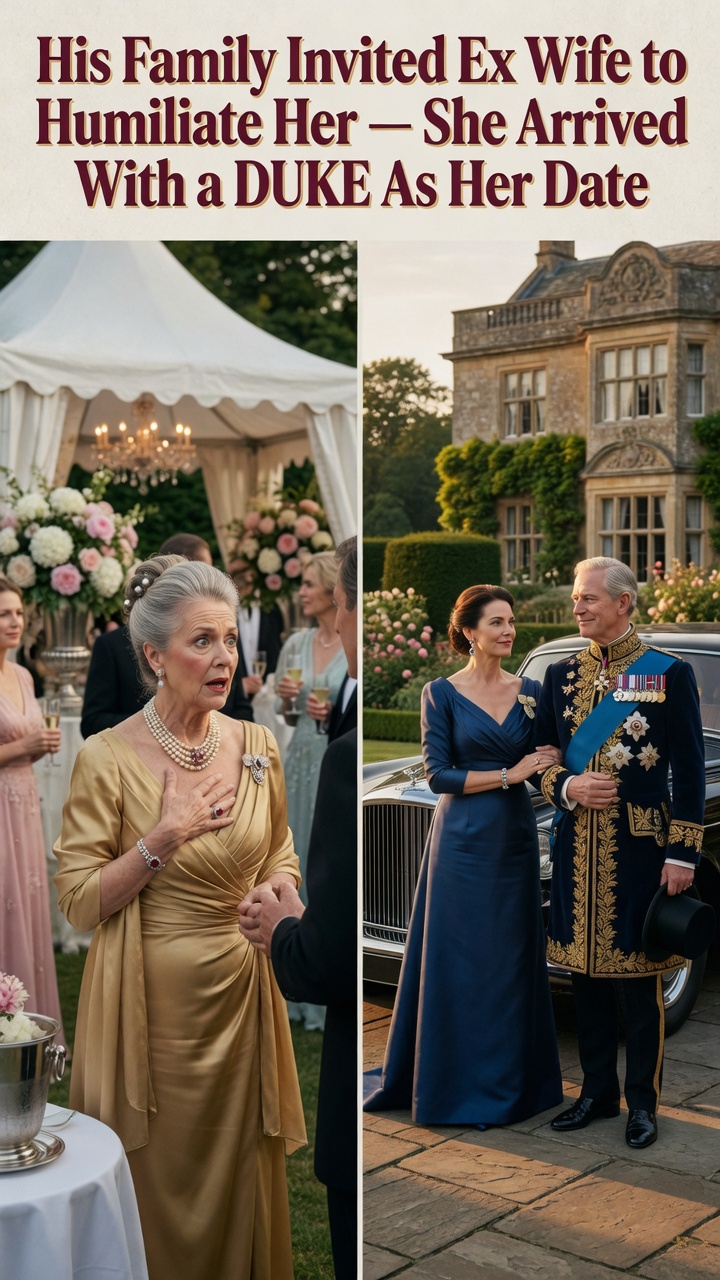
His Family Invited Ex Wife to Humiliate Her — She Arrived With a DUKE As Her Date
Part 1: The Envelope
Margot Dalworth stood in the center of her small, sun-drenched Cambridge apartment, the quiet morning air suddenly feeling suffocatingly thin. In her hand, she held a thick, cream-colored envelope, its edges embossed with heavy, shimmering gold. It was a beautiful object—an elegant piece of stationery that cost more than her monthly grocery bill—but it felt like a cold stone against her palm.
She didn’t need to open it to know what was inside. The return address, The Haywood Estate, West Hills, Portland, was burned into her memory like a brand. Trevor Haywood was getting married.
Three years ago, she had been Trevor’s wife. Three years ago, she had been a “mistake” that Deline Haywood, Trevor’s formidable mother, had corrected with a crisp, impersonal $3,000 cashier’s check and a demand to “simply disappear.” Margot had been twenty-five, naive, and deeply in love with a man who had shown her the world only to lock her out of it the moment the novelty of her middle-class background wore off.
Margot tore open the envelope. The invitation was standard, dripping with the kind of performative wealth that defined the Haywood family. But it was the small, handwritten note tucked inside that sent a sharp, familiar jolt of humiliation through her chest. Deline’s spidery, arrogant cursive mocked her from the page:
Dear Margot,
We thought you’d want to see Trevor marry someone from the right sort of family. Do come if you can manage the travel costs. No gift necessary; we understand your situation must be difficult.
Warmly, Deline.
Margot’s grip tightened until the paper crinkled. It was a tactical strike. They didn’t want her there because they missed her; they wanted her there as a prop. They wanted her to sit in the audience, wearing her store-bought dress, watching Trevor exchange vows with some polished debutante, all to prove how much better off he was without the girl from Reed College. They wanted her to feel small. They wanted to confirm that she was, and always had been, “the help.”
She walked to the window, looking out over the red-brick buildings of Cambridge. A memory of Portland clawed at her—the sound of Deline’s voice demanding she supervise the appetizers at her own wedding reception while Trevor laughed with his friends, pointedly ignoring her. She remembered the “children’s table” at Thanksgiving, and the way the servers had looked through her as if she were made of glass.
“They think I’m still that girl,” Margot whispered to the empty room. “They think I’m still waiting for them to choose me.”
She looked down at her left hand, where an emerald ring, purchased with her own hard-earned curator’s salary, caught the light. She picked up her phone, her thumb hovering over the screen. She didn’t call a friend; she didn’t call her mother. She opened her texts, found the contact for Thaddius Ashccraftoft, and typed three words.
Portland, August 15th. We’re going.
She hit send before her courage could fail. Thaddius replied almost instantly with a single, calm emoji: a chess pawn.
Margot took a deep breath. She wasn’t going to Portland to fight for Trevor. She wasn’t going to win him back or even to tell him off. She was going because Deline Haywood had left her with one final, lingering lesson: that in the world of the elite, image was everything. If they wanted a performance, she was going to give them a premiere they would never forget.
As the afternoon sun cast long shadows across her studio floor, Margot began to plan. She wasn’t just going to show up. She was going to tear their carefully curated social hierarchy apart from the inside out. But as she laid out her suitcase, a sudden, cold thought chilled her blood: what if Thaddius wasn’t the ace she thought he was? What if, in her quest for revenge, she was playing directly into the Haywoods’ hands?
Part 2: The Normal Duke
The following weeks were a blur of secrecy and preparation. Margot kept her life in Boston separate from the impending collision in Portland. She worked at the Fog Art Museum, her mind sharp and focused, while at night, she exchanged cryptic emails with Thaddius’s office in London.
Thaddius Ashccraftoft was a paradox. In the four months they had been dating, he had been the most “normal” man she had ever met. He lived in a modest apartment in the North End, took the ‘T’ to work, and loved the smell of old paper in bookstores. He never talked about his family, never flaunted his connections, and spent his weekends with Margot eating pastries from local bakeries.
He was the antidote to the suffocating pretension of the Haywoods. And yet, there was always that flicker of something beneath his casual sweaters. He possessed a stillness, a way of moving through a room that suggested he was always the person in charge, even when he was just arguing about the best place to buy a bagel.
“You’re quiet today,” Thaddius said one evening as they walked along the Charles River.
Margot stopped, looking at the water. “I got the RSVP card for Portland. I’ve sent it back. My boss gave me the time off, though he thinks I’m visiting a sick relative.”
Thaddius laughed, a warm, genuine sound. “Technically, you are. You’re visiting the ‘sick’ remnants of your past.”
“Are you sure about this?” Margot asked, turning to him. “You’re a private person, Thaddius. This is going to be a spectacle. The Haywoods are going to be insufferable, and the press—they’ll be there.”
Thaddius stepped closer, his blue eyes intense. “Margot, I’ve spent my entire life trying to escape the shadow of a title that people use as a mirror to see their own ambitions. I’m tired of being ‘The Duke’ to people who don’t care who I am. With you, I’m just Thaddius. If we go to this wedding, we go as ourselves. We don’t owe them a performance—we owe them the truth of who we are.”
He reached into his pocket and pulled out a small, worn piece of parchment—a clipping from an old art history journal. “I looked up your ex-husband’s family. The Haywood development group. They’re influential in the Pacific Northwest, but in the grand scale of international preservation, they’re a drop in the ocean.”
“They don’t see it that way,” Margot warned.
“That is their misfortune,” Thaddius replied, his tone chillingly smooth.
As they neared the end of the walk, Margot felt a strange flutter of nerves. She had spent years convincing herself that she was nothing, that her worth was tethered to the validation of people like Deline. Now, she was standing next to a man who didn’t just disagree—he acted as if the idea was laughable.
But that night, Margot had a dream. She was back in that Portland garden, tray in hand, and Deline was screaming at her that she didn’t belong. When Margot tried to speak, her voice wouldn’t come out. She looked for Trevor, but he was gone, and standing in his place was a man with Thaddius’s face, but he was wearing a crown that turned into iron shackles.
She woke up in a sweat, the air in her studio apartment feeling heavy and stagnant. She sat up, her hand brushing the emerald ring on her nightstand. She wasn’t going to be the girl with the tray anymore. But the closer the date came, the more she wondered if she was becoming exactly what she hated—someone who used status to win a fight.
Was she doing this for justice, or was she just as obsessed with “belonging” as the Haywoods were? She checked her email. There was a message from her mother in Oregon, mentioning that she’d heard the Haywood wedding was going to be the “event of the season.”
The trap was set. Everyone expected her to be the jilted, broken ex-wife. She stared at her reflection in the dark mirror. Tomorrow, she would be someone else. But would she recognize herself when it was over?
Part 3: Arrival in Portland
The plane touched down at PDX under a grey, drizzling sky—the classic Portland welcome. Margot felt a strange, physical weight lift off her as she walked through the terminal. Three years ago, she had left this city on a Greyhound bus with $2,800 in her pocket and a shattered sense of self. Today, she was stepping off a private flight, her hand firmly in Thaddius’s.
“You look tense,” Thaddius said, adjusting his scarf.
“It’s the air,” Margot replied. “It smells like rain and memories.”
They checked into the Sentinel Hotel, a beautiful, historic space that felt worlds away from the sterile, sprawling mansion of the Haywoods. Margot insisted on staying downtown. She wanted to be near the streets where she used to walk, the coffee shops where she’d cried over Trevor’s coldness, and the bookstore where she’d finally learned to love her own company.
As they unpacked, Margot’s phone buzzed with a notification from a local news site. Haywood Wedding Preparations: A Gilded Affair. She clicked the link. The photos of the estate made her stomach churn. They had transformed the gardens into a miniature Versailles.
“They really are going all out,” she muttered, showing the screen to Thaddius.
He glanced at it, unbothered. “It’s a bit gaudy, isn’t it? Very ‘new money trying to convince the ghosts of old money that they’ve finally arrived.'”
“Deline would kill you for saying that,” Margot said, feeling a rare, genuine laugh bubble up.
“Deline would have to catch me first,” he retorted.
Later that afternoon, they took a walk through downtown. Margot led him to Powell’s Books. She wanted to show him the aisles that had saved her life. As they wandered the shelves, she caught sight of a familiar face—one of her old acquaintances from her brief, disastrous stint in the Portland art social scene.
The woman, Sarah, stopped, her eyes widening as she recognized Margot. “Margot Dalworth? Oh my god! I heard—” She stopped, her eyes darting to Thaddius. She didn’t know who he was, but she knew the cut of his coat and the way he looked at Margot.
“I’m here for the wedding,” Margot said calmly, her heart racing.
“Oh,” Sarah said, her voice dropping. “I… I heard Deline was saying you might not make it. How are you? Are you… okay?”
“I’ve never been better, Sarah,” Margot said, her smile steady. “This is Thaddius. We’re just in town for the festivities.”
Thaddius gave a polite, distant nod. He didn’t offer his hand, and he didn’t introduce himself. He just stood there, a tall, imposing figure of quiet confidence. Sarah looked thoroughly confused. She muttered something about having to go and practically ran out of the bookstore.
“Well,” Thaddius said, once she was out of earshot. “That went well.”
“She’s going to call Deline within five minutes,” Margot said, her palms sweating. “The countdown has officially started.”
Back at the hotel, Margot pulled out the gown. It was sapphire silk, a shade that felt like the deep ocean—calm, cold, and impenetrable. She had spent months preparing for this moment. She had practiced her breathing, her stance, and her tone. But looking at the gown, she realized she was terrified.
What if she walked into that tent and felt exactly like the girl who was told to check the coat room? What if the Haywood influence was so strong that it dragged her back into the past the moment she crossed the property line?
She looked at Thaddius, who was reading a book by the window. He looked so incredibly normal. “Thaddius?”
He looked up. “Yes, my love?”
“If I lose it tomorrow… if I start crying, or if I just turn around and run away, promise me you won’t let me look back.”
He set the book down and walked over, his expression grave. “Margot, you don’t have to do this. We can leave right now. I don’t care about the Haywoods. I don’t care about their tent or their roses. I care about you.”
“I know,” she whispered. “But I have to do this. Not for them. For the girl who got on that bus three years ago.”
She went to sleep that night to the sound of Portland rain against the window, dreaming not of the wedding, but of the woman she was becoming—a woman who wasn’t afraid of the rain, because she knew she could weather any storm.
Part 4: The Arrival
The morning of the wedding was breathless. The rain had cleared, leaving the air damp and sweet. Margot sat in the hotel suite, her hair being styled by a professional who didn’t ask her for her background, only how she wanted her waves pinned. Thaddius was in the other room, his valet assisting him with the intricate details of the Ashccraftoft ducal regalia.
When he emerged, Margot gasped. He was no longer the man in the wool sweater. He was a force of nature. The deep blue velvet of his tailcoat was perfectly tailored, the gold embroidery glinting with a weight of history that seemed to fill the room. He wore his orders with a casual familiarity that made them look like a natural part of him.
“You look,” she struggled for the word, “like a fairytale.”
Thaddius smiled, though his eyes were serious. “I look like a man who is ready to stand beside you.”
The journey to the Haywood estate was a blur. They had arranged for a private car, though Thaddius had insisted on the Bentley being brought from London for the occasion. It felt like a war machine in the quiet suburbs of Portland. As they approached the estate, the line of luxury cars began to swell.
“They’re watching us,” Margot said, peeking through the tinted glass. “I can see the valet’s face. He looks like he’s seen a ghost.”
“Good,” Thaddius said. “Let them be unsettled.”
As the Bentley pulled into the estate, the world seemed to tilt. The music stopped. The guests, who had been chatting under the billowing white tents, all turned as one toward the drive. It was a mass movement, a collective surrender of attention.
They stepped out. The silence was heavy, broken only by the crunch of gravel under their feet and the distant, confused twittering of birds. Thaddius moved with an easy, unhurried gait, his hand firmly at the small of Margot’s back. He wasn’t rushing; he wasn’t seeking approval. He was simply moving, and the crowd, as if driven by an ancient, instinctual command, parted to make a path.
Deline Haywood stood near the altar, her champagne-colored dress looking suddenly, painfully ordinary next to the deep, regal blue of Thaddius’s coat. She was frozen, her mouth slightly agape, her eyes darting from the Bentley’s royal insignia to the emerald ring on Margot’s finger.
Trevor, standing at the altar with his bride, looked as though he had been hit by a physical force. His face was pale, his eyes wide and vacant. He looked at Margot—not as the wife he had thrown away, but as something he could no longer comprehend.
Thaddius walked to Deline. He didn’t bow—that would have been too much of an honor. He gave a slight, dismissive nod.
“Mrs. Haywood,” he said, his voice carrying clearly in the unnatural quiet. “My fiancée and I are delighted to be here. I trust the ceremony is still proceeding?”
Deline struggled to find her voice. “I… yes. I… I didn’t know you were—”
“Quite,” Thaddius interrupted smoothly. “We wouldn’t have missed Trevor’s… ‘upgrade.'”
He didn’t wait for a response. He guided Margot toward the third row, where two chairs stood conspicuously empty. As they sat, the tension in the tent became palpable, a coiled spring ready to snap. The bride, Kimberly, looked at her bouquet, then at the Duke, then at Margot, her eyes flashing with a mix of fury and intense, probing curiosity.
The ceremony began, but it was a farce. The officiant was stuttering; the string quartet was playing out of tempo. Everyone was watching the third row. Every time Margot shifted, every time Thaddius inclined his head, a ripple of movement went through the guests.
Margot looked at Trevor. He was sweating. He couldn’t look at her, yet he couldn’t stop glancing at her. The power dynamic of the room had been inverted. The people who were supposed to be the center of attention—the beautiful bride, the successful groom, the matriarch—had been reduced to background characters in their own production.
“They’re miserable,” Margot whispered to Thaddius.
“They are realizing that they chose to impress the wrong people,” he replied.
Suddenly, Deline leaned forward, her face a mask of cold, calculated spite. She whispered something to the officiant, and the officiant paused, looking toward the Haywood matriarch. It was a blatant attempt to regain control. Margot felt a surge of adrenaline. This wasn’t over. Deline was preparing for a final stand, and if Margot knew her at all, she was about to make a move that would be as clumsy as it was cruel.
Part 5: The Toast
The reception, following the disastrously awkward ceremony, was an exercise in social torture. The champagne flowed, but the guests were distracted, their eyes constantly flitting toward the table where the “Duchess-to-be” sat, radiating an effortless, calm beauty that made the bride’s carefully constructed elegance look staged.
Deline was working the room like a woman possessed. She was trying to weave a narrative, whispering to donors and neighbors, clearly suggesting that Margot’s presence was a vulgar, calculated stunt. But it wasn’t working. The title—Duke—was a gravitational pull that Deline couldn’t compete with. When a Duke enters a tent in a town like Portland, he isn’t just a guest; he becomes the axis upon which the entire event rotates.
Thaddius was masterful. He stood beside Margot, his hand never leaving her waist, his manner impeccable. He was the perfect gentleman, charming, articulate, and completely detached from the social climbing that surrounded him.
“You’re doing it again,” Margot whispered as they stood near the garden edge.
“Doing what?”
“Looking at the guests like they’re specimens under a microscope.”
Thaddius grinned. “Because they are. Look at the Mayor’s wife. She’s trying to decide whether to apologize to you for ‘never knowing’ you, or whether to pretend she always knew you were destined for great things.”
“She’ll go with the second one,” Margot said. “She’s a pragmatist.”
Suddenly, the room fell silent. Deline had stepped onto the dais, her microphone in hand. She looked triumphant, her eyes sweeping over the crowd until they landed on the third row.
“I want to thank everyone for being here,” Deline began, her voice dripping with a sweetness that didn’t reach her eyes. “To witness such a perfect union. It is a testament to the fact that when you belong to a family like ours, you know exactly what is required of you, and you know who belongs beside you.”
She pointedly avoided looking at Margot, but her words were a serrated blade. “Trevor has found a partner who understands the traditions, the history, and the sacrifices that come with the Haywood name. It is a refreshing, beautiful change.”
A murmur went through the room. It was a direct, vicious swipe. Kimberly beamed, looking entirely too satisfied with the insult.
Thaddius stiffened, his fingers tightening on the stem of his champagne flute. “I should—”
“No,” Margot said, her voice sharp. “Don’t.”
“She is disparaging you in front of three hundred people,” Thaddius said, his voice low.
“She’s disparaging herself,” Margot corrected. “Watch.”
Thaddius didn’t wait. As Deline finished her toast, he stood up. The room, sensing a shift in the wind, went even quieter.
“Forgive the interruption,” Thaddius said, his voice calm, ringing with the effortless authority of the peerage. “But I’m afraid I must object to the idea of ‘sacrifices’ in a union. In a true partnership, there are no sacrifices—only shared growth.”
He walked toward the dais. The crowd parted. Deline’s smile withered, replaced by a look of mounting panic.
“My fiancée, Margot,” Thaddius continued, stopping at the base of the dais and looking up at Deline, “has taught me more about the meaning of sacrifice, dignity, and real worth in the last six months than I learned in all my years of navigating the peerage. She didn’t have to ‘sacrifice’ anything to belong—she was always enough.”
He turned to the crowd, his smile broad and genuinely amused. “And quite frankly, if you think that belonging is defined by the name on your mailbox, you’ve all missed the point of the party.”
The tent erupted into a chaotic mix of gasps, laughter, and frantic whispering. Deline looked as though she had been slapped. Trevor stepped down from the dais, his face dark, his fists balled at his sides.
“You think you’re better than us?” Trevor hissed as he reached the floor. “Because you have a title? You’re a relic, Ashccraftoft. You’re a museum piece.”
Thaddius didn’t even blink. He looked at Trevor with a profound, detached pity. “Trevor, I don’t think I’m better than you. I simply know that I am free. You are still trying to please a woman who treats people like service staff at their own wedding.”
Trevor lunged, but the security detail they had brought—two men who looked like they could wrestle bears—stepped in immediately. The scene was pure, unadulterated disaster. The wedding, the “perfect union,” the “event of the season” had descended into a public breakdown, and Margot, standing there in her sapphire silk, felt the last remaining threads of her past life dissolve into dust.
Part 6: The Exit
The aftermath of Thaddius’s toast was a masterpiece of social destruction. The guests, who had come to witness a fairy tale, were now witnessing a nervous breakdown. Trevor was being held back by his best man, his face contorted with rage, while Kimberly was crying into her veil, her expensive lace bodice heaving. Deline was frantically trying to speak to the Mayor, but he was already moving toward the exit, his wife in tow, looking like they wanted to be anywhere else on earth.
“I think,” Thaddius said, turning to Margot with a faint, wry smile, “that we have said our piece.”
Margot looked around the tent. She saw faces she recognized—people who had ignored her, people who had patronized her, people who had once been her entire world. Now, they were just spectators to a train wreck they’d helped create.
“Let’s go,” Margot said.
They turned and walked toward the exit. This time, no one parted the crowd. People were too busy filming, too busy whispering, too busy trying to distance themselves from the Haywood family.
As they reached the Bentley, a journalist from the Portland Tribune—a woman Margot recognized from her years in the city—dashed forward. “Margot! A comment? Is it true you’re engaged to the Duke of Ashccraftoft?”
Margot stopped. She looked at the woman, then at the sprawling, artificial chaos of the Haywood estate.
“The wedding was lovely,” Margot said, her voice clear and resonant. “I just hope Kimberly finds the happiness that Trevor wasn’t able to offer.”
She got into the car. As they pulled away, she caught one final glimpse of the scene: Deline, standing alone near the rose arbor, her champagne-colored dress looking faded and grey in the fading afternoon light. She looked small. She looked like exactly what she had tried to make Margot feel: irrelevant.
Inside the Bentley, the silence was luxurious and deep. Thaddius reached over, his gloved hand finding hers. “That was spectacular. The look on his face when he realized he couldn’t hit me without facing an international incident was priceless.”
“You were a bit cruel,” Margot said, though she couldn’t suppress a grin.
“I was a bit truthful. There’s a difference.”
“Where to now?” she asked.
“To the airport,” he said. “The jet is waiting. I think we’ve had quite enough of the West Hills.”
As the estate disappeared from view, Margot felt a profound sense of closure. She hadn’t gone back to reclaim her place in Trevor’s world. She had gone back to prove that she had already moved to a different one. She wasn’t the girl who needed their approval. She was the woman who had walked out of their house, built a career, and found a man who valued her for her intellect, her stubbornness, and her refusal to be anything less than herself.
But as they hit the highway, Thaddius grew quiet. He reached into his coat pocket and pulled out a phone that had been muted the entire time. He glanced at the screen, his brow furrowed.
“What is it?” Margot asked.
“My mother,” Thaddius said, his voice tight. “She’s been trying to reach me. The scandal… it’s already hit the London wires. The British press doesn’t take kindly to Dukes making scenes at Oregon weddings.”
“Will it be a problem?”
Thaddius sighed. “Let’s just say my family’s idea of ‘preservation’ is very different from mine. They like their heritage quiet, tucked away, and entirely obedient to the status quo. I just set their social standing on fire, didn’t I?”
Margot felt a cold spike of anxiety. “Thaddius, if this title is going to cause you trouble—”
“I don’t care,” he interrupted, turning to look at her. “I was tired of the cage, Margot. You just helped me unlock the door. Now, let’s see what happens when I finally walk out.”
But as the plane climbed above the clouds, Margot couldn’t shake the feeling that they had only just begun the fight. Deline was a sore loser, and if the Haywood family’s history of “particular” social views was anything to go by, she wouldn’t let this be the end. She was already planning her next move, and Margot realized, with a chill, that she had no idea what it would be.
Part 7: The Aftermath
The scandal of the Portland wedding didn’t fade—it metastasized. For weeks, the tabloids were filled with images of the “Disgraced Groom” and the “Duke Who Scorned a Wedding.” The Haywoods were suddenly the subject of a very public, very unflattering spotlight. Their “perfection” was dissected, their wealth questioned, and their social standing, once rock-solid, began to crumble like wet sand.
But Margot’s life in Boston remained anchored in the quiet, focused reality she had built. She was the director of European collections now, a position she earned through her expertise, not her name. She and Thaddius married in a small, private chapel in London, a ceremony devoid of press, devoid of spectacles, and entirely filled with the people who truly loved them.
It was a cold, grey October morning when she received the final envelope from Portland. It wasn’t gold-embossed. It was a simple, white business envelope, postmarked from a firm of lawyers.
She opened it with a steady hand. Inside was a letter from Deline Haywood. It wasn’t arrogant. It wasn’t cruel. It was brief.
Margot,
The estate has been sold. The family is moving to Florida. You were right about the weight of names. I thought I was preserving a legacy, but I was just building a tomb. I hope you found what you were looking for.
Deline.
Margot stared at the letter. There was no apology—Deline wasn’t capable of that—but there was an admission. The woman who had treated her like a servant was gone, her empire reduced to a business letter.
She walked to the window of her new home in London, a townhouse that overlooked a quiet, green square. Thaddius walked in, his wool sweater looking just as worn as the ones he had worn in Boston. He wrapped his arms around her, resting his chin on her shoulder.
“Thinking about the past?” he asked.
“Thinking about how much time we waste trying to impress people who don’t even like themselves,” she replied.
“A profound realization,” Thaddius said, kissing her temple. “Shall we go to the museum? I want to see the new acquisition you were talking about.”
“Only if you promise not to guess the attribution until I tell you.”
“I make no promises regarding my terrible art opinions.”
As they walked out into the London morning, Margot realized that the emerald ring on her finger wasn’t just a symbol of her marriage—it was a symbol of her independence. She hadn’t traded her freedom for a title; she had traded her uncertainty for a man who allowed her to be exactly who she was.
The Haywoods were gone, the wedding was a distant, messy memory, and the “Duke” was just Thaddius. Margot smiled, her step light, her heart full. She didn’t need the validation of a mansion in Portland or the approval of a matriarch in champagne silk. She had the work she loved, the man she adored, and the absolute, unwavering knowledge that she was, and always had been, enough.
She looked at her reflection in a shop window as they passed. She saw a woman who was composed, capable, and entirely, beautifully herself. The girl with the appetizer tray was long gone, replaced by someone who walked through the world with the quiet authority of a person who knew exactly what they were worth—and refused to accept anything less.
The story was over, the curtain had fallen on the Haywood era, but for Margot, the rest of her life was just beginning—and it was going to be better than anything she had ever imagined.
“You’re smiling,” Thaddius noted, pulling her closer as the London fog began to roll in.
“I’m just thinking,” Margot said, “that I really do have excellent taste.”
“In art or in husbands?”
“Both,” she laughed, and together, they disappeared into the morning, two people who had found their own way through the darkness, leaving the world of pretense behind for a reality that was finally, truly their own.