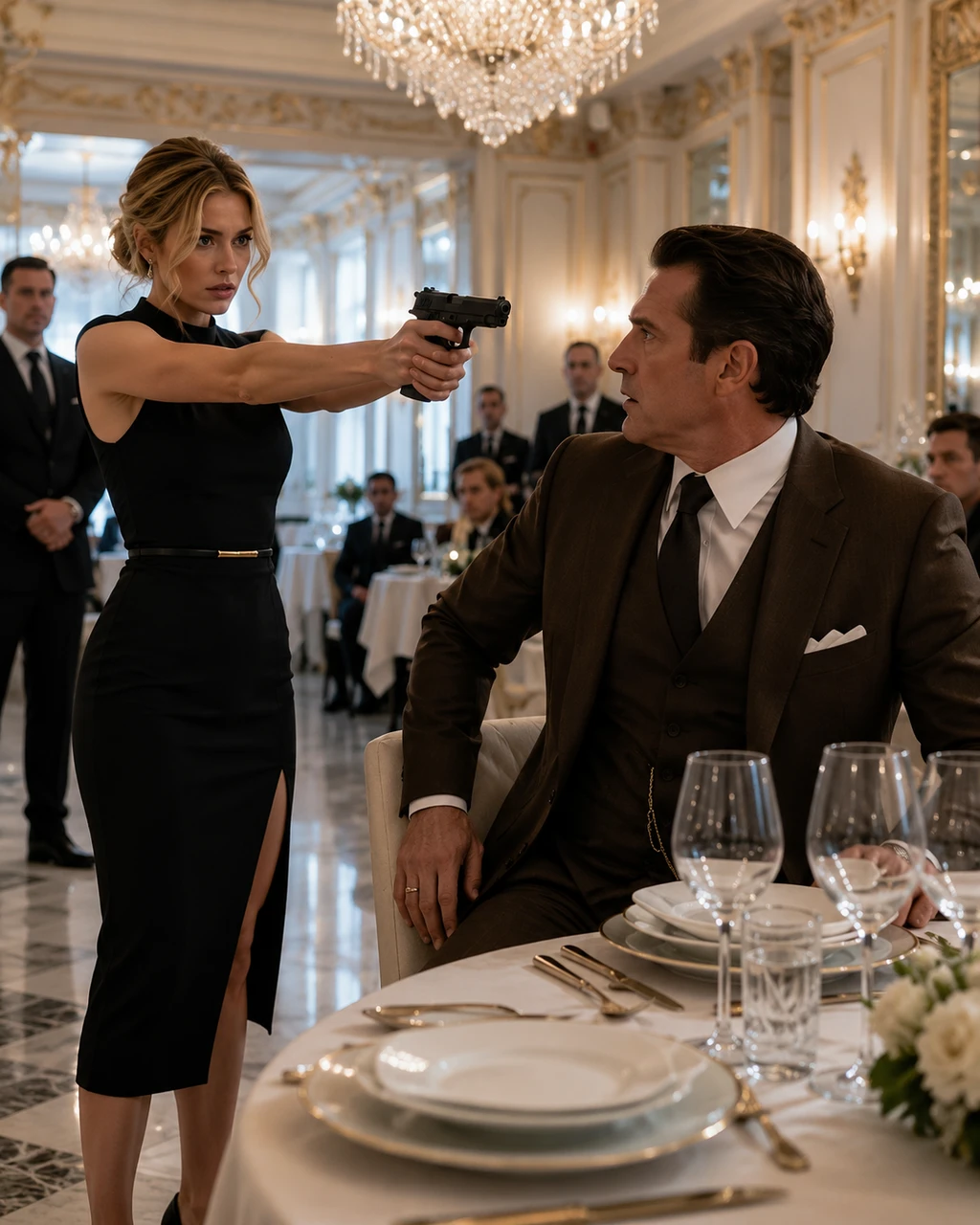
Six Seconds of Silence: The Moment the Mafia Boss Met His Match
Part 1: The Weight of the Cylinder
The silver revolver sat on the glass tabletop like a predatory insect. Its barrel caught the low, amber light of the chandelier, glinting with a lethal, polished promise. The room, which had been buzzing with the low, sycophantic chatter of Lorenzo’s inner circle, fell into a vacuum of silence so deep it felt like the air itself had been sucked out.
Marco, still standing behind the sofa, rested a hand on his holster, his eyes locked on Sarah with a mixture of amusement and predatory curiosity. He wanted her to bolt. He wanted to see the mask slip, to see the terror break the porcelain stillness of her face.
Lorenzo Valente didn’t even look at the weapon. He kept his eyes on Sarah, his expression unreadable, a faint, ghost-like smile hovering at the corners of his mouth. “They say,” he began, his voice smooth as silk over sandpaper, “that fear is a biological response to an objective threat. But you, Sarah… you seem to have mastered the ability to override your own biology.”
Sarah sat on the very edge of the leather cushion, her hands folded primly in her lap. She felt the vibration of the bass from the club below through the soles of her shoes, a rhythmic thumping that reminded her of a panicked heartbeat. Keep breathing, she told herself. Don’t think about the gun. Think about the rent. Think about the oxygen concentrator for Nana.
“It’s not a mastery, Mr. Valente,” Sarah said, her voice steady, though it sounded strange to her own ears, thin and fragile in the stifling room. “It’s a calculation. If I panic, I make mistakes. If I make mistakes, I lose my job. If I lose my job, I lose everything.”
“And if you pick up that gun?” Lorenzo gestured toward the table. The cylinder sat heavily, a cold, metallic fact of life. “What does that calculate to?”
Sarah stared at the weapon. Her pulse hammered against her throat, but she didn’t look away. She reached out, her fingers hovering just inches from the cold steel. The room felt like it was tilting on its axis.
“I don’t know,” she whispered.
“Try it,” he challenged, leaning closer. The scent of sandalwood and expensive tobacco rolled off him. “Prove to me that your heart isn’t just a pump, but a choice.”
Sarah’s hand trembled—a microscopic movement, barely perceptible—but she closed her fingers around the grip. The weight was heavier than she expected, cold and unyielding. She didn’t think; she let the quiet room in her head take over. She lifted the barrel, her arm extending with a fluid, unnatural grace, and pointed it directly at the space between Lorenzo’s eyes.
The room erupted into a chaos of movement. Marco pulled his weapon in a blur of motion, and three other men lunged forward, their hands flying to their waistbands.
“Stop!” Lorenzo barked, his voice sharp enough to cut glass. He didn’t blink. He didn’t even flinch. He just watched Sarah, his eyes widening with a terrifying, electric hunger.
Sarah’s finger rested against the trigger. She felt the resistance, the tiny amount of pressure needed to end the most feared man in Chicago. She saw the flickers of movement in the corner of her eye—the men circling her like wolves.
“The gun is loaded, Sarah,” Lorenzo whispered, his voice dangerously low. “There’s one in the chamber. You have the power to change the landscape of this city right now.”
She looked at him, and for a fleeting second, she didn’t see a monster. She saw a man who was bored, a man who had seen everything except the one thing he couldn’t control: an ending he didn’t write.
“I’m a waitress, Mr. Valente,” she said, her voice deathly calm. “I serve drinks. I don’t settle debts.”
She lowered the gun to the table, her hand shaking violently the moment it lost contact with the steel. She stood up, her breath hitching in her chest, and turned to walk away.
“Wait,” Lorenzo said.
She froze.
“You haven’t told me what you think of the service,” he added, his voice chillingly light.
Sarah looked back. The room was deathly still, the tension thick enough to choke on. She realized then that she hadn’t just passed a test; she had stepped onto a wire, and there was no way to get off.
Part 2: The Architect of Shadows
“The service is adequate,” Sarah said, her voice steadier than she felt. She didn’t wait for him to dismiss her again. She turned and walked, her footsteps clicking sharply against the polished concrete floor of the corridor.
She didn’t stop until she reached the alley behind The Obsidian. The air was thick with the scent of damp pavement and the metallic tang of urban rot. She leaned against the brick wall, her lungs burning as she dragged in great, ragged gasps of the humid Chicago night air.
Why didn’t he shoot me?
She kept seeing his face—the way his eyes had brightened when she pointed the gun at him. It wasn’t the look of a man facing death. It was the look of a man who had finally found a new toy.
“You’re shaking, kid.”
Sarah jumped, spinning around. A man leaned in the shadows of the fire escape. He was older, his face a roadmap of scars and bad decisions. It was Silas, the man who handled the deliveries for the club. He was the one who whispered warnings when the air turned sour.
“He wants something,” Sarah said, her voice trembling. “Silas, why is he doing this?”
Silas stepped out into the dim light. He lit a cigarette, the match flare illuminating his weary, hollowed-out eyes. “Enzo doesn’t play games, Sarah. He plays with people. Most of them break. The ones who don’t? They disappear into the architecture of his life. He doesn’t want you dead. He wants to know what makes you tick so he can use the rhythm.”
“I have to leave,” she said, desperation clawing at her throat. “I’ll go to another city. I’ll go to my aunt’s in Nebraska.”
Silas let out a hollow, humorless laugh. “There is no ‘away’ from him. You saw the inner circle. You pointed a gun at his head and walked out. In his world, that makes you a legend—or a target. You’re already part of the story, Sarah. The only question is whether you’re the protagonist or the collateral damage.”
Sarah thought about her life. The small apartment with the peeling wallpaper. The medical bills. The crushing, suffocating weight of being invisible. She had spent her whole life trying not to be noticed, and yet, here she was, the center of the most dangerous man’s attention.
She went home that night, but she didn’t sleep. She sat in the dark, watching the door. When the sun finally bled over the horizon, she did something she hadn’t done in years. She opened the floorboard beneath her bed and pulled out the small, worn box her father had left her.
Inside was a badge, a faded photograph of a man she barely remembered, and a notebook filled with names, dates, and locations—things that didn’t make sense to a child, but looked like a roadmap to an adult.
She opened the notebook to the final page. There was a single name written in her father’s shaky handwriting: Valente.
Her heart skipped a beat. The past wasn’t just a memory; it was a debt. And she had just walked right into the heart of the creditor’s house.
The next night, when she walked into The Obsidian, she felt different. The fear was still there, but it was buried under a cold, sharp-edged resolve. She wasn’t just Sarah Miller, the waitress, anymore. She was something else.
As she walked toward the stairs, Greg grabbed her arm, his face frantic. “Don’t go up there, Sarah. Please. He’s… he’s been asking for you since noon. He’s in a mood. A bad one.”
Sarah pulled her arm away, her eyes flashing with a sudden, icy fire. “I have a table to serve, Greg.”
She pushed past him, her heart thudding in time with the bass. She didn’t just walk to the private suite; she marched. She had answers to find, and she wasn’t going to let the devil stand in her way.
Part 3: The Price of Knowledge
The suite was silent. The music from below was a distant, muffled throb. The air smelled of ozone and expensive cologne. Lorenzo was sitting alone, his feet propped up on the table, staring at the ceiling.
He didn’t look at her when she entered. He just gestured to the chair across from him. “You’re late again, Sarah.”
“I was busy,” she replied, dropping the tray onto the side table.
Lorenzo turned his head, his gaze sweeping over her with a clinical intensity that made her skin crawl. “Busy with what? Your nursing classes? Your sick grandmother? Or are you finally starting to realize that the life you’re living is too small for you?”
Sarah didn’t sit. She stood, her hands clenched at her sides. “Why are you doing this, Lorenzo? Why the games?”
He stood up then, moving with the predatory grace of a cat. He walked toward her, and Sarah stood her ground, refusing to retreat. He stopped inches from her, his presence overwhelming, a wall of cold authority.
“Because you interest me,” he whispered, his eyes searching her face as if looking for a crack in the armor. “You have this… detachment. This ability to see the world as a series of facts instead of feelings. It’s a gift, Sarah. Most people are governed by their terror. You? You are governed by your necessity.”
“Is that all I am to you? A curiosity?”
“For now.” He reached out and touched her cheek, his skin cold. Sarah didn’t pull away. She saw the flickers of something in his eyes—a shadow of recognition, perhaps, or a memory he couldn’t quite place. “I want to see what you do when the stakes are real. Not for money. For survival.”
He reached into his pocket and pulled out a small, ornate envelope. He dropped it on the table between them.
“Open it,” he said.
Sarah hesitated, her breath catching in her throat. She picked up the envelope, her fingers trembling. Inside was a photograph. It was an old picture, yellowed at the edges. It was her father, smiling, standing next to a younger version of Lorenzo. They were standing in front of the very building they were in now, though it had looked very different then—less gold, more grit.
“I knew your father,” Lorenzo said, his voice devoid of emotion. “He was a man of… vision. He helped me build this city, in his own way. And then he made a mistake. A very costly mistake.”
Sarah’s blood turned to ice. “What did he do?”
“He tried to play both sides,” Lorenzo said, walking to the window and looking out at the city lights. “He thought he could be the hero and the villain at the same time. It’s a common fantasy.”
“He died because of you,” Sarah whispered, the words coming out before she could stop them.
Lorenzo turned, his face unreadable. “He died because he was weak. He chose a path that led to a dead end. And now, you’re on that same path, Sarah. You’re working in my club, living in the shadow of the man who ruined your life. And you’re doing it with such beautiful, quiet grace.”
Sarah felt a surge of rage, hot and blinding, consume her. She wanted to hit him, to scream, to tear the room apart. But she forced it down. She shoved it into that quiet, empty room in her head.
“I’m not my father,” she said, her voice a low, dangerous whisper.
Lorenzo’s smile returned, darker and more predatory than before. “That remains to be seen.”
He gestured to the door. “Get back to work, Sarah. I have a feeling our next act is going to be quite spectacular.”
Sarah turned and left, her mind reeling. The photograph burned in her pocket. She had come here to survive, but now, she realized, she was being pulled into a war that had started before she was even born. And the worst part was, she knew she couldn’t walk away. Not anymore.
Part 4: The Breaking Point
The days turned into a blur of grey light and neon shadows. Sarah worked her shifts at The Obsidian with a precision that bordered on machine-like. She moved through the room like a ghost, serving drinks, clearing tables, and avoiding the gaze of the men who filled the place with their whispered secrets and heavy silences.
She felt the eyes of Lorenzo on her constantly. Even when he wasn’t in the room, she felt his presence—the weight of his observation, the pressure of his expectations.
Her grandmother’s health was failing. The nurses told her it was only a matter of time. Sarah spent her days at the hospital, sitting by the bed, reading to her, or just holding her hand. Every night, she returned to the club, the artificial world of The Obsidian, and played the part of the waitress who had no past, no fear, and no future.
One night, the back door of the club swung open, and a man she didn’t recognize stumbled in. He was bleeding from a wound in his side, his face pale and grey. He grabbed Sarah’s arm, his grip tight and frantic.
“Help me,” he gasped, his voice a ragged whisper. “They’re coming. I have something… something he needs.”
Sarah looked at the door. Through the glass, she saw the silhouette of two men, their guns drawn, moving with the cold, deliberate pace of professional killers.
She didn’t think. She didn’t analyze. She acted.
She dragged the man into the service closet, kicking the door shut just as the shadows passed by outside. She pressed a hand over the man’s mouth, her heart hammering against her ribs like a trapped bird.
“Quiet,” she commanded, her voice barely a breath.
The man slumped against her, his blood warm and sticky on her uniform. She reached into the supply cabinet, pulling out gauze and antiseptic. She worked with the training she’d picked up from her nursing classes, her hands steady, her movements efficient.
“Who are you?” she asked, her voice low.
“I’m a messenger,” the man whispered, his eyes wide with pain. “He doesn’t want you to know the truth, Sarah. The things your father did… they weren’t about money. They were about protection.”
“What kind of protection?”
“He was the one who kept the city from burning,” the man said, his breath hitching. “He was the architect. And Lorenzo? He was just the blunt instrument.”
Sarah felt a shiver run down her spine. The pieces of the puzzle began to click into place, forming a picture that was more terrifying than anything she had imagined.
“Why are you telling me this?”
“Because you’re the only one left who can finish what he started,” the man said, then his head slumped forward. His breathing slowed, then stopped.
Sarah stared at his body, the silence in the room heavy and oppressive. She had just become a witness to a murder, a protector of a secret, and the target of a hunt. She was no longer just a waitress. She was an accomplice.
She heard a sound outside the closet. A soft, measured knock on the door.
“Sarah?” Lorenzo’s voice, smooth and calm, drifted through the wood. “I know you’re in there. And I know you’re not alone.”
She stood up, her heart a dull ache in her chest. She had a choice to make: open the door and face the devil, or find a way out that would haunt her for the rest of her life.
She wiped the blood from her hands, straightened her apron, and reached for the doorknob.
“I’m coming,” she said.
Part 5: The Architect’s Daughter
The door swung open, and there he was. Lorenzo Valente, standing in the dim light of the hallway, his suit impeccable, his eyes scanning the closet. When he saw the body on the floor, he didn’t look shocked or surprised. He looked disappointed, as if he’d been expecting a better performance.
“You really should learn to choose your company better, Sarah,” he said, stepping over the body without a glance.
“He was dying,” Sarah said, her voice steady. “He asked for help.”
“And you gave it to him,” Lorenzo mused, looking at the blood-stained gauze in her hands. “That’s the problem with you, Sarah. Your empathy. It’s a weakness. It’s the one thing that will get you killed in this world.”
“I don’t think it’s a weakness,” Sarah replied, standing tall. “I think it’s the only thing that separates me from you.”
Lorenzo laughed, a dry, hollow sound that echoed in the narrow corridor. “And what does that separation get you? Does it pay the hospital bills? Does it keep your grandmother alive? Does it save you from the people who are coming for that package?”
“What package?” Sarah asked, her heart racing.
Lorenzo gestured to the dead man’s jacket. Sarah reached down, feeling the bulge in the inner pocket. She pulled out a small, leather-bound notebook. It looked exactly like the one in her father’s box.
“Your father was a collector of secrets,” Lorenzo said, his voice dropping to a low, intimate tone. “He knew that the only way to survive in this city is to hold the strings. He kept a record of everything—the bribes, the betrayals, the bodies. He thought it would protect him. He was wrong. It was his death warrant.”
“And you want it,” Sarah said, clutching the notebook to her chest.
“I want it, yes,” Lorenzo agreed. “But more than that, I want to see if you have the strength to use it. Your father was a brilliant man, but he lacked the cruelty to survive his own creation. I’m curious to see if you inherited his brain—or his flaws.”
He stepped closer, his gaze locked on hers. “You have two choices, Sarah. You give me the book, and you go back to your life. You take your grandmother to the best doctors, you live in comfort, and you never have to worry about a bill again. Or, you keep it. And you find out exactly how much your father’s legacy is worth.”
Sarah looked at the book. It was heavy, a burden she hadn’t asked for, a weight that promised to drag her under. She thought about her grandmother, about the quiet life she had dreamed of. And then she thought about the man on the floor, and her father, and the secrets that had destroyed everything she had ever cared about.
“I choose the truth,” she said.
Lorenzo’s expression darkened, a flicker of something raw and dangerous passing through his eyes. “The truth is a heavy thing to carry, Sarah. It will burn you to the ground.”
“Then I’ll burn,” she replied.
Lorenzo stepped back, a slow, predatory smile spreading across his face. “Very well. Then let the game begin.”
He turned and walked away, leaving her alone with the body and the book. Sarah knew then that there was no turning back. She had stepped off the ledge, and now she was falling, the wind rushing past her ears, the darkness waiting below. But for the first time in her life, she wasn’t afraid. She was ready.
Part 6: The Game of Echoes
The city of Chicago felt different now. Every shadow held a secret, every street lamp seemed to illuminate a tragedy, and every person she passed felt like an actor in a play she had just been handed the script for.
Sarah spent her days in the public library, pouring over the contents of the notebook. It was a dense, intricate web of information—names of city officials, records of illicit real estate deals, and names of people who had simply vanished into the night. It was the blueprint for the entire underworld, a map of the rot that held the city together.
She realized, with a sinking feeling, that her father hadn’t just been an observer. He had been the one who had kept the machine running. He had been the one who had facilitated the deals, the one who had ensured that the right people were paid and the right people were silenced.
The weight of it was suffocating.
She kept going to the hospital, sitting by her grandmother’s bed, listening to the rhythmic beep of the machines. One night, her grandmother opened her eyes, her gaze clear and sharp.
“Sarah?” she whispered, her voice raspy.
“I’m here, Nana,” Sarah said, reaching out to take her hand.
“You look like him,” her grandmother whispered, a flicker of pain in her eyes. “You have his look. That look that says you’re trying to figure out how to put the pieces together.”
“I’m trying to fix it, Nana,” Sarah said, tears stinging her eyes.
“You can’t fix a broken city,” her grandmother said, her grip tightening on Sarah’s hand. “You can only survive it. Don’t let them turn you into what they are. Don’t let the darkness take your light.”
Her grandmother died that night.
Sarah didn’t cry. She didn’t scream. She sat in the sterile room, listening to the silence of the machine that had finally stopped beating. She felt a strange, cold emptiness in her chest, a void where her world had once been.
She walked out of the hospital, the night air biting at her skin. She had nothing left to lose. No bills to pay, no one to protect, no future to dream of.
She went to The Obsidian.
The club was packed, the bass shaking the walls, the crowd lost in the haze of alcohol and artificial highs. She walked past the bar, past the service station, and straight to the VIP area. She didn’t wait to be announced. She walked right into the private suite.
Lorenzo was there, surrounded by his men, laughing at a joke one of them had told. The music died down as she entered. The men went still, their hands hovering near their weapons.
Lorenzo looked up, his eyes widening as he saw her. “Sarah. You’re back.”
“My grandmother died tonight,” she said, her voice devoid of any emotion.
Lorenzo looked at her, his expression shifting into something unreadable. “I’m sorry for your loss, Sarah. But that doesn’t change the fact that you’re here.”
“I’m not here for sympathy,” Sarah said, pulling the notebook from her jacket. She threw it onto the table, the sound of it hitting the glass sharp as a gunshot. “I’m here to settle the debt.”
The room went deathly silent.
“You want the truth?” she asked, her gaze locked on Lorenzo’s. “The truth is, you’re not the one who runs this city. You’re just the one who takes the blame. My father wasn’t your subordinate. He was your mentor. He taught you everything you know. And now, I’m going to show you exactly what he left behind.”
She pulled a remote from her pocket and pressed a button.
Part 7: The Final Act
The screen mounted on the wall behind the bar flickered to life. It began to display documents, photos, and recordings—the contents of the notebook, broadcasted to every screen in The Obsidian. The music cut out. The club fell into a stunned, deafening silence as the dirty laundry of Chicago’s elite began to scroll across the room in high definition.
Lorenzo stared at the screen, his face turning a mask of pure, unadulterated rage. He looked at Sarah, his eyes burning with a fire that was both terrifying and strangely impressed.
“You,” he whispered, his voice trembling with fury. “You just destroyed everything.”
“I didn’t destroy anything,” Sarah said, her voice clear and resonant. “I just exposed the truth. You spent your whole life trying to control the narrative, Lorenzo. You thought you were the author. But you were just a character in someone else’s story.”
The men in the room were panicked, whispering to each other, their eyes darting toward the exits. They knew that the information on that screen was enough to bring the entire city down on top of them.
“You think you’re going to get out of here alive?” Marco hissed, reaching for his weapon.
“Stop!” Lorenzo barked, though his voice lacked its usual authority. He looked at Sarah, his gaze softening into something like respect. “You have his spirit, Sarah. I’ll give you that.”
“I don’t want your respect,” Sarah said, her voice cold. “I want justice. And the only way to get it is to burn this place to the ground.”
She reached into her pocket and pulled out a small, metallic device—a detonator.
“I know the wiring in this building, Lorenzo,” she said, her voice steady. “I know where the gas lines are, and I know how to cut the power. You think you’re the master of the shadows, but you forgot one thing: you built this place on top of a foundation of secrets, and secrets have a way of collapsing.”
Lorenzo looked at her, his expression shifting from rage to a haunting, quiet recognition. “You’re going to kill us all?”
“I’m going to end the cycle,” Sarah said, her finger resting on the button.
The men were shouting now, the sound of the panic below rising through the floorboards. The police sirens were already wailing in the distance, a chaotic symphony of approaching reckoning.
“Do it, then,” Lorenzo said, leaning back in his chair. “Show me that you’re your father’s daughter. Show me that you can do what he never could.”
Sarah looked at him. She saw the man who had been the architect of her pain, the monster who had shaped her life, and the only person in the world who truly understood the darkness she carried.
She looked at the screen, where the final, incriminating document was being displayed.
She closed her eyes, and for a second, she was back in the quiet room in her head. She saw the past, the present, and the future. She saw the choice.
She let go of the detonator.
She turned and walked toward the door.
“Where are you going?” Lorenzo called out, his voice echoing in the vast, emptying room.
“I’m leaving,” Sarah said, not looking back. “You’ve already destroyed yourself, Lorenzo. You didn’t need my help for that.”
She walked out of the suite, down the stairs, and into the night. The club was in chaos, people screaming and running for the doors. She stepped into the cool, damp air, the rain beginning to fall.
She looked up at the neon sign of The Obsidian, flickering and dying as the power began to fail.
She had no home, no money, and no future. But she had something she hadn’t had in years: she was free.
She turned and walked into the shadows of Chicago, a ghost among the living, a woman who had seen the face of the devil and refused to blink. And as the city began to wake up to the truth, Sarah Miller disappeared, leaving behind only the echo of a story that would never be forgotten.