The Hostage-Taker Chose the Wrong Nurse — He Had No Idea She Was Special Operations
Part 1: The Quiet Professional
Nobody paid much attention to nurse Rachel Carter. That was exactly how she liked it. Mercy Valley Medical Center employed over three hundred nurses, and Rachel was just one more face among them. At thirty-two, with brown hair tied into a practical bun, blue scrubs, and a calm, quiet smile, she was unremarkable. Doctors barely looked her way, and most of her colleagues assumed she was just another dedicated employee who preferred the graveyard shift because it was less stressful. They knew she never panicked, but they didn’t know why.
The truth sat buried beneath ten years of classified military records—records that officially did not exist. These files described operations in places most people couldn’t find on a map, involving tactical maneuvers and high-stakes survival. Rachel had spent the last two years at Mercy Valley trying to forget the adrenaline, the tactical gear, and the constant threat of violence. She wanted the peace of a normal life. She wanted to be the person who saved lives with medicine, not with a combat knife.
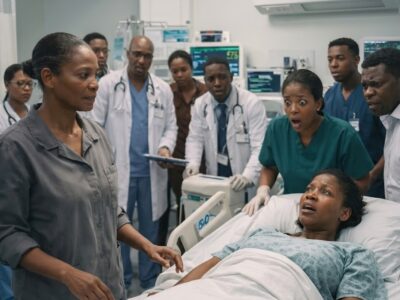
On Thursday, that plan shattered. The emergency department was experiencing the kind of chaos that usually only happened on television—packed rooms, weeping families, and doctors pushed to their limits. When the ambulance arrived with a gunshot victim in critical condition, Rachel moved to assist without hesitation. As the trauma team worked to stabilize the man, he suddenly gripped her wrist with surprising strength. His eyes fluttered open, and he whispered, “They found me.”
Before Rachel could react, the man lost consciousness, and the monitors screamed a warning. Dr. Michael Reynolds, the chief of emergency medicine, caught the look on Rachel’s face for a split second. He was a man who noticed everything, and he saw something that didn’t belong on a nurse’s face: raw, calculated fear. Then, just as quickly, it vanished.
Rachel went back to work, but her instincts—the ones she had tried so hard to suppress—had kicked into high gear. She began scanning the room, checking the exits, and tracking movement. That was when she saw them. Three men walked through the main doors. They were dressed in expensive suits and moved with an eerie, coordinated confidence. They didn’t look like visitors; they looked like hunters. One of the men locked eyes with Rachel for a brief moment. She didn’t know his face, but she knew the look in his eyes. It was the look of a predator.
She stepped into a medication room and closed the door, her heart hammering against her ribs. She had a number memorized—a contact from her past that she hadn’t dialed in years. Her thumb hovered over her phone screen, but she hesitated. Was she overreacting? She slipped the phone back into her pocket just as a deafening sound shook the building. Boom. A gunshot echoed through the lobby, followed by screams. The emergency department transformed into a war zone, and Rachel knew with chilling certainty that the men had come for the patient—or perhaps, they had come for her.
Part 2: The Siege Begins
The lobby was a nightmare of scattered chairs, fleeing visitors, and terrified cries. Rachel didn’t run away; she moved toward the sound of the gunfire, her body reacting on autopilot. She saw the three men—they weren’t hiding anymore. They wore body armor and carried military-grade rifles. One security guard was already unconscious; another had been disarmed. The lead gunman, a man with a cold, professional demeanor, held a pistol to the hospital administrator’s head.
“Nobody moves,” the gunman commanded. The silence that followed was heavy and suffocating.
Rachel scanned the room, counting shooters. Three visible, but her gut told her there were more lurking in the shadows. Then, a six-year-old girl, standing near her terrified mother, began to wail. The gunman turned, annoyed, and started walking toward the child. Rachel didn’t think; she moved. She placed herself directly between the gunman and the little girl. The lobby held its breath.
“She’s scared,” Rachel said, her voice eerily calm.
The gunman laughed. “So am I.” He stepped closer, studying her, sensing something off about her posture, her lack of fear. He pointed his pistol at her. “Congratulations, nurse. You’re my new hostage.”
As he dragged her toward the center of the lobby, Rachel began her assessment. She wasn’t fighting back yet. She was gathering data: the weight of his grip, his center of gravity, his dominant hand. She was letting him believe he was in control. Outside, the police had already surrounded the hospital, and news helicopters were circling overhead, but inside, the situation was descending into a lethal game of chess.
The gunman received a radio transmission, nodded, and smiled. “Good news,” he muttered. Whatever they were waiting for was drawing closer. Rachel looked around the room, observing the panic on the faces of the doctors and the helplessness of the guards. She was counting seconds, distances, and vulnerabilities. The gunman turned to her and sneered, “You’re very calm for someone about to die.”
“I’m a nurse,” Rachel replied. “I deal with emergencies.”
He laughed, but the laughter didn’t reach his eyes. He remained suspicious. He couldn’t put his finger on it, but he knew he was missing something crucial about the woman he held at gunpoint.
Part 3: The Target
The surgery team remained trapped in operating room three, desperately trying to keep the gunshot victim alive. The patient regained consciousness just long enough to whisper, “They killed my team. They’ll kill everyone.” The surgeon felt a cold shiver; the man wasn’t fighting for his own life; he was fighting to keep the hospital from becoming a slaughterhouse.
Back in the lobby, the lead gunman kept studying Rachel. The way she observed the exits, the way she tracked the movement of his men—it wasn’t the behavior of a medical professional. It was the behavior of a soldier. He leaned close to her ear, his voice a low rasp. “Former military?”
Rachel didn’t blink. “I’m a nurse.”
“Medics don’t watch exits,” he countered, his eyes narrowing. “Medics don’t check my reflection in the glass.”
Rachel stayed silent. She knew the game was changing. If he realized her background, he would kill her immediately rather than keeping her as a hostage. Suddenly, a young nurse cried out. An elderly patient was crashing, his oxygen levels dropping dangerously low. The lead gunman looked annoyed, but he gestured for Rachel to help. “Go,” he ordered, his pistol tracking her every movement.
Rachel knelt beside the patient. She worked with a quiet, efficient precision that was far beyond the scope of a standard clinical nurse. As she stabilized the old man, she caught the eye of Dr. Reynolds. She gave him a tiny, almost imperceptible nod—a command to stay quiet.
Outside, a black SUV arrived. A gray-haired man stepped out. He carried no insignia, but the police commander turned pale when he saw the credentials the stranger flashed. “Is Rachel Carter inside?” the man asked.
“Yes,” the commander said, his voice trembling.
The gray-haired man sighed, looking at the hospital with a weary, knowing expression. “If Rachel Carter is inside, the hostage takers are already dead men walking.”
Part 4: The Hidden Threat
Inside the lobby, Rachel saw it: a small, metallic click. One of the gunmen was planting something beneath a waiting-room chair. Her blood ran cold. It was an explosive charge. She realized the horrifying truth—the hospital wasn’t just a hostage scene; it was a bomb site. They weren’t planning to negotiate; they were planning to level the building to cover their tracks.
The lead gunman’s radio crackled. “Someone moved the patient.”
His face twisted into a mask of fury. “Find him!”
He turned to Rachel, his eyes burning with suspicion. He dragged her toward the center of the lobby, grabbing the attention of everyone in the room. He forced one of his men to turn on the large television, and suddenly, the entire world was watching the live broadcast of the siege.
“We want the patient,” the gunman told the camera, holding his pistol to Rachel’s head. “One hour. After that, the nurse dies first.”
In the police command center, the gray-haired man laughed. The commander looked at him, stunned. “You find this funny?”
“Look at her,” the man said, pointing at the screen. “She isn’t panicking. She’s calculating. God help those idiots.”
Rachel watched the gunman’s reflection in the TV screen. She saw the explosive charges being armed one by one. She realized that the lead gunman didn’t even know his own employer had betrayed him. He was a contractor, a pawn in a much larger, darker game. Someone higher up was pulling the strings, someone willing to sacrifice the gunmen along with the hostages.
Dr. Reynolds, huddled among the terrified civilians, managed to whisper to her, “Rachel, what do we do?”
Rachel didn’t look at him. She stared straight ahead, her voice barely a breath. “Trust me.”
The doctor felt a chill that had nothing to do with the air conditioning. The woman speaking to him was no longer the quiet nurse from the graveyard shift. She sounded like a commander briefing her squad for a high-risk extraction.
Part 5: The Realization
The radio in the gunman’s hand exploded with panicked voices. “Boss, we have a problem.”
The gunman pressed the radio to his ear. “What now?”
“We identified the nurse. She was special operations. Tier one. Her unit nickname was Ghost Angel.”
The lead gunman froze. His face went gray. He slowly lowered the radio, his eyes locked onto Rachel. The fear in his gaze was palpable, shifting from the hunters to the hunted. He knew the stories. Ghost Angel wasn’t just a soldier; she was a legend.
The lobby grew silent. The dynamic had shifted entirely. The gunmen were no longer in control; they were terrified, realizing they had captured the one person who could turn the hospital into their graveyard. The gunman stepped back, trying to regain his composure, but his hands were shaking. He was looking at Rachel and finally seeing what she really was: a weapon in the form of a nurse.
“Who are you?” he hissed, his voice cracking.
“You wouldn’t believe me,” Rachel replied calmly.
Suddenly, the intercom crackled. A calm, authoritative voice echoed through the building. “Attention.”
Rachel’s posture straightened. She recognized that voice. It was her former CO. The entire building fell into a deep, heavy silence. The voice continued, “Rachel. Permission granted.”
The words acted like a signal. The lead gunman lunged for her, desperation making him sloppy. He was trying to reassert his authority, but he had waited too long.
Rachel moved. She was a blur of motion, her hands striking with surgical precision. She twisted the gunman’s wrist, heard the snap of bone, and disarmed him before the weapon hit the floor. The lobby erupted into chaos as the other gunmen opened fire, but Rachel had already utilized the gurney for cover. She was a ghost in the scrubs, moving with the fluidity of a predator. The federal rescue team, seeing the signal from outside, breached the lobby walls. The siege was ending in a storm of tactical maneuvers and high-intensity gunfire.
Part 6: The Architect
The federal operators flooded the lobby, neutralizing the remaining gunmen with professional ease. But Rachel didn’t stop. She knew the bombs were still active. She grabbed the lead gunman by the throat, pulling him upright. “How many?” she demanded.
The man spat blood, his eyes dull with defeat. “Those weren’t our explosives,” he wheezed. “The real threat is the hospital itself.”
Rachel’s blood ran cold. The intercom flickered to life again. It was the voice of Gabriel Mercer—the man who had orchestrated the entire nightmare. “Impressive,” Mercer’s voice drawled through the speakers. “You always were difficult to kill, Rachel. But the hospital still dies today.”
Every fire alarm in the building shrieked at once. Rachel sprinted toward the maintenance tunnels. She knew Mercer. He wouldn’t be in the lobby; he would be at the heart of the system, controlling the collapse. The federal team followed, but they were playing catch-up to a woman who had been trained for this exact scenario.
She reached the boiler room, descending deep into the bowels of the building. The air was thick with the scent of ozone and steam. There, standing over a master control panel, was Mercer. He looked like a man of business, not a man of violence. He held a detonator in his hand.
“Hello, Rachel,” he said, not even turning around.
“Walk away, Mercer,” Rachel said, her voice steady.
“No,” he replied, lifting the device. “History is written by survivors.”
He pressed the button. Nothing happened. He pressed it again. Still, silence. His face turned a dangerous shade of purple as he realized his masterpiece had been sabotaged. Linda, the head nurse, had done her work well. She had traced the lines, identified the bypasses, and disconnected the network while the world was distracted by the gunfire upstairs.
Part 7: The Aftermath
Mercer lunged for her, but he was a man of desks and directives, not combat. Rachel met him with a single, devastating strike. He hit the concrete floor, his eyes glazing over as the federal team surged in, weapons leveled. The siege was over.
Hours later, the sun crept over the horizon, painting the Mercy Valley Medical Center in gold. The street was crowded with ambulances and news vans. Rachel sat on the curb, her blue scrubs stained with dust and grime, her hands still steady. A little girl approached her, hugged her tightly, and asked, “Are you a superhero?”
Rachel looked at her colleagues—the doctors, the nurses, the people who had risked their lives to protect their patients. She saw Linda, still checking charts as if the last few hours hadn’t happened. She saw Dr. Reynolds, his face etched with exhaustion and respect.
“No,” Rachel said, shaking her head. “They are.”
Dr. Reynolds sat down beside her, handing her a bottle of water. “Ghost Angel, huh?”
Rachel sighed, her exhaustion finally catching up with her. “I was a nurse.”
Reynolds laughed, a sound of genuine relief and wonder. “I think you’re both.”
As the morning proceeded, Rachel looked at her hands. They didn’t shake. She had spent years trying to bury the soldier, to keep the Ghost Angel hidden beneath the persona of a quiet nurse. But as she watched the people of Mercy Valley beginning to rebuild their lives, she realized she didn’t need to choose. She was a healer, and when the world turned dark, she was the one who stood in the gap. The siege was over, the hospital stood, and for the first time in years, Rachel Carter felt exactly like who she was meant to be. The Ghost Angel had found a home, and the world was just a little bit safer for it. She stood up, brushed the dust from her scrubs, and walked back inside to finish her shift. There were still patients to care for, and the work was far from over.