The Mafia Boss Saw a Man Chasing an 18-Year-Old Girl… Do You Know Him? Her Answer Changed Everything
Part 1: The Rain and the Refuge
The rain behind Marchettes wasn’t just falling; it was attacking. It hammered the pavement in unrelenting, thick sheets, flooding the gutters and turning every crack in the city sidewalk into a rushing, muddy river. Above the back entrance, the neon sign flickered—red, white, red—casting a pulsing, jagged light that made the puddles look like they were bleeding into the dark.
Inside, Marchettes was a sanctuary of white tablecloths and expensive wine. It was a place for hushed deals and untouchable people. Kieran Ashford sat in the corner booth, his back to the wall, exactly where he had sat for years. He was forty-six, silver-tempered, with a jaw set in stone. In front of him sat a glass of bourbon, untouched. Across from him, his second-in-command, Luca, was talking about a shipment problem at the docks, but Kieran heard nothing. He was watching the rain, feeling the familiar, suffocating weight in his chest—a ghost of an old grief that never quite died.
Then, the back door didn’t just open; it exploded inward with the force of a gunshot.
The girl who stumbled in was a wreck. She was eighteen, thin, and shivering, her gray hoodie soaked through. She looked like a trapped animal, scanning the dining room with wide, wild eyes before collapsing to her knees near the booth. The kitchen staff froze; the diners at nearby tables put down their forks. Kieran was already on his feet, his senses heightened, his protective instincts firing before his brain could even process the threat.
Behind her, a man walked in. He was tall, mid-fifties, with a close-cropped beard and an air of polished, terrifying calm. He adjusted his leather jacket as if they were simply walking into a theater. “She’s my stepdaughter,” the man said, his voice smooth and commanding. “She’s having an episode.”
Nadia, the girl, flinched violently at his voice. She clawed at the carpet, her fingers digging into the fibers. Kieran stepped forward. He didn’t look at the man; he knelt in front of the girl, his face dropping to her level. “Do you know him?” he asked, his voice low and steady.
Nadia looked at him, her lips trembling, the bruise on her jaw stark against her pale, rain-slicked skin. She looked at Kieran, then back at the man—Glenn Hargrave—who was waiting with a practiced, predatory smile.
“He’s my stepfather,” she whispered, her voice cracking.
Hargrave let out a sigh of mock relief. “See? Like I said, she’s unwell.”
Nadia shook her head slowly, tears carving tracks through the grime on her face. “He’s been selling me,” she said, her voice rising, suddenly shrill with terror. “He’s been selling me for two years, and nobody believes me!”
The room went dead silent. Kieran felt the air grow cold. He wasn’t a man who believed in coincidences, and he certainly wasn’t a man who ignored a girl who looked exactly like the sister he had lost twenty-seven years ago. The door to his past, a door he had welded shut, creaked open. And on the other side, he saw a monster.
Part 2: The Mask of Respectability
Glenn Hargrave didn’t panic. He was a master of his craft—the craft of being the “good man.” He pulled a folded document from his jacket, his hands steady. “I have papers from her psychiatrist, Dr. Leland Ree. She has a history of delusions. Trauma responses from her biological father.”
Kieran stood up, his height giving him an immediate, overwhelming dominance. He looked at the document, then at Hargrave, and his eyes darkened into something dangerous. He knew the type. He knew the polished veneer of men who hid behind community outreach centers and donor lists.
“Luca,” Kieran said, his voice flat. “Close the restaurant.”
“Done,” Luca replied. Within minutes, the diners were gone, the doors locked, and the silence of the restaurant became a cage. Hargrave looked around, the practiced smile finally faltering as he realized he was surrounded by men who didn’t work for the public.
“This is kidnapping,” Hargrave stammered, his bravado leaking away. “I’ll call the police.”
“Call them,” Kieran said, stepping into Hargrave’s space. He was six inches shorter, but he felt twice as large. “I would love for the police to hear what she has to say.”
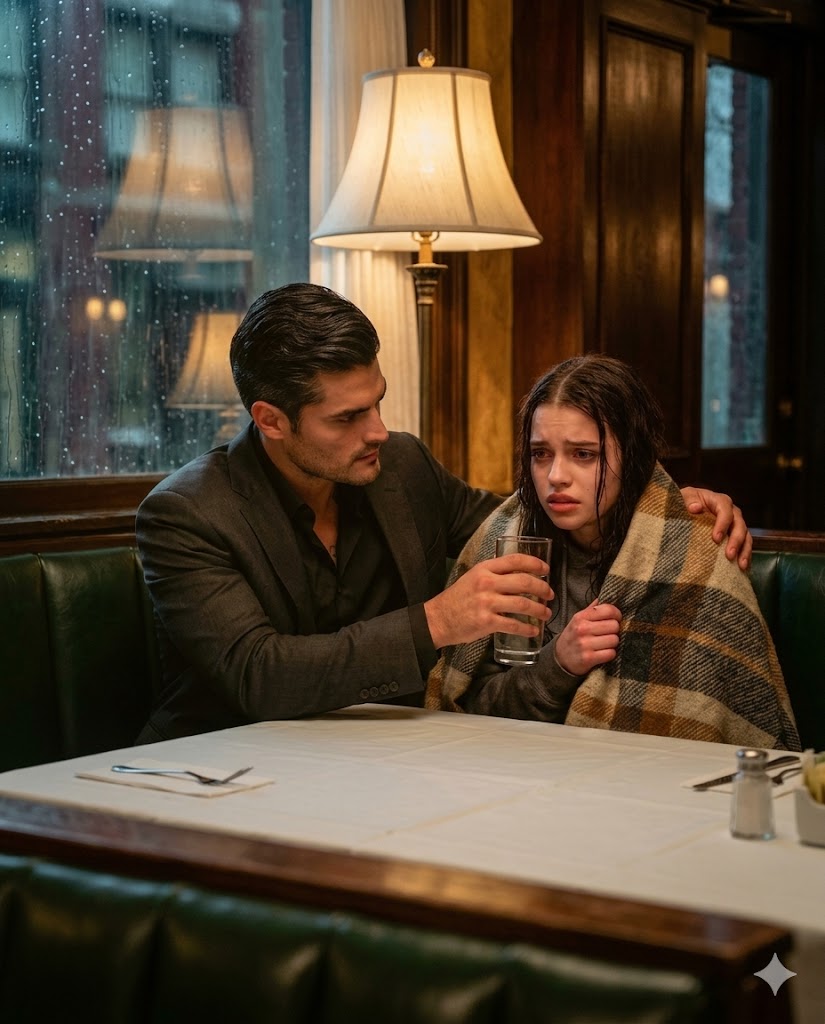
Nadia, wrapped in a blanket Luca had provided, began to speak. It started as a trickle and became a flood. She spoke of the real estate developers, the car dealership owners, the state senator—men of influence who came to the house when her mother worked late. She spoke of the “donor dinners” that were actually auctions of her body. She spoke of the psychiatrist who received generous donations to write lies that silenced her.
Kieran listened, his hands clenching at his sides. Every word felt like a physical blow. He thought of Colleen, his sister, who had vanished into the same kind of dark, quiet rooms. He had spent his life building an empire of fear to keep his own wounds from being touched, and here was a girl whose wounds were wide open, begging for someone to see them.
“He told me I was crazy,” Nadia whispered, clutching the blanket. “He made me believe it. Every time I reached out, he was there with his papers, his lawyers, his ‘concern.’ I was invisible.”
Kieran turned to Hargrave. The man was sweating now, his skin blotchy. “She’s sick,” Hargrave repeated, though his voice was a thin, rattling reed. “You don’t know what you’re doing.”
“I know exactly what I’m doing,” Kieran said. He looked at Luca. “Call Brin Torres.”
Brin Torres was a detective who knew where the bodies were buried—and who had buried them. When she arrived, she didn’t look like a savior; she looked like a judge. She took one look at Nadia and set her notebook down. She didn’t ask Kieran for the backstory; she didn’t need to. She just started recording. As Nadia recounted the name of a prominent state senator, Torres’s pen stopped moving for a heartbeat, then began to fly.
The trap was closing. But as Kieran watched, he saw a flicker in Hargrave’s eyes. A look that said he had a fail-safe. Kieran felt a chill down his spine. The game wasn’t just about truth anymore; it was about survival.
Part 3: The Web of Deception
The investigation moved with the speed of a landslide. Torres worked the case with surgical precision, moving through the layers of Hargrave’s life. They found the outreach centers—not just buildings, but nodes in a trafficking pipeline that had been hidden in plain sight for years. They found the doctor, Dr. Ree, who collapsed under the pressure of federal investigation, turning over a treasure trove of fabricated files that detailed the systematic gaslighting of seven different girls.
Nadia stayed at a hidden brownstone, a place Kieran had maintained for years as a ghost-house for those needing to disappear. Mrs. Callaway, the woman who ran it, was the only person who knew Nadia was there. Kieran visited twice, standing in the doorway, never staying long. He was terrified that if he got too close, he would somehow break the fragile progress she was making.
“She’s resilient,” Brin Torres told him during one of their secret meetings in a deserted parking lot. “But these men, Kieran… they’re connected to the city’s heart. Ellison, the developer? He’s on the mayor’s re-election committee. The senator? He’s slated to run for governor.”
“Then find the money,” Kieran said. “Follow the charitable donations. Hargrave wasn’t doing this for free. He was laundering the payment through the centers.”
“We’re trying,” Torres said. “But someone is scrubbing the records from the inside. We’re losing files.”
“They’re scrubbing from the top down,” Kieran countered. He looked out into the darkness. “I’ll handle the scrubbers.”
That night, Kieran met with Luca. They didn’t talk about business; they talked about leverage. They spent the night sifting through digital archives, tracking the movement of funds from the outreach centers to offshore accounts. They found the link—a shell company controlled by a local judge who had presided over several “custody” cases involving the girls in Hargrave’s pipeline.
The web was larger than they had dared to imagine. It wasn’t just a ring; it was an institution. It was a parasitic structure that fed on the marginalized and the forgotten.
The next morning, the papers hit. Not the newspapers—the private papers, sent to the city’s three most aggressive investigative journalists. A cache of bank statements, emails between Ree and Hargrave, and property deeds.
By noon, the city was in a panic. The “good man” mask had been ripped away, and the ugly reality was staring back at everyone. But as the arrests began, Kieran felt no triumph. He felt only the cold, hard reality that the wound in his chest was still there. And somewhere in the dark, Hargrave still had one more trick to play.
Part 4: The Fail-Safe
Hargrave was arrested on a Tuesday. He didn’t fight. He didn’t yell. He walked out of his home with the smile of a man who knew his lawyers were already drafting the motions. But that night, a fire started at the evidence locker of the precinct where Torres worked. It was small, contained, and extinguished before it could do real damage, but the message was clear: they were being watched.
Kieran knew that Hargrave’s fail-safe wasn’t legal—it was violent.
He drove to the brownstone. He didn’t knock; he let himself in. The house was quiet, the smell of lavender and old paper hanging in the air. He found Nadia in the kitchen, reading a book. She looked up, and for the first time, her eyes didn’t fill with terror when she saw him.
“You’re not safe here anymore,” Kieran said without preamble.
Nadia stood, her book dropping to the floor. “Why? What happened?”
“They know,” Kieran said. “They’re panicking, and panicked men make mistakes. You need to leave the city.”
“Where would I go?”
“I have a place in Canada. A cabin, off the grid. You take Mrs. Callaway, you leave tonight.”
“What about the trial?” Nadia asked, her voice steady. “I have to testify.”
“You’ll testify,” Kieran said. “But not from here. We’ll get you back when the time comes.”
She searched his face. “Are you coming with us?”
“No,” Kieran said. “I have to stay. I have to finish this.”
As they were packing, the security system tripped. A silent alarm on the perimeter fence. Kieran didn’t wait. He shoved Nadia and Mrs. Callaway toward the basement tunnel. “Go! Don’t stop for anything!”
The front door exploded. Three men in black tactical gear poured into the foyer, their weapons raised. Kieran stood in the living room, his own pistol drawn, his movements fluid, efficient, and lethal. He took two of them down before they even realized where he was. The third retreated, firing blindly into the foyer.
Kieran dove behind the heavy oak stairs, the wood splintering under the barrage. He heard the sirens in the distance, but they were minutes away. He looked toward the basement door. He heard the faint sound of the latch clicking shut. Nadia was safe.
He stood up and charged. The last gunman turned, but Kieran was faster, his hands catching the man’s weapon and twisting it away. He didn’t kill him; he broke his arm and slammed him against the wall, his own weapon leveled at the man’s throat.
“Who sent you?” Kieran growled.
The man wheezed, his eyes wide. “Webb… the lawyer… he said… he said you were a liability.”
Kieran didn’t hesitate. He knocked the man unconscious with the butt of the gun. The sirens were screaming in the driveway now. He grabbed his coat, checked the basement door, and slipped out the back exit, vanishing into the night just as the police lights flooded the house.
Part 5: The Ledger of Debts
The attempt on the brownstone changed the game. Torres was livid, but she was also energized. She used the attackers’ identities to link the lawyer, Cyrus Webb, directly to the trafficking ring. By morning, Webb was in custody. By noon, the entire legal strategy for Hargrave’s defense had collapsed like a house of cards.
Kieran sat in his office, his hands stained with engine grease—he’d been working on one of his own cars, a grounding ritual. Luca stood by the door.
“Webb is talking,” Luca said. “He wants immunity. He says he has the names of everyone involved.”
“Give him immunity,” Kieran said. “But make sure he understands that if he leaves out a single name, the deal is off.”
The names came out. Senator Weimoth, the judge, the developers. The city’s elite were exposed as the architects of a nightmare. The trial was no longer just a trial; it was a reckoning.
But as the list grew, Kieran felt a strange sense of detachment. He had lived his life believing he was the architect of his own fate, that he could control the chaos. But he realized that he was just a cog in a much larger machine of human depravity.
He called Torres. “I want the file on my sister’s case. The 1999 case. Colleen Ashford.”
There was a long silence. “Kieran, that case is cold. It’s been dead for twenty years.”
“I have a new lead,” Kieran said.
“What is it?”
“Boyd Ellison,” Kieran said. “I found a reference in the outreach center logs. He was doing this in the late nineties, too. He was working with an associate of Glenn’s back then. A man named Draki.”
The detective on the case. Kieran’s heart skipped. The man who had told his mother that people simply disappeared.
“I’ll look into it,” Torres said, her voice dropping. “But Kieran… if this is connected… don’t do anything reckless.”
“I’ve been reckless my whole life, Brin,” he said, and hung up.
He pulled the old case file out of his safe. He had kept it, a physical copy, yellowed and brittle. He started reading, looking at the names he had ignored for two decades. The dots were starting to connect. The trafficking ring hadn’t started with Glenn Hargrave; Glenn Hargrave had simply inherited a structure that had been operating since the eighties.
His sister hadn’t just disappeared. She had been part of the first generation of girls lost to a system that had protected these men for decades. Kieran stood up and walked to the window. The rain was starting again. He had spent his life protecting himself, but he realized now that he had been protecting the wrong thing. He had been protecting his grief, his distance, his cold, empty empire.
He turned back to the safe. He took out the ledger, the one that held the true history of his organization. It was time to burn it.
Part 6: The Testimony
The trial became the center of the world. Nadia testified on a Tuesday. The courtroom was packed, a sea of faces that seemed to blur together for her. But when she looked toward the back, she saw Kieran. He was a silent sentinel in the back row, his presence a physical anchor.
She didn’t look at the judge. She didn’t look at the jury. She looked at Hargrave. She looked at him with the eyes of a survivor who no longer feared the monster because she had seen him for what he was: a small, cowardly man hiding behind a mask.
She spoke for four hours. She detailed the abuse, the manipulation, the cold, calculated terror. She spoke about the nights, the men, the fear, and the final, desperate run through the rain. Every word was a nail in the coffin of their operation.
When she finished, the courtroom was so quiet you could hear the hum of the air conditioner. Hargrave stared at his lap. He didn’t look up once.
Kieran watched from the back. He saw the way Nadia’s hands had steadied, the way her voice had gained power. He realized he hadn’t saved her. She had saved herself. He had only been the door.
After the testimony, Brin Torres met him outside. “It’s enough,” she said. “We have them. All of them.”
“What about Draki?” Kieran asked.
Torres looked away. “He retired ten years ago. He’s living in a gated community in Florida. I’ve sent the file to the state attorney general, but without a body, without a direct link to a specific crime, it’s going to be a long shot.”
“I don’t need a conviction,” Kieran said.
“Don’t do it, Kieran.”
“I’m not doing anything, Brin,” he said. And for the first time, he meant it. He was done with the shadows. He was done with the life that had made him an accomplice to the world’s darkness by his own silence.
He went back to the brownstone. Nadia was waiting on the porch. She looked older, stronger. “Thank you,” she said.
“You did the work,” Kieran said.
“Are you leaving?”
“I’m stepping down,” Kieran said. “Luca is taking over the operations. He’s a good man, in his way. He’ll make sure the girls are safe.”
“Where will you go?”
“I don’t know,” Kieran said. “Maybe I’ll find a place with seasons. Maybe I’ll finally get some sleep.”
He started to walk away, then stopped. “Nadia.”
She looked at him.
“You’re going to be okay,” he said. It wasn’t a question. It was a statement of fact.
“I know,” she said.
He walked toward his car, the weight in his chest feeling lighter than it had in twenty-seven years. It wasn’t gone, but it wasn’t a stone anymore. It was just a memory, and for the first time, he could see the sky.
Part 7: The Riverbed
Three months later, the city was moving on. Hargrave and his associates were buried under decades of prison time. The outreach centers were being repurposed as genuine shelters, funded by the liquidated assets of the traffickers. Nadia was enrolled in social work at City College, her mother slowly, painfully, beginning the long process of reconciliation.
Kieran sat in the corner booth at Marchettes one last time. He had sold the business. The new owners were already remodeling, adding brighter lights and a modern menu. He looked at the booth—the scarred wood, the worn cushions—and realized it had never been a place of power. It had been a place of waiting.
He left a generous tip for the waiter and walked out the front door. The winter air was crisp, the smell of snow on the horizon. He walked to his car, but he didn’t drive away. He sat there, watching the front entrance of the restaurant, watching the people come and go, living their lives in the light.
He reached into his pocket and pulled out the folded note Nadia had left him months ago. He read it again. You gave me a door when every door was closed.
He folded it and put it away. He looked up at the sky. A few flakes of snow were beginning to fall. He started the car, his movements calm and deliberate.
He had no grand plan. He didn’t have a map. He just had the road, the car, and the silence. For twenty-seven years, he had been a man shaped by what he had lost. For the rest of his life, he was going to be a man shaped by what he had saved.
As he pulled away from the curb, he saw a girl walking toward the restaurant. She was about sixteen, wearing a thin coat, her eyes scanning the street with a nervous, guarded intensity. Kieran didn’t stop. He didn’t intervene. He saw a police cruiser turn the corner and he watched as the officer slowed down, offering the girl a friendly wave.
The world was still a dangerous place. It would always be a dangerous place. But as Kieran drove out of the city, he knew he wasn’t carrying the weight anymore. He had shifted the stone. And beneath it, something small, something quiet, something alive was finally beginning to grow.
He drove toward the mountains, the city lights fading in the rearview mirror. He turned on the radio—soft, instrumental jazz—and let the music fill the silence. He was a man with no history and no future, just the present moment, expanding ahead of him like an endless, white-tipped road.
He didn’t know where he was going, but he knew one thing for certain: he was finally, for the first time in his life, simply a man. He took a deep breath, tasted the cold air, and kept driving. He was going to find those seasons. He was going to see the leaves change. He was going to sleep.
The weight was gone. The riverbed was quiet. And the river was finally, truly, running free.









