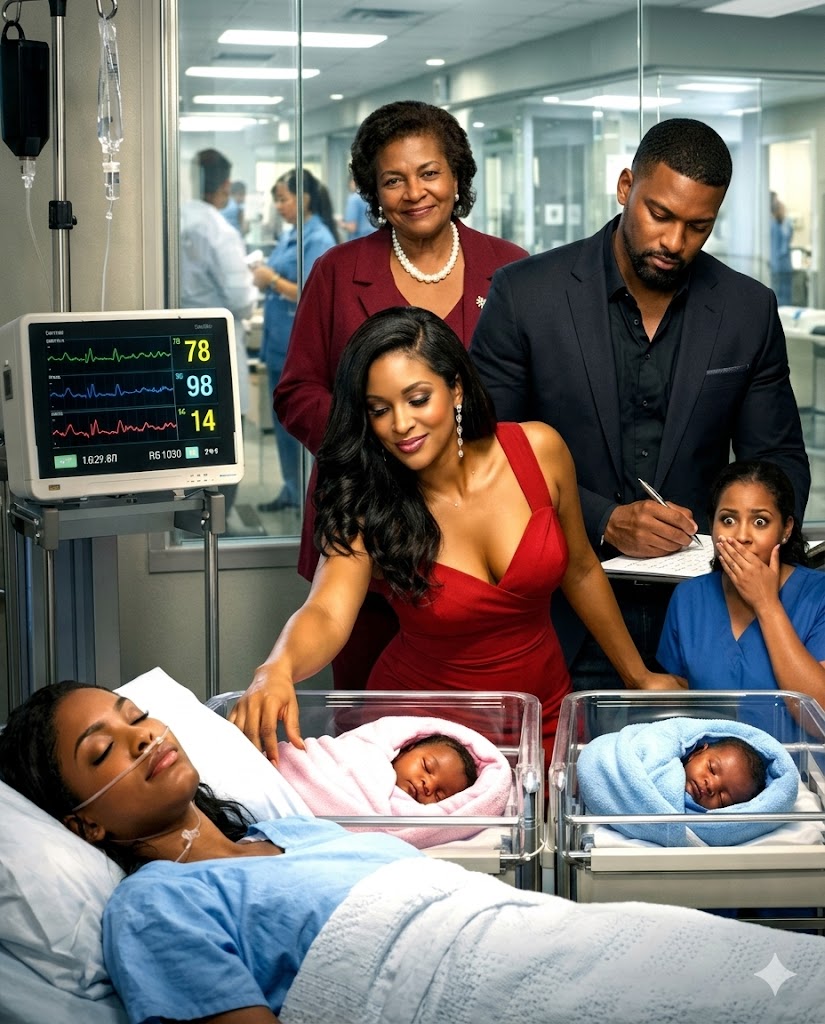
Unaware His Wife Secretly Built A $65B Fortune, He Declared Her Dead And Let His Mistress Adopt Their Newborn Twins In The Hospital She Built
Part 1: The Kitchen Doors of Prestige
The name carved deep into the white marble above the grand entrance read Cole Medical Center in letters so tall a man had to tilt his head completely back just to take them all in. On a clear night, the towering glass facade lit up the entire metropolitan block, casting a warm, structural glow over the city grid like a monument built by an unyielding hand.
On the night this story begins, the pavement outside the atrium was choked with luxury sedans and flashing cameras. There were women in haute couture gowns, men in bespoke tuxedos, and the light, effortless laughter that only exists in rooms where everybody has too much capital and not enough truth. It was the annual charity gala for the hospital’s multibillion-dollar expansion fund, and the city’s elite had come out to celebrate the miracle of their own philanthropy.
Inside, the grand atrium glittered. Massive diamond-lit chandeliers hung low and golden from the vaulted ceilings, throwing sharp fractures of light across every smiling face. The jazz band played smooth and easy in the mirrored corner, and the heavy air smelled of expensive white orchids, champagne, and money.
At the absolute center of the room, standing at the bronze podium with a microphone in his hand and a grin that suggested he had engineered the horizon himself, was Kwame Washington. He was a good-looking man—tall, wide-shouldered, the specific kind of man who took up space in a room naturally without ever seeming to try. He wore his tuxedo like it had been stitched onto his frame personally, and the crowd watched him the way crowds always watch a charismatic performer: completely under the spell of his surface.
Standing just to his left, close enough that the high-definition media cameras caught her in every single frame, was Desire. She wore gold—a deep, liquid gold gown that caught the chandelier light every time she shifted her weight on her five-inch heels. She smiled the specific smile women use when they are fully aware they are the center of an audience’s attention. Her manicured hand rested lightly on Kwame’s sleeve. She looked at home. She looked like she belonged exactly where she was standing.
And that was the point. That was always the calculation.
What nobody in that glittering, regular room noticed—or cared to notice—was that the woman whose name was etched onto every founding deed of that medical center was not at the podium. She was not sitting at the head of Table One. She was not draped in liquid gold or holding anyone’s arm for the photographers.
Dr. Akusa Cole Washington arrived forty minutes late to her own gala. She looked tired in the specific way that lives behind the eyes of a brilliant administrator, her navy linen dress hanging simply over a body that was currently eight and a half months heavy with twins. She had come straight from an un-minuted emergency board meeting—a meeting she had called herself regarding the hospital’s next major regional clinic acquisition. It was the kind of high-stakes meeting that nobody in that ballroom would have believed a quiet woman like her had the legal or financial authority to run.
She walked through the grand atrium she had spent three years designing and looked for her husband through the crowd. She found him at the bronze podium. She saw Desire standing beside his light.
Akusa stopped walking for just a single heartbeat—one breath, no more—and then she kept moving forward, her flat leather shoes silent against the polished marble floor. She was almost at the VIP line when Gloria stepped directly into her path.
Gloria Washington, Kwame’s mother, wore a heavy champagne silk dress and a smile that possessed absolutely no warmth at all. She placed a dry, heavily ringed hand on Akusa’s forearm, leaning in until the scent of her perfume filled Akusa’s space. Her public smile never left her face for a single second.
“Tonight is not your night, baby,” Gloria whispered, her voice a sharp, soft needle that didn’t carry past the edge of her champagne glass. “It never really was. Go find somewhere quiet to sit before the press starts asking why the director looks so… ordinary.”
Gloria turned back to the cameras like nothing had happened, her laughter rising to join the music. Then Bertram appeared from the left—Kwame’s older brother, built wide, heavy, and always moving within the orbit of whatever dirty paperwork his family needed managed. He didn’t say a word to his sister-in-law. He simply placed his large hand against Akusa’s shoulder blade and steered her gently, but without an ounce of true gentleness, away from the stage.
He guided her toward a small, drafty table located at the very back of the room, right beside the heavy swinging doors where the kitchen staff moved in and out with trays of dirty dishes. An usher was already standing there, briefed and ready by Bertram’s team.
“I’m sorry, ma’am,” the young usher said, his voice tight as he blocked the aisle. “This entire section is reserved for VIP guests this evening. You’ll be more comfortable back here.”
Akusa looked at the usher. She looked at Bertram’s unyielding face. She did not argue. She did not make a scene in front of the board members. She stood perfectly still for a moment, her hands folded over her heavy belly, her face a serene, unreadable mask of absolute stone.
Across the room, Kwame caught sight of her through the crowd. He saw his wife standing near the kitchen doors, alone, tired, eight months pregnant with his children. He didn’t call her forward. He didn’t instruct his brother to clear a path to the front table. Instead, he raised his crystal flute toward Desire, smiled broadly for the Bloomberg camera that clicked just then, and turned his back on the rear wall.
It was Reginald Osei who crossed the room to her. Reginald was the long-serving chairman of the Cole Medical Group board—a quiet, measured man in his late sixties who had spent his life watching the rise and fall of ambitious men, choosing to be moved only by what carried real structural weight. He walked directly past the VIP tables, past Bertram’s warning glare, and stopped in front of Akusa.
When he reached her, he didn’t offer a casual social nod. He executed a real, traditional bow—the kind of bow you reserve for a sovereign or a person you respect completely from the inside out.
“The board knows exactly what you’ve built here, ma’am,” Reginald said, his low voice a steady anchor against the noise of the jazz band. “Tonight’s performance doesn’t change a single line on the ledger.”
Akusa looked at him, her dark eyes reflecting the warm light of the chandeliers she had bought.
“It never does, Reginald,” she said softly.
What nobody in that glittering atrium understood—not Kwame at the bronze podium, not Gloria with her champagne, not Desire in her gold dress—was that every single dollar in that expansion fund being celebrated that night traced back to a private holding company that belonged entirely to the woman standing by the kitchen doors. They believed she was an inconvenience they had successfully managed into the background. They had no idea she was simply waiting for the clock to strike the hour.
Part 2: The Red Dirt and the Silver Locket
Akusa drove herself home that night alone in her modest sedan. The yellow streetlights of the city moved past her windshield in long, continuous lines, and she didn’t turn on the radio. She just drove through the quiet, one hand steady on the wheel, the other resting flat against her belly where her twins moved and shifted like they were already eager to break out into the world.
She passed the medical center twice without meaning to, circling the block with the slow, circular focus of a person analyzing a design flaw. The building glowed tall and warm against the dark sky, her surname invisible in every brick of the exterior facade, yet present in every single watt of light that touched those high windows. She looked at it once from the driver’s seat—a long, steady, clinical look—and then she accelerated toward her house.
She was still awake at midnight when the first sharp pain hit her lower back. By 2:00 AM, she was clutching the kitchen counter, her breath shallow as she dialed the private number for Pette—her senior corporate counsel and the only woman who held the codes to her offshore holding entities.
To understand the absolute, unyielding stillness of the woman leaning against that counter, you have to go back. You have to go all the way back to a small village in rural Ghana where the roads were nothing but packed red dirt and the summer evenings smelled of woodsmoke, wild herbs, and rain that hadn’t fallen yet but was coming soon.
You have to go back to a little girl sitting on the concrete steps of her grandmother’s house with a book in her lap, her bare feet buried in the warm dust, reading like the words on those pages were the only food her spirit required to grow.
Her grandmother, Nana Afia, was a small, broad woman with hands that had worked every single day of her long life. She tended to the sick people of the district with nothing more than local herbs, traditional remedies, and a deep, quiet steadiness that never cracked under pressure. People came knocking at her wooden gate at all hours of the night—frightened mothers, bleeding farmers, old men whose lungs were failing. Nana Afia never turned a single soul away from her door. She would mix her remedies in heavy ceramic bowls, speak in a low, calm cadence that dropped the room’s anxiety, and most of the time, the people went home better.
Akusa had watched her do it thousands of times. She asked her grandmother once, while sorting dried leaves on the porch, where she had learned the science of healing.
The old woman had looked at her over her glasses, her thumb rubbing a spot of red clay from a bowl. “I didn’t learn it from a school, child. I paid attention. The world is full of people who talk loud because they want you to think they have power. But the true power is in the silence. The silence is where you see the joints of a thing. It’s where you see what’s broken before it even falls.”
The morning Akusa left the village for America on a full academic scholarship, her grandmother was standing at the iron gate before the sun had even cleared the trees. She didn’t cry. She didn’t make a long, emotional speech. She simply reached down into the neckline of her dress, unclipped a old silver locket, and pressed it into Akusa’s palm.
It was a simple, modest thing—no diamonds, no filigree, just the dull shine of old silver that had been worn completely smooth by decades of contact with her skin. Inside the locket was a tiny, folded piece of parchment. Akusa opened it right there in the dust of the access road, her eyes tracing her grandmother’s unsteady, shaky handwriting.
What you build in silence will speak for you when the time comes.
Akusa folded the paper back into its slot, clicked the silver latch shut, and put it around her neck. She had not taken it off since—not when she graduated at the top of her healthcare economics class at Columbia, not when she worked two separate night shifts to cover the operational fees for her first clinical licenses, and not when she married Kwame Washington two years after college.
Kwame had been a magnetic presence on campus back then—the kind of man who walked into a room and instantly made everyone feel like they had been waiting for him to arrive. He had loud, easy laughter, a wide charm, and an ambition that Akusa had mistaken for substance. She had believed his surface was a reflection of an internal structure. It took her three years of marriage to realize that the structure didn’t exist. Kwame was a hollow tower; he was completely dependent on the admiration of others to keep himself upright.
While Kwame chased executive titles, corporate connections, and the public feeling of being important, Akusa worked. She began investing early, carefully, methodically, routing her capital through a private holding firm called The Nardos Group—a Delaware entity whose registration documents pointed to absolutely no one but her.
She acquired a small, failing clinic in her third year of marriage. Then a second. Then a regional diagnostics network. She built the systems, hired the right compliance officers, and grew what had started as a struggling operation into a healthcare giant that stretched across three territories. She kept Kwame’s name off every document by design. She had tried to explain the financial architecture of the acquisitions to him once over dinner, and he had simply smiled his slow, patronizing smile, patted her hand, and said, “That’s nice, baby. You keep playing with your clinics.” Then he went back to checking his phone.
She understood that night that he was not ready for the truth of her mind. He might never be ready. So she left him inside his illusion and returned to the quiet.
Now, clutching the edge of her quartzite kitchen counter as a second contraction ripped through her abdomen, Akusa looked out the window at the dark garden. The silver locket was warm against her collarbone. She heard the sound of her car tires on the driveway—Pette had arrived. The time for the quiet was running out, and the ledger was about to be opened.
Part 3: Room 4B and the Scratch of Iron
The twins came into the world at 3:14 AM on a night that felt like the city was holding its breath. The labor was an arduous, heavy battle that left the senior attending physicians in the private delivery suite with a hard, technical fear on their faces that they worked very hard to conceal from the family in the waiting room.
The children arrived—a boy and a girl, small, perfect, and furious with life, crying the exact second the cold air hit their skin. It was the loud, defiant sound common to children who are determined to let the world know they have broken through the gate.
But Akusa didn’t hear her children cry.
By the time her daughter drew her very first breath, Akusa was already somewhere else. Her physical body had given every single ounce of liquid capital it possessed to keep the twins alive, and then it had gone completely, terrifically still. The electronic monitors beside her bed began talking in rapid, urgent tones; the nurses moved with a frantic, silent speed; and the lead surgeon spoke words into his mask that he did not repeat to Kwame when he walked out into the corridor.
The word the doctors logged on her medical chart was coma.
They explained the condition to Kwame in the private consultation room on the fourth floor, their voices dropped into that soft, clinical frequency used when an institution is trying to manage an execution before the lawyers arrive. They said her brain was protecting its own architecture. They said there was no data available to project a timeline for her recovery. She might wake up in forty-eight hours; she might stay behind that wall forever. They handed him three glossy brochures on long-term palliative care, offered him a glass of water, and told him to go home and rest.
Kwame sat in that consultation room alone for an hour after the doctors left. His hands were flat on his knees, his head bowed. He sat by her bed in Room 4B for three days straight. To his credit, he sat there. He looked at her pale face beneath the breathing tubes, and he held her hand. On the second night, when the room was dark save for the green lines of the heart monitor, he put his head down on the edge of her mattress and cried quietly into the linen sheet.
But on the morning of the fourth day, Gloria came.
She arrived with two cups of expensive coffee and a calm that felt heavily rehearsed. She sat beside her son in the vinyl chair, took his hand, and spoke to him in the exact, reasonable cadence she had used his entire life whenever she wanted to steer him toward a family policy.
“You have two newborn children at home, Kwame,” Gloria said, her eyes fixed firmly on Akusa’s unmoving face. “And you have a woman here who may never open her eyes again. You cannot spend your mouth waiting for a ghost. You have to think about your future now. You have to think about those babies.”
Bertram came that evening, bringing the structural legal documents from his office. He didn’t look at the patient. He laid the files spread open on the tray table beside the medical monitors.
“Things are going to get complicated with the fund if we don’t clear the signature loops soon, Kwame,” Bertram said, his voice flat. “The investors are already asking why the acquisitions have stalled. There are assets to consider. There is your position within the medical group to secure. If she stays like this, the board will look for a new face.”
By day five, Kwame called Desire. On the morning of the seventh day, Kwame Washington stood in the wide corridor outside Room 4B—a corridor whose stone tile Akusa had chosen, whose lighting parameters she had personally authorized in a compliance meeting two years prior—and he looked the attending nurse directly in the eye.
“My wife passed away during the night,” Kwame said. His voice was completely steady. He was dressed in a clean, tailored suit; his brother stood like a wall at his shoulder.
The nurse looked up from her terminal, her eyes wide with a fragile, professional confusion. Her digital system showed absolutely no change in the patient status for Room 4B. The green vitals were still scrolling down the screen in a steady, rhythmic loop.
“Mr. Washington… the monitors haven’t alerted,” she stammered, her fingers hovering over the keyboard. “The chart says she’s stable.”
“The chart is wrong,” Bertram said, stepping forward, sliding a legal certification document across the counter. “The family has already authorized the private transition framework. Process the termination files immediately. We have the legal clearance.”
The nurse looked at the signature line on the paper. The name was stamped with Bertram’s private corporate notary seal. She had no reason in that specific second to challenge the hierarchy of the tower. She tapped the code.
Patient File: Reclassified.
Akusa heard the scratch of the iron pen against the clip desk through the thin wood of her door.
She heard her husband’s voice in the corridor tell the nurse she was gone. She heard the small, mechanical click of the keyboard as her existence was deleted from the hospital’s active directory. And three hours later, she heard the distinct, sharp sound of Desire’s heels clicking down the long tile hallway toward the elevators—the confident, unhurried rhythm of a woman who had already walked into her house and begun rearranging the furniture.
In the absolute stillness of Room 4B, Akusa Cole Washington did not fade. Her body was a prison of ice, but her mind was a ledger, and she was currently cataloging every single footstep.
Part 4: The Performance of Grief
The memorial service Kwame organized for his “late” wife was everything the city’s lifestyle sections could have hoped for. It was quiet, immaculate, and profoundly tasteful. Held at the historic chapel near the country club, the pews were filled with senators, investors, and heads of regional charities who wanted to be seen supporting the grieving visionary.
Kwame gave a short, ten-minute speech from the pulpit. He spoke about love, about legacy, and about the deep, broken sorrow of a man who had been left to carry the light of a grand institution alone. He didn’t use notes. He allowed his voice to crack exactly twice—once when he mentioned her dedication to the children, and once when he looked down at the front row where Gloria sat with her hand over her mouth, performing a grief that looked flawless for the cameras clicking from the rear balcony.
Desire sat beside Gloria. She didn’t wear gold today; she wore a high-necked black silk dress that fit her like a second skin, her eyes hidden behind oversized designer sunglasses that reflected the light of the altar candles. She held Kwame’s hand when he stepped down from the pulpit, a firm, public declaration of continuity that the city’s social registers would print without a single question.
Within two weeks, Desire moved her leather trunks into Akusa’s home.
She walked through the wide, sun-lit rooms Akusa had decorated; she sat at the kitchen island Akusa had chosen from a marble yard in Italy; and she stood in the center of the nursery Akusa had painted with her own hands during the quiet weeks of her seventh month. Desire didn’t like the pastel green of the walls. By Friday, a crew of commercial painters had cleared out the furniture and repainted the room in a sharp, cold ivory.
Bertram had found a probate attorney—a man with gold rings and a small office in Buckhead who specialized in clearing asset loops for families who didn’t want to answer too many questions from state auditors. Through a process that moved with an unnatural, terrifying speed, Desire began signing the hospital procurement documents as the legal guardian of the twins. She gave them new names—names that sounded like characters in a high-end social chronicle—and she threw away the African names Akusa had written on the back of her grandmother’s parchment.
But inside Room 4B, the geometry of the world remained completely undisturbed.
The medical machines breathed beside Akusa with their steady, rhythmic mechanical clicks. The old silver locket lay dull and unpolished against her collarbone, hidden beneath the white institutional sheets. The floor nurses came and went every four hours, tracking her vitals, changing her intravenous lines, noting no change on the auxiliary charts, and moving on to the next bed. Most of them didn’t know her name; her file had been routed through a private research protocol that listed her simply as Patient 104.
But one of them knew.
Nurse Adoa had worked at Cole Medical Center since the foundation stones were mud. She had known exactly who Akusa Cole Washington was from the first day she walked into the building carrying her structural blueprints. Every single morning at 5:30 AM, before her official shift clearing terminal logs started, Adoa would step into Room 4B with a cup of black coffee, close the privacy blinds, and stand beside the bed.
She didn’t speak to the machines; she spoke to the woman. She spoke in that low, steady cadence of the village, the tone you use when you are absolutely certain the soul is still inside the house, even if the windows are dark.
“Dr. Cole,” Adoa would whisper every morning without fail, her hand resting lightly against the cold metal of the bed rail. “We’re still here. The board meeting is scheduled for Monday. Reginald is holding the proxies from London. Don’t you let them take your dirt, ma’am. We’re still here.”
Akusa heard her.
Doctors spend decades writing papers about what a coma patient can or cannot process behind the wall of their paralysis. They map the brainwaves, they track the neural responses to sound, and they call it an involuntary reaction. They don’t understand that a quiet woman who has spent her entire life paying attention doesn’t stop auditing the world just because her eyes are closed.
Akusa heard the wind hitting the glass window on the fourth floor. She heard the rain during the spring storms. She heard the distinct, hurried shuffle of the resident doctors during the morning rounds, and she heard her children crying somewhere down the hall on the first night of their lives—a distant, thin sound that had been cut off when the nurses moved them to the private nursery downstairs.
She heard it all. And she was gathering her numbers.
She was patient with the patience her grandmother had taught her under the neem trees. She didn’t try to force her eyelids open before the muscles had cured; she didn’t waste her energy trying to scream into a plastic tube. She lay inside the absolute stillness of her body, allowing her heart to execute its slow, mathematical beats, while outside her tower, her husband was busy spending the credit lines of an empire that was about to run out of road.
Part 5: The Alignment of the Note
Eight months passed. The world outside Room 4B kept going at its regular, relentless pace, completely unconcerned with the ghost on the fourth floor. The seasons shifted across the city line—the winter ice melted into the gray mud of spring, and the spring hardened into the thick, humid heat of an Atlanta summer.
Kwame Washington had spent those eight months building himself into a regional monument. He gave interviews to lifestyle magazines about his “journey through the wilderness of grief.” He posted polished, black-and-white photographs of himself holding the twins on his terrace, his face arranged into a look of courageous, determined fatherhood. He had positioned himself perfectly as the tragic, visionary widower who was sacrificing his personal peace to carry on his late wife’s legacy at Cole Medical Center.
The city believed every word. Why wouldn’t they? He was charming, he was wide-shouldered, and his suits were perfect. He had Bertram managing the legal filings behind him and Gloria managing the charity boards in front of him, and Desire standing at his side on every red carpet, looking exactly like the future.
But behind the surface of his performance, Kwame was drowning.
For eight straight months, through three separate law firms in Buckhead and Delaware, he had been trying to gain access to Akusa’s personal estate and her majority shareholding in the Cole Medical Group. He believed, with the simple, blind entitlement common to men of his class, that because he was her husband, the accounts would automatically adjust themselves to his signature now that she was gone.
Every single entry loop had been systematically blocked.
Pette was always there, sitting in the administrative conference rooms like a block of old granite, offering absolutely zero explanation to his lawyers except that the estate was under a private structural review by the trust’s London trustees. Kwame was frustrated by the delays, but he wasn’t worried. He assumed it was a matter of administrative processing. He assumed that an institution built with his face on the billboards would eventually have to bend to his signature.
He had invited himself to deliver the keynote address at the upcoming expansion gala. He intended to use the evening—the biggest night on the regional healthcare calendar—to officially announce his ascension as the new permanent Chairman of the Cole Medical Group. Reginald Osei had confirmed his speaking slot on the schedule, signed the executive clearance form, and said absolutely nothing else.
On a Tuesday morning in late August, at exactly 4:47 AM, Akusa Cole Washington opened her eyes.
The room was dark, save for the pale green glow of the vital monitors. The silence was absolute. Nurse Adoa was sitting in the vinyl chair by the window, her reading glasses low on her nose, a mug of black coffee between her hands, speaking her quiet daily words to the room.
“The wind is from the south today, Dr. Cole,” Adoa was saying softly, her eyes on her schedule. “The roses in the courtyard are dropping their petals. It’s going to be a hot one.”
Akusa’s hand moved.
It wasn’t a violent spasm; it was a slow, deliberate contraction of her fingers against the white cotton sheet. The thin silver locket at her throat slid half an inch across her collarbone.
Adoa stopped mid-sentence. She set her coffee mug down on the rolling tray table carefully, her hands starting to shake as she leaned over the bed rail.
Akusa’s eyes were wide, clear, and completely, terrifically present. She looked at Adoa’s face under the green light, and the silence between the two women held the weight of eight months of un-spoken data.
“Pette,” Akusa said.
Her voice was barely a breath, a rough, dry rattle that had no liquid capital behind it yet, but it was a word. It was a command.
Adoa was already crying, her fingers slamming into the emergency call button, her voice a frantic, happy whisper as she leaned over the mattress. “Yes, yes, Dr. Cole. I’m calling her right now. She’s already at the hotel down the street. We’re still here, ma’am. We’re still here.”
Pette arrived within forty minutes, her leather briefcase clicking against the metal rail as she sat beside the bed. The two women didn’t spend time on tears or emotional relief. Akusa lay back against the pillows, her breath steadying with every minute, and listened to the forensic report of her own death. She listened to the name changes of her children; she listened to the ivory paint in her nursery; she listened to the dates of Kwame’s red carpet appearances. Her face didn’t move an inch.
When Pette finished reading the legal timelines, the room fell into a heavy, clinical silence.
“The gala,” Akusa said, her voice stronger now, the iron of her grandmother’s medicine finally clearing the ice from her throat.
“It’s in three weeks, Akusa,” Pette said, leaning in close. “Kwame has the keynote slot. He’s already drafted the press releases for his ascension.”
Akusa closed her fingers around the silver locket at her neck. She looked at the white marble wall of Room 4B and tapped her finger once against the sheet.
“Let him speak,” she said softly. “I want to hear what he says about my legacy.”
Part 6: The Return to the Atrium
The three weeks that followed her awakening were weeks of silent, mechanical construction. Akusa remained in Room 4B, her recovery managed by a private medical team Reginald Osei had cleared from the research division—men and women who owed their entire careers to Akusa’s grants and who knew how to maintain an absolute baseline of institutional silence.
She didn’t spend her hours in anger. She didn’t rehearse a single speech for the cameras. She ate the food Adoa brought her from the Ghanaian market; she walked the length of her private room five times every morning to rebuild the liquid capital in her leg muscles; and she sat by the window at night, holding her silver locket, watching the dark outline of the city she was about to reclaim.
The night of the expansion gala arrived with a heavy, unmoving heat that hung over the white columns of the entrance like a velvet shroud.
The Cole Medical Center atrium was dressed exactly as it had been eight months ago—low, golden chandeliers throwing warm fractures of light over two hundred of the state’s elite, champagne moving on silver trays, and a jazz band playing smooth and easy in the corner.
Kwame Washington arrived looking magnificent. He wore a new custom tuxedo with silk lapels, his broad shoulders squared, his wide smile fixed at full operational performance for the photographers lining the red carpet. Desire walked beside him in a gown of deep burgundy silk that caught the light with every step, her diamond earrings flashing like small teeth under the chandeliers. Gloria and Bertram sat in the front row of the VIP section like a royal court, their faces arranged into an expression of unassailable corporate security.
Kwame took the bronze podium during the second hour of the program. He adjusted the microphone, looked out at the rows of investors and city officials, and began his address. His voice was beautiful—a rich, theatrical baritone that filled the high spaces of the atrium with the language of vision, transformation, and legacy.
“We are not simply expanding a building tonight,” Kwame said, his hand raised confidently toward the projection screen. “We are expanding a promise. A promise that my late wife, Akusa, poured her beautiful spirit into. As we lay these new foundations, I intend to take bold, unyielding leadership of this institution to ensure that her name remains a light for this city—”
The heavy mahogany double doors at the back of the atrium swung open.
The brass handles didn’t clatter, but the rush of hot air from the foyer made the nearest curtains ripple.
Akusa Cole Washington walked into the room.
She wore a simple, un-branded white dress that cost less than the linen napkins on the tables. She wore no diamonds, no gold, and no rings. Her hair was pinned back elegantly with her mother’s gold clip, and her grandmother’s silver locket hung dull against her collarbone. She walked slowly, her steps deliberate because her body was still recovering its structural strength, but she walked with a steadiness that filled the room before she was even halfway across the floorboards.
She didn’t look at the guests. She didn’t look at the flashbulbs that suddenly began to ignite in the middle rows. She kept her level, unblinking eyes fixed directly on the stage.
The silence moved through that grand ballroom like a freezing wind through an open window. It started at the back row, table by table, face by face, as the recognition rolled across the guests like a physical wave. The laughter died mid-breath; the silver forks stopped mid-air; the jazz band trailed off into an agonizing discord.
Kwame heard the silence before he saw her face. He stopped mid-sentence, his pointer finger frozen an inch from his notes, his jaw going completely slack as his brain tried and failed to process the figure moving down the center aisle.
Reginald Osei rose from his seat at the head board table. He didn’t look at Kwame’s panic. He walked up the stage steps, reached out his hand, and gently, almost tenderly, took the bronze microphone from Kwame’s limp, sweating fingers. Kwame didn’t resist; his body had run out of code.
Reginald faced the room, his old voice booming through the high-end audio system with the calm, enormous force of a judge delivering a final verdict.
“Ladies and gentlemen,” Reginald announced, his eyes locking onto Bertram’s pale face in the front row. “The board of the Cole Medical Group would like to formally reintroduce our founder, our majority owner, and our permanent Acting Chairwoman… Dr. Akusa Cole Washington.”
He paused, letting the silence harden into stone.
“Whose name,” Reginald added, his voice dropping into a colder register, “appears on every single structural deed, every corporate license, and every bank account this institution has ever opened. Including the deed to the very marble you are standing on tonight.”
Part 7: The Closing of the Ledger
Pette moved through the frozen aisles of the ballroom with the quiet, structural efficiency of a liquidation officer clearing out a bankrupt estate. She distributed heavy, leather-bound folders to every single member of the press pool and the regional financial networks stationed at the media tables.
Inside each folder was the complete, unredacted corporate history of The Nardos Group and Cole Medical Center—decades of tax certificates, banking trails, and state registry documents bearing Akusa’s signature on every single line. The journalists opened the folders, their fingers flying across their digital tablets as the true ledger of the $65 billion healthcare empire was displayed in black and white.
The cameras that had been locked onto Kwame’s tailored tuxedo slowly, automatically turned toward the front aisle where Akusa stood.
Gloria Washington’s champagne glass slipped from her fingers. It didn’t shatter on the thick Persian carpet, but the amber liquid soaked into her champagne silk gown like a stain that wouldn’t come out. Bertram sat perfectly still, his hands flat on his knees, his face the exact color of dry ash as he looked at the federal compliance warrants Pette’s assistant had just dropped onto his table.
Desire took two slow, silent steps backward toward the shadow of the stage curtain, her diamond earrings no longer catching the light, her eyes fixed on the rear exit door. She was a practical woman; she knew when the life had run out of a room.
Reginald offered the microphone to Akusa. She took the metal casing in her steady right hand, stepped up to the podium, and looked out at the room. She didn’t look at Kwame, who was standing three feet away, his chest heaving under his tuxedo, completely invisible behind the shadow of her arrival. She looked at the room the way an architect looks at a building she had built with her own calloused hands.
“This hospital was built to heal people,” Akusa said, her voice low, clear, and perfectly flat—carrying a deep, unbothered power that left absolutely zero room for interpretation. “And it will continue to do exactly that under its rightful leadership. Effective at midnight, the regional board is dissolved, and all foreign subsidiary clearings are frozen pending a full compliance audit. Thank you for your donations. Good night.”
She set the microphone down on the bronze plate with a soft, final clack. She looked at Kwame then—just once, for a single, unhurried second. There was no fury in her dark eyes. There was no dramatic staging of her betrayal. She looked at him with the precise, clinical pity an authenticator reserves for a low-grade copy. Then she walked to the head of the board table and took her seat.
The board members stood up one by one, their hands moving in a thundering, emotional ovation that filled the high spaces of the atrium like rain after a long drought.
The morning after the gala, the story wasn’t a regional financial notice; it was a national conversation. The headlines replayed the forty-seven seconds of the Shilla video side-by-side with the scanned images of the fraudulent death certificate Bertram’s firm had processed. By noon, Kwame Washington was served with a criminal asset misrepresentation warrant at his house. He came to the front door in his silk bathrobe, his hair unkempt, his fingers shaking as the state officers handed him the pages. The look on his face was the look of a man who still believed, up until that exact second, that his charm would somehow negotiate him out of gravity.
It didn’t. The accounts were frozen; the lifestyle was liquidated; and the Maybach was repossessed from the driveway before the sun went down.
Desire left the house on Thursday afternoon. She packed what she had brought into two canvas bags—everything she had come with, and absolutely none of what she had tried to take. She didn’t file a counter-petition for the twins; she didn’t look back at the white columns as her taxi pulled away from the gate. When the performance was finished, she simply moved to another theater.
The twins came home on a Friday afternoon. Nurse Adoa drove them her own sedan, carrying them into the wide, quiet living room where the white paint had been restored to the walls.
Akusa sat in the armchair by the window, the golden summer light falling across her lap. When Adoa placed the children in her arms—a boy and a girl, eight months old, their dark eyes wide with a serious, unblinking curiosity—Akusa closed her eyes and let her face sink into the warm scent of their skin. Her hands didn’t shake. Her chest rose and fell in a slow, mathematical rhythm that matched the ticking of the clock on the mantel piece.
She unclipped the old silver locket from her throat, clicked the latch open, and looked at her grandmother’s handwriting one last time. What you build in silence will speak for you when the time comes.
She folded the paper back into its slot, clicked it shut, and tucked the old silver piece gently beneath her daughter’s blanket, right against the baby’s small, warm hand.
Some mornings now, before the city headquarters wake up fully and the hospital’s phones start their daily administrative rattle, there is a quiet hour—a particular quality of silence that belongs only to people who have walked through a storm and come out the other side with their bones intact.
Akusa moves through her house slowly, her boots silent against the hardwood. She makes her tea, checks on her sleeping children, and stands at the window with the warm mug held in both hands, watching the skyline turn from gray to gold. Pette comes over at 6:00 AM, bringing fresh pastries from the market near the historic district. They sit at the kitchen table together and talk about the new clinic clearings, their voices low and real in the quiet room.
Akusa doesn’t talk about Room 4B anymore. She doesn’t need to describe what the dark felt like or how the text of the lies sounded through the wood of her door. She has already processed the data in the only place where numbers don’t lie. She knows that what Kwame and Gloria and Bertram had tried to take from her had never truly been within their reach. They had taken her furniture; they had put their perfume in her kitchen; they had paraded her name carpets for an audience.
But a woman’s real wealth—the mind that knows how to align the note and the hands that pour the concrete—that cannot be declared dead on a digital terminal. The structure remembers who laid the stones. Marble is honest that way. And as Akusa Cole Washington stands up from her table to greet her children waking in the next room, she looks at the sky and doesn’t see a single shadow left on the road. The columns are balanced. The audit is complete. She is finally, beautifully, perfectly whole.
THE END.