The CEO’s Worst Nightmare
Part 1: The Shattered Spectacle
The Armand Grand Hall had always been built for spectacle. Its marble staircase curved like a judgment. Its crystal chandeliers hung over the ballroom like frozen lightning. Every year, the Allesian Hearts Gala gathered the kind of people who smiled for cameras while quietly measuring one another’s worth. Tech billionaires. Fashion editors. Senators’ wives. Private equity kings. Influencers with diamond collars and empty eyes. Everyone was there to be seen, praised, envied, or feared.
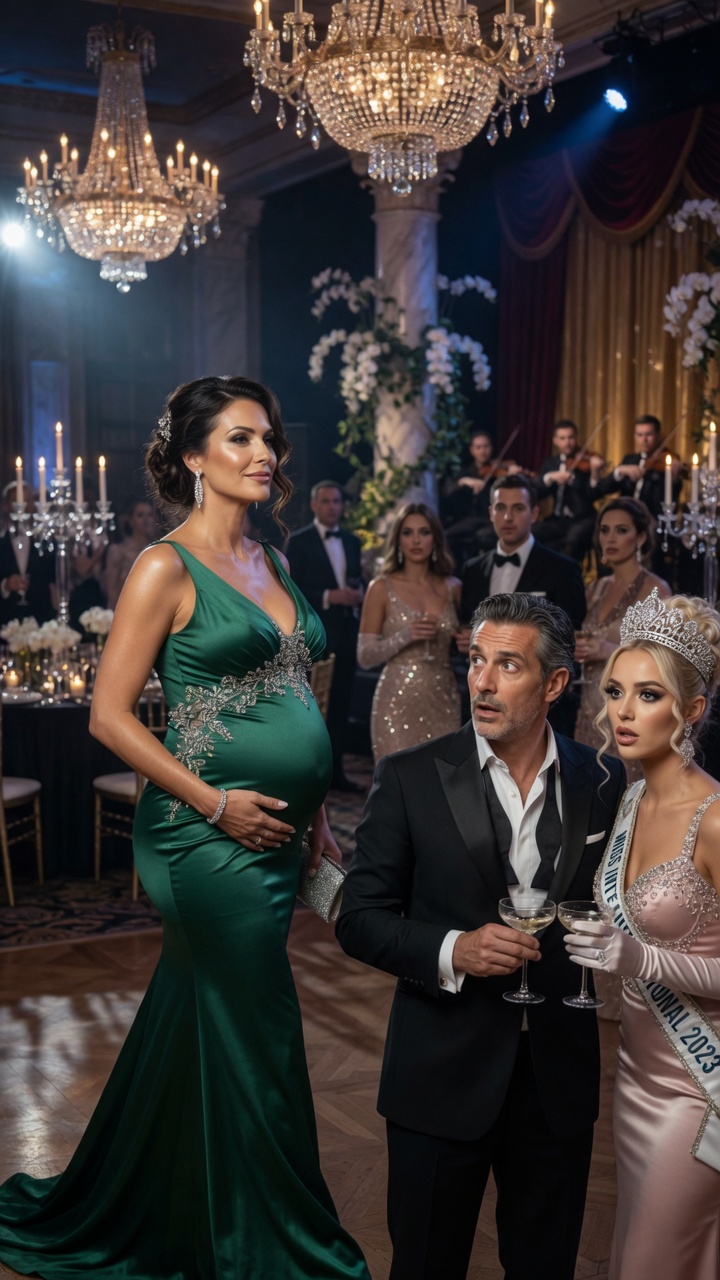
Julian came to be worshiped. He arrived at 8:00 p.m. in a white Rolls-Royce, wearing a midnight-blue tuxedo that made him look exactly like the man magazines had once claimed he was: brilliant, handsome, untouchable. On his arm was Dalia Fontaine. Beauty queen. Model. Internet darling. Twelve years younger than me. Her silver gown clung to her like poured moonlight, and the diamond on her finger was so large it looked less like a promise and more like a threat.
Reporters screamed their names. “Julian! When’s the wedding?” “Dalia, show us the ring!” “Julian, is your ex-wife attending tonight?”
Julian paused for that one. He smiled, the same polished smile he had practiced in mirrors before investor meetings. “I doubt Khloe would show her face,” he said smoothly. The reporters laughed. Dalia laughed too, leaning into him like she had won a prize.
And I stood less than fifty feet away in the private entrance, watching everything on a security monitor while Gabriel adjusted the clasp of my bracelet.
“You don’t have to do this,” he said quietly.
I looked down at the soft curve of my stomach. “Yes,” I said. “I do.”
Two years earlier, I had disappeared from public life so completely that gossip blogs wrote theories about me like I was missing treasure. Khloe Marin Duval spotted in Italy. Khloe Duval in rehab? Julian Duval’s ex-wife hiding after divorce scandal.
None of them knew the truth. I was not hiding because Julian left me. I was hiding because if I stayed in Los Angeles one more day, surrounded by cameras and pity and headlines calling me barren, broken, replaced, I would have forgotten who I was before I became his wife.
Before Julian, I was Khloe Bennett from a small town outside Tulsa, Oklahoma. I grew up in a rental house with peeling yellow paint, a father who worked at a steel plant until an accident crushed his spine, and a mother who cleaned houses for women who never learned her name. I learned early that survival had a sound. It sounded like bills being opened at midnight. Like my mother whispering, “We’ll figure it out.” Like my father apologizing for pain that wasn’t his fault.
I left Oklahoma with a scholarship to Northwestern, sixty-two dollars, and a promise to myself that I would never again shrink just because life expected me to. At Northwestern, I studied economics and strategic communications. I worked at the library before sunrise, poured coffee on weekends, edited papers at night, and slept so little I sometimes forgot what day it was. That was where I met Julian. He was already famous on campus, a computer science major with a startup, a smile like trouble, and the kind of confidence people mistook for destiny.
The first time he noticed me, I was sitting in the back row of a tech panel, listening to him describe his app as “democratizing human connection.” When the moderator opened the floor, I raised my hand. “You’re not democratizing connection,” I said. “You’re monetizing loneliness. Isn’t that just exploitation with better branding?”
The room went silent. Julian blinked. Then he smiled like I had just become interesting. That night, he found me in a bookstore café and asked me out. I said no. The next day, he came back with caramel tea and a used copy of The Lean Startup covered in sticky notes. We talked for six hours. By spring, he called me his brain trust. By graduation, I had rewritten his investor pitch, rebuilt his messaging strategy, and helped him close the seed funding that would make him rich.
When he sold his first company at twenty-six for $22 million, he proposed over Chinese takeout in our tiny Chicago apartment. “You’re the reason any of this works,” he whispered. “Build the rest with me.” I said yes because I believed him. That was my first mistake. In the beginning, he loved my mind. Then he used it. Then he resented it. Behind closed doors, he asked for my opinion. In public, he took credit for it. I told myself that was marriage. Partnership. Sacrifice.
Then came the pregnancies. The first loss gutted us. The second made me quiet. The third broke something in me that never healed right. I still remember sitting on the bathroom floor in our glass penthouse, blood on a white towel, my whole body shaking as Julian stood in the doorway checking his phone. “I can’t miss Davos,” he said. I looked up at him. “I just lost our baby.” He sighed, tired and irritated, like grief was a scheduling conflict. “You need to stop letting this define you, Khloe. We have a company to run.”
Three months later, his lawyer texted me before Julian did. The press release came that afternoon: Julian and Khloe Duval have decided to part ways amicably. They remain supportive of each other’s future endeavors. Supportive. He left me with an NDA, a settlement he thought was generous, and a world full of people who believed I had been discarded because I could not give him a child. A week after our divorce was announced, he was photographed with a twenty-four-year-old model outside a hotel in Miami. I left the country the next morning.
Now, standing in the shadows of the gala, the memory of that bathroom floor felt like a lifetime ago. I adjusted the strap of my gown. Gabriel reached out, his hand hovering near my arm, offering the support he’d been providing for months. He was a good man, steady and kind, a stark contrast to the chaotic brilliance I’d once been addicted to.
“They’re ready for us,” Gabriel said.
I took one final breath, the air in the private hall smelling of expensive lilies and anticipation. Julian was out there, basking in the light of the woman who was meant to replace me. He was about to learn that some ghosts don’t stay buried—they come back, and they bring the storm with them. We stepped forward, the heavy doors swinging open to reveal the ballroom, and the music seemed to stutter as the room caught sight of the woman Julian Duval thought he had erased.
Part 2: The Weight of Gold
The music didn’t actually stop, but the collective gasp that swept through the Armand Grand Hall felt louder than the orchestra. As Gabriel and I moved into the light, I could see the exact moment Julian noticed us. He was midway through a laugh, his head tilted back in that arrogant, effortless way, when his eyes tracked across the room and landed on me.
The smile didn’t just vanish; it died.
His eyes traveled from my face, down to the black velvet, and locked onto the curve of my stomach. The color drained from his face so rapidly he looked like a statue being chiseled out of stone. Dalia, who had been clinging to his arm, followed his gaze. When she realized who I was—or rather, who I had been—her grip on Julian’s tuxedo sleeve tightened until her knuckles turned white.
Gabriel leaned down, his voice a low hum against my ear. “Do you want me to guide you to a table, or would you prefer to watch him scramble?”
“Watch him scramble,” I whispered.
We walked straight toward them. It wasn’t a confrontational strut; it was the slow, inevitable movement of a tide. Julian was paralyzed. He looked as though he had seen a specter, and in a way, he had. For two years, he had told himself the narrative that I was a broken woman who had fled into obscurity, unable to handle the pace of his success. Seeing me now, radiant, undeniably pregnant, and walking on the arm of the most respected private investor in Manhattan, was a cognitive dissonance he clearly couldn’t process.
“Khloe?” he managed to say. His voice was breathless, stripped of its usual rehearsed authority.
“Hello, Julian,” I said, my voice as cool as the marble beneath our feet. “I see you’ve found another… endeavor.”
Dalia looked between us, her confusion turning into a sharp, territorial spike of jealousy. “Julian, who is this?”
Julian didn’t answer. He couldn’t. He was still staring at my stomach, his mouth slightly parted. Gabriel stepped forward, extending a hand that Julian took automatically, like a man in a trance.
“Gabriel Lancaster,” he said, his tone perfectly polite, perfectly lethal. “You’ve done a marvelous job with the foundation tonight, Julian. Though, I think we have some rather significant news that might shift the focus of the evening.”
“News?” Julian repeated, his eyes finally dragging themselves up to meet mine. “What news?”
“Khloe and I have decided to merge our interests,” Gabriel said, his hand resting firmly on the small of my back—a gesture of ownership that was purely protective. “Both professionally and personally.”
The silence that followed was heavy enough to drown in. I saw the gears turning behind Julian’s eyes. He wasn’t thinking about me as his ex-wife anymore. He was thinking about his company, his standing, and the terrifying realization that I hadn’t disappeared—I had been acquiring. He knew how I thought. He knew I had been the brain behind his early success. The thought that I might have been applying that same strategy to his rivals—like Gabriel—seemed to hit him with the force of a physical blow.
“You’re working with him?” Julian asked, his voice regaining a fraction of its edge.
“I’m working for myself, Julian,” I said, stepping closer. I looked at Dalia, who was trembling, then back at him. “You always told me I was the reason your company worked. I’ve spent the last two years proving you right. And proving that it works even better when you’re not the one taking the credit.”
Dalia gasped, a sharp, indignant sound. “How dare you speak to him like that? We are celebrating our future!”
“Your future,” I said, smiling at her, “is a very fragile thing, Dalia. I’d be careful where you step. These chandeliers are heavy, and they have a habit of falling on people who think they’re untouchable.”
I turned away before she could formulate a retort. Gabriel walked with me, his presence a shield, as we moved toward the center of the hall. The room was buzzing now—a thousand conversations sparking at once. I could hear my name being tossed around like confetti.
I reached the platform where the gala committee was stationed. I had no intention of making a speech, but I had every intention of making a statement. I looked at the security guard near the stage, a man I’d helped hire years ago, and nodded. He signaled the sound tech.
The lights dimmed. The music faded. All eyes turned toward us.
“Ladies and gentlemen,” I said into the microphone, my voice steady, amplified by the hall’s acoustics. “I’m Khloe Marin. And while many of you have known me by a different name, I’m here tonight to celebrate something more important than charity optics. I’m here to celebrate the truth.”
I glanced at Julian. He was hovering near the edge of the crowd, his face a mask of barely suppressed panic. I saw him reach for his phone, likely to call his lawyers, his publicists, anyone who could manage this disaster. But I knew something he didn’t. I had already had his phone line intercepted.
The gala was no longer about his pageant or his fiancée. It was about to become the unveiling of everything he had tried to keep in the dark.
Part 3: The Unveiling
The silence in the room was absolute, a vacuum waiting to be filled. I stood on the platform, the weight of the moment pressing against me, but beneath it was a bedrock of certainty. I had spent two years in the wilderness, rebuilding, plotting, and watching the man who had called me “broken” continue his climb on a ladder built of lies.
“Tonight,” I continued, my voice echoing off the vaulted ceiling, “we are here for Allesian Hearts. But heart is about more than a donation. It is about transparency.”
I tapped the microphone stand. Behind me, the massive projector screen—usually reserved for photos of donors and charity projects—flickered to life. Instead of the expected images of smiling models, it displayed a series of documents.
They were invoices.
They were contracts.
They were bank statements linking Julian’s personal accounts to the pageant’s funding—a clear-cut case of financial malpractice, embezzlement, and systematic exploitation of the very girls he claimed to be “supporting.”
The room let out a collective, sharp intake of breath. Dalia Fontaine’s hand went to her throat. She looked at the screen, her eyes wide, as a particular document appeared: a contract signed by her, assigning sixty percent of her future earnings to a shell company owned by Julian.
He hadn’t been sponsoring her; he had been harvesting her.
Julian rushed the stage, his face purple, his composure completely abandoned. “Turn it off! This is a hack! A smear campaign!”
He reached for the cables, but Gabriel stepped in, his tall, imposing frame blocking Julian’s path. “I wouldn’t do that, Julian. The authorities are already outside. And they have the original hard drives.”
Julian stopped, his eyes frantic. He looked at the crowd, the reporters who were already recording every second of his collapse, the investors who were staring at him with cold, calculating hatred. He realized then that he wasn’t just losing a wife or a reputation—he was losing the power he had spent his entire life addicted to.
“Khloe, talk to me,” he pleaded, his voice dropping into the desperate, intimate register he used to use when he wanted something. “We can settle this. I’ll give you whatever you want. The house, the money—”
“I don’t want your money, Julian,” I said, my voice loud enough for the microphone to pick up. “I want you to see exactly what you look like when you have nothing left to exploit.”
I stepped off the platform, the velvet of my gown trailing like a dark flame behind me. As I walked through the crowd, people moved aside. Not out of fear, but out of a sudden, jarring respect. I wasn’t the woman who couldn’t have children anymore. I wasn’t the woman who was “discarded.” I was a woman who had orchestrated the perfect, surgical dismantling of a man’s empire, and they knew it.
I found Dalia standing by the bar, trembling. She looked small, stripped of her moonlight gown and her diamond threat.
“He told me he loved me,” she whispered.
“He loves what you can do for him,” I said, stopping to look her in the eye. “He loved the idea of you, just like he loved the idea of me. But he doesn’t know how to love a person, Dalia. He only knows how to love an acquisition.”
“What do I do?” she asked, her voice cracking.
“You survive,” I said. “And then you start over. Just like I did.”
I walked toward the exit, Gabriel by my side. The gala was effectively over. The police were escorting Julian toward the service entrance, and the reporters were already filing their stories. The spectacle had shifted from a celebration of the elite to the autopsy of a predator.
As we reached the private entrance, I felt the cold air of the city hit my face. It was a sharp, biting cold, the kind that reminded you that you were alive. I looked at the car waiting for us, the city lights shimmering in the distance.
“You did it,” Gabriel said.
“I did,” I replied, my hand resting on my stomach. The baby kicked, a tiny, defiant flutter that felt like a secret promise.
“Where to?”
“Somewhere quiet,” I said. “Somewhere I don’t have to look over my shoulder.”
But as we pulled away, I glanced back at the Armand Grand Hall. Through the window, I saw Julian being pushed into the back of a police cruiser. He wasn’t looking at the cameras. He was looking at me.
And in that final look, I saw something I hadn’t expected: he wasn’t angry anymore. He was terrified. He realized, finally, that I was the only person who had ever truly seen him—and that I was the one who had finally judged him.
The car turned the corner, and the gala vanished. I leaned back, letting the exhaustion take me, knowing that while the public spectacle was finished, the real work of my life—the work of being a mother, of being a woman in her own right—was only just beginning.
Part 4: The Quiet Aftermath
The silence in my apartment was the most luxurious thing I had ever experienced. For two years, I had lived in the noisy, pressurized vacuum of Julian’s ambition. Here, in this modest but beautiful home overlooking the Hudson, the only sounds were the distant foghorns of river traffic and the soft hum of the city.
Gabriel had been a saint through it all. He hadn’t asked for anything, hadn’t pushed for a relationship, hadn’t demanded to be the man in my life. He had simply been there, a steady, unyielding presence as I tore down my past.
“You’re quiet tonight,” he said, coming into the kitchen with two cups of herbal tea.
I was standing by the window, watching the lights of Manhattan. “I’m just thinking about what comes next. The lawyers, the trial, the public fallout. It’s going to be relentless.”
“Let it be,” Gabriel said, setting the tea down. “You’ve already won the war. Everything else is just mopping up the debris.”
He was right, of course, but the debris felt personal. Julian hadn’t just stolen my time; he had stolen the version of myself that believed in the future. Watching him fall had been necessary, but it had also been a confrontation with the parts of me that had once loved him. I had to face the reality that I had been complicit in my own suppression. I had stayed, I had excused, I had sacrificed.
“I need to go back,” I said suddenly.
Gabriel paused. “Back where?”
“Oklahoma. My parents’ house. I need to close that chapter, properly.”
Gabriel studied me. He didn’t ask why. He didn’t tell me it was a waste of time. He simply nodded. “I’ll have the jet ready whenever you want.”
The flight to Tulsa felt like traveling back in time. As the landscape transitioned from the jagged steel of New York to the rolling, golden plains of the heartland, I felt a deep, ancestral ache. I hadn’t been home since my father’s funeral, a day that felt like it had occurred in a different life.
When I arrived, the house was just as I remembered—peeling yellow paint, a sagging porch, and a yard filled with wild, unruly weeds. But it wasn’t the poverty that hit me. It was the memory of the love that had lived here. I walked through the rooms, the floorboards creaking under my feet like old bones. I found the kitchen where my mother had whispered about figuring things out, and the hallway where I’d marked my height until I was seventeen.
I went to the backyard and sat on the steps, the same spot where my father had told me about building something tall. I looked out at the horizon, the vast, open space of Oklahoma, and I realized why I had come back.
I hadn’t come for closure. I had come for a foundation.
I needed to remember who I was before I was a “Duval.” I needed to remember the girl who went to Northwestern with sixty-two dollars and a dream that was hers alone.
My mother’s old neighbors, an elderly couple named the Millers, came over with a tray of cookies. They didn’t know who I was, or what I had done in New York. They just saw a woman who looked like her mother.
“You look like you’ve been carrying the world on your shoulders,” Mrs. Miller said, her voice soft.
“I have,” I admitted.
“Well, dear,” she said, squeezing my hand, “sometimes you have to put it down. Even for a minute. The earth is strong enough to hold it.”
That night, I sat on the porch and watched the stars. They were different here—brighter, closer, indifferent to the scandals of Manhattan. I realized that my life wasn’t defined by the gala or the arrest or the money. It was defined by the resilience that had brought me back to these steps.
I pulled out my phone and looked at a photo of the baby’s ultrasound.
“We’re going to be okay,” I whispered to the dark.
But as I turned to head inside, I saw a car parked at the end of the gravel road. The lights were off, but I could see the silhouette of a man sitting inside.
He hadn’t followed me. He couldn’t have.
But I knew that silhouette. And I knew that feeling of being hunted.
Part 5: The Shadow of the Past
My heart plummeted as I recognized the car. It was a black sedan, a rental, completely out of place in the rural quiet of the Oklahoma countryside. I stood on the porch, my breath catching in my throat. Had Julian found me? Was this some final, desperate attempt at intimidation?
I watched the car for a long minute. It didn’t move. No one stepped out. It was just… there, like a silent threat. I retreated into the house, locking the door and turning off all the lights. I felt a surge of the old terror, the kind I had felt when I was Julian’s wife, but it was quickly replaced by something else: anger.
I went to the back room, pulled out a small, emergency bag I had packed—just in case—and called Gabriel.
“He’s here,” I said, my voice low.
“Who?” Gabriel asked, his voice sharp with alarm.
“Julian. Or someone working for him. A black sedan at the end of the driveway.”
“Get out of there, Khloe. Now. I’m sending a security team to your location, but it will take twenty minutes. Get to the woods behind the house.”
I didn’t wait. I grabbed my coat, threw on some boots, and slipped out the back door into the darkness. The woods were dense, a tangle of oak and hickory, but I knew these paths. I had run them as a child.
I scrambled through the brush, my heart a frantic drum against my ribs. I could hear the sound of someone moving behind me—a branch snapping, the crunch of dried leaves. They were close.
I ducked behind a massive, ancient oak, my hand over my mouth to stifle my breathing. A light beam cut through the darkness, sweeping over the trees. I held my breath, my mind racing. I was the woman who had brought down an empire; I wouldn’t be taken in the woods of Oklahoma.
The light moved past, then stopped.
“I know you’re here, Khloe,” a voice said. It wasn’t Julian. It was deeper, rougher. “You think you’re so smart, don’t you? You think you can just walk away?”
I didn’t answer. I reached into my pocket, my fingers finding the small, self-defense pepper spray I always carried—a habit from my days in Chicago.
I waited until the figure passed the tree, then lunged.
I sprayed him, his scream of surprise echoing through the woods as he dropped his light. I ran—not away, but toward the house. I had to get to the main road, to the town, anywhere there were people.
I reached the gravel road just as a set of headlights came toward me. I flagged them down, my chest heaving, the car screeching to a halt.
The driver rolled down the window. It was the local sheriff.
“Miss? You okay?”
“Someone’s following me,” I said, pointing toward the woods. “He’s armed.”
The sheriff’s face hardened. He grabbed his radio, and within minutes, the woods were alive with sirens. I sat in the back of the cruiser, watching as they moved through the trees, the beams of their lights like a search for truth.
When they emerged, they had a man in handcuffs. He was a private investigator, a man I recognized from the files I had seen on Julian’s desk—a man who did the dirty work when Julian couldn’t.
“He had a list,” the sheriff said, handing me the folder they had confiscated. “Pictures of you, maps of your father’s old property, and a list of your recent investments. He was tracking you, Miss.”
I looked at the folder. The hatred in my chest was absolute. Julian hadn’t just lost the war; he was trying to kidnap me.
“Is Julian behind this?” I asked, my voice cold.
“We’re questioning him now,” the sheriff said. “But he’s already claiming he didn’t hire this guy.”
“He’s lying,” I said.
I sat in the cruiser, looking at the man in handcuffs, and I realized that the fight was far from over. Julian would never let me go. He would never let me be free.
I had to finish it. Not for the foundation, not for the money, but for my life.
Part 6: The Final Confrontation
The legal proceedings were a nightmare of bureaucracy, but they had one unexpected benefit: they forced Julian to step out from behind his legal team. He had to testify, he had to face the evidence, and he had to look me in the eye.
The courtroom was packed—reporters, shareholders, curious onlookers—all of them wanting a glimpse of the man who had lost everything. When I took the stand, the room was so quiet I could hear the hum of the air conditioning.
“Mr. Duval,” the prosecutor began, “you have consistently denied hiring the private investigator found on Ms. Marin’s property. Yet we have found a digital trail linking your personal email account to a secure portal that issued the payment.”
Julian sat at the defense table, his face a mask of calculated arrogance. “I have thousands of employees. It’s possible someone else accessed my account.”
“And the photos of Ms. Marin?” the prosecutor asked. “The ones showing her movements, her flight information, her property in Oklahoma? These were printed from your home office printer.”
Julian shifted, a flicker of genuine fear crossing his face. I stared at him, my hand resting on the wooden railing of the stand. I remembered the man who had proposed over Chinese takeout, the man who had promised to build the future with me. He didn’t exist. He had never existed.
“Mr. Duval,” I said, my voice echoing through the courtroom. “You’ve spent your life hiding behind your status, your lawyers, and your lies. But look at me. Not the CEO, not the public figure. Just me. Khloe.”
He turned to me, his eyes wide.
“You think this is about you,” I continued. “You think this is about a lost company or a failed marriage. But it’s not. It’s about the fact that you are a small, petty man who couldn’t handle a woman who saw through you.”
“I loved you,” he whispered, a desperate, hollow sound.
“You loved the person who made you feel important,” I said, my voice steady. “And the moment I stopped being that person, you discarded me. But you didn’t count on one thing: I learned from you, Julian. I learned how to build, how to invest, and how to protect what is mine.”
I looked at the jury—twelve people who looked at me not with pity, but with a growing, palpable respect.
“The evidence is clear,” the prosecutor said, closing the folder. “The defense has no argument.”
The jury deliberations were mercifully short. When they returned, the verdict was guilty on all counts—extortion, harassment, and conspiracy to kidnap.
As they led Julian away, he didn’t look at his lawyers. He looked at me. For a moment, the mask slipped, and I saw him as he really was: a man who had lost his empire, his reputation, and his life, all because he couldn’t let go of a woman who had finally learned to fly.
I walked out of the courthouse, the sun blindingly bright. Gabriel was waiting for me.
“It’s over,” he said, taking my hand.
“No,” I said, looking at the city skyline. “It’s just beginning.”
I wasn’t just a mother-to-be. I was a strategist, a survivor, and a woman who had finally realized that the greatest power wasn’t what you took from others—it was what you built for yourself.
Part 7: The Future We Build
The years that followed were not without their challenges, but they were defined by a sense of purpose that the emptiness of my previous life had never known. The Adabio Foundation grew, becoming a global powerhouse that funded education for young girls, medical research for women’s health, and technology for communities that had been forgotten.
I was no longer Khloe Duval. I was Khloe Marin, and I was the architect of a world I could be proud of.
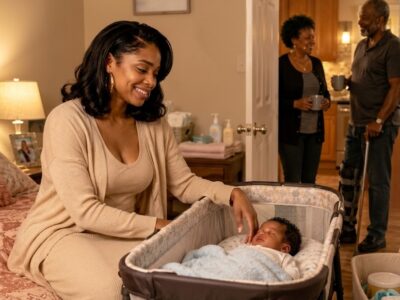
The baby—a girl, with the same stubborn spirit as her grandfather—was the center of my life. She was a constant reminder of the resilience that had brought us through the darkness and into the light.
I still saw Gabriel, our relationship deepening into a partnership that was based on respect, shared values, and a love that didn’t need to be earned. He was the partner I had needed, not the one I had been trying to impress.
One evening, I sat on the terrace of our new home, the city lights flickering like a constellation of possibilities below. My daughter was asleep in her room, the house quiet and filled with the scent of lavender and the soft, steady rhythm of the city.
“You’re smiling,” Gabriel said, joining me.
“I’m happy,” I said. “For the first time, I’m truly happy.”
“You’ve earned it,” he said, his voice soft.
I looked at the sky, the stars bright and indifferent to the stories of the people below. I realized that my life hadn’t been a tragedy, as the magazines had written. It had been a transformation. I had started as a small-town girl who believed in a promise, I had survived the wreckage of a billionaire’s ego, and I had become the woman who finally understood that the most important thing you can ever build is a foundation of truth.
The past was a lesson, the future was a mystery, and the present was a masterpiece of our own making.
I wasn’t looking for a savior anymore. I was the one who had saved myself.
And as I leaned into Gabriel, I knew that whatever the future held, I was ready to face it. I was home. Not in a building, not in a name, but in the woman I had finally become.
The struggle was never truly over, but for the first time, I wasn’t afraid to see what would happen next. I was ready. I was Khloe Marin, and I was finally, truly, free.