They Bet $100,000 on My Humiliation
Part 1: The Wager
The alarm buzzed at 6:30, and I had already been awake for ten minutes, staring at the crack in my bedroom ceiling. The apartment in Queens was small enough for me to know every flaw in the paint, every noise in the plumbing, every creak of the kitchen door when the wind hit the window. I got up without rushing because rushing never helped. The 7:15 train leaves at the same time, rain or shine. I picked the gray cotton blouse, the straight skirt I always wore, the flat shoes that did not hurt until nighttime. I pulled my hair into a tight bun, put on my thick-framed glasses, and checked the mirror for three seconds before heading out.
Nobody on the street ever noticed me, and I was grateful for that every single day. The walk to the station took eight minutes, and the subway car came packed, like always. I squeezed in between a man in a rumpled suit and a woman sleeping on her feet with her fingers hooked around the bar. I crossed Manhattan while the train rocked, not thinking much beyond the day ahead.
I got off at the Midtown station at 7:50. The Ashcroft Holdings building rose up on the corner, all dark glass with the discreet logo etched into the marble wall at the entrance. I walked past reception with a nod to the security guard, got into the executive elevator, and hit the 48th floor. The world I lived in during the day was on that number. The floor was empty because I always got there before him. I walked to my desk, set my bag underneath, opened my computer, and before anything else, went into Mr. Ashcroft’s office. I straightened the papers on the desk, changed the water, checked the room temperature—66°, the way he liked it—and made sure the Italian coffee was ready in the break room. After two years, I did all of that with my eyes closed.
My phone buzzed when I got back to my spot. It was Wren, my best friend of four years, owner of a gallery in Chelsea, and an expert at dragging me to places I never belonged. In four years, I only knew the basics about her family: a distant father, a mother who died young, a brother she only described as complicated and who never showed up in any photo in her apartment. I never pushed. Anyone who grew up without a family learns to respect other people’s silences.
Saturday is the foundation gala. You thought about going?
I laughed to myself and answered with three words: Who? Me? She sent an eye-roll emoji and a line about how I needed to get out of Queens before I turned into mildew. I put the phone away when the elevator doors opened. Dashell Ashcroft came down the hallway with his leather briefcase in hand and his overcoat hanging open over his black suit. He walked past my desk without looking, like on the other seven hundred and some days I had worked there, and went straight into his office. Never a full good morning. Just a nod of the head at best. I had already stopped expecting it.
At 11:10 in the morning, the Callaway file came back signed from legal, and I headed down the hallway connecting the finance department to the executive wing with the folder pressed against my chest. His office door was cracked open, and the voices spilled out before my hand could touch the knob. I recognized Knox Ellery’s—Dashell’s best friend since Princeton, senior partner at the firm, the one who laughed at jokes the boss never found funny—and the voices of two executives from finance. I was about to knock and go in, but my own name slipped through the crack before the knock could happen. I froze with my body leaning forward, folder held tight against my chest.
“Oh, come on, Dash. You wouldn’t have the guts.” Knox’s voice came low and amused. “Invite your own secretary to the gala, the ugly one.”
The whole hallway seemed to tilt half an inch to the side.
“Fifty grand,” Knox went on. “Fifty grand if you take Maren on your arm into that ballroom.”
“Double it,” said one of the others, eager. “One hundred grand, and she has to smile.”
The folder started to feel heavy against my chest. I heard a leather chair creak, pictured Dashell leaning back, pictured his face—the face I had known in profile for two years and that had never really looked at me.
“One hundred grand,” he repeated. “For Maren.” A short pause. “Knox, you’re paying way too much for a joke.”
That was the sentence that broke me apart inside. The others laughed. One of them tossed out a comment about me trying to fit into a decent dress, and I did not catch the rest because my chest had turned into a drum. But I did not cry in the hallway because I learned at fourteen that hallways are no place to cry. I took three deep breaths, the way Wren had taught me one late night, straightened my back until my spine hurt, and waited for them to change the subject.
When Knox started talking about the merger numbers, I knocked twice on the door and pushed it open. I walked in with my face set at the exact level of indifference that two years of practice teaches you to build. Knox was sitting on the black leather couch, ankles crossed, a pen spinning between his fingers. The two executives occupied the armchairs facing the desk. Dashell was behind the dark wood desk, his chair half-turned toward the window, as if the view of Manhattan was more interesting than the conversation I had just overheard. I set the folder down on the right corner of his desk, where he liked me to leave it, and turned to go.
“Maren.” Knox’s voice was sweet as arsenic. “Don’t leave yet now.”
I stopped. He smiled, head tilted, and threw a glance at Dashell. “Dash, weren’t you going to invite someone for Saturday, for the foundation event? I don’t think you’ve invited anyone yet, have you?”
The ambush closed in the air between us. I felt Dashell look at me for the first time in months, and he looked differently. He looked like someone who realizes the hallway has thin walls, like someone who understands that I understood. For a second, I thought he would back down, make up an excuse, dismiss me. But Knox kept stretching out his smile. The $100,000 check was waiting to be torn up, and Dashell Ashcroft had never lost a bet made out loud. He pushed the chair forward, rested his forearms on the desk, and looked me dead on. His jaw locked a millimeter before his mouth opened.
“Maren. Foundation gala. Saturday, 8:00. You’re coming with me.”
Part 2: The Art of the Performance
I stood in the silence of his office, the weight of his words pressing down on me like a physical force. My pulse was a frantic bird in my throat, but I couldn’t let it show. I had spent two years becoming the wallpaper of this office—unassuming, efficient, and perpetually overlooked. To suddenly become the centerpiece of their cruel little bet was a shift in reality I wasn’t prepared for, but I had no choice. I couldn’t afford to be the girl who cried in the hallway; I had to be the girl who played the game.
“I’ll have it on your calendar, Mr. Ashcroft,” I said, my voice steady, betraying none of the chaos in my mind.
Knox let out a sharp, jagged laugh. “See, Dash? She’s a professional. A true sport.”
Dashell didn’t look at Knox. His eyes remained fixed on me, dark and unreadable. He seemed to be searching for a crack in my composure, some sign that I was terrified or humiliated. I gave him nothing. I turned on my heel and walked out, my back straight, my heart racing so hard I thought it might bruise my ribs.
I made it back to my desk and slumped into my chair, the safety of my cubicle suddenly feeling like a glass wall. The phone buzzed. It was Wren.
So? Did you tell him about the gallery invitation?
I typed back, my fingers trembling: He invited me to the foundation gala. With him.
Wren: Holy shit. Did he actually? Are you serious?
Maren: Serious as a heart attack. I think there’s a bet involved.
Wren: A bet? What kind of bet?
Maren: A hundred thousand dollars. I’m the punchline, Wren.
I didn’t wait for her reply. I closed my laptop and stared at the door. I knew I should go home, quit, disappear into the quiet of Queens, and never look back. But the memory of his laugh—that low, held-back laugh when he agreed to the bet—refused to let me go. It wasn’t just about the money or the humiliation anymore. It was about the fact that for two years, I had been invisible, and now, they were trying to make me a spectacle. If I was going to be their joke, I was going to be the kind of joke that left them reeling.
The next few days were a blur of cold calculations. I had to look the part. I needed a dress that didn’t scream ‘secretary’ and I needed a demeanor that didn’t scream ‘victim.’ I called Wren that evening, and she met me at my apartment in Queens, her eyes widening as I laid out the truth.
“You’re not turning it down,” she said, her voice full of fierce joy. “You’re going to win it.”
“I don’t have the money for a gala dress, Wren. Or the shoes. Or the hair.”
“You don’t need money,” she said, throwing open my closet and sighing at the gray cotton. “You need a makeover that would make these people doubt their own eyes. And lucky for you, my gallery has a gala dress that was never picked up by a client. It’s midnight blue, silk, and it belongs on you.”
We spent the week working on a version of myself I didn’t know existed. Wren wasn’t just a friend; she was a sculptor. She took the bun down, and my hair, which I’d kept hidden for years, cascaded in dark, thick waves that actually had shine. She taught me how to use makeup to emphasize my eyes instead of hiding them behind those thick, ugly frames.
“Ditch the glasses,” she said, handing me a pair of subtle, high-end contacts. “See the world clearly, Maren. They’ve been counting on you not looking back at them.”
On Saturday morning, I stared at the mirror and didn’t recognize the woman looking back. She was elegant, poised, and possessed a quiet, dangerous beauty. But the transformation wasn’t just physical. As I stood there, I realized that for two years, I had been holding myself back—not because I had to, but because I was afraid of taking up space. That fear was gone.
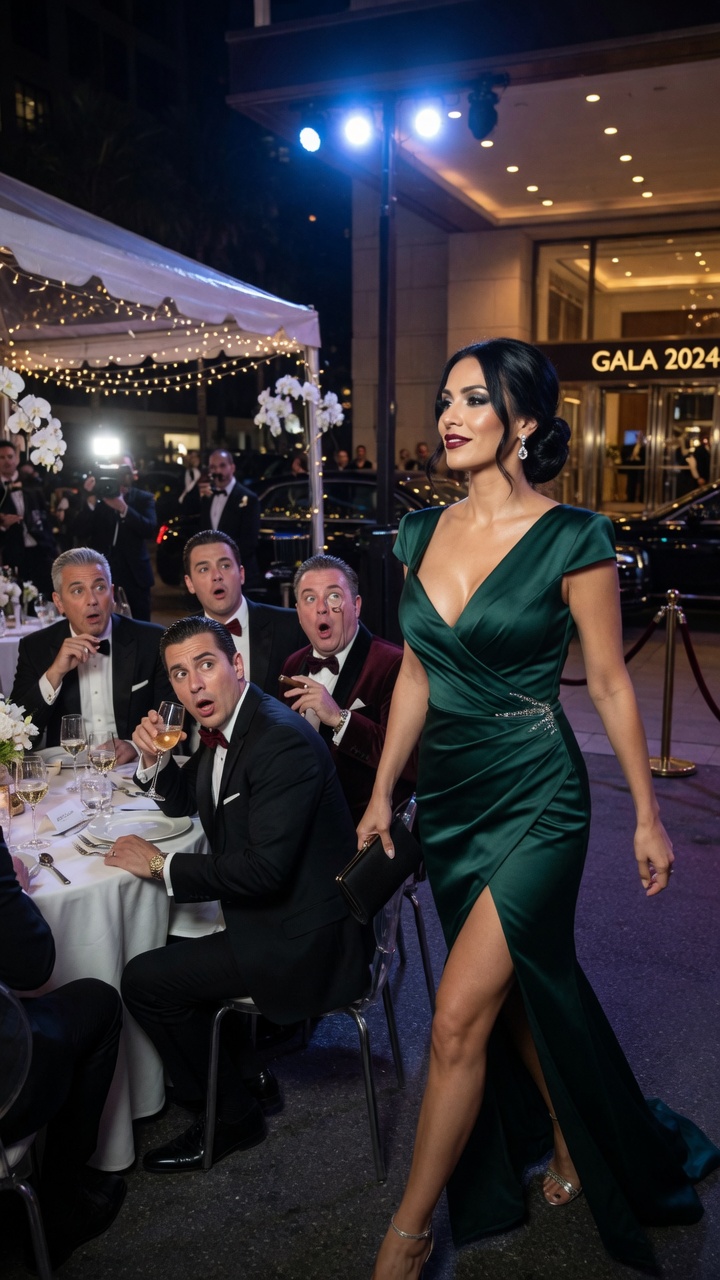
At 7:45 p.m., the limo—a black beast of a car provided by the firm—pulled up to my apartment building. I stepped out, the midnight blue silk whispering against my legs. I felt the stares of my neighbors, but for the first time, it didn’t matter. I wasn’t just Maren from Queens. I was a player.
As the car glided toward the gala, I took a deep breath. Dashell was waiting at the entrance, his face darkening when he saw me. He had expected the secretary in the gray blouse. He hadn’t expected this.
“You’re late,” he said, his voice clipped, trying to regain his sense of control.
“I’m exactly on time, Mr. Ashcroft,” I replied, meeting his gaze with a smile that didn’t reach my eyes. “And I believe we have a bet to attend to.”
He didn’t take my arm. He stared at me for a long beat, his eyes tracing the line of my neck and the way the blue silk caught the light. “Knox is going to lose his mind,” he muttered, almost to himself.
“Let’s hope so,” I whispered, walking into the ballroom before he could say another word.
The room was vast, filled with the city’s elite. As we entered, the whispers began. They were the same whispers as before, but the tone had shifted. It was no longer mockery; it was confusion, and then, a sudden, sharp recognition. I walked with the confidence of someone who knew exactly who she was, and I saw Knox near the bar, his drink freezing halfway to his mouth. He looked at Dashell, then at me, his face turning an interesting shade of pale.
“Well,” I said to Dashell, feeling the power of the moment settle over me. “Aren’t you going to introduce me to your friend?”
Dashell stood there, a man who had bet his pride on a girl he thought was invisible, only to find himself standing next to a woman he couldn’t help but see.
Part 3: The Unraveling
Knox didn’t move. He stood by the bar, his glass of scotch trembling ever so slightly in his hand. He looked like a man watching a car crash in slow motion. Dashell, however, recovered his poise with the practiced ease of a man who makes his living in the high-stakes world of finance. He cleared his throat, his hand coming to rest firmly, perhaps too firmly, on the small of my back.
“Knox,” Dashell said, his voice smooth as polished marble. “I believe you’ve met Maren. My assistant.”
“Assistant,” I corrected, my tone pleasant but sharp enough to draw blood. “And your date for the evening, I believe.”
Knox’s face twisted in an awkward grimace. “Of course. Maren. You look… very different.”
“And you look like you’ve seen a ghost, Knox,” I said, offering him a cool smile. “Is everything alright?”
“Everything is fine,” Dashell interjected, his hand tightening on my back. “Let’s get a drink.”
We moved through the room like a storm, the crowd parting as we passed. People were staring, really staring, their eyes darting between my dress, my hair, and the way Dashell was holding me. I wasn’t the ugly secretary anymore; I was a mystery, a sudden presence that demanded explanation. I could see the rumors starting to circulate: Who is she? Is she a new acquisition? Did Dashell have her hidden away?
“You’re enjoying this,” Dashell whispered into my ear as we reached the bar. It wasn’t a question.
“I’m enjoying the evening,” I replied, my voice steady. “Aren’t you?”
He looked at me, really looked at me, and I saw a flicker of something in his eyes—not contempt, but something approaching respect. Or maybe it was fear. “You played a hell of a game, Maren.”
“I haven’t even started playing yet,” I said, taking a sip of the champagne the waiter placed before me.
Suddenly, the music swelled, a cue for the main event—the auction for the foundation’s benefit. We moved to the tables, where the elite sat in a circle of wealth. Knox was there, and his wife, a woman who had once told me in the office hallway that my coffee mug was ‘cluttered.’ She looked at me, then at my dress, and then at her husband, her eyes narrow and sharp.
“So, Maren,” she said, her voice dripping with artificial sweetness. “How long have you been… working for Dash?”
“Long enough to know how things operate,” I replied. “And long enough to know when someone is bluffing.”
The table went quiet. The woman bristled, her wine glass stopping in mid-air. Dashell watched the exchange, his interest visibly spiking. He wasn’t bored anymore. He was watching a predator in his own den.
“Bluffing?” the woman asked, her smile tight. “What on earth does that mean?”
“It means,” I said, my voice soft, “that people often underestimate what’s right in front of them. It’s a dangerous mistake to make in this industry, don’t you think?”
I leaned back, feeling the midnight blue silk rustle against the chair. Knox looked like he wanted to jump out of his skin. “Dash, let’s talk about the Callaway file.”
“Not now, Knox,” Dashell said, his eyes never leaving my face. “I think Maren has more to say.”
I felt a surge of adrenaline. This wasn’t the office. They couldn’t talk over me here. “Actually, I think the Callaway file is a perfect example. It took three revisions to get it right, didn’t it? And if I hadn’t pushed for those changes, we would have lost the client.”
“You did?” Knox stammered, looking at Dashell.
Dashell didn’t look at him. He looked at me, a strange, half-smile touching his lips. “She did.”
“I think,” I said, my pulse drumming in my ears, “that there are many things in this firm that wouldn’t happen if it weren’t for the people you choose to ignore.”
Knox’s wife stood up, her face flushed. “I think I need some air.”
She left, and the rest of the table looked like they were trapped in a cage of their own making. I had done it. I had shattered the illusion that I was just the secretary. I was the person who knew where the bodies were buried, and for the first time, they were realizing that the girl in the thick glasses had been reading the fine print all along.
Dashell leaned in closer, his voice low. “You’re dangerous, Maren.”
“Am I?” I asked, my heart singing. “Or am I just paying attention?”
Before he could answer, the gala organizer, a woman named Eleanor, stepped onto the stage. “Before we begin, I’d like to acknowledge a very special contributor who has made tonight’s event possible.”
She paused, looking around the room. I felt a sudden, cold premonition.
“Mr. Dashell Ashcroft, would you please join me?”
Dashell stood up, but he didn’t let go of my hand. He pulled me up with him. We walked to the stage, the room holding its collective breath.
“Dashell,” Eleanor said, smiling, “we’ve heard about the… investment you’ve made in the foundation this evening. A contribution of one hundred thousand dollars, made in the name of your… ‘date’?”
The room exploded into whispers. Knox’s face was the color of a sheet. Dashell had kept his side of the bet. He had paid the money. But he had done it in a way that made it impossible for me to deny what he had done. He had bought me in front of everyone.
I felt the heat of the spotlight on my back, the thousands of eyes watching me. I had wanted to play the game, but now the game was being played on a stage I hadn’t chosen.
“Is this true?” Eleanor asked, her smile wide.
I looked at Dashell. His face was a mask of cold pride. He had done it. He had paid for his bet, and in doing so, he had sealed my fate as the centerpiece of his joke.
I took the microphone. My hand was steady.
“It’s true,” I said, my voice ringing across the ballroom. “It’s a very generous contribution. And I think we should all thank Mr. Ashcroft for his investment in… people.”
The room went silent again, but this time, the silence was different. It was the silence of people trying to understand what the hell was happening. I hadn’t cried. I hadn’t run. I had taken their joke and turned it into a public declaration of their own corruption.
But as I looked down at the crowd, I saw the look on Dashell’s face. He wasn’t laughing. He was looking at me like I was the only person in the world, and for a terrifying second, I realized that I hadn’t just won the bet. I had unleashed something I couldn’t possibly control.
Part 4: The Aftermath of the Gala
The ride home was a suffocating layer of silence. The driver kept his eyes on the road, his posture rigid as he navigated the dark streets of Manhattan. Dashell sat next to me, his presence filling the back seat, his shoulders tense. He hadn’t said a word since we left the stage, his gaze fixed out the window at the blurred city lights.
“You really did it,” I said, breaking the silence. My heart was still hammering, but the adrenaline was beginning to ebb, leaving behind a hollow exhaustion. “You paid the bet.”
Dashell turned to look at me, his eyes dark. “You didn’t think I would?”
“I thought you were a man who kept his word, even when the word was a joke.”
He leaned in, the scent of his cologne—sandalwood and expensive scotch—filling the small space. “It stopped being a joke the moment you walked out of that elevator. You changed the terms the moment you opened your mouth.”
“Is that why you announced it?” I asked. “To prove you could?”
“To prove you couldn’t be bought,” he said. His voice was rough, uncharacteristically raw. “Everyone in that room thought you were something you weren’t. I wanted them to know that I knew exactly who you were.”
“And who is that, Dashell?”
“A woman who doesn’t belong in a glass cage.”
He didn’t explain. He didn’t have to. The car pulled up to my building in Queens, a stark contrast to the opulence we had just left. He got out and opened the door for me, his hand lingering on the frame as I stepped onto the sidewalk.
“Are you coming in?” I asked, a question I hadn’t planned to ask, but that felt like the only logical conclusion to the night.
“I don’t think I should,” he said, his eyes searching mine.
“Because of the bet?”
“Because if I go in there, Maren, the joke is going to be on me.”
I didn’t answer. I turned and walked toward my building, feeling his eyes on my back. I climbed the stairs, the quiet of the apartment settling around me like an old friend. I changed out of the midnight blue silk, feeling the weight of the night slip away.
But I couldn’t sleep. I sat in the kitchen, the light of the refrigerator the only illumination in the room, and thought about the way he had looked at me. It wasn’t the look of a man who had won a bet. It was the look of a man who had been blindsided by a reality he had spent years avoiding.
My phone buzzed. A text from Knox.
Knox: We need to talk. You have no idea what you’ve unleashed.
I stared at the screen, a cold feeling creeping into my chest. He wasn’t talking about the bet. He was talking about the company, the files I had seen, the secrets I had inadvertently stumbled upon.
I knew then that I wasn’t going to be a secretary anymore. I was going to be a target. And the only person who could help me navigate the storm was the man who had started the whole thing.
Part 5: The Corporate Web
The next morning, the office felt different. The air was thick with the scent of coffee and impending doom. People were whispering, their eyes darting to my desk as I walked in. I sat down and opened my computer, the screen flickering to life with a dozen urgent notifications.
Knox was already in the office, his door closed, the blinds drawn tight. I could hear his raised voice, muffled but angry. Dashell was nowhere to be seen.
At 10:00 a.m., the door to Dashell’s office opened, and he stepped out, looking like he hadn’t slept at all. He didn’t look at Knox; he looked at me.
“Maren. My office. Now.”
I stood up, the stares of the entire finance department following me. I walked into his office, and he shut the door behind me with a decisive click.
“Did you hear from him?” he asked.
“Knox? Yes.”
“What did he say?”
“He said I have no idea what I’ve unleashed.”
Dashell walked to the desk and pulled out a manila folder, his hands steady. “He’s right. I’ve been trying to stop him for months, but he has the board in his pocket. He has the lawyers. He has everyone who matters.”
“And now?”
“Now we have the one thing he doesn’t—information.”
He opened the folder, and I saw the files—the same ones I had seen on his desk months ago, but now they were filled with evidence: bank transfers, shell companies, offshore accounts. It was everything.
“You’ve been tracking him?” I asked, my voice barely a whisper.
“I’ve been waiting for the right moment. I didn’t want to drag you into it, Maren. I didn’t want you to be the target.”
“I was already the target the moment I stepped into this building,” I said.
Dashell looked at me, his eyes softening. “I never wanted you to be the joke, Maren. The bet? It was a test. I wanted to see if I could make you believe in yourself. I didn’t think it would spiral this far.”
“You used me as an experiment,” I said, my voice hardening.
“I used myself as an experiment,” he corrected. “I bet a hundred thousand dollars because I wanted to see if I could be the man you deserved. And I failed.”
“You didn’t fail,” I said, looking at the evidence. “You just didn’t see the finish line.”
The door swung open, and Knox stood there, his face red with rage. “I knew it! I knew you two were conspiring!”
“It’s not a conspiracy, Knox,” Dashell said, standing up. “It’s an investigation.”
Knox laughed, a sound that held no mirth. “Investigation? The board is meeting at noon. And you’re the one who’s going to be removed.”
“We’ll see,” I said, stepping forward. “Because I have the Callaway files, Knox. All of them. Including the ones you didn’t think I saw.”
Knox’s face turned white. He looked at me, then at Dashell, then at the files on the desk. “You… you wouldn’t.”
“I would,” I said. “And I did.”
The hallway seemed to shrink as the tension hit its peak. We were three people on the edge of an abyss, and only one of us was going to walk away with our life intact.
Part 6: The Boardroom Confrontation
The boardroom was a cavern of polished mahogany and high-backed leather chairs, the air stagnant with the weight of decades of corporate ego. Twelve people sat around the table, their faces masks of professional indifference, though I could see the twitch of nerves in the chairman’s jaw. Dashell stood at the head of the table, his presence commanding, his expression unyielding. I sat to his right, a folder of evidence spread before me.
“This is ridiculous,” Knox snarled, standing at the opposite end. “We are here to discuss the CEO’s failure to lead, not to entertain the delusions of an assistant.”
“An assistant who holds the keys to the kingdom,” Dashell replied, his voice calm. “Maren, please.”
I stood up, my heart a steady drum. I didn’t look at the board members. I looked at the chairman. “For two years, I have processed the files for this firm. I have seen the way the numbers move, and I have seen the way the ethics disappear.”
I opened the folder and pushed the first set of documents toward the center of the table. “This is the Callaway file, the true version. The version that hasn’t been laundered through the shell companies in the Caymans.”
The room erupted in gasps. The chairman looked down at the documents, his face turning gray. “This is unauthorized access to company property.”
“This is evidence of a crime,” I said, my voice unwavering. “And I’ve already sent a copy to the SEC and the district attorney.”
Knox lunged forward, his hands slamming onto the table. “You bitch!”
“Sit down, Knox,” Dashell said, his voice a low, dangerous warning. “Or the police will be here to escort you out.”
The board members were scrambling, trying to read the documents, their faces reflecting a range of terror. It was a masterpiece of exposure. I had laid out their web of lies with the precision of a curator arranging an exhibit, and there was no way for them to argue the facts.
“We can fix this,” the chairman stammered, looking at Dashell. “We can settle this quietly.”
“There is no quiet fix for embezzlement,” Dashell said, his gaze fixed on the chairman. “This company is done with the old guard. You’re all fired.”
“You can’t fire us! The bylaws—”
“I changed the bylaws last night,” Dashell said, a thin, sharp smile appearing on his face. “With the approval of the majority shareholders. You’re done.”
The boardroom was a sea of shattered reputations. I watched as they stood, one by one, their power evaporating in the light of the truth. It was a triumph, but I felt a strange sense of detachment. I hadn’t done this for the company. I hadn’t done this for Dashell. I had done it for myself.
“What now?” I asked Dashell as we walked out of the room.
“Now,” he said, taking my hand, “we build something real.”
We walked out of the building, the air of Midtown feeling different, lighter. We were two people who had emerged from the wreckage of a corporate empire, and for the first time, I felt like the future was actually ours to define.
“The bet?” I asked, laughing. “What happens to the hundred grand?”
“I think,” Dashell said, looking at me with a warmth that felt entirely genuine, “it should be donated to the foundation you wanted to start in Queens.”
I felt my heart stop. “How did you know?”
“I’ve been reading your files for two years, Maren,” he said, his eyes crinkling at the corners. “You’d be surprised what you find when you start paying attention.”
Part 7: The True Beginning
The foundation office was a small, sun-drenched space in Queens, surrounded by the familiar noise of the subway and the smell of roasting coffee. It wasn’t the marble-floored cavern of Ashcroft Holdings, but it was ours. We had spent the last three months building it, layer by layer, brick by brick.
Dashell had stepped down as CEO, a move that sent the market into a frenzy, but he seemed entirely at peace. He was working with me, helping to set up the infrastructure, using his immense knowledge to ensure the foundation was stable, effective, and beyond reproach.
We had become partners, not just in business, but in life. The transition hadn’t been easy—the lawyers, the press, the fallout from the scandal—but we had navigated it all with a newfound sense of purpose.
One afternoon, I was looking through a box of old files when I found a small, handwritten note from the day I started at Ashcroft Holdings. It was a note to myself: Don’t let them make you invisible.
I smiled, remembering the girl who had walked into that lobby, terrified and unsure of her place in the world. She seemed like a different person entirely.
“What are you looking at?” Dashell asked, coming up behind me and wrapping his arms around my waist.
“The past,” I said, leaning back into him.
“Forget it,” he said, his voice soft against my ear. “We’re in the present now.”
We stood there, looking out the window at the bustling Queens street. The city was still the same, but the way I saw it had changed completely. I wasn’t just a cog in a machine anymore; I was a person who mattered.
“Are you happy?” he asked, turning me around to face him.
I looked at him, the man who had bet on me, the man who had nearly destroyed me, and the man who had helped me find my way back. He was no longer the arrogant billionaire I had watched from behind the safety of my cubicle. He was just Dashell—a man who had learned the hard way that power wasn’t worth anything if you were alone at the top.
“I’m more than happy,” I said. “I’m free.”
He kissed me, and for the first time in my life, I felt like I was exactly where I was meant to be. The bet was over, the company was changed, and the future was a vast, open landscape that we were finally, truly, ready to explore.
The story had begun with an ugly secretary, a broken bet, and a hallway filled with whispers. But it was ending with two people who had found the truth in the middle of a lie, and who had learned that the most important thing you can ever build is a foundation of integrity.
I was Maren from Queens, and I had finally, truly, found my voice.
As we walked out of the office and into the golden afternoon sun, I knew that everything we had gone through was just the preface. The real story—the one that really mattered—was only just beginning. And this time, I wasn’t going to wait in the hallway to see what happened next. I was going to lead the way.